How to Get Rid of AI Overview on Google: 2026 Guide
Frustrated by Google AI Overviews? Learn 4 proven methods to disable, hide, or bypass AI summaries in search results. Simple fixes that work in 2026.
Apr 16, 2026



Creative marketing for banks requires a mix of data-driven personalization, omnichannel engagement, and community-focused campaigns that build trust. Successful strategies include AI-powered targeting, direct mail combined with digital advertising, customized card programs, and interactive social media challenges. The most effective campaigns achieve measurable results through targeted, personalized approaches.
Banks face a decisive moment. Customer expectations have shifted dramatically, and traditional marketing approaches simply don't cut it anymore. Financial institutions that continue with one-size-fits-all campaigns watch their engagement rates stagnate while innovative competitors pull ahead.
The good news? Forward-thinking banks are achieving remarkable results by reimagining their marketing strategies. Some institutions with modest asset bases are generating significant new business through intelligent, creative campaigns.
This isn't about having the biggest marketing budget. It's about working smarter with the resources available — combining data-driven personalization, omnichannel engagement, and authentic community connection.
Most banks still rely heavily on generic messaging pushed through limited channels. Branch posters promoting a standard rate. Email blasts with the same offer sent to every customer. Digital ads that target demographics instead of behaviors.
Here's the thing though — consumers now expect the kind of personalized, seamless experience they get from companies like Amazon and Netflix. They want financial institutions to understand their specific needs and deliver relevant solutions at the right moment.
According to BAI research, consumers are 85% more likely to recommend a financial institution after a very good customer experience. That gap between expectation and reality represents both the challenge and the opportunity.
Marketing teams at financial institutions face mounting pressure to deliver personalized customer experiences across an omnichannel environment. Shifting consumer preferences complicate this further as banking customers demand engagement relevant to their specific financial needs.
Artificial intelligence has transformed what's possible for banks of any size. Even community financial institutions with lean marketing teams can now execute sophisticated, targeted campaigns that were previously beyond reach.
Real-world results validate this approach. One institution with approximately $150 million in total assets achieved strong click-through rates using intelligent targeting technology — and did so with just 17,000 accountholders, generating significant new loan volume without expanding their internal team.
Another credit union leveraged a combination of digital advertising and postcard mailers through AI-driven campaign optimization. Click-through rates exceeded 6%, far above historical benchmarks. One campaign demonstrated significant conversion rate improvements versus prior year performance, with measurable gains in new loan balances, deposit growth, and product adoption by new members.
AI-powered marketing platforms analyze customer data to identify patterns and predict behaviors. They segment audiences based on actual financial needs rather than simple demographics.
The technology identifies which customers are most likely to need a mortgage in the next 90 days. Which members might benefit from a debt consolidation loan. Which accountholders show signals of switching to a competitor.
Then it delivers personalized messages through the channels each customer prefers — whether that's email, social media, direct mail, or digital advertising. The timing, offer, and creative are all optimized for maximum relevance.
Some 200 innovative institutions of varying sizes have leveraged AI-powered predictive modeling and data-driven engagement technologies to generate over $1.3 billion in new loans and $1.1 billion in new deposits within a nine-month period.

Banks often launch campaigns across multiple channels at once, which makes weak creative decisions expensive long before performance data starts coming in. Extuitive gives teams a way to evaluate ad concepts before launch by analyzing messaging patterns, creative structure, and historical campaign signals. The platform is designed to help marketers spot stronger-performing campaign directions earlier instead of depending only on costly live testing after launch.
Extuitive helps marketing teams:
Book a demo with Extuitive and test campaign ideas before rolling them out at scale.
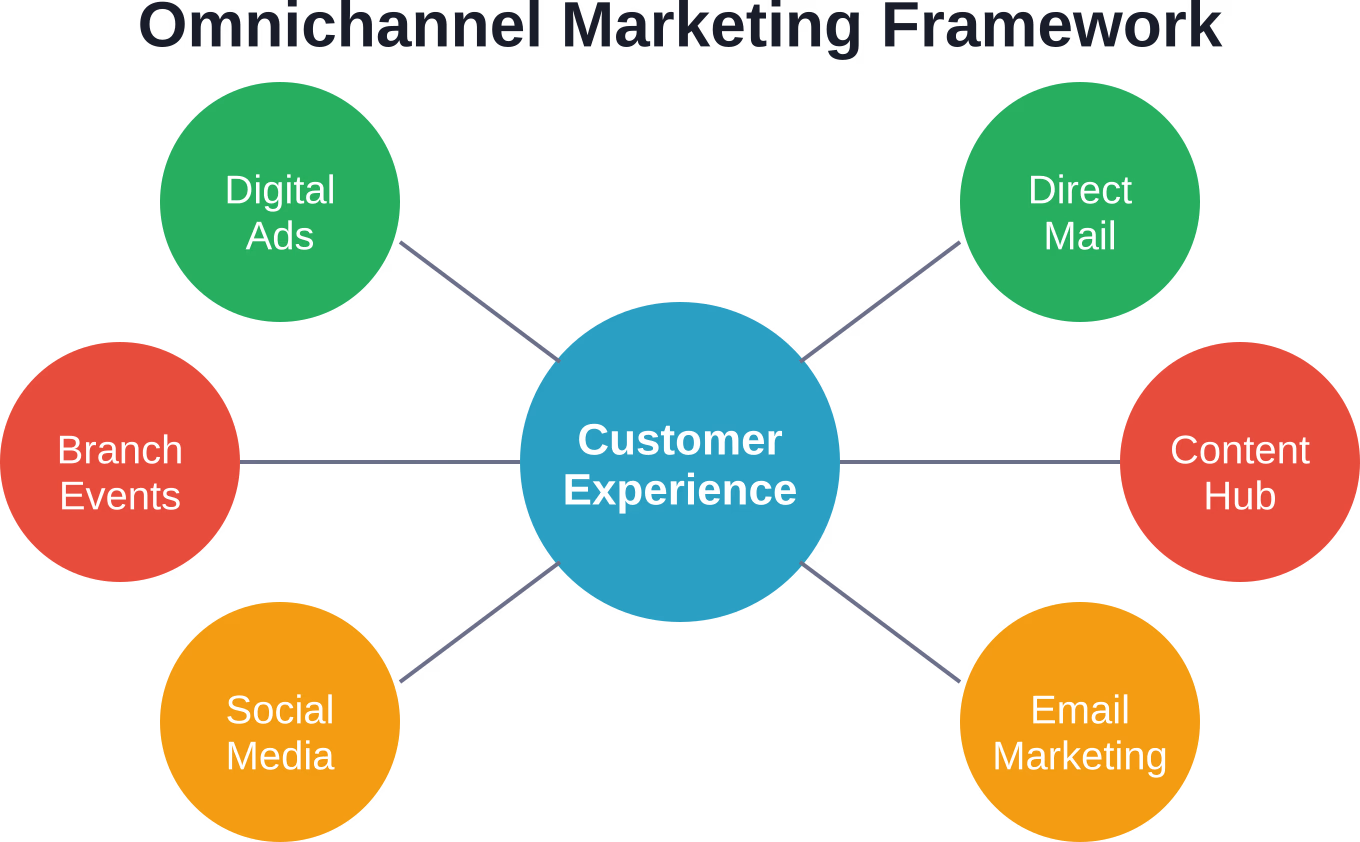
Single-channel marketing is dead. Customers interact with banks across multiple touchpoints — branch visits, mobile apps, websites, social media, email, and yes, even physical mail.
The most effective campaigns create a cohesive, multisensory experience across all these channels. But here's where most banks stumble: they treat each channel as a separate silo with disconnected messaging and creativity.
How many financial institutions consider their brand to be a multisensory, personal experience? Not that many. But more institutions should see themselves that way. Apple does. Amazon and Netflix do, too.
A true omnichannel strategy means coordinating message, timing, and creativity across every customer touchpoint. When someone clicks a digital ad, the landing page experience should be seamless. When they visit a branch, staff should be aware of recent digital interactions.
Email campaigns should complement — not repeat — what customers see on social media. Direct mail should drive to personalized landing pages that continue the conversation started in the mailpiece.
Many banks wrote off direct mail as outdated. That's a mistake.
According to the U.S. Postal Service, about 90% of direct mail gets opened and 75% of households read or scan advertisements in their mail. Direct mail has proven particularly effective with younger demographics.
Compare that to the 78% of households influenced by email. Direct mail holds its own, especially when combined with digital channels in a coordinated campaign.
The key is treating direct mail as one component of an integrated strategy. Use it to drive recipients to personalized landing pages. Track response rates through unique URLs or QR codes. Follow up digitally with those who engage.
One successful approach combines postcard mailers with digital advertising retargeting. Recipients who don't immediately respond see coordinated display ads reinforcing the same message and creativity. This hybrid approach achieved click-through rates exceeding 6% — well above industry benchmarks.
Community financial institutions have a unique advantage: deep understanding of local customers and authentic community connections. Leveraging this advantage requires marketing that goes beyond transactions to build genuine relationships.
Hosting or sponsoring community events creates visibility and positions the bank as a community partner rather than just a vendor. Free giveaways and interactive experiences draw attention and foot traffic.
An inflatable money machine set up outside adds a fun, interactive element that serves as both visual draw and a memorable experience. Even if cash giveaways aren't viable, other promotional items create lasting impressions.
Research from ASI Central shows that 57% of people who own promotional items keep some for more than 5 years. The average household owns about 30 different promotional products, and 55% of people pass promotional products on to others, extending brand reach beyond the initial contact.
Generic pens and notepads don't cut it anymore. Effective promotional marketing for banks requires items that recipients actually want to keep and use.
Consider items aligned with financial wellness themes: budgeting planners, piggy banks, financial literacy materials for kids, secure document bags. Each interaction reminds customers of the bank's role as a financial partner.
Personalization extends beyond targeted messaging to the products themselves. Customized debit and credit cards represent an often-overlooked opportunity to increase engagement and usage.
According to BAI research, customized cards have shown measurable usage increases compared to generic cards. When customers design their own card with personal images or choose from curated designs, they form a stronger emotional connection with that payment method.
This matters because card usage drives interchange revenue and keeps the bank top-of-mind with every transaction. A custom card featuring a customer's pet photo or favorite vacation spot transforms a commodity payment method into something personal.
The implementation is straightforward with modern card platforms. Banks can offer online design tools that let customers upload images or select from galleries while maintaining brand elements and required disclosures.
Effective content nurtures customer leads. In fact, research indicates that quality content plays a crucial role in lead nurturing for financial institutions.
But content marketing for banks requires a different approach than other industries. Financial topics are complex and regulated. Customers seek authoritative, trustworthy information — not salesy pitches.
Educational content builds trust and positions the bank as a helpful resource. Topics might include:
The key is answering questions customers actually have — not just promoting products. When someone searches for information and finds genuinely helpful content from a bank, that bank becomes a trusted authority.
Community banks and credit unions should lean into local expertise. Create content around local market conditions, neighborhood guides for homebuyers, spotlights on local businesses, and analysis of regional economic trends.
This content serves dual purposes: it provides value to the community while improving local search visibility. When potential customers search for information about the local area, the bank's content can rank and build awareness.
Banks need to meet customers where they are — and different generations congregate on different platforms with different expectations.
Gen Z is financially conscious with significant spending power in the U.S. Born between 1997 and 2012, this generation is financially conscious, digitally savvy, and demanding.
Traditional banking marketing falls flat with Gen Z. They expect authenticity, social responsibility, and genuine engagement — not corporate speak.
Interactive social media challenges aligned with bank brands perform well. A "Save $100 in 30 Days" challenge on TikTok or an Instagram Story template that helps with budgeting makes financial wellness shareable and engaging.
Gen Z loves to create and share. Give them tools, templates, and challenges that make it easy to participate and spread the word organically.
Each social platform requires different content strategies:
The worst approach is posting identical content across all platforms. Each requires native content that fits the platform's culture and user expectations.
Creative campaigns mean nothing without measurement. Banks need to track performance beyond vanity metrics and focus on business outcomes.
The institutions achieving remarkable results track performance rigorously and iterate quickly. When campaigns deliver strong results, they analyze why and apply those lessons to future campaigns.
When conversion rates improve significantly versus prior year, they identify the specific elements that drove improvement. This continuous optimization separates good marketing from exceptional results.
Creative marketing for banks must navigate regulatory requirements. The Federal Financial Institutions Examination Council member agencies promote compliance with federal consumer protection laws through supervisory and outreach programs.
But compliance doesn't require boring marketing. It requires thoughtful approaches that deliver creative, engaging campaigns within appropriate guardrails.
Work closely with compliance teams early in campaign development. Present concepts before creative production begins. Build review processes that move efficiently without bottlenecking campaigns.
The best marketing teams make compliance a partner rather than an obstacle. They educate compliance colleagues on marketing goals and welcome input that protects the institution while preserving creative impact.
Many banks lack internal resources for sophisticated marketing execution. Managed services provide expert extensions of internal teams — highly effective and efficient.
One modestly sized institution with just 17,000 accountholders reported measurable increases in member engagement while streamlining marketing efforts through managed services partnerships.
These partnerships work best when the external team deeply understands banking and regulatory requirements. Generic marketing agencies often struggle with financial services nuances. Specialized providers bring banking expertise along with marketing capabilities.
Managed services can handle everything from campaign strategy and creative development to execution, optimization, and reporting. This allows lean internal teams to focus on relationship management and strategic direction.
Moving from traditional to creative, results-driven marketing doesn't happen overnight. Successful transitions typically follow this progression:

Start with pilot campaigns that test new approaches on a limited scale. Learn what works, adjust quickly, and scale successful tactics. This reduces risk while building organizational confidence in new methods.
Technology selection matters. Choose platforms that integrate with core banking systems, provide robust analytics, and support omnichannel execution. The right technology foundation enables sophisticated campaigns without requiring massive internal technical resources.
The banks and credit unions achieving remarkable results in 2026 share common characteristics. They embrace data-driven personalization while maintaining authentic community connections. They coordinate seamlessly across channels rather than operating in silos. They measure rigorously and optimize continuously.
Most importantly, they recognize that creative marketing isn't about being flashy or clever — it's about deeply understanding customer needs and delivering genuinely helpful, relevant experiences at scale.
The institutions generating millions in new loans and deposits through intelligent marketing didn't get there by chance. They made strategic decisions to modernize their approaches, invested in the right technology and partnerships, and committed to continuous improvement.
The good news? These capabilities are accessible to banks of any size. The institution with 17,000 accountholders achieving strong results through AI-driven targeting started in the same place every bank starts — recognizing the need to evolve and taking the first steps toward transformation.
Start with pilot campaigns that test new approaches on a limited scale. Partner with specialists who understand banking's unique requirements. Measure everything and learn quickly. Then scale what works.
The moment to transform bank marketing is now. Customer expectations continue rising, competition intensifies, and the gap between traditional approaches and what actually works continues widening. But the opportunity for institutions willing to embrace creative, data-driven marketing has never been greater.


