Top Shopify Marketing Agencies in Houston: A Practical Overview
A clear look at Shopify marketing agencies in Houston, how they work, and what to consider before choosing one.
Feb 11, 2026



AI arbitrage refers to two distinct business models: using AI tools to deliver client services more efficiently than traditional methods (agency arbitrage), or using AI to identify and exploit price differences across markets (trading arbitrage). The agency model has become the dominant interpretation in 2026, where businesses leverage AI automation to reduce costs while maintaining premium pricing based on outcomes rather than hours worked.
The term "AI arbitrage" has exploded across business forums, YouTube channels, and LinkedIn posts throughout 2026. But what does it actually mean?
The confusion is real. Some people talk about AI arbitrage as a way to automate crypto trading. Others describe it as selling AI services to local businesses. And then there are the hype machines promising passive income with zero effort.
Here's the thing though—AI arbitrage isn't one thing. It's two completely different business models that happen to share the same name. Understanding which one you're dealing with makes the difference between a legitimate opportunity and a costly mistake.
Traditional arbitrage means buying something in one market and selling it in another for a higher price, pocketing the difference. The strategy depends on price inefficiencies that exist temporarily across different platforms or locations.
AI arbitrage borrows this concept but applies it in two distinct ways.
This is the dominant interpretation in 2026. Agency AI arbitrage means leveraging artificial intelligence to deliver services far more efficiently than traditional methods—effectively "buying low" on AI tools and "selling high" on expert outcomes.
The mechanics are straightforward. Agencies pay minimal costs for AI tools that can automate tasks like content creation, customer service, data analysis, or design work. They then charge clients based on the value of the outcome, not the hours required to produce it.
According to analysis from the top-ranking pages, modern agencies can harness the speed, scale, and 24/7 availability of AI to outperform competitors and meet client demand for faster, personalized solutions. The margin comes from efficiency. The advantage compounds as tools improve and teams learn faster.
Real talk: clients pay for outcomes. If AI reduces a 40-hour project to 4 hours, but the client still receives the same quality deliverable, the agency captures that 36-hour difference as profit.
This version involves using AI algorithms to identify and exploit price differences across financial markets—most commonly in cryptocurrency exchanges.
Crypto arbitrage works like this: an AI system monitors prices across dozens or hundreds of exchanges simultaneously. When Bitcoin trades for $42,000 on one exchange but $42,150 on another, the algorithm instantly buys low and sells high, capturing the $150 difference.
Sounds simple. But the reality is more complex.
The speed advantage matters here. Automated AI arbitrage systems can operate 24 hours a day across all market sessions, removing the need for constant screen monitoring or manual intervention. According to project documentation, fully automated investing runs continuously, managing assets automatically.
That said, trading arbitrage faces significant barriers that didn't exist five years ago.
The agency model has become the more accessible and sustainable approach for most people entering the AI arbitrage space in 2026.
Here's what the process looks like in practice.
Not every service works well for AI arbitrage. The best opportunities share common characteristics: they're repetitive, information-based, and currently expensive because they're labor-intensive.
Content creation sits at the top of the list. Blog posts, social media management, email campaigns, and product descriptions can be generated by AI with human oversight for quality control and strategic direction.
Customer service represents another strong opportunity. A LinkedIn article reports that AI integration transformed a pricing software company's website—adding a ChatGPT-based chatbot significantly increased user engagement.
Data analysis, basic graphic design, SEO optimization, and research tasks also fit the model well.
The operational framework requires three components: AI tools, human oversight, and client management processes.
Agencies select specialized AI platforms for different functions. ChatGPT or Claude handle written content. Midjourney or DALL-E create visual assets.
But here's where many newcomers get it wrong—AI doesn't replace human expertise entirely. Skilled team members review outputs, ensure brand consistency, inject strategic thinking, and maintain quality standards. The AI handles volume and speed. Humans handle judgment and refinement.
Client management processes must evolve too. Successful AI arbitrage agencies educate clients about their approach through content like blog posts, whitepapers, and webinars explaining AI use-cases in specific niches.
The entire arbitrage model collapses if pricing is based on hours rather than value.
Traditional agencies bill hourly or use time-based project estimates. AI arbitrage agencies must shift to value-based pricing: what is the outcome worth to the client?
A website redesign might take significantly more time traditionally than with AI assistance. If the redesign generates substantial additional revenue for the client, the agency can charge based on value delivered, not hours invested.
This pricing strategy is what transforms efficiency gains into actual profit.
Some interpretations of AI arbitrage focus on physical or digital product resale rather than services.
The traditional approach involved manually scanning products at retail stores, checking if they sold for more on Amazon, and buying inventory to flip. Time-consuming and limited by physical constraints.
AI changes the equation.
According to competitor analysis, an AI arbitrager can use software to scan large quantities of items online rapidly, identifying pricing differences across platforms.
The automation extends to listing management. Manual crosslisting—posting the same item across multiple platforms like eBay, Poshmark, Mercari, and Amazon—takes roughly 15 minutes per item. AI-powered crosslisting tools reduce this to under a minute while automatically syncing inventory to prevent overselling.
Profit margins on retail arbitrage tend to be smaller than agency work—but volume can compensate when automation handles the heavy lifting.
Crypto arbitrage using AI sounds appealing on paper. Market inefficiencies exist. Price differences appear regularly across exchanges. AI can spot and execute trades faster than humans.
So why isn't everyone doing this?
Several factors limit profitability for retail participants.
Transaction fees eat into margins significantly. Moving funds between exchanges, executing trades, and withdrawing profits all incur costs. A $150 price difference might net only $30 after fees.
Transfer times create problems too. Cryptocurrency networks process transactions at different speeds. Bitcoin transfers can take 30-60 minutes during network congestion. By the time funds arrive at the second exchange, the price difference often disappears.
Capital requirements are substantial. Meaningful profits require meaningful position sizes. Small per-trade profits become insignificant when trading volume is limited. Scaling requires significant capital locked across multiple exchanges.
Competition has intensified. Institutional trading firms run sophisticated arbitrage algorithms with direct exchange connections, minimal fees, and massive capital bases. They close price gaps within seconds.
That said, opportunities haven't vanished entirely. Less liquid cryptocurrency pairs sometimes show exploitable spreads. Geographic arbitrage across international exchanges can work for traders with access to multiple regions. Decentralized finance platforms occasionally create temporary inefficiencies.
Various platforms advertise fully automated AI arbitrage systems that supposedly generate consistent returns with minimal user involvement.
Approach these claims with extreme caution.
Legitimate algorithmic trading exists and institutions use it successfully. But retail-focused platforms promising 30%, 50%, or 100% annual returns through automated arbitrage often fall into several problematic categories.
Some are outright scams—taking deposits with no actual trading occurring. Others engage in real trading but with risk levels far higher than advertised, leading to significant losses during volatile markets. A few operate legitimately but charge fees that eliminate most user profits.
The fundamental question: if an algorithm could generate consistent, high returns through arbitrage with minimal risk, why would the creators sell access to retail customers instead of simply scaling their own capital?
The concept itself is not a scam. Both agency arbitrage and trading arbitrage represent legitimate business strategies.
But the hype surrounding AI arbitrage has attracted bad actors and created unrealistic expectations.
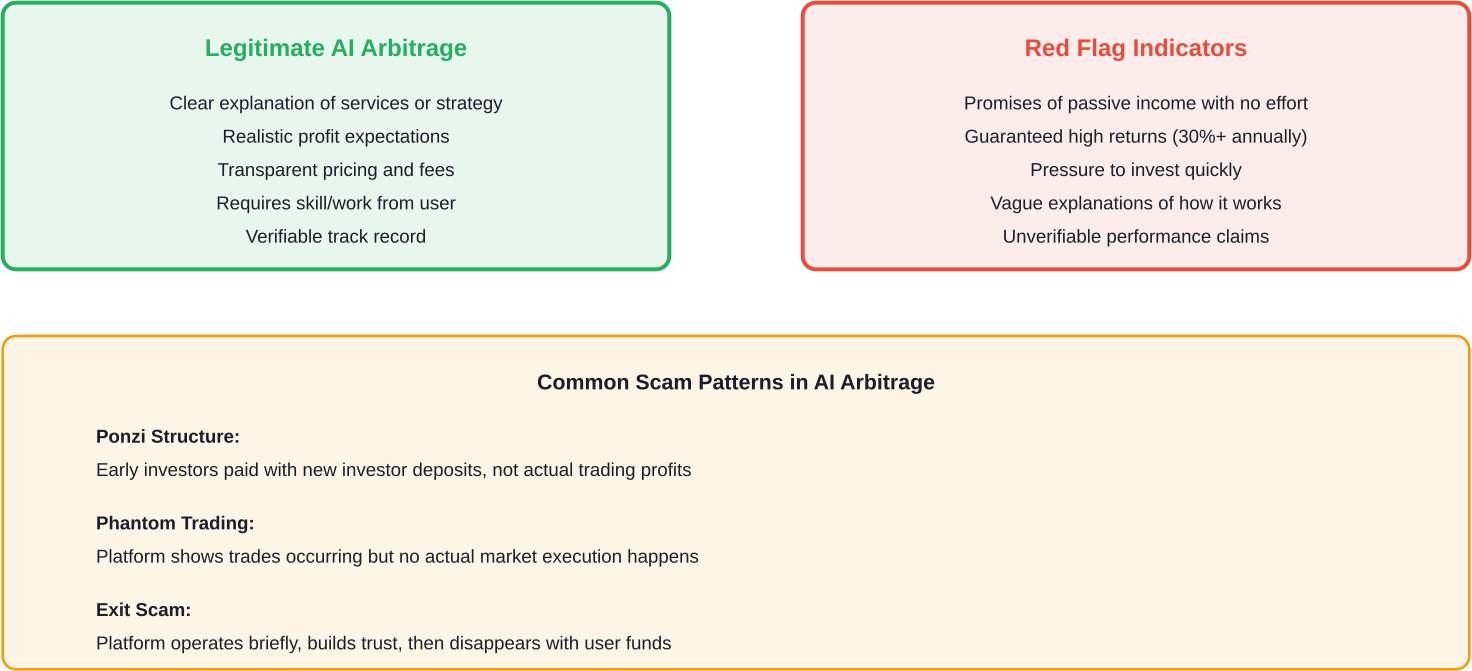
Community discussions across Reddit and business forums highlight several patterns that indicate potential scams.
Guaranteed returns should trigger immediate skepticism. No legitimate trading or business strategy can guarantee specific profit percentages, especially high ones. Markets fluctuate. Competition changes. Technology evolves. Real businesses acknowledge uncertainty.
Passive income claims without work requirements also raise red flags. Agency arbitrage requires client acquisition, service delivery, and quality control. Retail arbitrage needs product research, inventory management, and customer service. Even automated trading requires capital, monitoring, and risk management.
Vague explanations about how the system actually works often hide the fact that no real system exists. Legitimate businesses can explain their value proposition clearly: "We use AI to create content faster, reducing costs while maintaining quality." Scams rely on complexity and confusion.
Pressure tactics—limited spots available, special pricing ending soon, testimonials from people who made thousands in their first week—are classic manipulation techniques.
Various hype cycles have promoted AI arbitrage through influencer marketing and course sales. One pattern involves individuals promoting AI arbitrage as a foolproof money-making method, often selling courses or software access.
The business model in these cases is usually course sales, not arbitrage profits. The promoter makes money by selling the dream of AI arbitrage to newcomers, not by successfully executing arbitrage themselves.
This doesn't mean the underlying concept is worthless. But it does mean buyers should distinguish between education about a legitimate strategy versus exaggerated promises designed primarily to sell courses.
What can someone actually expect if they pursue AI arbitrage seriously and ethically?
Starting an AI arbitrage agency in 2026 requires real skills: sales ability, service delivery knowledge, client management, and strategic thinking about how to apply AI tools effectively.
The good news is that barriers to entry have lowered significantly. Someone with marketing expertise can launch a content agency without hiring a team of writers. A consultant can offer data analysis services without employing statisticians. The AI handles execution while the founder provides strategy and oversight.
Revenue potential scales with client acquisition and pricing strategy. An agency landing multiple clients at premium rates can generate meaningful monthly revenue. If AI reduces delivery costs significantly compared to traditional methods, profit margins can improve substantially after overhead.
That's a legitimate business, not passive income. Client acquisition takes effort. Service delivery requires oversight. Quality control needs attention. But the economics work considerably better than traditional service businesses operating without AI leverage.
Product arbitrage using AI scanning and crosslisting tools offers a different risk-reward profile.
The advantage is tangible: physical products with verifiable price differences across platforms. The disadvantage is margin compression as more sellers adopt similar tools and competition increases.
Successful retail arbitragers in 2026 focus on niche categories where they develop specialized knowledge. Vintage clothing, collectibles, discontinued items, or region-specific products offer better opportunities than commodity goods where margins are razor-thin.
Automation handles the volume. A seller might list 50-100 items daily across multiple platforms using AI tools. Even with modest per-item profits, volume can create meaningful income. But this requires inventory capital, storage space, shipping logistics, and customer service.
Again, not passive. Not effortless. But economically viable for people willing to treat it as a real business.
Crypto arbitrage using AI is the most technically challenging and capital-intensive approach.
Retail traders with limited capital face significant headwinds including transaction fees and transfer times. Some traders find success with manual arbitrage using AI as a scanning tool rather than full automation—identifying opportunities algorithmically but executing trades manually to avoid depositing funds with questionable platforms.
The realistic expectation for someone starting crypto arbitrage in 2026 is single-digit annual returns at best, with substantial risk of capital loss if they're using untested platforms or strategies they don't fully understand.
For those committed to pursuing the agency model—the most accessible and sustainable approach—several foundational steps matter.
Start by becoming proficient with the AI tools relevant to the services being offered. Free tiers and trial periods allow hands-on learning without significant upfront investment.
Testing multiple platforms reveals which tools produce the best outputs for specific use cases. ChatGPT might excel at long-form content while Claude handles technical documentation better. Jasper might optimize marketing copy while Copy.ai suits social media better.
Equally important is developing the skills to evaluate, edit, and improve AI outputs. The arbitrage advantage comes from speed, not from blindly accepting whatever the AI generates. Quality control separates sustainable agencies from those that damage their reputation with low-quality deliverables.
Generalist agencies face intense competition from established players. Specialists offering deep expertise in a particular industry or service type can command premium pricing.
A marketing agency serving dental practices can use AI to create content faster while applying specific knowledge about what messages resonate with dental patients and what compliance requirements apply to healthcare marketing.
A research service targeting venture capital firms can leverage AI for data gathering and preliminary analysis while adding value through industry insights and strategic interpretation.
The niche provides the differentiation. The AI provides the efficiency.
Many potential clients in 2026 still harbor skepticism about AI-generated work or don't understand the quality levels AI tools have reached.
Successful agencies educate prospects through content marketing. Case studies showing before-and-after results. Blog posts explaining how AI augments rather than replaces human expertise. Webinars demonstrating the agency's process and quality standards.
Transparency about using AI tools, combined with clear quality guarantees and revision policies, builds trust more effectively than trying to hide the AI involvement.
The arbitrage model works at small scale but becomes truly profitable with systematization.
Documenting processes—exactly which prompts produce the best results, how outputs are reviewed and refined, what approval workflows clients follow—allows agencies to train team members and maintain consistency as they grow.
BPO companies are evolving into AI-savvy consultancies, reskilling staff for advanced AI services and forming tech partnerships. The same evolution is available to smaller agencies willing to invest in process development and team training.
The technology landscape for AI arbitrage has matured significantly. Here are the categories that matter most.
Specific tool recommendations should be verified on official websites for current pricing and features, as these change frequently. The principle matters more than the specific platform: match the tool capabilities to the service requirements and client expectations.
Where is this heading?
The efficiency gap that creates arbitrage opportunities in the agency model will gradually narrow as AI adoption becomes universal. When every agency uses AI tools, the competitive advantage disappears.
But that timeline extends over years, not months. Adoption rates vary dramatically by industry, geography, and business size. Small regional businesses lag far behind tech-forward startups in AI implementation.
The strategic advantage is shifting from "using AI" to "using AI better." Agencies that develop superior prompting techniques, better quality control processes, and smarter integration of multiple AI tools will maintain margins even as basic AI usage becomes standard.
New opportunities emerge continuously as AI capabilities expand. Tools that couldn't handle video editing effectively in 2024 now produce professional results. Services that required human creativity two years ago are increasingly automatable.
For trading arbitrage, the opposite trend continues. Opportunities shrink as more sophisticated algorithms enter the market and exchanges implement better price synchronization.
AI arbitrage is not a magic formula for effortless income. It's a legitimate business strategy that leverages automation to improve service delivery economics or identify market inefficiencies.
The agency model offers the most accessible path for most people. It requires real skills, genuine effort, and business fundamentals. But the economics work—AI tools have reached quality levels that enable dramatic efficiency gains while maintaining professional output standards.
Trading arbitrage faces steeper challenges in 2026 as markets mature and competition intensifies. Retail participants need realistic expectations and should approach automated platforms with skepticism.
The opportunity is real for those willing to treat AI arbitrage as a business rather than a shortcut. Build genuine skills with AI tools. Develop valuable services clients actually need. Price based on outcomes. Deliver quality. Scale systematically.
That's the reality of AI arbitrage—not a passive income dream, but a legitimate business model that rewards competence, consistency, and strategic thinking about how to apply emerging technology to create real value.


