Facebook Ads Spy Tools: How Marketers Find Winning Ads Faster
Discover how Facebook ads spy tools help marketers find winning creatives, angles, and funnels without guessing or wasting budget.
Jan 26, 2026



Software companies can accelerate growth through targeted content marketing, SEO optimization, product-led strategies, and data-driven digital campaigns. The most effective marketing ideas combine thought leadership, free trials, account-based targeting, and multi-channel outreach that speaks directly to technical buyers and business decision-makers.
The software industry is exploding. The global software market is projected to reach US$780.93bn in 2026, with the United States alone accounting for US$395.00bn of that revenue. But here's the thing—market size doesn't guarantee success.
With thousands of software companies competing for attention, standing out requires more than a great product. It demands smart marketing ideas that resonate with technical buyers, build trust with decision-makers, and prove ROI before the first contract is signed.
So how do the most successful software companies cut through the noise? They combine data-driven strategies with authentic engagement. They understand that marketing software isn't about shouting louder—it's about being present at the exact moment a prospect realizes they have a problem you can solve.
Software marketing operates differently than traditional product marketing. The buying journey is longer. The decision-makers are more technical. And the stakes are higher.
According to research from the University of Hawaii at Manoa (scholarspace.manoa.hawaii.edu), B2B lead generation in Software-as-a-Service firms relies heavily on digital marketing touchpoints to create awareness, capture intent, and drive pipeline generation. Analysis of 17,548 companies over 24 months revealed that firm-initiated digital marketing touchpoints showed statistically significant higher forecasted sales value long-term compared to market-initiated ones, with firm-initiated touchpoints having a higher first-click-to-customer ratio.
Translation? The content you create and the outreach you control matters more than waiting for inbound traffic alone.
The software market is projected to grow at an annual rate of 4.67% from 2026 to 2030, reaching US$937.39bn by 2030. Enterprise software will dominate, with a projected market volume of US$337.11bn by 2026. That growth creates opportunity—but also intensifies competition.
Content marketing isn't optional for software companies anymore. It's the foundation.
But not just any content. Software buyers—especially technical buyers—can spot shallow marketing fluff instantly. They want depth. They want proof. They want to see that your team actually understands the problems they're trying to solve.
The best software content marketing strategies balance accessibility with technical rigor. Write blog posts that tackle real implementation challenges. Publish case studies with specific metrics and outcomes. Develop whitepapers that dive deep into architectural decisions.
According to competitor content, one software company generated $57,120 in revenue with their campaign and ongoing focus on blog posts covering software trends and case studies. Regularly updating content keeps visitors engaged and signals to search engines that the site remains active and authoritative.
What should that content include?
The goal isn't to create content for content's sake. Each piece should either answer a question prospects are actively searching for or introduce a perspective they hadn't considered.
Software buying cycles are complex. Different stakeholders need different information at different stages.
Early-stage content builds awareness and establishes authority. Mid-stage content addresses specific evaluation criteria. Late-stage content removes final objections and provides ammunition for internal champions to convince their colleagues.
Search engine optimization remains one of the highest-ROI marketing strategies for software companies. When someone searches for a solution to a technical problem, being the top result creates immediate credibility.
Generic keywords like "project management software" attract massive search volume but low conversion rates. Long-tail keywords like "project management software for distributed engineering teams" attract fewer searchers—but those searchers are much closer to buying.
Research analyzing 24 months of data from 17,548 companies found that firm-initiated digital marketing touchpoints have a higher first-click-to-customer ratio than market-initiated ones. Controlling the narrative from the first interaction improves conversion throughout the funnel.
Build content around questions prospects actually ask. Use tools to find search queries, but also listen to sales calls, read community discussions, and pay attention to support tickets. The language prospects use reveals what they care about.
Here's something many software companies overlook: documentation is marketing.
Developers evaluating software often go straight to the docs. Clear, comprehensive, searchable documentation signals product maturity and reduces perceived implementation risk. Well-optimized documentation pages rank for technical queries and drive qualified traffic.
Make documentation publicly accessible. Include real code examples. Keep it updated. Add search functionality. The easier you make it for prospects to evaluate your product independently, the more qualified they'll be when they reach out.
Product-led growth has transformed enterprise software buying. According to research from Dartmouth's Tuck School of Business (digitalstrategies.tuck.dartmouth.edu, published 2020-01-30), the traditional model—where sales reps targeted senior executives and long implementation processes followed contract signing—is giving way to product-led growth and self-service evaluation.
Modern software buyers want to experience the product before committing. They want to test it with real data. They want to prove value to themselves before involving procurement.
A free trial that takes three weeks to configure and another two weeks to see results won't convert. The best trials get users to their first "aha moment" within hours, not days.
What makes a trial successful?
Track which features trial users engage with most. Monitor where they get stuck. Use that data to refine the trial experience and inform sales conversations.
Community discussions often provide more value to prospects than marketing materials. Users share real implementation stories, workarounds, and honest assessments.
Create spaces where users can help each other. Forums, Slack channels, Discord servers—the platform matters less than the quality of conversation. Encourage employees to participate authentically, not just drop marketing messages.
Active communities reduce support burden, increase retention, and generate word-of-mouth referrals. They also create content—community questions and answers often rank for long-tail searches.
Enterprise software requires a fundamentally different marketing approach than SaaS tools. Deals involve multiple stakeholders, longer sales cycles, and higher contract values.
Account-based marketing flips traditional lead generation on its head. Instead of casting a wide net and qualifying leads, ABM identifies target accounts first, then creates personalized campaigns to engage decision-makers at those specific companies.
Start with ideal customer profiles based on existing successful customers. Which industries? Which company sizes? Which tech stacks? Which pain points?
Build a list of target accounts that match those criteria. Then research each account deeply. Who are the key decision-makers? What initiatives has the company announced publicly? What technology do they currently use? What challenges might they face?
This research informs everything—content topics, ad targeting, sales talking points, event invitations.
Generic marketing doesn't work for six-figure software deals. Decision-makers expect vendors to understand their specific context.
Develop account-specific assets: custom demos using their industry terminology, case studies from similar companies, whitepapers addressing their regulatory requirements, ROI projections based on their company size.
Coordinate across channels. If a target account sees a LinkedIn ad, visits the website, receives a personalized email, and hears from a sales rep—all delivering consistent, relevant messages—conversion rates skyrocket.
For B2B software companies, LinkedIn isn't just another social channel. It's where decision-makers consume content, evaluate vendors, and build professional relationships.
LinkedIn's algorithm rewards consistent, valuable content. Company pages matter, but individual employee voices—especially executives and subject matter experts—drive more engagement.
Encourage team members to share insights, comment on industry developments, and engage authentically. Each employee's network extends the company's reach. Their professional credibility lends weight to the company's messaging.
What content performs well on LinkedIn for software companies?
The goal isn't to go viral. It's to stay visible and valuable to the specific audience that matters—potential buyers, partners, and influencers in the target market.
LinkedIn's targeting capabilities let software companies reach decision-makers with surgical precision. Target by job title, company size, industry, skills, groups—even specific companies for account-based campaigns.
Sponsored content performs well for thought leadership and educational content. InMail works for personalized outreach to high-value prospects. Dynamic ads can retarget website visitors with relevant offers.
The key is matching ad content to audience intent. Don't push product demos to cold audiences. Lead with education, build awareness, then nurture toward conversion.
Email remains one of the highest-ROI channels for software marketing. But effectiveness depends entirely on relevance and timing.
Sending the same message to everyone on an email list wastes opportunity. Different segments need different content based on their role, industry, product interest, and stage in the buying journey.
Basic segmentation includes:
Advanced segmentation uses behavioral triggers—someone who visited the pricing page three times in a week gets different messaging than someone who downloaded a whitepaper six months ago and hasn't returned.
Most software buyers aren't ready to purchase immediately. Automated nurture sequences keep prospects engaged while they evaluate options, build internal consensus, and secure budget.
Effective nurture sequences provide value at each touchpoint. Don't just send promotional emails. Share relevant case studies, link to useful blog posts, invite to webinars, offer assessment tools.
Track engagement to identify buying signals. When a prospect suddenly starts opening every email and clicking multiple links, that behavioral change indicates increased interest. Alert sales to reach out.
Software companies need robust analytics to understand which marketing activities drive pipeline and revenue. Vanity metrics like page views and social followers don't pay the bills.
Marketing attribution gets complicated in B2B software with long sales cycles and multiple touchpoints. A prospect might encounter a dozen marketing interactions before converting.
Key metrics to track include:
Research analyzing 24 months of data from 17,548 companies found that firm-initiated digital marketing touchpoints showed statistically significant higher long-term forecasted sales value compared to market-initiated ones, with firm-initiated touchpoints generating a higher first-click-to-customer ratio. This underscores the importance of measuring both immediate conversions and pipeline influence.
Not all marketing channels deliver equal returns. Continuously evaluate which activities generate the most qualified pipeline per dollar spent.
That said, some high-value channels don't scale linearly. A personalized account-based campaign might convert at 40% but only reach 50 accounts. A content marketing program might convert at 2% but reach 50,000 prospects.
The optimal mix balances efficiency, scale, and strategic goals. Early-stage companies often prioritize high-efficiency, low-scale tactics. Growth-stage companies invest in scalable channels even if per-lead costs are higher.

Most software companies do not struggle with ideas—they struggle with spending too much money figuring out which campaigns actually work. Extuitive helps brands forecast likely ad performance before campaigns go live by analyzing historical ad data, messaging patterns, creative structure, and audience-response signals. Instead of relying entirely on trial and error, teams can compare campaign directions earlier and move forward with higher-confidence creatives.
With Extuitive, software companies can:
👉Book a demo with Extuitive to forecast your next software campaign before it goes live.

Digital channels dominate software marketing discussions, but physical touchpoints can cut through digital noise—especially for high-value enterprise accounts.
When pursuing a seven-figure enterprise deal, a well-crafted direct mail piece stands out in a way that another email never will. Decision-makers receive hundreds of emails daily. They receive far fewer packages.
Effective direct mail for software companies isn't about brochures. It's about creating memorable experiences that start conversations. Send personalized gifts tied to account research. Mail printed case studies with handwritten notes. Deliver dimensional mailers that demonstrate product value physically.
The key is integration. Direct mail works best when coordinated with digital touches—an email references the package, a sales call follows up, LinkedIn ads reinforce the message.
The most effective marketing ideas for software companies rarely exist in isolation. Multi-channel campaigns create reinforcement through repetition and variety.
A product launch might include: blog posts explaining the problem, video demos showing the solution, webinar deep-dives for technical audiences, email sequences for existing users, LinkedIn ads for cold prospects, and sales outreach to target accounts. Each channel reaches different people in different contexts, but all deliver consistent core messaging.
Track cross-channel journeys to understand how prospects move between touchpoints. The prospect who sees a LinkedIn ad, then visits the website, then attends a webinar, then requests a demo—that journey reveals which combination of channels drives action
The software market is growing—projected to reach US$780.93bn in 2026 and US$937.39bn by 2030. But growth creates competition.
The marketing ideas that work for software companies share common traits: they demonstrate real expertise, they respect buyer intelligence, they provide value before asking for commitment, and they measure outcomes ruthlessly.
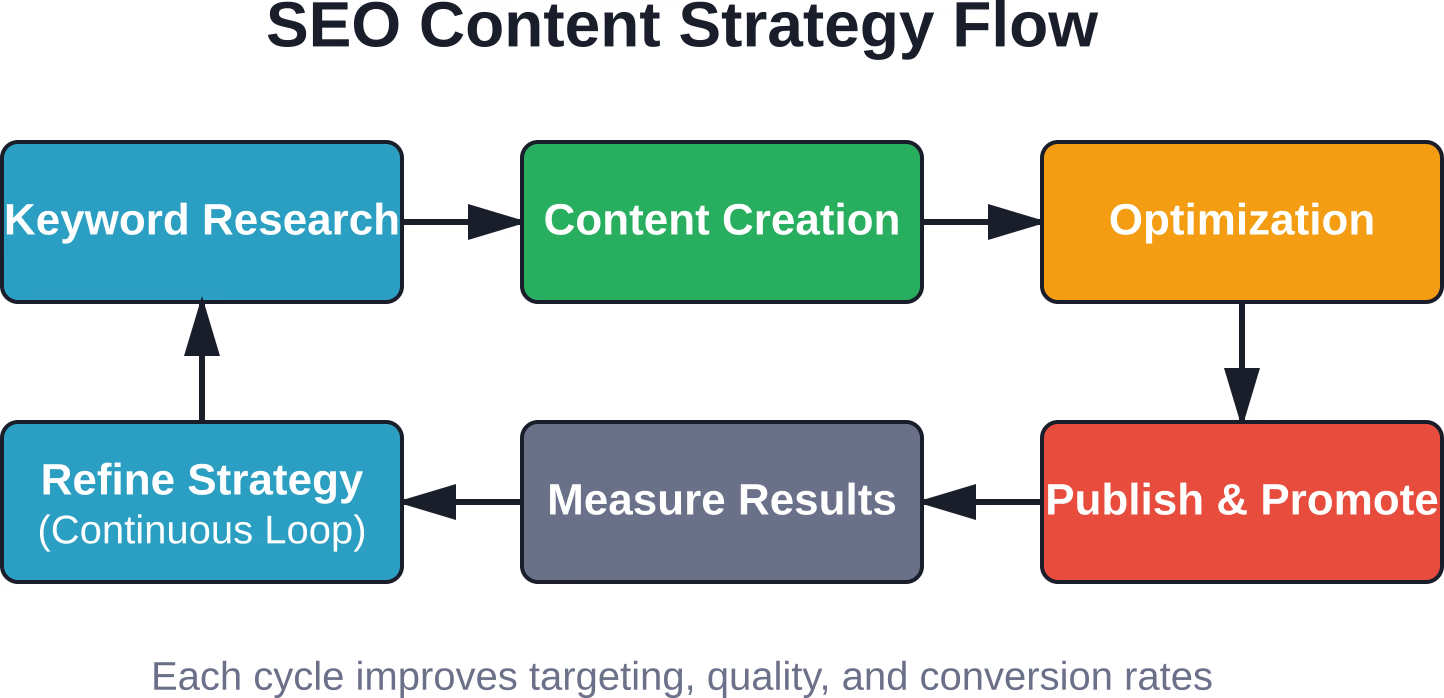
Start with the fundamentals. Build content that educates. Optimize for search visibility. Make it easy for prospects to experience the product. Then layer in sophisticated strategies—account-based targeting, multi-channel orchestration, data-driven optimization.
The companies that win don't necessarily have the biggest marketing budgets. They have the clearest understanding of who they serve, what problems they solve, and how to demonstrate value at every stage of the buyer journey.
Ready to accelerate growth? Pick two or three marketing ideas from this guide that align with current capabilities and market position. Implement them thoroughly. Measure results. Refine based on data. Then expand.
The best time to build a systematic marketing engine was a year ago. The second-best time is right now.


