Best Shopify Returns Apps Worth Installing
Tired of messy returns? Here are the best Shopify returns apps now—real pricing breakdowns and which ones save the most time and money for your business.
Mar 24, 2026



Temu dropshipping faces significant practical limitations due to lack of automated fulfillment tools, long shipping times, and branded packaging that reveals the source to customers. While Temu offers low prices, alternatives like AliExpress, 1688.com (via agents), and specialized dropshipping platforms provide better automation, supplier integration, and business-focused features for sustainable e-commerce operations.
Temu has exploded onto the e-commerce scene with rock-bottom prices and massive product selection. Pronounced as 'Tee Moo,' Temu is a global e-commerce platform headquartered in the US and owned by PDD Holdings, the same company that owns Pinduoduo in China. The platform leverages its parent company's existing network of local manufacturers to offer products at competitive prices.
But here's the thing—just because Temu sells products cheaply doesn't mean it's built for dropshipping.
According to community discussions across platforms, dropshippers quickly discover that Temu lacks the infrastructure that makes dropshipping actually work. No automated order fulfillment. No blind shipping. No supplier integrations with Shopify or WooCommerce.
So what's the real story? And what should dropshippers use instead?

Temu dropshipping can move quickly, which makes weak ad creative expensive. Extuitive helps teams predict ad performance before launch, so ad concepts can be reviewed earlier instead of waiting for live spend to show what did not work. That makes it easier to compare ideas and put budget behind stronger creative.
Talk with Extuitive to:
👉 Book a demo with Extuitive to review ad concepts before launch.
Temu operates as a consumer-facing marketplace. That matters because the platform's entire design caters to individual shoppers hunting for deals, not business owners running dropshipping operations.
Traditional dropshipping suppliers understand they're serving resellers. They offer wholesale pricing tiers, private labeling options, and automated order processing. Temu doesn't.
The platform ships orders in Temu-branded packaging. Customers receive bright purple bags and boxes with the Temu logo plastered everywhere. That immediately reveals where the product actually came from, destroying any brand perception a dropshipper tried to build.
Most successful dropshipping operations rely on integrations. Tools like AutoDS, DSers, or Oberlo connect stores directly to suppliers, automating everything from product imports to order fulfillment.
Temu doesn't support these integrations. Orders need manual processing—copying customer addresses, placing orders individually, and hoping everything arrives correctly.
That workflow collapses fast once order volume increases beyond a handful of sales per day.
Temu ships from China using standard international logistics. Delivery typically takes 10-20 days to most markets, sometimes longer during peak seasons.
Compare that to AliExpress suppliers offering ePacket shipping or specialized dropshipping suppliers with warehouses in the US, UK, or EU providing 3-7 day delivery. The difference matters enormously for customer satisfaction and refund rates.
Low product prices look attractive on paper. But dropshipping profitability depends on total operational costs, not just unit prices.
Manual order processing eats time. Scaling from 10 orders per day to 50 becomes impossible without hiring virtual assistants. That labor cost eliminates the savings from cheaper products.
Higher refund rates from long shipping times and packaging issues cut into margins. Customer complaints spike when orders take three weeks and arrive in obvious Temu packaging.
According to Better Business Bureau data, Temu responds to most customer service issues within 8 hours, with cases typically resolved no later than 24 hours. But dropshippers dealing with volume need supplier-level support—order tracking APIs, bulk processing, and dedicated account managers.
Building a brand means customers associate quality and service with the store name. That's impossible when products arrive in Temu packaging.
Customers realize they overpaid for something available cheaper on Temu. They leave negative reviews. Some dispute charges.
Real talk: branded packaging destroys trust faster than almost any other dropshipping mistake.
The good news? Multiple platforms actually designed for dropshipping offer better pricing than Temu while solving the automation and shipping problems.
AliExpress built its business serving dropshippers. The platform offers extensive integration with major dropshipping tools, supplier ratings and reviews, and ePacket shipping options.
Suppliers on AliExpress understand dropshipping. Many offer unbranded packaging by default. Some provide private labeling services for higher-volume orders.
Tools like DSers, Oberlo, and AutoDS connect directly to AliExpress, automating product imports, inventory sync, and order fulfillment. The entire workflow takes minutes to set up.
Now, this is where it gets interesting. 1688.com is Alibaba's domestic Chinese marketplace where manufacturers sell to local businesses. Prices run 30-60% lower than AliExpress for identical products.
The catch? The site operates entirely in Chinese and doesn't ship internationally. That's where sourcing agents come in.
Services like CJDropshipping, TopDawg, and others act as intermediaries. They purchase from 1688 suppliers, handle quality control, manage warehousing, and ship internationally with faster delivery times.
This approach combines wholesale pricing with professional dropshipping infrastructure—automation, API access, and unbranded or custom packaging.
Platforms like Spocket and Modalyst curate suppliers from the US and EU. Products cost more but ship faster—typically 2-7 days.
The higher product costs get offset by lower refund rates, better customer satisfaction, and premium pricing opportunities. Customers pay more for faster delivery and perceived quality.
These platforms integrate directly with Shopify, WooCommerce, and other e-commerce platforms. Everything runs automatically from day one.
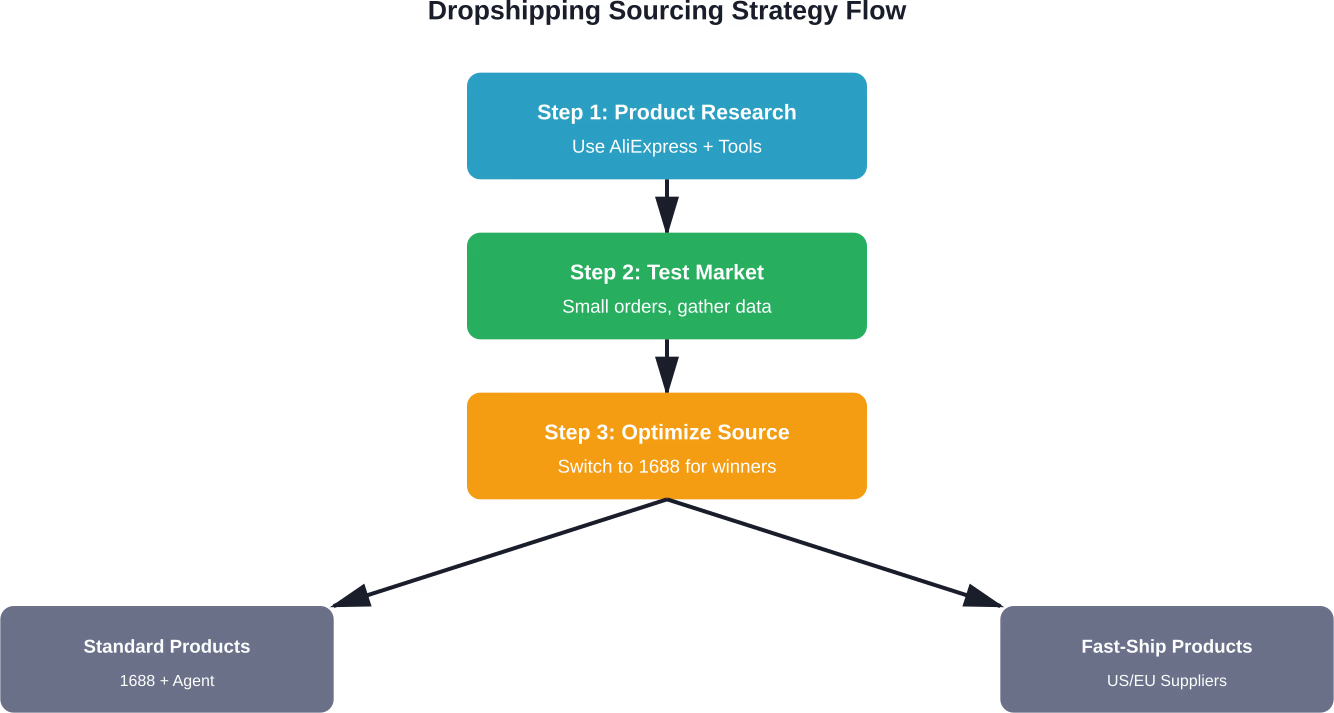
Smart dropshippers use a hybrid approach. They don't rely on a single source.
Start with AliExpress to validate products and test markets. The platform's breadth makes it ideal for product research—identify winning products, test different niches, and gather customer feedback.
Once a product proves profitable, source the same item from 1688 through an agent. The lower unit cost increases margins by 20-40% on proven winners.
For products where fast shipping matters more than margins—trending items, impulse purchases, seasonal products—consider US or EU suppliers through Spocket or direct relationships.
Manual browsing wastes time. Successful dropshippers use data-driven tools to identify winning products before competitors saturate the market.
Tools like AutoDS provide analytics on trending products, sales volume estimates, and competition levels. They scan AliExpress, Amazon, and other platforms to surface products gaining traction.
Google Trends reveals search volume patterns. A product with steadily increasing search interest over 3-6 months indicates sustainable demand rather than a temporary spike.
Facebook Ad Library shows what competitors are actively advertising. Heavy ad spend on specific products signals profitability—companies don't keep running ads for products that don't convert.
Chasing the absolute lowest price ruins more dropshipping businesses than any other single mistake.
The cheapest supplier often has the longest shipping times, worst quality control, and poorest communication. That $2 savings per unit costs $50 in refunds and chargebacks.
AliExpress and similar platforms provide detailed supplier metrics for a reason. Orders processed, dispute rate, response time, and customer feedback reveal reliability.
A supplier with 98% positive feedback and 10,000 orders processed will outperform a supplier with 92% feedback and 500 orders—even if the second supplier costs 10% less.
Look for suppliers offering ePacket or other tracked shipping methods. Untracked shipping saves $1-2 per order but generates customer service nightmares when packages go missing.
Order samples. Always. Every time.
Product photos lie. Descriptions exaggerate. The actual product quality, packaging, and shipping time only become clear when holding the physical item.
Testing prevents the disaster of scaling a product to 50 orders per day only to discover it breaks after two uses or arrives looking nothing like the listing photos.
The Federal Trade Commission has increased enforcement actions against deceptive e-commerce operations. According to an FTC suit from March 24, 2025, the agency secured permanent bans and monetary judgments against e-commerce business opportunity scam operators.
Dropshipping itself is completely legal. But specific practices cross into illegal territory.
False advertising—showing product images that don't match what ships—violates FTC regulations. Misrepresenting shipping times or product origins creates legal liability.
Transparent business practices protect both customers and sellers. Clear shipping time estimates, accurate product descriptions, and responsive customer service build sustainable businesses while avoiding regulatory problems.
Unrealistic expectations sink most new dropshippers before they properly start.
Dropshipping isn't passive income. It's a real business requiring product research, marketing testing, customer service, and continuous optimization.
The first three products usually fail. So do the next five. Finding winning products requires systematic testing, not luck.
Successful dropshippers treat it as a numbers game. Test 20 products. Two will break even. One might generate significant profit. Scale that winner aggressively while continuing to test new products.
Here's what most dropshipping guides skip: sourcing is the easy part. Thousands of suppliers offer millions of products.
The hard part? Profitably acquiring customers.
Facebook ads, Google ads, TikTok marketing, influencer partnerships—these skills determine success or failure. A mediocre product with excellent marketing crushes an excellent product with poor marketing.
Budget 70% of time on marketing and customer acquisition, 30% on operations and sourcing. Not the reverse.
Temu works brilliantly for what it's designed to do—sell products directly to consumers at aggressive prices. But that design makes it fundamentally incompatible with professional dropshipping operations.
The lack of automation alone disqualifies Temu for anyone planning to scale beyond hobby-level sales. Add branded packaging, retail pricing, and no business infrastructure, and the platform simply doesn't compete with purpose-built alternatives.
Smart dropshippers in 2026 use AliExpress for product testing and market validation, transition winning products to 1688 sourcing for better margins, and leverage US or EU suppliers for products where fast shipping drives conversions.
Success comes from matching the right sourcing strategy to specific products and markets—not from finding a single magical supplier platform.
Start with proper infrastructure. Use platforms that integrate with your store, provide tracking and analytics, and treat dropshipping as the legitimate business model it is. The operational headaches saved are worth far more than a few dollars per unit in product costs.


