Top Meta Ads Agencies in Nashville: Who’s Actually Driving Results in 2026
Discover leading Meta ads agencies in Nashville for high-ROAS campaigns. Find expert Meta advertising partners for local and e-commerce growth in 2026.
Mar 24, 2026



Finance companies can boost customer acquisition and retention through digital strategies including content marketing, mobile-first design, email campaigns, interactive calculators, and compliance-focused social media. The most effective approaches combine educational content with personalized tools while maintaining regulatory compliance and building trust through transparent communication.
Marketing a finance company looks nothing like promoting consumer goods. Trust matters more than flashy campaigns. Regulations shape every message. And consumers research financial decisions for weeks before making contact.
The financial services industry has shifted dramatically toward digital channels. Smartphone ownership among mobile phone users increased from 2011 to 2015, fundamentally changing how consumers access financial information. Over 65% of millennials now primarily manage their finances through mobile banking apps. But here’s the thing — most finance companies still market like it’s 2010: generic ads, product-focused messaging, and zero personalization.
The firms winning today understand something crucial: modern financial marketing isn't about pushing products. It's about building authority, delivering value upfront, and meeting customers where they already spend time.
Traditional financial advertising relied heavily on brand recognition and one-way messaging. A bank would buy TV spots, print ads, and billboards. Customers would walk into branches.
That model broke.
Consumers now research financial products online extensively before ever speaking with a representative. They compare offerings across dozens of providers. They read reviews, watch videos, and seek recommendations from peers.
The Federal Reserve's Small Business Credit Survey found that 32% of small businesses seeking credit in 2018 turned to online lenders, up from just 19% in 2016. This represents a massive shift in just two years.
Financial services buyers expect educational content, transparent pricing, and digital-first experiences. Companies stuck in broadcast mode lose to competitors who provide value before asking for business.
Content marketing has become essential for financial services firms. Unlike product-centric advertising, content marketing educates prospects while establishing expertise.
The approach works because financial decisions involve significant research. Someone considering investment options might spend months learning before committing. A small business owner evaluating loan products will compare terms across multiple lenders.
Quality content meets these prospects during their research phase, positioning your firm as a trusted resource long before they're ready to buy.
Educational blog posts addressing common financial questions remain highly effective. Topics like "How to choose between fixed and variable rate mortgages" or "Tax strategies for small business owners" attract organic search traffic from qualified prospects.
Video content performs exceptionally well in finance. Market updates, product explainers, and client testimonials build trust faster than text alone. Video content performs exceptionally well in financial services marketing.
Downloadable resources—guides, checklists, comparison charts—work as lead magnets. Someone who downloads your "Retirement Planning Checklist" has self-identified as interested in retirement services.
Case studies and client success stories provide social proof. They demonstrate real outcomes rather than theoretical benefits.
Effective financial content requires understanding your audience's specific pain points. Retail banking customers have different concerns than wealth management clients. Small business borrowers need different information than corporate treasury teams.
Start by mapping the customer journey. What questions do prospects ask at the awareness stage? What objections surface during consideration? What information closes deals?
Create content for each stage. Awareness content educates broadly—"Understanding different business loan types." Consideration content compares options—"Term loans vs. lines of credit: Which fits your business?" Decision content addresses final concerns—"What documents you'll need to apply."
Compliance review is non-negotiable. According to the SEC's marketing rule amendments adopted in December 2020 and effective in May 2021, investment advisers face strict requirements for testimonials, endorsements, and performance advertising. Financial firms must have every piece of content reviewed and approved before publication.
Mobile optimization isn't optional anymore. With high rates of mobile phone ownership increasing year over year, and smartphone ownership climbing steadily, finance companies must design for mobile first.
Nearly half of millennials access their financial accounts exclusively through mobile devices. They check balances, transfer funds, deposit checks, and research products—all from phones.
Yet many financial websites still treat mobile as an afterthought. Forms that require excessive typing. PDFs that don't render properly. Application processes that force desktop usage.
Design websites and landing pages for mobile screens first, then scale up to desktop. This forces simplification and prioritization:
Email remains one of the highest-ROI marketing channels for financial services. It allows personalized, segmented communication at scale.
Financial firms can use email to nurture prospects over long buying cycles, re-engage dormant customers, and provide ongoing value to active clients.
Generic email blasts underperform. Segmented campaigns based on customer type, product interest, or lifecycle stage generate significantly higher engagement:
Market updates and financial news position your firm as a timely information source. Brief, digestible commentary on economic trends keeps you top-of-mind.
Educational series build authority. A seven-email course on "Fundamentals of Business Finance" delivers value while staying in front of prospects for weeks.
Product announcements work when framed around customer benefits, not features. "New feature helps you approve loans 50% faster" beats "We've updated our processing system."
Personalized recommendations based on customer data increase relevance. If someone primarily uses checking services, an email about optimizing their checking account outperforms a generic investment pitch.
Interactive tools provide immediate value while capturing qualified leads. Someone using your mortgage calculator is likely researching home loans. Someone running retirement projections through your tool is a retirement planning prospect.
These tools also keep users on your site longer, which signals quality to search engines and improves rankings.
Loan calculators let prospects estimate payments for mortgages, auto loans, or business financing. They provide transparency while capturing contact information.
Investment return calculators help users project portfolio growth. They're particularly effective for wealth management and retirement planning firms.
Budget planners and cash flow tools attract small business owners and retail banking customers. These tools demonstrate your understanding of financial management challenges.
Savings goal calculators make abstract financial goals concrete. "You need to save $847 per month to reach your down payment goal in 24 months" is more actionable than vague advice to "save more."
Tax estimators provide immediate value during tax season while positioning your firm for follow-up conversations about tax strategy.
Allow basic calculator use without registration. Let users get initial value to build trust.
Gate advanced features or detailed results behind a simple form. "Enter your email to save these calculations" or "Get a personalized recommendation by answering three more questions."
Follow up immediately with relevant content. Someone using a retirement calculator should receive retirement planning resources, not generic newsletters.
Social media marketing in financial services requires balancing engagement with compliance. Every post must meet regulatory requirements while still being interesting enough for people to actually read.
The key is providing value without making specific product claims that require disclaimers.
Financial literacy tips provide value without promoting specific products. "5 ways to improve your credit score" educates without selling.
Industry news commentary positions your firm as plugged-in and knowledgeable. Brief reactions to Federal Reserve announcements or major economic reports demonstrate expertise.
Behind-the-scenes content humanizes your brand. Employee spotlights, community involvement, and company culture posts build connections.
User-generated content and testimonials work when properly disclosed. According to the SEC's marketing rule, investment advisers using testimonials must enter into written agreements with promoters and oversee compliance, except when promoters receive de minimis compensation (under $1,000) or are affiliates.

Finance companies rarely struggle with launching ads. The bigger problem is knowing which campaigns deserve more budget before the testing costs pile up. Extuitive helps brands forecast likely creative performance using historical campaign behavior, engagement patterns, and AI-powered consumer intelligence. That gives finance teams a more practical way to evaluate campaigns earlier instead of relying entirely on expensive trial-and-error cycles.
Here’s how Extuitive can support finance marketing teams:
👉Book a demo with Extuitive before scaling your next finance advertising campaign.
SEO drives long-term, cost-effective customer acquisition for finance companies. Unlike paid ads that stop working when budgets run out, organic search rankings deliver ongoing traffic.
Financial services keywords tend to be highly competitive but also extremely valuable. Someone searching "small business loans near me" or "retirement planning advisor" has high commercial intent.
Site speed impacts both user experience and rankings. Financial websites often suffer from slow load times due to heavy security features and complex functionality. Optimize images, enable compression, and minimize unnecessary scripts.
Mobile responsiveness affects rankings directly. Google's mobile-first indexing means the mobile version of your site determines rankings even for desktop searches.
Secure hosting (HTTPS) is non-negotiable for financial sites. Both for user trust and search rankings.
Structured data markup helps search engines understand your content. Financial services can use schema markup for reviews, FAQs, local business information, and more.
Keyword research reveals what prospects actually search for. Financial services customers often use surprisingly specific long-tail queries: "how to qualify for SBA 7(a) loan with low credit" or "best rollover IRA for teachers."
Create dedicated pages for each service and customer segment. Don't try to rank one homepage for everything. Separate pages for commercial real estate loans, equipment financing, and working capital lines each target different keywords.
Answer specific questions comprehensively. A detailed guide answering "How does mortgage underwriting work?" can rank for dozens of related queries.
Update content regularly. Financial information becomes outdated quickly. Fresh content signals relevance to search engines.
Banks, credit unions, and financial advisors with physical locations need local SEO. Most competitors ignore it, creating opportunity:
Video content builds trust faster than text. Seeing and hearing real people makes financial services less intimidating and more relatable.
Video also performs exceptionally well in search results and on social media. YouTube is the second-largest search engine, and video posts on social platforms receive significantly more engagement than text or image posts.
Partner marketing leverages existing relationships to reach new customers. For financial services, this often means partnering with complementary businesses that serve the same customers.
Referral marketing taps into existing customer satisfaction. Happy customers become advocates who bring in new business.
Accounting firms make natural partners for banks and business lenders. Accountants regularly advise clients on financing decisions. Real estate agents partner effectively with mortgage lenders. The relationship benefits both parties and serves customers better.
Insurance agents and financial advisors complement each other. Many customers need both services but work with separate providers. Business consultants and commercial lenders serve overlapping markets. Consultants often recommend financing as part of growth strategies.
HR platforms and retirement plan providers can create integrated solutions. Payroll systems that connect directly to 401(k) platforms improve user experience.
According to the SEC's marketing rule, the de minimis threshold for oral compensation to promoters is $1,000 within the preceding 12 months.
Paid advertising accelerates customer acquisition when done strategically. The key is balancing cost per acquisition with customer lifetime value.
Financial services often have high customer lifetime values, making higher acquisition costs viable. Someone who becomes a wealth management client might generate hundreds of thousands in fees over decades.
Google Ads work well for high-intent financial keywords. Someone searching "apply for business line of credit" is ready to act:
Display advertising builds awareness across financial publisher sites and news platforms. It works for longer consideration cycles.
Retargeting brings back website visitors who didn't convert. Someone who used your mortgage calculator but didn't apply is a qualified prospect worth following up with display ads.
Frequency caps prevent ad fatigue. Showing the same financial services ad twenty times in a week annoys rather than persuades.
Facebook and Instagram ads reach specific demographics effectively. Targeting by age, income, location, and interests narrows audiences to likely customers.
LinkedIn advertising costs more but reaches business decision-makers. Commercial banking and B2B financial services often find better ROI on LinkedIn despite higher costs.
Lead generation ads with built-in forms reduce friction. Users can express interest without leaving the platform.
Every marketing idea discussed requires compliance oversight. Financial services operate under strict regulations from the SEC, FINRA, state banking regulators, and other agencies.
But compliance shouldn't stifle marketing. It should shape it.
Transparency differentiates financial brands. Clearly explaining fees, terms, and processes builds confidence. Educational content demonstrates expertise without pushing products. Teaching prospects about financial concepts positions your firm as a resource rather than just a vendor. Customer testimonials and reviews provide social proof, but must follow regulations. The SEC's modernized marketing rule allows testimonials with proper oversight and written agreements. Security messaging reassures concerned customers. Explaining data protection measures, fraud prevention, and privacy policies addresses common financial services anxieties.
Financial services marketing requires tracking metrics that matter—not just vanity metrics like followers or impressions.
Customer acquisition cost (CAC) measures total marketing and sales costs divided by new customers acquired. Tracking CAC by channel reveals which marketing efforts deliver the best ROI.
Customer lifetime value (LTV) represents total revenue a customer generates over their relationship. The LTV to CAC ratio indicates marketing sustainability—ratios above 3:1 generally signal healthy marketing.
Lead quality matters more than lead quantity. Track conversion rates from lead to customer, not just lead volume. A hundred qualified leads beat a thousand unqualified ones.
Application completion rates identify friction points. If users start applications but abandon them, the process needs simplification.
Content engagement metrics—time on page, pages per session, return visits—indicate content quality and relevance.
Financial services often involve long, complex buying journeys. Someone might research for months, interact with multiple touchpoints, and convert offline.
Multi-touch attribution attempts to credit each touchpoint appropriately. First-touch attribution credits the initial interaction. Last-touch credits the final conversion source. Multi-touch models distribute credit across the journey.
Use unique phone numbers and landing pages for different campaigns to improve tracking. Asking "How did you hear about us?" applications provide additional data.
Connect marketing data with CRM and sales systems. Understanding which marketing leads actually become profitable customers closes the attribution loop.
Financial services marketing continues evolving. Several trends are reshaping strategies heading into the remainder of 2026.
Consumers expect personalized experiences. Generic marketing messages underperform.
Financial firms increasingly use data and automation to deliver personalized content, product recommendations, and outreach based on customer behavior, demographics, and lifecycle stage.
Dynamic website content changes based on visitor characteristics. Email campaigns segment audiences into dozens of sub-groups. Ad creative varies by demographic and interest.
Chatbots and live chat provide immediate answers to prospect questions. Financial services buying involves uncertainty—instant access to information removes friction.
But automation must feel helpful, not robotic. Good conversational marketing seamlessly escalates complex questions to human representatives.
Some financial brands build communities around shared interests rather than just selling products. Investment platforms create forums for investors to discuss strategies. Banks sponsor small business owner networks.
Community marketing builds loyalty and generates word-of-mouth referrals. Members become advocates.
Voice assistants change how people search for financial information. Voice queries tend to be longer and more conversational than typed searches.
Optimizing for voice means targeting question-based keywords and providing clear, concise answers that voice assistants can read back.
Marketing finance companies successfully require balancing multiple priorities. Compliance can't be ignored. Trust must be earned. Competition is fierce. And customers research exhaustively before committing.
But the firms winning today understand that modern financial marketing isn't about pushing products. It's about delivering value upfront, building authority through education, and meeting customers where they already spend time.
Start with the fundamentals. Build a content marketing program addressing real customer questions. Optimize your digital presence for mobile users—they represent an increasingly dominant share of financial services consumers. Create email campaigns that nurture prospects over long buying cycles.
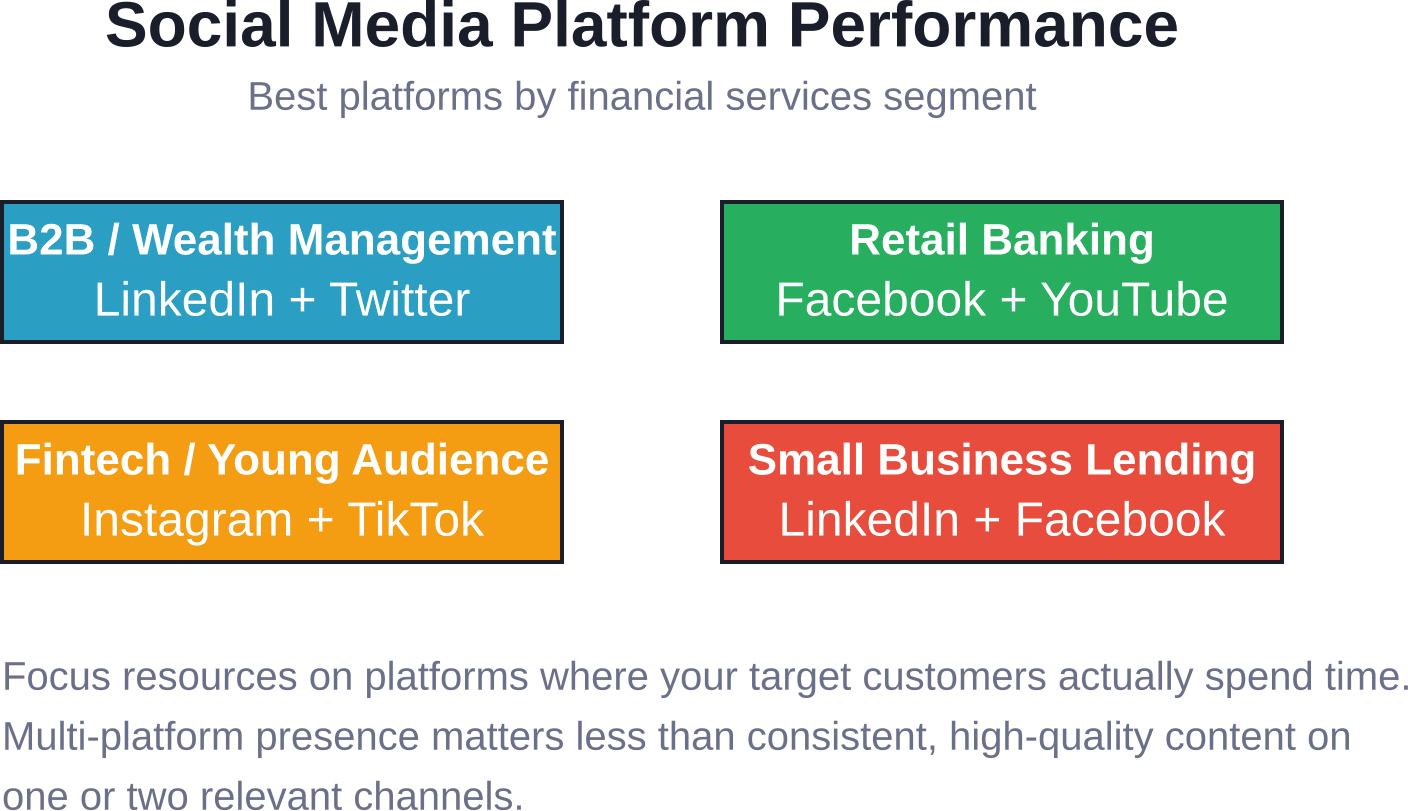
Add interactive tools that provide immediate value while capturing qualified leads. Develop social media presence on platforms where your specific customers actually engage. Invest in SEO for long-term, cost-effective customer acquisition.
Layer in video content to build trust faster. Establish strategic partnerships for referral business. Use paid advertising strategically to accelerate results while organic strategies mature.
And build compliance into every process from the start. Regulatory requirements aren't obstacles—they're guardrails ensuring your marketing builds the trust financial services require.
The most effective financial marketing combines multiple channels working together. Content attracts prospects through search. Email nurtures them through research. Social media keeps your brand visible. Tools demonstrate value. Video builds connection. And every touchpoint reinforces expertise and trustworthiness.
Start implementing these strategies today. Pick two or three that align with your resources and target customers. Build them consistently for six months. Measure results. Double down on what works. Adjust what doesn't.
The finance companies thriving in 2026 aren't those with the biggest advertising budgets. They're the ones that built sustainable marketing systems delivering qualified prospects consistently. Systems that educate before they sell. That provides value before asking for business. That earns trust before requesting commitment.
Your next customer is researching financial services right now. The question is whether they'll find your competitors or find you.


