Ultimate Comparison of ROAS Optimization Tools for Facebook Ads Profit
Explore leading ROAS optimization platforms for Meta ads. See how native AI features stack up against third-party tools for smarter campaign scaling.
Mar 24, 2026



Employment attorneys can grow their practice through targeted marketing strategies including local SEO optimization, content marketing focused on workplace rights, paid advertising campaigns, strategic social media engagement, and reputation management. The most effective approach combines website optimization, educational content creation, client testimonials, and targeted outreach to both employees and employers facing workplace disputes.
The employment law landscape is shifting. According to the Bureau of Labor Statistics, lawyers held approximately 864,800 jobs in 2024, with 51% working in legal services and 12% as self-employed workers. For employment attorneys specifically, demand has been climbing—litigation demand increased 3.2% through November 2024, reaching a 15-year high.
But here's the thing: more competition means smarter marketing. Employment attorneys can't rely on word-of-mouth alone anymore.
The median annual pay for lawyers was $151,160 in May 2024, with those in legal services earning a mean wage of $182,020. That's solid income, but only if you're consistently attracting the right clients. Whether you represent employees facing discrimination or employers navigating compliance issues, your marketing needs to speak directly to people in crisis—and do it before they call your competitor.
This guide breaks down practical marketing strategies employment attorneys are using right now to fill their calendars with quality cases.
Employment law splits into two distinct audiences: employees and employers. Each group searches differently, worries about different things, and responds to different messaging.
For employee-side attorneys, your prospects often include workers who've been wrongfully terminated, face workplace harassment, deal with wage theft, or experience discrimination. These individuals are typically stressed, often financially strained, and searching frantically for answers at odd hours.
Employer-side attorneys serve businesses that need preventive counsel, compliance help, or defense against claims. These clients tend to search during business hours, often after receiving a complaint or notice.
Real talk: you can't effectively market to both audiences with the same messaging. The employee who just got fired doesn't care about your corporate compliance expertise. The HR director doesn't want to read about wrongful termination lawsuits—she wants to avoid them.
Employment discrimination cases show clear patterns. Sexual harassment cases involve females in approximately 78% of instances, while age discrimination splits nearly 50/50 between males and females. Understanding these patterns helps you craft targeted content and select appropriate advertising channels.
Geographic targeting matters too. California employed 87,780 lawyers as of May 2022, followed by New York with 86,230. High-concentration markets mean more competition but also more potential clients searching for help.
Your website does heavy lifting in employment law marketing. It needs to accomplish several jobs simultaneously: establish credibility, explain complex legal issues simply, capture leads, and convert visitors into consultations.
Start with clear practice area pages. Don't just list services—explain what each type of case looks like from the client's perspective. Someone Googling "can I sue for wrongful termination" doesn't know legal terminology yet. Write for them, not for other attorneys.
Navigation should be dead simple. Visitors often arrive stressed and skimming frantically. They need to find answers and contact information within seconds. Bury your contact form three clicks deep, and they'll bounce to a competitor.
Every employment law website needs these components working together:
Page speed matters more than most attorneys realize. While 99.5% of lawyers require a professional degree, potential clients prioritize fast-loading websites for their user experience. If your site takes more than three seconds to load, you're losing consultations.
Local search dominates legal marketing. When someone needs an employment lawyer, they typically add their city or state to the search query. "Employment attorney near me" or "wrongful termination lawyer Boston" drive the majority of high-intent searches.
Google Business Profile optimization is non-negotiable. Claim your profile, verify it, then optimize every field. Use your primary practice areas in your description. Upload professional photos of your office and team. Post regular updates.
But wait—there's more to local SEO than just Google Business Profile. You need consistent NAP (name, address, phone number) across every online directory. Inconsistent information confuses Google and tanks your rankings.
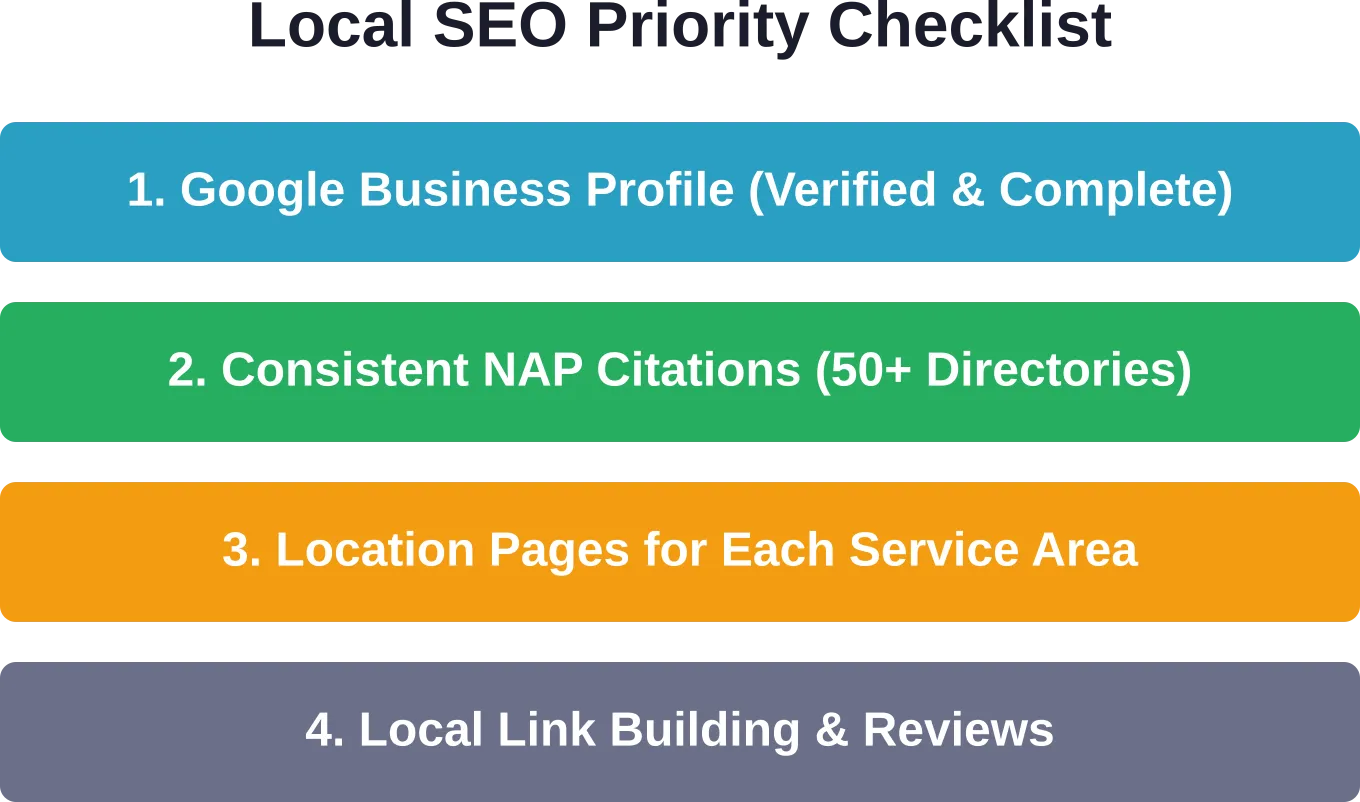
Client reviews directly impact your local rankings and conversion rates. Google prioritizes businesses with consistent recent reviews. More importantly, potential clients read them obsessively before reaching out.
Ask satisfied clients for reviews, but do it strategically. Send the request via email shortly after case resolution, include a direct link to your Google Business Profile, and make the process ridiculously easy.
Negative reviews happen. Respond professionally, avoid getting defensive, and never discuss case details publicly. A measured response to a negative review often impresses prospects more than a dozen glowing testimonials.
Content marketing works differently for employment attorneys than other practice areas. Your potential clients are searching for answers to very specific, often urgent questions. They need information now, not a vague blog post about "workplace rights."
Create content that addresses specific scenarios: "What to Do When You're Fired While on FMLA Leave" or "How to Document Workplace Harassment for a Legal Claim." These targeted pieces rank well and attract high-intent visitors.
According to research from academic institutions, 60% of consumers believe companies routinely misuse their personal data. This distrust extends to attorneys too. Content marketing builds trust by demonstrating expertise before the potential client ever picks up the phone.
Different content formats serve different purposes in your marketing funnel:
Video content deserves special attention. Most people would rather watch a three-minute video than read a 1,500-word article. Simple explanation videos addressing common employment law questions can dramatically increase engagement and time on site—both SEO ranking factors.
Organic SEO takes time. Paid advertising puts you in front of potential clients immediately. Google Ads, specifically, captures people at their moment of highest intent—right when they're searching for an employment attorney.
The challenge? Employment law keywords are competitive and expensive. "Employment lawyer" can cost $50-$150 per click in major markets. That's steep, especially considering only a fraction of clicks convert to consultations.
The solution is hyper-targeted campaigns. Don't bid on broad terms like "lawyer" or even "employment lawyer" alone. Target specific case types: "sexual harassment attorney," "wrongful termination lawyer," "FMLA violation attorney."
Industry analyses indicate that employment law firms working with marketing agencies typically spend a minimum of $1,500 monthly. That's often just the management fee—the actual ad spend sits on top of that.
For Google Ads to work effectively in competitive legal markets, most firms need to budget $3,000-$5,000 monthly in total (management plus ad spend). That sounds like a lot until you calculate client lifetime value. If one case brings in $20,000-$50,000 in fees, the math works.
Most website visitors don't convert on the first visit. They're researching, comparing options, sometimes just gathering information before they're ready to hire an attorney.
Retargeting keeps your firm in front of these prospects as they browse other websites. Someone who visited your wrongful termination page but didn't contact you sees your ads on news sites, blogs, and social media for the next 30-90 days.
Retargeting campaigns typically cost significantly less per click than search ads while maintaining strong conversion rates among this warm audience.
Social media won't directly generate tons of consultations, but it plays an important supporting role in employment law marketing. It builds name recognition, establishes expertise, and creates touchpoints with potential clients and referral sources.
LinkedIn matters most for employer-side attorneys and B2B networking. Share insights on employment law developments, compliance tips, and workplace trends. Connect with HR professionals, business owners, and corporate counsel.
Facebook still drives engagement for employee-side practices. Join local community groups, answer employment law questions (without providing specific legal advice), and share educational content about workplace rights.

In employment law, even small changes in wording or positioning can affect how people respond to an ad, especially in campaigns built around trust and legal uncertainty. With Extuitive, businesses can evaluate campaign concepts before launch through predictive advertising signals and AI consumer simulations rather than relying only on live ad performance later.
Before launch, Extuitive can help teams review:
👉Book a demo with Extuitive to explore campaign direction before ads begin spending.
The best social media content for employment attorneys includes:
Avoid overly promotional content, political rants, and anything that could be construed as providing specific legal advice to non-clients. Ethics rules vary by state, but staying conservative on social media protects your license.
Not everyone who visits your website is ready to hire an attorney immediately. Some are still employed and researching their options. Others aren't sure if they have a case. Email marketing nurtures these leads until they're ready to move forward.
Offer a valuable download in exchange for email addresses: "Free Guide: 10 Things to Do Before Filing an Employment Discrimination Claim" or "Employer's Checklist: Avoiding Common FMLA Compliance Mistakes."
Then send a well-crafted email sequence over 3-4 weeks. Each email should provide genuine value—not just thinly veiled sales pitches. Educate, build trust, and stay top-of-mind.
According to research, employees who perceived their work experiences as more fair improved their performance by 26%, and employee retention increased by 27%. This insight can fuel compelling email content about the importance of workplace fairness and proper employment law compliance.
Don't send the same emails to employees and employers. Segment your list based on how people joined it. Someone who downloaded "Know Your Rights: Workplace Harassment" should receive different content than someone who downloaded "Employment Contract Best Practices for Employers."
Marketing automation platforms handle this segmentation automatically once you set up the workflows. The initial setup takes time, but then it runs on autopilot, nurturing leads while you focus on billable work.
Referrals remain the highest-quality lead source for most employment attorneys. Cases that come through professional referrals convert at higher rates and tend to be better quality.
But referrals don't happen by accident. You need a deliberate strategy to build and maintain referral relationships.
Network with attorneys in complementary practice areas. Family law attorneys encounter employment issues during divorces. Personal injury lawyers hear about workplace accidents. Estate planning attorneys learn about employment disputes affecting estate values.
Make it easy for other attorneys to refer to you. When someone sends a referral, respond immediately, keep them updated on case progress, and thank them properly. Attorneys who refer once will keep referring if you handle their clients well.
Don't overlook non-attorney referral sources:
Offer to provide free educational workshops for these groups. A 30-minute lunch presentation on employment law basics builds relationships and establishes you as the go-to employment attorney when their clients need help.
Legal marketing ethics vary by jurisdiction, but several universal principles apply everywhere. Violating these rules risks bar discipline, which is a career-ending mistake no amount of new clients can justify.
Never guarantee specific results. "We'll get you six figures in your discrimination case" violates ethics rules and sets unrealistic expectations. Instead, discuss typical case outcomes without making promises.
Avoid soliciting clients at their moment of vulnerability. The attorney who hands out business cards at the unemployment office might generate leads but also generates bar complaints.
All advertising must be truthful and not misleading. Case results must include context. "$500,000 wrongful termination settlement" sounds great but is misleading if you omit that it's a one-time result from unusual circumstances.
Research from the University of Kansas School of Business examining attorney marketing found that social media announcements of plaintiff's attorneys' corporate investigations strongly predict future litigation. Understanding where aggressive marketing crosses into solicitation helps employment attorneys stay on the right side of ethics rules.
Marketing without measurement wastes money. You need to know which channels drive consultations, which consultations convert to signed clients, and what your true cost per case acquisition runs.
Start with basic call tracking. Use unique phone numbers for different marketing channels (website, Google Ads, print advertising, etc.). When someone calls, you'll know exactly where they found you.
Set up conversion tracking on your website. Track form submissions, phone clicks, and document downloads. Google Analytics 4 handles this natively once configured properly.
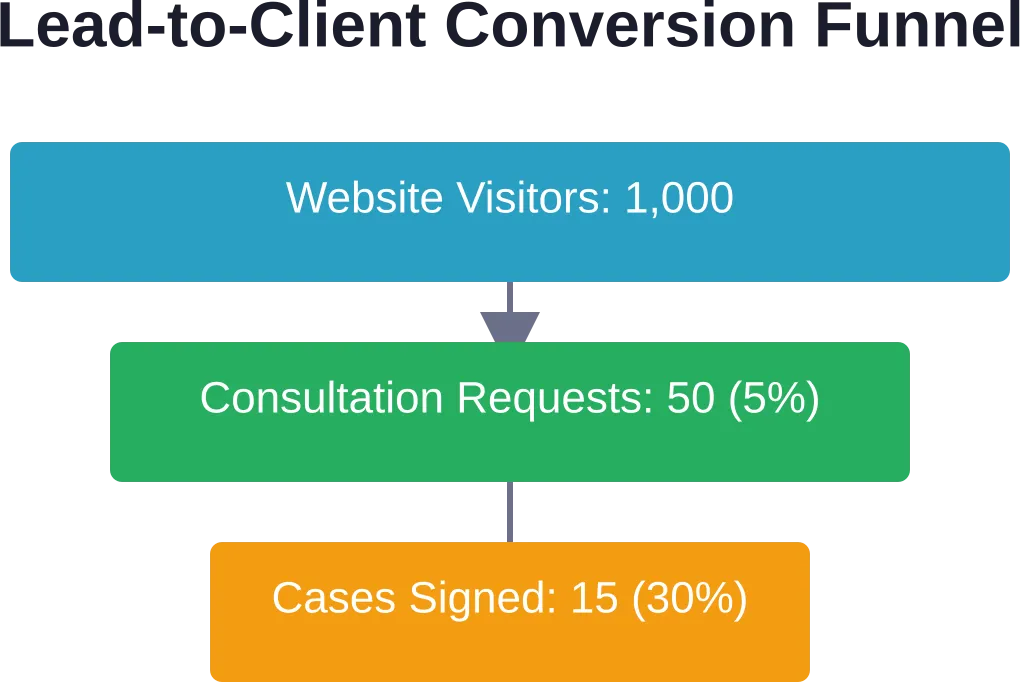
Focus on metrics that actually matter for business growth:
Vanity metrics like website traffic or social media followers feel good but don't pay the bills. A firm with 500 monthly visitors converting at 5% outperforms one with 5,000 visitors converting at 0.5%.
According to the 2024 Report on the State of the US Legal Market from Thomson Reuters and Georgetown Law's Center on Ethics and the Legal Profession, law firms experienced market shifts in 2024. This expansion creates opportunities for employment attorneys serving businesses.
Counter-cyclical practices like litigation tend to perform better during economic uncertainty. Employment law straddles both sides—preventive work for employers during good times, litigation for employees during downturns.
According to the Bureau of Labor Statistics Occupational Requirements Survey for 2025, prior work experience was required for 56.1% of lawyers and on-the-job training was required for 66.1%. For employment attorneys specifically, developing expertise in emerging workplace issues—remote work policies, gig economy classification, workplace technology privacy—creates marketing differentiation.
Generative AI is reshaping law firm operations across nearly all aspects. Employment attorneys who understand these technological shifts can market themselves as forward-thinking while competitors struggle to adapt.
Effective marketing for employment attorneys isn't about implementing every tactic simultaneously. It's about choosing the right combination of strategies for your specific practice, market, and budget.
Start with the fundamentals: a solid website optimized for conversions, local SEO dialed in, and a Google Business Profile attracting reviews. These foundational elements cost relatively little but drive consistent results.
Layer in content marketing next. Even one well-researched blog post weekly builds substantial SEO value over time. Focus on answering the specific questions your potential clients are actually searching for.
Once those basics are working, consider paid advertising to accelerate growth. Start small, track everything meticulously, and scale what works while cutting what doesn't.
Remember that legal marketing is a long game. SEO takes 6-12 months to show significant results. Referral relationships develop over years, not weeks. The employment attorneys winning in 2026 are the ones who started building their marketing foundation in 2024 and 2025.
The market will keep evolving. New platforms will emerge. Search algorithms will change. But the core principle stays constant: help potential clients find you when they need you, build trust through valuable content and professional service, and make it easy for them to take the next step.
Marketing employment law services successfully require understanding your audience, implementing proven strategies consistently, and measuring what actually drives results. The attorneys building thriving practices in 2026 aren't necessarily the best lawyers—they're the ones potential clients can actually find when they need help.
Start with your website and local SEO foundation. Build from there with content marketing and strategic paid advertising. Nurture referral relationships. Stay ethical in all your marketing efforts.
The employment law market continues expanding, with litigation demand at 15-year highs and corporate legal spending increasing. The opportunity exists. The question is whether your marketing can capture your share of it.


