Why Shopify Is Bad and Could Be Holding Your Business Back
Explore the limitations of Shopify and why it may not be the right fit for businesses looking to scale efficiently and customize freely.
Feb 3, 2026



Technology companies can drive growth through content marketing, thought leadership, strategic LinkedIn engagement, and AI-powered personalization. The most effective strategies combine educational content, partner co-marketing, video demonstrations, and email nurture campaigns that address multiple stakeholders in the B2B buying cycle. Success requires humanizing complex technical concepts while maintaining data transparency and building credibility through consistent, value-driven marketing.
Marketing a technology company isn't the same as marketing consumer goods. The buying cycles stretch longer. Decision-makers multiply. Technical complexity increases. And the stakes? They're considerably higher.
Here's the thing though—Four out of every five employees are involved in B2B tech buying decisions. That single IT decision-maker who once controlled the budget? That person's influence has been distributed across departments, roles, and hierarchies.
This shift demands a fundamental rethinking of how tech companies approach marketing. The strategies that worked five years ago won't cut it today.
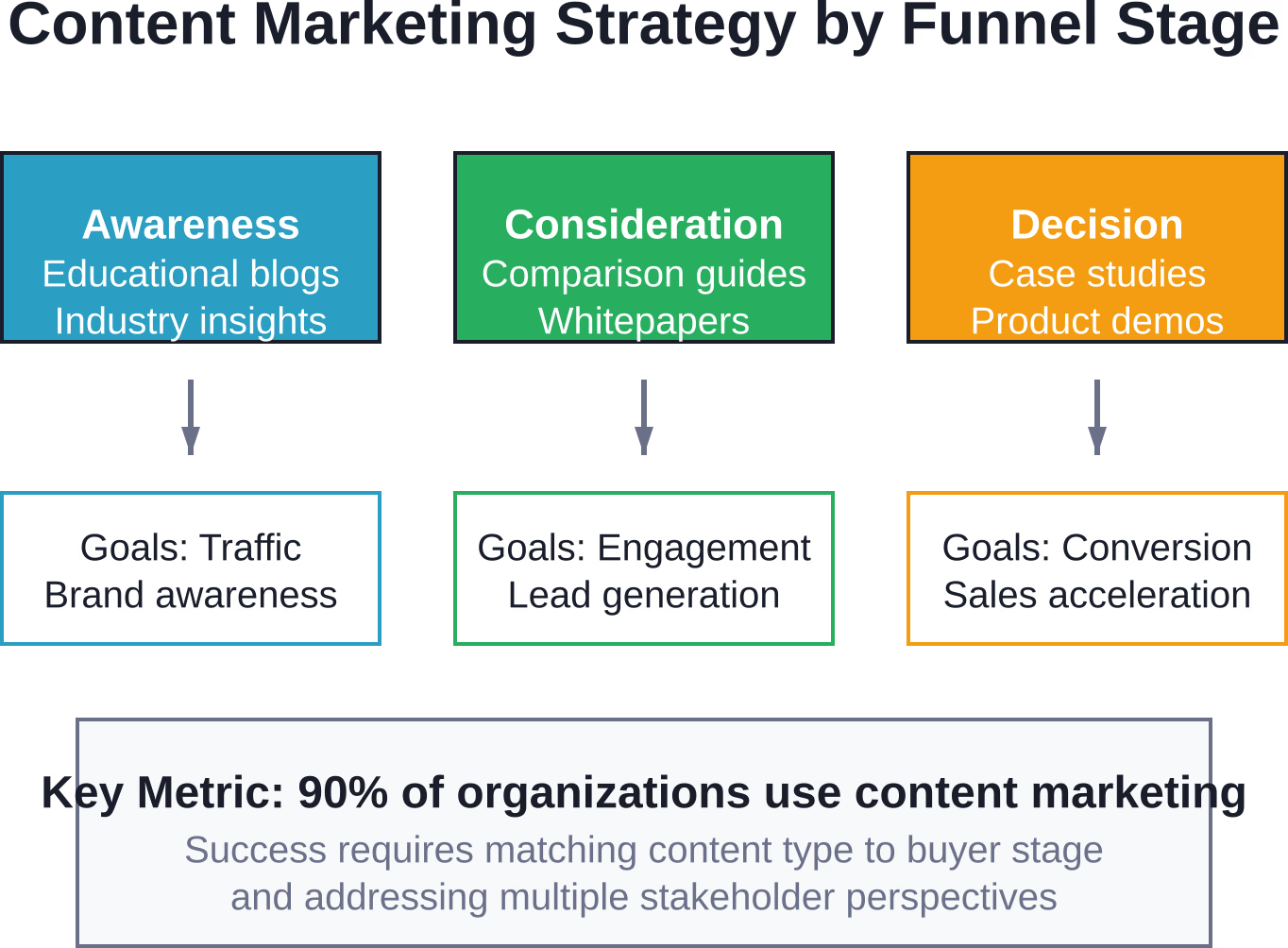
Real talk: With 90% of organizations utilizing content marketing and 80% of consumers preferring custom content over generic advertising. For technology companies specifically, the challenge intensifies because Approximately 68% of tech content marketers overall say they struggle to create content that appeals to multiple roles in the buying process.
Technology purchases represent significant investments. The average B2B tech buying cycle involves six to ten stakeholders, each with different priorities, technical knowledge, and concerns.
A CFO cares about ROI and total cost of ownership. A CTO evaluates architecture and integration complexity. End users worry about usability and workflow disruption. Security teams scrutinize compliance and vulnerability management.
Traditional marketing funnels assume a linear journey: awareness → consideration → decision. But tech buying doesn't work that way anymore.
Prospects research independently. They consume content across multiple channels before ever contacting sales. By the time they request a demo, they've already formed strong opinions based on what they've found—or haven't found—about your company online.
And if your marketing hasn't addressed their specific role, pain points, and technical requirements? They've likely moved on to a competitor who did.
Technology content marketing remains the most consequential factor in a tech company's success, with 62% of purchases starting with online browsing.
But what makes technology content different?
It requires balancing technical depth with accessibility. Going too technical alienates business stakeholders. Going too simple loses credibility with technical evaluators.
Blog posts serve multiple functions for tech companies. They improve search engine visibility, demonstrate expertise, and provide value before asking for anything in return.
The most effective technology blogs focus on solving specific problems rather than promoting products. They answer the questions prospects type into search engines at 2 AM when they're trying to solve a critical issue.
Think troubleshooting guides, architectural comparisons, integration tutorials, and performance optimization techniques. These attract qualified traffic because they target people actively seeking solutions.
Most of the population are visual learners. That means incorporating diagrams, screenshots, and visual explanations dramatically increases content effectiveness.
Longer-form content serves different purposes. Whitepapers establish thought leadership on complex topics. They're often required reading for technical evaluators who need to justify recommendations to their teams.
These documents should dive deep into technical specifications, performance benchmarks, security architectures, and compliance frameworks. Don't shy away from complexity here—this audience expects and values technical rigor.
Case studies prove that your solution works in real-world scenarios. They're especially powerful when they feature companies similar to your prospects in size, industry, or technical requirements.
Video marketing has become essential for technology companies. Demonstrations, tutorials, customer testimonials, and explainer videos humanize complex topics in ways text cannot.
Video serves particularly well for:
The key is matching video content to buyer journey stages. Top-of-funnel videos introduce concepts and build awareness. Middle-funnel content compares approaches and explores use cases. Bottom-funnel videos address specific implementation questions and objections.
Social media for tech companies looks different than B2C social strategies. The platforms, content types, and engagement patterns all shift.
LinkedIn dominates B2B technology marketing. Twitter serves as a real-time thought leadership and industry news platform. Other networks play supporting roles at best.
LinkedIn isn't optional for technology companies—it's where B2B buying research happens. Decision-makers spend time on LinkedIn consuming content, researching vendors, and evaluating thought leaders.
The platform works for tech companies because it allows targeting by job title, company size, industry, and technology stack. Content can reach exactly the personas involved in buying decisions.
Effective LinkedIn strategies include:
The key is consistency and value. Posting sporadically or only promoting products kills engagement. Regular insights, industry analysis, and helpful content builds audiences that actually pay attention when product announcements do occur.
A significant majority of B2B companies use Twitter for marketing. The platform excels at real-time conversations, industry news sharing, and building relationships with influencers and analysts.
Twitter serves tech companies well for:
But wait. Twitter requires active monitoring and quick response times. It's not a broadcast channel—it's a conversation platform. Companies that treat it like a press release distribution service miss the point entirely.
Email delivers strong ROI among marketing channels—making it one of the highest-returning marketing channels available.
For technology companies, email serves multiple critical functions throughout extended buying cycles. It nurtures leads who aren't ready to buy. It educates prospects about complex technical concepts. It maintains relationships with customers to drive retention and expansion.
Generic email blasts don't work for B2B technology marketing. The CFO doesn't care about API architecture. The developer doesn't want to read about TCO models.
Effective email segmentation divides lists by:
This allows sending relevant content that speaks directly to each recipient's concerns, technical level, and decision-making authority.
Long buying cycles require long nurture sequences. Educational drip campaigns keep prospects engaged over weeks or months by delivering consistent value.
These campaigns work best when they follow a logical learning progression. Start with foundational concepts. Build toward more advanced topics. Include case studies and social proof as prospects move closer to decision-making.
The content should be genuinely helpful—guides, checklists, best practices, industry research. Save the hard sales pitches for when prospects indicate buying intent through behavior like pricing page visits or demo requests.
SEO drives compound returns over time. Unlike paid advertising that stops delivering when spending stops, organic search traffic continues generating leads from content published months or years ago.
Technology companies have inherent SEO advantages. Technical teams can implement advanced optimizations. Complex products create opportunities for extensive content. High transaction values justify investment in comprehensive SEO programs.
Site architecture, page speed, mobile optimization, and crawlability form the foundation. These technical factors determine whether search engines can effectively index and rank content.
Technical teams at technology companies often understand these requirements better than marketing teams at other organizations. That technical fluency translates to cleaner implementations and fewer fundamental issues.
Key technical SEO priorities include:
Keyword research for B2B technology differs from consumer SEO. Search volumes appear lower because markets are more specialized. But the value of each conversion dramatically increases.
The focus should shift from high-volume keywords to high-intent queries. Someone searching "enterprise data warehouse comparison" has infinitely more buying intent than someone searching "what is a database."
Content should match search intent precisely. Informational queries need educational content. Comparison queries need detailed vendor evaluations. Implementation queries need technical documentation.
Technology ecosystems thrive on partnerships. Integration partners, resellers, technology alliances, and consulting partners all extend market reach.
Partner marketing amplifies messages, creates integrated solutions, and builds credibility through association with established brands.
Integration partnerships create natural co-marketing opportunities. When two technologies work together to solve larger problems, joint marketing benefits both parties.
Co-marketing tactics include:
The key is ensuring genuine value. Forced partnerships that don't serve customer needs damage credibility rather than building it.
Resellers and channel partners need marketing support to effectively sell solutions. Partner enablement programs provide the tools, training, and content partners need to generate demand.
This includes customizable marketing materials, sales decks, demo environments, training resources, and lead generation support. The easier it is for partners to market and sell, the more they'll prioritize promoting the solution.
When target customer counts are limited and deal sizes are substantial, account-based marketing makes strategic sense.
ABM flips traditional funnel logic. Instead of generating broad awareness and filtering down, it starts with specific target accounts and creates personalized engagement programs for each.
ABM starts with identifying which accounts represent the highest potential value. This typically involves sales collaboration to identify accounts with strong fit, buying potential, and strategic importance.
Selection criteria include company size, industry vertical, technology stack, budget indicators, growth trajectory, and organizational structure. The goal is creating a focused list of accounts that justify personalized marketing investment.
Once target accounts are identified, marketing creates customized campaigns addressing each account's specific situation, challenges, and stakeholders.
This might include:
The investment per account increases dramatically. But so does the conversion rate and deal size when done effectively.
Acquiring new customers costs five to seven times more than retaining existing ones. For technology companies with subscription models, customer lifetime value depends entirely on retention and expansion.
Customer marketing focuses on existing accounts—driving adoption, preventing churn, expanding usage, and creating advocates.
Online communities create spaces where customers help each other, share best practices, and build expertise. These communities reduce support costs while increasing customer engagement and satisfaction.
Successful community programs provide genuine value. They're not promotional channels disguised as communities. They're places where users find answers, share creative solutions, and connect with peers facing similar challenges.
Happy customers become powerful marketing assets. Case studies, testimonials, reference calls, and speaking opportunities all leverage customer success to build credibility with prospects.
Formal advocacy programs identify satisfied customers willing to participate in marketing activities. They're often incentivized through recognition, early access to features, or executive engagement rather than financial compensation.
According to research, firms that engage in co-creation claim a 20% increase in consumer satisfaction and loyalty. That engagement creates stronger relationships while generating valuable marketing content.
Events create high-bandwidth interactions impossible through digital channels alone. They accelerate relationships, demonstrate products hands-on, and create memorable experiences.
Major industry conferences attract concentrated audiences of prospects, customers, partners, and industry influencers. Strategic conference participation builds brand visibility and generates qualified leads.
Tactics range from simple booth presence to premium sponsorships with keynote speaking slots. The investment varies dramatically based on event tier and participation level.
The key is maximizing ROI through preparation. Pre-event outreach schedules meetings with target accounts. At-event execution focuses on qualified conversations rather than collecting massive badge scans. Post-event follow-up converts conversations into pipeline.
Hosting proprietary events creates controlled environments optimized for specific goals. User conferences strengthen customer relationships. Prospect events generate qualified pipelines in specific markets.
These require substantial investment but create unique positioning opportunities. The company controls messaging, content, and experience rather than competing for attention in crowded conference halls.
AI is reshaping how technology companies execute marketing strategies. A minority of marketers currently rely on AI across marketing functions—but that percentage is climbing rapidly as tools mature and results prove themselves.
Personalization drives results—but many marketers struggle with personalization implementation. AI addresses this challenge by analyzing behavior patterns and automatically customizing content, timing, and channel selection.
Applications include:
However, data transparency remains critical. 45% of consumers cite visibility and control over their data as a top priority when engaging with brands. Technology companies must balance personalization benefits with clear data governance and opt-in controls.
Marketing automation platforms orchestrate multi-touch campaigns across channels and time. They're essential for managing the lengthy, non-linear buying journeys typical in B2B technology.
Automation handles lead nurturing, scoring, segmentation, and handoff to sales. It ensures no prospect falls through cracks during months-long evaluation processes.
But wait. Automation requires substantial upfront strategy work. Poorly planned automation creates negative experiences—irrelevant messages, awkward timing, obvious template errors. Technology amplifies strategy, whether good or bad.

Technology companies often test multiple positioning angles, product messages, and audience segments at the same time, but weak campaigns can absorb serious budgets before sales teams even see clear pipeline signals. Extuitive predicts real-world ad performance before launch using AI models validated against live campaign results, giving marketing teams earlier visibility into which creatives are more likely to drive engagement and stronger CTR or ROAS outcomes.
Extuitive is designed to help marketing teams:
👉Book a demo with Extuitive and evaluate tech campaign performance before launching ads.
What gets measured gets managed. But measuring technology marketing effectiveness requires moving beyond vanity metrics to business impact.
Marketing exists to generate revenue. All metrics ultimately roll up to pipeline contribution and revenue attribution.
This requires tracking leads through the entire funnel—from initial touch through closed deal. Multi-touch attribution models credit marketing activities that influence opportunities rather than only measuring first or last touch.
For technology companies with long sales cycles, pipeline acceleration matters as much as pipeline generation. Marketing that shortens sales cycles by providing better education and proof points delivers substantial value even when attribution is ambiguous.
Content performance indicators show what's resonating and what's not. These metrics inform content strategy iterations and resource allocation.
Key metrics include:
The goal is connecting content performance to downstream outcomes. Which content types generate the highest-quality leads? Which pieces most effectively move opportunities through stages?
Certain mistakes appear repeatedly across technology company marketing programs. Recognizing these patterns helps avoid them.
Technology companies love talking about features, specifications, and technical capabilities. Engineers build features, so marketing highlights them.
But prospects don't buy features. They buy outcomes.
A CTO doesn't want "distributed microservices architecture with container orchestration." They want "applications that scale without downtime during traffic spikes."
The shift from feature-focused to outcome-focused messaging requires discipline. It means leading with business value and supporting with technical capabilities, not the reverse.
That 68% of tech content marketers struggle to create content for multiple roles? That struggle manifests as content that speaks to one persona while ignoring others.
Marketing that only addresses technical evaluators loses when business stakeholders can't justify the investment. Marketing that only speaks to executives fails when technical teams can't implement or support the solution.
Effective technology marketing creates content for each buying committee member—then makes it easy for them to find the content relevant to their concerns.
Content marketing requires consistency. Sporadic blogging or intermittent social media presence doesn't build audiences or search authority.
Technology companies often start strong then fade as product development demands attention. The marketing blog goes quiet for months. The LinkedIn page stops updating.
That inconsistency signals lack of commitment. It also wastes the compound returns that consistent content marketing generates over time. Search authority builds gradually. Audiences grow through regular valuable content, not occasional promotional bursts.

The marketing landscape continues evolving. Several trends are reshaping how technology companies approach their marketing strategies.
Product-led growth flips traditional enterprise sales models. Instead of demos followed by lengthy sales cycles, prospects can start using the product immediately through free tiers or trials.
Marketing's role shifts when the product itself drives acquisition. Content focuses on onboarding, activation, and expansion rather than generating sales conversations. The product experience becomes the primary marketing asset.
This model works particularly well for developer tools, SaaS applications, and infrastructure services where prospects can evaluate functionality hands-on before committing a budget.
Developer communities, user groups, and practitioner networks increasingly influence technology buying decisions. Grassroots advocacy from actual users carries more weight than vendor marketing.
Technology companies invest in community building not as marketing tactics but as genuine value creation. They sponsor meetups, support open-source projects, create educational resources, and facilitate peer connections.
The marketing return comes indirectly—through brand affinity, word-of-mouth, and organic advocacy rather than directly attributable conversions.
Static content faces increasing competition from interactive experiences. Calculators, assessments, interactive demos, and configurators engage prospects more deeply than white papers.
These tools provide immediate personalized value while generating useful data about prospect needs and priorities. They demonstrate product capabilities in ways that text descriptions cannot.
The investment in creating these experiences exceeds traditional content production costs. But the engagement and conversion rates often justify the additional resources.
Marketing execution requires tools. The marketing technology stack has expanded dramatically, creating both opportunities and complexity.
Core platform categories include:
The challenge isn't finding tools—it's integrating them into coherent workflows. Organizations often struggle with disconnected or incomplete customer data. That fragmentation creates blind spots and inefficiencies.
Marketing effectiveness depends on data flowing between systems. Leads captured in marketing automation need to sync to CRM. Website behavior should inform email personalization. Advertising platforms need audience data for targeting.
Integration architecture matters as much as individual tool selection. APIs, webhooks, and integration platforms connect systems and enable unified customer views.
But wait. More tools don't automatically mean better results. Technology enables strategy—it doesn't replace it. Starting with strategy then selecting tools that support it beats collecting tools then trying to figure out how to use them.
Technology marketing succeeds when it educates rather than promotes, when it serves multiple stakeholders rather than single decision-makers, and when it maintains consistency rather than sporadic bursts of activity.
The strategies outlined here—content marketing, SEO, social engagement, email nurture, partner collaboration, customer advocacy, and AI-powered personalization—work together as integrated systems rather than isolated tactics.
Look, the technology landscape evolves constantly. New platforms emerge. Buyer behaviors shift. Competitive dynamics change. Marketing strategies must adapt accordingly.
But the fundamentals remain constant: understand the audience deeply, provide genuine value before asking for anything, address concerns at each buying stage, and measure what actually matters to business outcomes.
The companies that invest in marketing as a strategic growth driver rather than a cost center position themselves to capture market share as their industries evolve. The question isn't whether to invest in marketing—it's how to invest most effectively given specific market positions, growth stages, and competitive contexts.
Technology creates unprecedented opportunities for companies that market as effectively as they engineer. The tools, channels, and strategies exist. The execution determines who wins.


