The Best Wholesale Apps for Shopify Right Now
Tired of clunky setups? Here are the top wholesale apps for Shopify that make pricing tiers and B2B orders feel effortless—tested by real store owners.
Mar 24, 2026



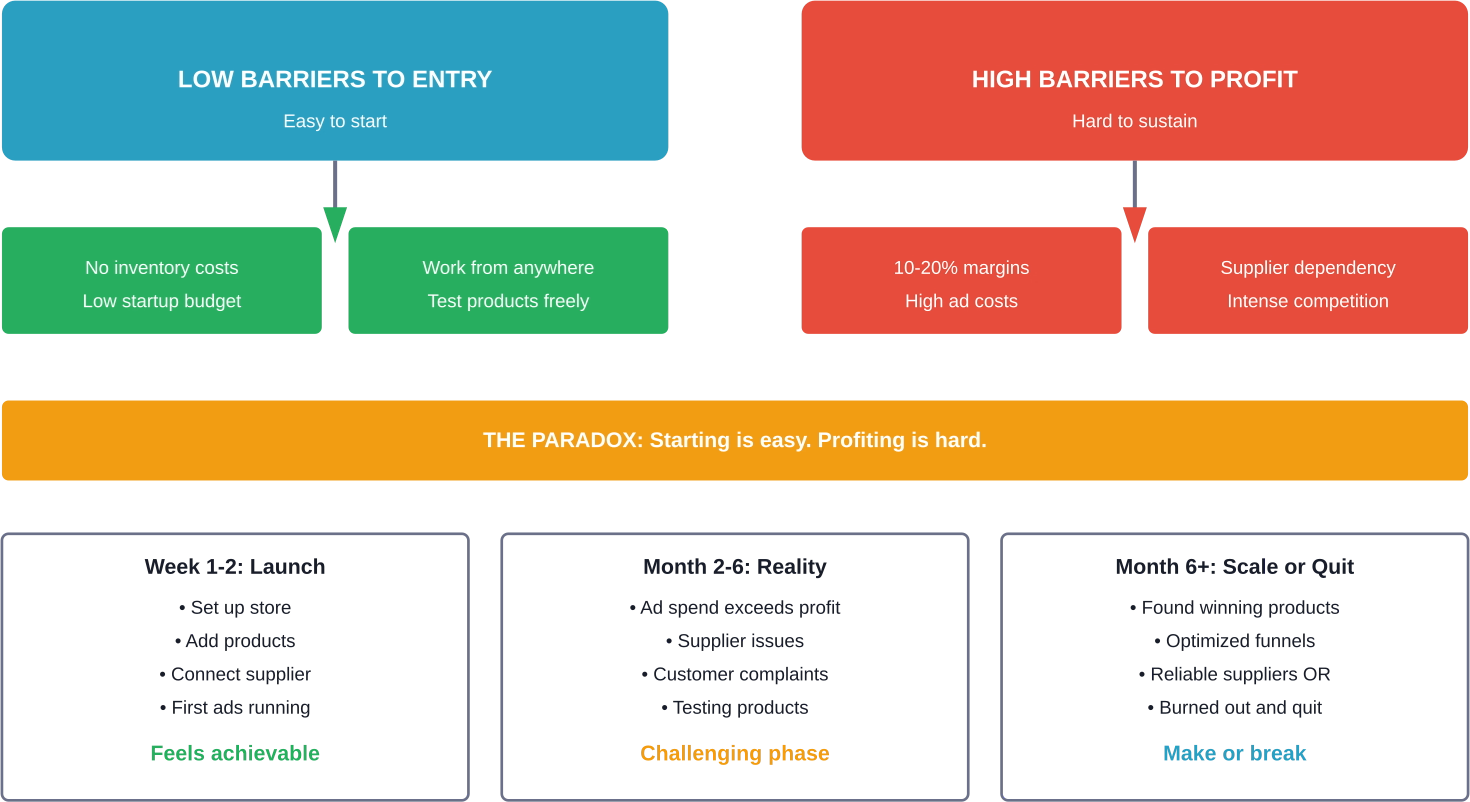
Dropshipping isn't inherently easy—it eliminates inventory management but introduces challenges like low profit margins (typically 10-20%), fierce competition, supplier dependency, and significant marketing costs. Success requires strategic product selection, reliable supplier vetting, and persistent optimization rather than passive income generation.
Scroll through YouTube or Instagram, and the message seems clear: dropshipping is your ticket to easy money. Work from your laptop, never touch inventory, and watch profits roll in while automating everything.
But here's the thing—that narrative leaves out some critical realities.
Dropshipping does simplify certain aspects of ecommerce. No warehouse costs. No upfront inventory purchases. The ability to test products without financial risk. These advantages are legitimate and have enabled countless entrepreneurs to build successful online stores.
Yet the Federal Trade Commission has taken repeated action against dropshipping-related scams, including schemes that promised consumers big profits from selling online. In October 2024, the FTC temporarily shut down operations. The FTC has also taken action against similar schemes that cost consumers millions through business opportunity scams. These enforcement actions highlight a crucial truth: the gap between marketing promises and operational reality is vast.
So what's the honest answer? Dropshipping is strategically accessible but operationally demanding. The barriers to entry are low, but the barriers to profitability are substantial.

Dropshipping may sound easy, but ad decisions still affect how much budget gets wasted. Extuitive helps teams predict ad performance before launch, compare ad concepts, and see which ideas look more promising before money is spent on live campaigns.
Talk with Extuitive to:
👉 Book a demo with Extuitive to review ad concepts before launch.
The appeal isn't entirely manufactured. Dropshipping genuinely removes several traditional retail obstacles that have historically prevented people from starting ecommerce businesses.
Traditional retail demands capital. Purchase inventory upfront, store it somewhere, and hope it sells before trends shift or products expire. Dropshipping eliminates this entirely.
The supplier holds inventory. When someone orders from the store, the retailer forwards that order to the supplier, who ships directly to the customer. Cash flow pressure drops dramatically compared to models requiring thousands in inventory purchases before making a single sale.
Starting a dropshipping business can cost as little as the price of a domain name and platform subscription. No warehouse lease. No storage units. No insurance for physical inventory.
Many entrepreneurs launch dropshipping stores with modest initial investments—covering platform fees, a domain, and some initial marketing budget. That's exponentially less than brick-and-mortar retail or even traditional ecommerce with inventory.
Manage everything remotely. No physical store ties entrepreneurs to specific geographic locations. As long as there's internet access, the business runs from anywhere.
This flexibility attracts digital nomads and people seeking alternative income streams without quitting day jobs. The operational model genuinely supports remote management in ways traditional retail never could.
Test products without financial commitment. If a product doesn't sell, remove it from the store. No dead inventory sitting in a garage.
This enables rapid iteration. Entrepreneurs can experiment with different niches, products, and marketing angles without the sunk costs that would make such experimentation prohibitively expensive in traditional models.
Now the other side. These challenges aren't impossible to overcome, but they're frequently downplayed or ignored in promotional content about dropshipping.
Here's where the math gets uncomfortable. Dropshipping profit margins are typically around 20% or lower. But that 20% is before marketing costs, platform fees, payment processing, and the inevitable customer service expenses.
The wholesale price already accounts for the supplier's handling, storage, and fulfillment. That leaves less room for markup compared to buying inventory in bulk. When advertising costs consume significant portions of revenue (often 15-30% in competitive niches), actual net profit can shrink to single digits.
Many beginners discover that making $10,000 in revenue doesn't translate to $10,000 in profit. After all expenses, they're left with a fraction of that headline number.
Control over fulfillment is surrendered. If the supplier ships late, sends the wrong product, or delivers poor quality items, the customer blames the store—not the supplier.
This dependency becomes especially problematic at scale. One bad supplier can destroy customer trust and generate chargebacks that threaten payment processor relationships. Academic research on dropshipping highlights that supply chain management remains one of the most significant operational challenges for dropshippers.
Vetting suppliers requires due diligence. Ordering samples, testing shipping times, and monitoring quality aren't optional steps—they're essential protections against reputational damage.
Low barriers to entry mean everyone can start a dropshipping store. That includes thousands of other entrepreneurs targeting the same products, often from the same suppliers, sometimes using identical product images.
Standing out requires significant investment in branding, content, advertising, or unique value propositions. Simply listing products on a store and hoping for organic traffic rarely works in 2026. The market has matured past that point.
Community discussions repeatedly emphasize that product research and niche selection determine success more than any other factor. Finding underserved markets—like eBike Generation's founder did by targeting hunters specifically—requires creativity and market knowledge.
Organic traffic is rare. Most dropshipping stores rely heavily on paid advertising—Facebook Ads, Google Ads, TikTok, Instagram. These platforms are pay-to-play environments where cost-per-click rises annually.
Testing ad campaigns requires budget. Finding profitable ad combinations takes experimentation. Many beginners spend considerable amounts on advertising testing before achieving their first sale.
Then there's the customer acquisition cost calculation. If acquiring one customer costs $30 in ads, and average order value is $50 with typical 20% margins, the net is negative $20 per customer. Relying on repeat purchases or upsells becomes mandatory—but dropshipping stores often struggle with customer retention because they lack brand differentiation.
When things go wrong (and they will), the store owner handles complaints. Packages arrive late. Products don't match descriptions. Items break during shipping.
Managing customer expectations without control over fulfillment creates constant friction. Refunds, replacements, and damage control consume time and erode margins. Some platforms report that customer service issues cause more dropshipping failures than product selection problems.
Academic research identifies common reasons dropshippers fail, including lack of market research, inadequate supplier vetting, and unrealistic profit expectations. Several themes emerge consistently.
Choosing products based on personal preference rather than market demand leads to failure. So does selecting oversaturated products where established competitors dominate search results and advertising channels.
Successful product research involves analyzing trends, identifying gaps in existing markets, and evaluating competition levels. Tools exist to assist with this, but the strategic thinking can't be automated.
Working with unreliable suppliers destroys customer satisfaction faster than any other mistake. Late shipments, poor packaging, and inconsistent quality generate negative reviews that permanently damage store reputations.
Proper vetting means ordering samples, testing communication responsiveness, verifying shipping times, and checking business legitimacy. Skipping these steps to launch faster almost always backfires.
Marketing materials showcase revenue, not profit. That $10,000 monthly revenue store might net $800 after all expenses.
Beginners who expect passive income within weeks become discouraged when reality involves constant optimization, testing, and problem-solving. The business model requires active management despite the hands-off inventory advantages.
Building a store is straightforward. Driving traffic profitably is advanced. Many entrepreneurs underestimate the skills required for effective digital marketing.
Conversion rate optimization, ad copywriting, audience targeting, retargeting strategies, email marketing—these aren't optional nice-to-haves. They're core competencies that separate successful stores from abandoned domains.
The timeline for profitability is longer than promoted. The timeline for achieving consistent profitability is typically 6-12 months for successful dropshippers.
Testing products, refining marketing, optimizing conversion rates, and building customer bases takes time. Entrepreneurs who quit after one or two failed product tests never reach the learning threshold where pattern recognition enables better decisions.
Dropshipping isn't a guaranteed path to failure either. Businesses generating seven figures exist. But they follow specific strategies that differentiate them from the majority of failed attempts.
General stores selling random trending products struggle against Amazon and established retailers. Niche stores targeting specific audiences build authority and brand recognition.
The eBike Generation example illustrates niche specialization. According to competitor source material, founder John Murphy used keyword research to build a $3 million company by identifying hunters as an underserved segment within the ebike market. That specificity enabled targeted marketing, relevant content creation, and product curation that resonated with the audience.
Finding underserved niches requires research but provides competitive insulation that general approaches lack.
Successful dropshipping businesses don't feel like dropshipping stores. They invest in branding—unique product photography, custom packaging inserts, branded domain names, content marketing, and social proof.
This brand building creates customer loyalty and justifies higher prices. Competing on price alone with identical products from the same suppliers is a race to the bottom. Brand differentiation escapes that trap.
Professionals order from multiple suppliers before committing. They test shipping times, evaluate packaging quality, assess communication responsiveness, and verify business legitimacy.
Building relationships with reliable suppliers—even if their prices are slightly higher—pays dividends through consistent quality and fulfillment. The marginal cost difference is negligible compared to the customer satisfaction benefits.
Some successful dropshippers eventually transition to hybrid models, keeping fast-moving items in their own inventory while dropshipping slower products. This balance provides control over popular items while maintaining the flexibility of dropshipping.
Attempting Facebook, Instagram, Google, TikTok, and Pinterest ads simultaneously spreads attention too thin. Each platform has unique audience behaviors, ad formats, and optimization strategies.
Focusing on one channel until achieving profitability there builds both skills and cash flow. That foundation then supports expansion into additional channels with lower risk.
The entrepreneurs who succeed approach dropshipping with business fundamentals: market research, financial planning, competitive analysis, customer service systems, and continuous optimization.
Those who treat it as passive income inevitably discover it demands active management. Setting realistic expectations about time investment and profit timelines prevents the disillusionment that causes premature abandonment.
The question comes up frequently: can dropshipping start with zero investment?
Technically, yes. Free platforms exist. Some suppliers don't require upfront fees. Domain names cost $10-15. But practical reality complicates that narrative.
Several platforms offer free tiers for dropshipping stores. These work for testing concepts but impose restrictions: limited products, branded domains, reduced features, or transaction fees that exceed subscription costs at scale.
Professional stores eventually migrate to paid plans because the limitations hinder growth. Starting free is possible, but treating it as a permanent solution creates competitive disadvantages.
Even with a free platform, driving traffic costs money. Organic social media can generate some visitors, but meaningful sales volume typically requires paid advertising.
Community discussions reveal that most entrepreneurs who start with truly zero budget spend months generating their first sales—if they persist that long. Those who allocate even modest advertising budgets ($200-500) see faster feedback loops and learning.
Rather than pursuing absolute zero cost, starting with $300-500 provides enough runway for platform fees, a domain, some product samples, and minimal ad testing. That small investment dramatically improves odds of reaching profitability before capital depletion or motivation loss.
The Small Business Administration's resources, including Small Business Development Centers and microloans, provide guidance and potential funding for entrepreneurs who qualify and approach dropshipping as legitimate business ventures rather than get-rich-quick schemes.
The FTC has taken multiple enforcement actions against business opportunity scams related to dropshipping and online selling
Several warning signs indicate potential scams:
Due diligence protects against scams. Research companies thoroughly, check FTC records for complaints, verify business legitimacy, and start with minimal financial commitment until proving concepts work.
The FTC maintains ReportFraud.ftc.gov for filing complaints about suspected scams. Reporting helps law enforcement agencies identify patterns and take action against fraudulent operators.
Success in dropshipping correlates more with skill development than initial capital or platform choice.
Understanding ad platforms, audience targeting, conversion optimization, and analytics interpretation separates profitable stores from failed attempts. These skills develop through practice, testing, and continuous learning.
Many successful dropshippers invest heavily in education—courses, communities, mentorship—not because the information is secret, but because structured learning accelerates the trial-and-error process.
Tracking true profitability requires understanding cost structures: product costs, shipping, platform fees, payment processing, advertising spend, refunds, and chargebacks.
Beginners frequently conflate revenue with profit, leading to unsustainable spending. Maintaining detailed financial records and calculating accurate margins determines whether the business generates actual income or just activity.
Effective product pages, compelling copy, trust signals, and conversion optimization all stem from understanding what motivates purchases and reduces friction.
This isn't about manipulation—it's about communication. Clearly articulating value, addressing objections, and building trust through social proof and guarantees directly impacts conversion rates and customer satisfaction.
Perhaps the most critical skill is persistence through setbacks. First products fail. Initial ad campaigns lose money. Suppliers disappoint. Technical issues arise.
Entrepreneurs who view these as learning opportunities rather than failures eventually accumulate the pattern recognition and problem-solving experience that enables success. Those who expect smooth sailing quit at the first obstacle.
Despite challenges, dropshipping remains viable for specific situations and approaches.
Established ecommerce businesses use dropshipping strategically—testing new products without inventory risk, then transitioning popular items to owned inventory for better margins.
This hybrid approach combines dropshipping's flexibility with traditional ecommerce's profitability. It's not an either-or decision but a strategic tool for product validation.
Small, specialized markets often can't support traditional retail's inventory requirements. Dropshipping enables serving these niches profitably because the inventory breadth comes from suppliers rather than upfront purchases.
The hunter-focused ebike example demonstrates this perfectly. The niche was too small for general retailers but perfect for specialized dropshipping.
For digital nomads or people prioritizing geographic flexibility, dropshipping's remote management capability provides genuine value. The income may require active effort, but the location independence is real.
Dropshipping offers a low-risk education in ecommerce fundamentals: store design, product presentation, digital marketing, customer service, and financial management.
Even if the initial dropshipping venture doesn't generate substantial income, the skills developed transfer to other business opportunities. Viewing it as paid education rather than guaranteed income creates appropriate expectations.
So is dropshipping easy? The answer depends entirely on what aspect we're discussing.
Setting up a store is easy. Adding products is easy. Launching is easy.
But finding profitable products, vetting reliable suppliers, mastering digital marketing, achieving positive unit economics, and scaling sustainably—those are decidedly not easy.
Dropshipping removes inventory barriers and lowers startup costs. That accessibility is valuable and legitimate. But it doesn't eliminate the fundamental challenges of building a profitable ecommerce business: understanding markets, reaching customers cost-effectively, and delivering value consistently.
The entrepreneurs who succeed approach dropshipping strategically rather than opportunistically. They invest time in market research, budget for learning through testing, build actual brands rather than product aggregators, and persist through the 6-12 month learning curve where most fail.
They recognize that low barriers to entry don't guarantee profitability—they guarantee competition. And they understand that the business model eliminates certain challenges while introducing others.
For people willing to develop marketing skills, commit to systematic testing, and treat dropshipping as a business requiring active management, the model offers genuine opportunities. The $3 million ebike company proves that niche focus and strategic execution can build substantial businesses using dropshipping infrastructure.
For those expecting passive income or quick money with minimal effort, dropshipping will almost certainly disappoint. The gap between that expectation and operational reality explains why the FTC continues shutting down scams that promise guaranteed returns.
The tools are accessible. The information is available. Success requires work, strategic thinking, financial literacy, and persistence—qualities that determine business outcomes regardless of the specific model.
If that sounds appealing, dropshipping offers a low-risk entry point to ecommerce with real potential. If it sounds like more effort than expected, that honest assessment saves time, money, and frustration that chasing unrealistic promises would have consumed.
The choice isn't whether dropshipping works—it demonstrably does for people approaching it correctly. The choice is whether the effort required aligns with personal goals, available time, and willingness to develop the skills that differentiate successful stores from abandoned domains.
That's the truth about dropshipping in 2026. Not a magic formula. Not a scam. Just a business model with specific advantages, specific challenges, and outcomes that correlate strongly with strategic execution and persistent effort.


