Top Open Source AI Agents: Tools People Actually Use
Explore open source AI agents, how they work, real use cases, and practical ways to start building with them today.
Apr 10, 2026



AI will not completely replace real estate agents, but it will transform the industry significantly. While AI can automate routine tasks like lead generation and data analysis, the human elements of negotiation, emotional intelligence, local expertise, and relationship-building remain irreplaceable. The future belongs to agents who embrace AI as a tool to enhance their service rather than compete against it.
The question keeps real estate professionals up at night: will artificial intelligence eventually make them obsolete?
It's a legitimate concern. AI has already disrupted industries from manufacturing to customer service. Real estate appears vulnerable with its data-heavy processes, repetitive administrative tasks, and commission-based structure that some consider inefficient.
But here's the thing though—the relationship between AI and real estate agents isn't as simple as replacement. It's more nuanced than that.
AI tools have already infiltrated real estate operations. Algorithms now generate property valuations, chatbots answer basic inquiries, and machine learning predicts market trends with increasing accuracy.
According to the National Association of REALTORS®, technology continues to transform how professionals conduct business. AI-powered platforms can scan thousands of listings instantly, match buyers with properties based on preferences, and even schedule showings without human intervention.
Research from Northeastern University shows that AI leasing agents like HouseFly are already handling routine questions from renters. The team behind the platform noted that 95% of inquiries don't result in closed leases—precisely the type of inefficiency AI excels at addressing.
Real talk: these tools are impressive. They save time, reduce costs, and handle volume that would overwhelm any human agent.
Let's cut through the noise and identify where AI genuinely threatens traditional agent responsibilities.
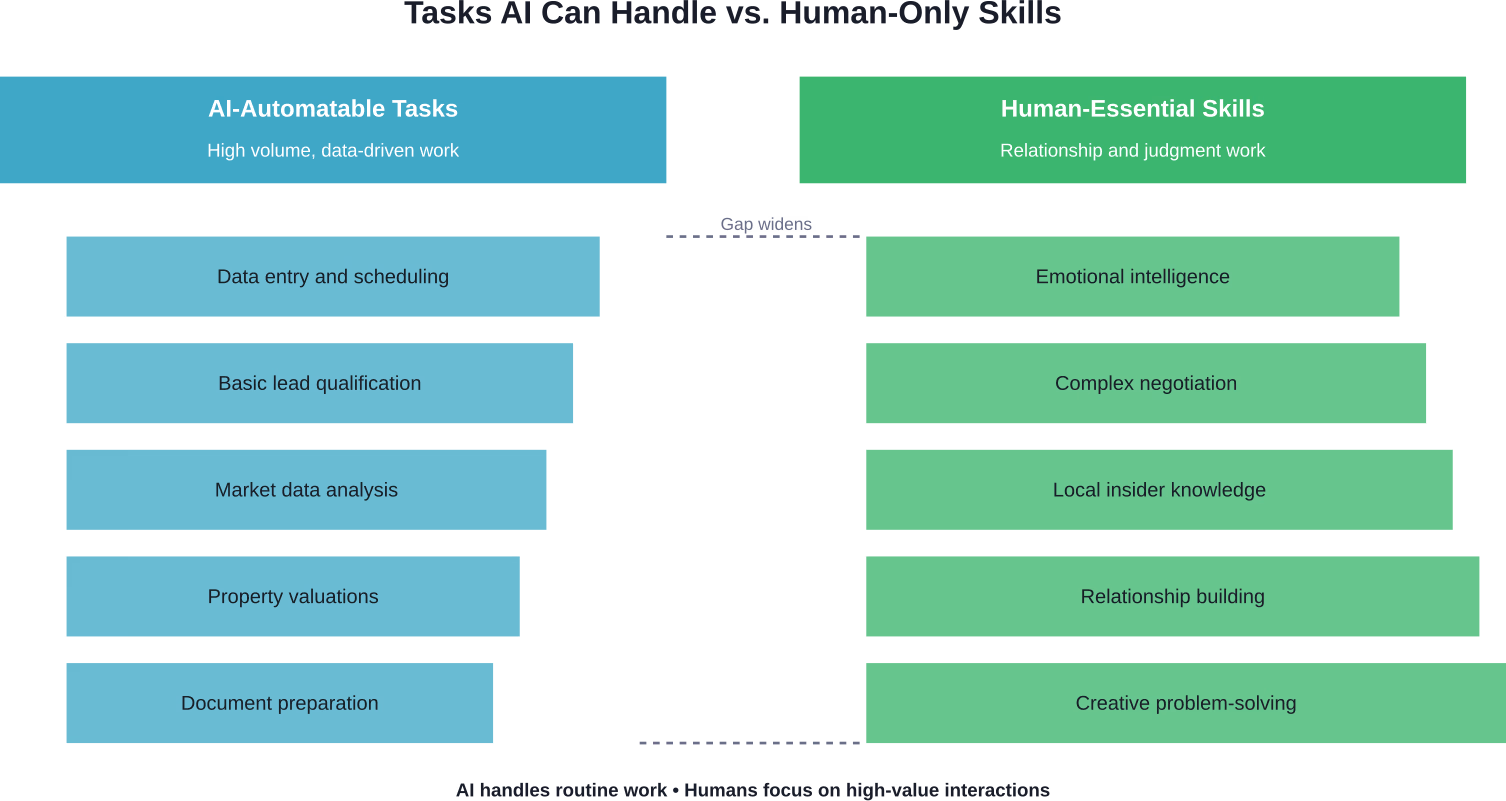
AI crushes repetitive work. Data entry, document preparation, appointment scheduling, and follow-up emails—all automatable. These tasks consume hours but generate zero revenue.
Agents who spend most of their time on paperwork rather than client relationships? They're vulnerable.
AI chatbots can engage website visitors 24/7, asking qualifying questions and filtering serious buyers from casual browsers. This technology handles hundreds of simultaneous conversations without fatigue or frustration.
The basic information gathering that once required phone calls now happens automatically before an agent ever gets involved.
Algorithms analyze comparable sales, market trends, and property characteristics faster than any human. Automated valuation models (AVMs) provide instant price estimates based on massive datasets.
For straightforward properties in stable markets, these estimates often match professional appraisals closely.
Now, this is where it gets interesting. Despite AI's capabilities, several critical aspects of real estate transactions resist automation.
Buying or selling a home ranks among life's most stressful decisions. Clients need empathy, reassurance, and someone who understands unspoken concerns.
An AI can't read body language during a showing. It can't sense when a buyer feels pressured or when a seller's asking price reflects emotional attachment rather than market reality.
These psychological dimensions require human intuition that current AI fundamentally lacks.
Real estate deals rarely proceed smoothly. Inspection issues emerge, financing falls through, appraisals come in low, or sellers get cold feet.
Navigating these obstacles requires creativity, relationship management, and the ability to craft solutions that satisfy multiple parties with competing interests. AI operates within programmed parameters—it can't improvise when situations become messy.
The best agents excel at finding middle ground that algorithms wouldn't even recognize as possible.
AI accesses public data about neighborhoods—crime statistics, school ratings, average home prices. But it can't tell buyers which streets flood during heavy rain, which neighbors are planning to sell, or that the elementary school rating doesn't reflect its new principal's improvements.
This hyperlocal intelligence comes from years of working in an area. It's accumulated through relationships, conversations, and direct observation—not datasets.
Real estate transactions involve hundreds of thousands of dollars and life-changing decisions. People want a trusted advisor, not a chatbot.
The relationship between agent and client often extends beyond a single transaction. Satisfied clients return for future deals and refer friends and family. This relationship-based business model doesn't translate to AI interactions.
The U.S. Bureau of Labor Statistics projects total employment to grow from 170.0 million in 2024 to 175.2 million in 2034, an increase of 3.1 percent. This slower growth reflects technological impacts across industries.
Research from the Brookings Institution found that more than 30% of all workers could see at least 50% of their occupation's tasks disrupted by generative AI. The impact hits middle- to higher-paid occupations particularly hard, with clerical roles facing substantial exposure.
Real estate agents fall into this exposed category. But wait—exposure doesn't equal elimination.
According to Brookings research measuring adaptive capacity, among workers in the top quartile of AI exposure, 26.5 million have above-median adaptive capacity. These workers can transition if displacement occurs.
The key word? Transition. Not disappear—transition.
Here's the uncomfortable truth that industry insiders acknowledge: most agents aren't particularly productive. Industry discussions suggest approximately 70% of agents who close a few transactions annually represent a significant portion of the workforce.
These part-time or low-performing agents survive in an industry with low barriers to entry and minimal accountability. They handle basic tasks that AI can easily replicate.
AI won't eliminate all agents—it will eliminate dead weight. The agents who provide minimal value beyond what a smartphone app can deliver? They're in trouble.
Top performers, however, will thrive by using AI to scale their operations and focus exclusively on high-value client interactions.
The best agents aren't fighting AI—they're weaponizing it.
Smart professionals use AI for lead generation and qualification, allowing them to focus energy on serious prospects. They deploy automated systems for market reports, property alerts, and routine communication.
This technology multiplies their effectiveness. An agent who previously managed 20 clients annually might handle 40 with the same time investment—but only if they master the human elements that AI can't replicate.
The National Association of REALTORS® emphasizes that technology should promote innovation, not replace the professional judgment and expertise that consumers value.
Consumers will benefit from this transformation. AI-enhanced agents provide faster responses, better data analysis, and more efficient transactions—while maintaining the personal touch that complex deals require.
Hybrid models are emerging where AI handles initial interactions and administrative work, with potential transitions to human agents for substantive discussions and negotiations.
The cost structure might shift too. As AI reduces overhead, competitive pressure could lower commissions—but probably not dramatically, since the human expertise component retains significant value.
The question isn't whether AI will replace real estate agents. The real question is: which agents will adapt to the AI-enhanced future?
Research from MIT Sloan notes that a new generation of autonomous 'agents' can already buy, sell, and negotiate on behalf of users. This capability will transform digital markets—but it doesn't eliminate the need for human oversight in high-stakes transactions.
The successful agent of 2026 and beyond looks different from their predecessor. They're tech-savvy, data-literate, and focused on relationship management rather than administrative tasks. They use AI as a competitive advantage, not a threat.
Industry experts consistently emphasize a people-first vision for work in the AI age. The goal isn't replacing humans—it's augmenting human capabilities to deliver better outcomes.
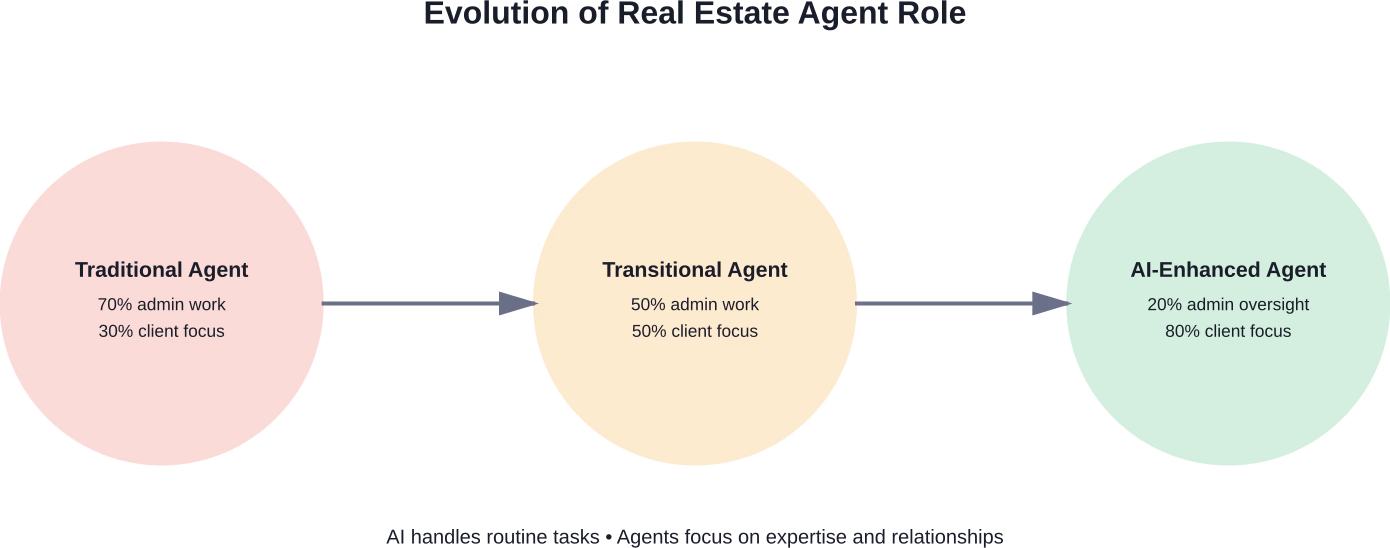
AI won't replace real estate agents—it will redefine what the job looks like.
The industry will shrink, squeezing out underperformers who can't justify their value in an AI-augmented market. The agents who remain will be more productive, more skilled, and better compensated because they focus on the irreplaceable human elements that technology can't replicate.
This transformation is already underway. The question isn't whether to accept it, but how quickly professionals will adapt to the new reality.
For consumers, this evolution means better service—combining AI's efficiency with human expertise. For agents, it means choosing between learning to leverage new tools or becoming obsolete.
The future of real estate isn't human versus AI. It's human plus AI, working together to deliver outcomes that neither could achieve alone.


