Best SEO Apps for Shopify: Maximize Your Store’s Reach in 2025
Discover the top SEO apps for Shopify to improve rankings, drive traffic, and grow sales - without drowning in complicated tools.
Dec 29, 2025



Nonprofits can boost visibility and donor engagement through strategic marketing that prioritizes storytelling, digital channels, and volunteer empowerment. With U.S. nonprofits raising $3.7 trillion annually, effective marketing helps organizations stand out in a crowded sector while building sustainable support for their missions.
U.S. nonprofits collectively raise $3.7 trillion every year, according to Candid. That's not just impressive—it's overwhelming. The sheer volume of organizations competing for attention, donations, and volunteer hours means standing out requires more than good intentions.
Marketing isn't about selling. It's about connecting people to a cause that matters.
Nonprofit marketing strategies work best when they're built on authenticity, consistency, and a clear understanding of the communities being served. The tactics that move the needle don't require massive budgets—they require smart thinking and genuine storytelling.
The landscape shifted dramatically between 2023 and 2025. According to Candid's research, arts nonprofits saw revenue decline across every category in 2024: earned revenue dropped 6%, government funding fell 26%, and foundation funding decreased 25%.
Meanwhile, early findings from nonprofit employee surveys suggest significant turnover concerns in the sector. Staff turnover creates knowledge gaps that impact consistency and institutional memory—two elements critical for sustained marketing efforts.
But there's opportunity in the challenge. Foundation leaders surveyed in early 2025 showed cautious optimism: 37.3% anticipated increasing their giving in 2025, while 53.9% expected to maintain 2024 levels. Foundation giving forecasts for 2025 showed cautious optimism among surveyed grantmakers.
The message? Nonprofits that market effectively can capture attention and funding even during uncertain times.
Traditional branding focuses on logos, colors, and consistent messaging. That matters. But movement marketing goes deeper—it positions your nonprofit as a catalyst for change that people want to be part of.
Movements grow when supporters feel ownership. They're not just donors; they're participants. This shift in perspective changes how organizations communicate.
Stop making every piece of content about your organization. Feature the people your work touches: volunteers who found purpose, community members whose lives improved, donors who explain why they give.
These stories carry more weight than any statistics your annual report could produce. They create emotional resonance and social proof simultaneously.
Not everyone can donate $500. Some can share a post. Others can volunteer an hour. A few will become monthly sustainers.
Design marketing materials that acknowledge this spectrum. Every call to action doesn't need to be "Donate Now." Sometimes it's "Share this story" or "Sign up for updates" or "Attend our virtual event."
Content marketing remains one of the highest-ROI strategies for nonprofits. It builds authority, improves search visibility, and gives supporters shareable material that extends your reach.
Email is a significant driver of nonprofit revenue, website traffic, and event registrations. Industry data shows email resulted in 11% of all online revenue in 2024, and the average small nonprofit raises $6.15 per subscriber.
Yet 32% of nonprofits don't send regular email campaigns. That's leaving money—and engagement—on the table.
Effective email marketing for nonprofits includes:
Social media marketing for nonprofits works best when platforms become spaces for conversation, not just broadcasting. Each network serves different purposes:
The key: don't try to be everywhere. Choose two platforms your audience actually uses and show up consistently.
Video marketing intimidates many nonprofits. Equipment costs, editing time, production quality concerns—the barriers feel high.
But smartphone cameras now shoot in 4K. Free editing apps like CapCut handle basic cuts and captions. Most importantly, audiences value authenticity over polish.
Effective nonprofit video content includes:
Peer-to-peer campaigns turn supporters into fundraisers. They host their own fundraising pages, share them with personal networks, and bring in new donors you'd never reach directly.
This strategy works particularly well for:
The nonprofit's role shifts from direct fundraising to supporter enablement. Provide toolkits with sample social posts, email templates, and shareable graphics. Recognize top fundraisers publicly. Make it easy and rewarding for supporters to represent your cause.
Digital marketing dominates strategy discussions, but physical materials still matter. A well-designed brochure at a community health clinic or a rack card at a library reaches people in moments when they're receptive to information.
Budget constraints mean choosing carefully. Prioritize materials that:
As much as 30% of annual giving occurs in December, with 10% arriving in the final three days of the year. Year-end giving campaigns require specific tactics that create urgency and emotional connection.
Build momentum throughout December with a public fundraising goal and visible progress tracker. Daily or weekly updates show supporters their contributions are part of a larger collective effort.
This works because it combines scarcity (limited time), social proof (others are giving), and transparency (you can see the goal and progress).
Matching gifts double donor impact and provide compelling urgency. A major donor or corporate sponsor agrees to match contributions up to a certain amount, and you market the limited-time opportunity.
Even a modest $5,000 match creates urgency. Promote it across email, social media, and your website with clear language: "Every dollar you give is doubled—but only until December 31."
Many donors seek tax benefits from charitable contributions. Highlight options like:
Partner with a financial advisor to create simple educational content—a one-page guide or short video—that supporters can share.


Nonprofits rarely have room for long testing cycles, especially when every campaign competes for limited donor attention and funding. Extuitive helps teams review ad concepts before launch using predictive models trained on campaign performance and audience behavior signals. Instead of relying only on post-launch results, organizations can compare creative directions earlier and make more informed campaign decisions before committing a budget.
Extuitive is designed to:
Book a demo with Extuitive and evaluate campaign ideas before they reach donors.
One of the most efficient marketing tactics involves reaching people through existing trusted channels. Find organizations, businesses, or individuals whose audiences overlap with yours—but who aren't direct competitors.
This could mean:
The key: provide value to the partner's audience. Don't treat it as an advertising slot. Share expertise, tell compelling stories, and let people discover your organization naturally.
Getting the right volunteers to the right opportunities matters. Stanford research on VolunteerMatch and Feeding America showed that SmartSort algorithms increased opportunities that received at least one response by 8% in Dallas-Fort Worth and Southern California.
Smaller nonprofits can apply similar principles:
Better matching reduces no-shows, increases volunteer satisfaction, and improves retention—all of which amplify your marketing efforts as satisfied volunteers become ambassadors.
Numbers matter. Data proves impact. But stories create the emotional resonance that drives action.
Effective nonprofit storytelling follows specific patterns:
Social media algorithms reward engagement and authenticity. That creates opportunities for nonprofits willing to experiment beyond standard nonprofit content.
Some unconventional approaches that work:
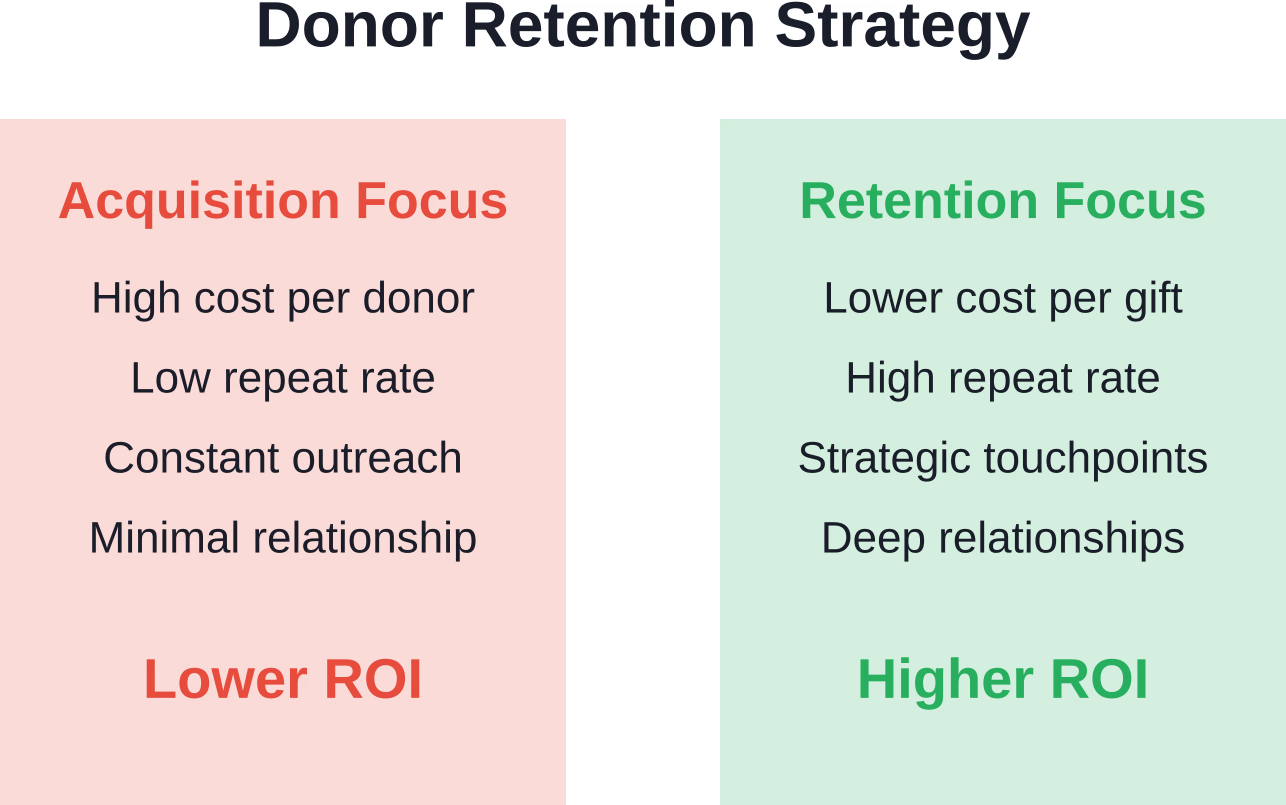
Donor retention costs far less than donor acquisition. Yet many nonprofits focus heavily on attracting new donors while neglecting relationships with existing supporters.
Stewardship marketing includes:
Treat stewardship as marketing. Every donor interaction either strengthens or weakens the relationship. Consistent, genuine appreciation keeps supporters engaged between appeals.
The nonprofits that thrive don't necessarily have the biggest budgets. They have clarity about their mission, understanding of their audience, and commitment to consistent, authentic communication.
Start with foundations: build an email list, establish presence on two social platforms, and create a simple content calendar. Master those basics before adding complexity.
Test everything. Track what works. Double down on high-performing tactics and abandon what doesn't resonate, regardless of what's supposedly "best practice."
Remember that marketing serves the mission. Every post, email, or campaign should connect people to the work that matters. When that connection is genuine, marketing stops feeling like promotion and starts feeling like community building.
The sector needs what your organization offers. Effective marketing ensures the right people discover it at the right time.
Ready to strengthen your nonprofit's visibility? Start by auditing current efforts: what's generating engagement, what's falling flat, and where gaps exist in supporter communication. Focus improvement efforts on the channels and tactics that align with organizational capacity and audience preferences. Progress beats perfection.


