How to Make Money on Shopify With No Money at All
Learn how to launch a Shopify store from scratch with zero upfront investment using dropshipping, digital products, and smart marketing.
Feb 9, 2026



Designing an AI marketing strategy involves identifying high-impact use cases, ensuring data quality and transparency, selecting the right AI tools, and building focused experiments that deliver measurable outcomes in 30-60 days. Brands must prioritize customer data control—45% of consumers say visibility over their data is a top priority—while integrating AI across automation, personalization, and predictive analytics to stay competitive.
Marketing has hit a turning point. The acceleration of artificial intelligence—especially agentic AI—is reshaping how brands think about customer experiences, creativity, and scale. This isn't just a technological shift. It's a strategic inflection point that offers a chance to reimagine engagement, elevate creative output, and drive growth like never before.
But here's the thing. Most marketing leaders recognize the opportunity of using AI but struggle with a fundamental question: Where do you actually begin?
The challenge isn't whether to adopt AI. It's how to systematically identify which marketing tasks offer the highest opportunities for automation, personalization, and predictive power—then deploy them in a way that builds trust and delivers results fast.
Traditional marketing playbooks no longer work. The infusion of AI didn't just speed things up. It collapsed the distance between strategy and execution. Marketing leaders who win aren't the ones with the best frameworks. They're the ones who've learned to train systems, meet modern search behavior, and run focused experiments that produce measurable outcomes in 30-60 days without organizational drama.
Artificial intelligence has moved from experimental to essential. Marketing departments that delay adoption risk becoming invisible to potential customers as AI platforms transform how consumers search and discover brands.
According to Adobe's 2025 AI and Digital Trends report, 45% of consumers say visibility and control over their data is a top priority when engaging with brands—a clear mandate for transparency. After conversations with CMOs and CIOs, it's evident that governance, ethics, and customer trust aren't optional add-ons. They're foundational to any AI marketing strategy.
Real talk: AI offers multiple advantages that traditional methods simply can't match.
AI automates repetitive tasks like data collection, reporting, and content scheduling. This frees marketing teams to focus on strategic, creative work that moves the needle. Tasks that once took hours now take minutes.
AI-driven forecasts for customer lifetime value and demand are up to 20% more precise than traditional methods, according to Think with Google. Real-time optimization means quicker responses to market shifts and customer behavior changes.
AI analyzes vast datasets to deliver personalized content, product recommendations, and messaging to individual customers across multiple channels. This level of customization was impossible to achieve manually.
Automation reduces manual labor costs. Predictive analytics minimize wasted ad spend. AI tools scale without proportional increases in headcount, making growth more sustainable.
The question isn't whether AI delivers value. It's how to capture that value systematically.
Before building a strategy, it's crucial to understand the types of AI applications available and how they may evolve. A useful framework categorizes AI along two dimensions: intelligence level and whether it stands alone or integrates into a broader platform.
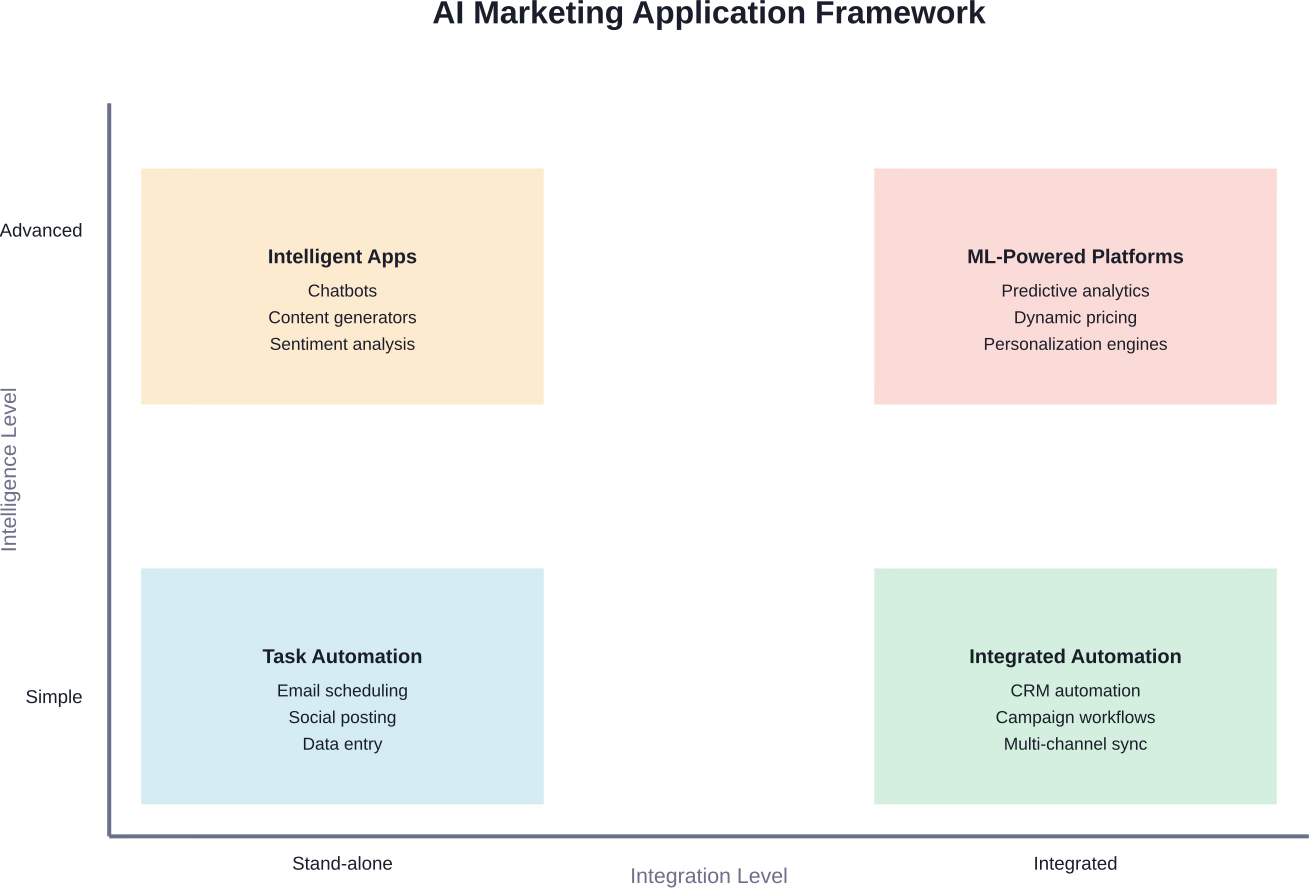
Simple stand-alone task-automation apps are a solid starting point. They handle boring, repetitive work like scheduling social media posts or extracting data from spreadsheets.
But advanced, integrated apps that incorporate machine learning have the greatest potential to create value. As firms build their capabilities, they should move toward these technologies—platforms that learn from data, predict outcomes, and adapt in real time.
Research outlines a three-step blueprint for integrating AI into marketing preparation:
Each facet plays a distinct role across the marketing lifecycle—from research to strategy development to execution.
Building an effective AI marketing strategy requires more than adopting tools. It demands a structured approach that aligns technology with business goals, data infrastructure, and customer expectations.
Start with the end in mind. What specific outcomes does the marketing organization need to achieve? Examples include:
AI should serve these objectives—not exist for its own sake. Every AI application must tie directly to a measurable business goal.
Data is at the heart of AI development. Poor data quality leads to poor predictions, biased recommendations, and broken customer experiences.
Establish clear data governance policies that address:
The Federal Trade Commission has emphasized transparency and accountability in AI adoption. Organizations must ensure consistency with regulatory guidance and prioritize public benefit.
People care deeply about how their data is used. According to Adobe's 2025 AI and Digital Trends report, 45% of consumers say visibility and control over their data is a top priority when engaging with brands.
Build trust by:
The FTC has cracked down on deceptive AI claims through Operation AI Comply. Brands that mislead consumers face legal consequences and reputational damage.
Choose AI tools and platforms that align with current capabilities and future needs. Consider:
Start with simple applications, prove value, then graduate to more sophisticated platforms. Avoid the temptation to adopt advanced machine learning tools before the organization is ready.
AI presents marketers with opportunities to build technological skills. But successful adoption requires more than tools—it requires people who know how to use them.
Invest in:
The marketing leaders who win are those who've learned to train systems, not just use them.
Now for the practical part. Here's how to design and implement an AI marketing strategy that delivers measurable results.
Before introducing AI, understand where the current process breaks down or slows down.
Conduct a comprehensive audit of:
Document the time, cost, and quality issues associated with each process. This establishes a baseline for measuring AI impact.
Not all marketing tasks benefit equally from AI. Prioritize use cases based on:
Common high-impact use cases include:
Start with 2-3 use cases maximum. Focused experiments that produce measurable outcomes in 30-60 days are more valuable than sprawling initiatives that take months to show results.
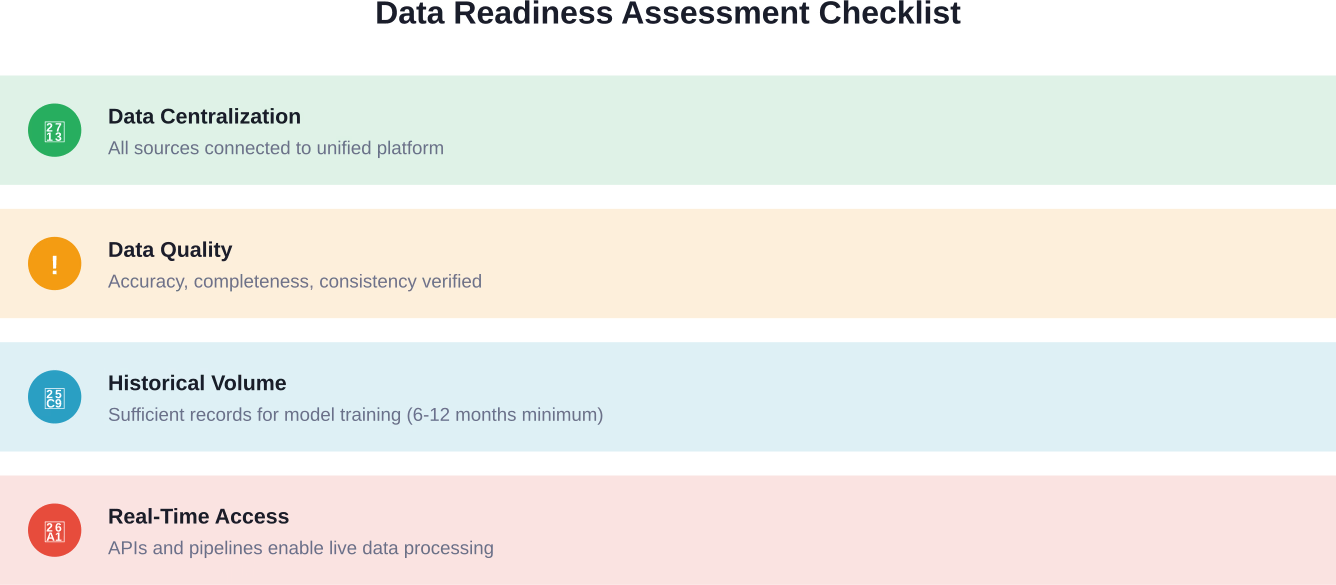
AI is only as good as the data feeding it. Evaluate whether existing data infrastructure can support the chosen use cases.
Ask these questions:
If data quality is poor, invest in cleaning and consolidation before deploying AI. Garbage in, garbage out.
Match tools to use cases and organizational maturity. Options range from simple automation platforms to sophisticated machine learning engines.
Categories of AI marketing tools include:
Check official websites for current pricing and feature availability, as these change frequently.
Launch a small-scale pilot focused on one or two high-impact use cases. Define clear success metrics upfront:
Run the pilot for 30-60 days. Track results rigorously. Document what works, what doesn't, and why.
This approach avoids organizational drama by proving value before asking for broader investment.
AI isn't a set-it-and-forget-it solution. Models degrade over time as customer behavior shifts. Campaigns need continuous optimization.
Establish feedback loops:
The best AI marketing strategies evolve. They incorporate learnings, adapt to market changes, and continuously push the boundary of what's possible.
Once pilots demonstrate ROI, expand successful use cases across additional channels, segments, or geographies.
Scaling requires:
Move from stand-alone apps to integrated platforms that share data and insights across the entire marketing ecosystem.
What specific strategies are marketing leaders deploying successfully right now? Here are proven approaches delivering results.
AI enables brands to create unique content variations for different audience segments without manual effort. Generative AI drafts initial versions. Thinking AI analyzes which variations perform best. Feeling AI ensures messaging resonates with target emotions.
This strategy works across email campaigns, landing pages, social media ads, and even website homepages that adapt based on visitor behavior.
Traditional lead scoring assigns points based on fixed rules. AI-powered predictive scoring analyzes hundreds of variables—demographics, behavior, engagement patterns, external signals—to identify which leads are most likely to convert.
According to available data, AI-driven forecasts for customer lifetime value are up to 20% more precise than traditional methods. This accuracy translates directly into higher conversion rates and lower acquisition costs.
AI adjusts pricing and promotional offers in real time based on demand, inventory levels, competitor pricing, and individual customer willingness to pay.
E-commerce brands and subscription services see significant revenue lifts by optimizing pricing dynamically rather than using static discount schedules.
Chatbots and voice assistants engage customers in human-like, instant two-way conversations. They answer questions, recommend products, schedule appointments, and resolve issues—all without human intervention.
This strategy improves customer experience while reducing support costs. It also captures valuable data on customer needs and pain points.
AI continuously monitors campaign performance across channels—paid search, social ads, display, email—and automatically adjusts bids, budgets, targeting, and creative elements to maximize ROI.
Marketers no longer need to manually check dashboards and tweak settings. The system learns what works and allocates resources accordingly.

Most optimization still happens after campaigns go live. But some teams are starting to shift part of that process earlier by evaluating creatives before spending budget.
In practice, tools like Extuitive use historical campaign data to estimate how new ads are likely to perform. Instead of testing everything in-market, marketers can narrow down options upfront and move forward with a smaller set of stronger candidates. This doesn’t replace ongoing optimization, but it changes the starting point and reduces the amount of trial-and-error needed later.
Feeling AI analyzes social media posts, reviews, and customer feedback to understand sentiment, identify emerging issues, and spot opportunities for engagement.
Brands can respond proactively to negative sentiment before it escalates or capitalize on positive momentum by amplifying what's working.
AI offers tremendous upside, but implementation comes with real risks. Address these proactively.
Regulatory scrutiny around AI and data use is intensifying. The Federal Trade Commission has issued guidance emphasizing transparency and accountability. Organizations must ensure compliance with GDPR, CCPA, and emerging AI-specific regulations.
Failure to protect customer data or provide transparency leads to legal consequences, fines, and lasting reputational damage.
AI models trained on biased data produce biased outcomes. This can result in discriminatory targeting, offensive content, or exclusion of certain customer segments.
Mitigate bias by:
AI should augment human creativity and judgment, not replace it. Over-automation leads to generic content, tone-deaf messaging, and loss of brand voice.
Maintain human involvement in strategic decisions, creative direction, and customer relationship management.
The FTC has cracked down on companies making false or exaggerated claims about AI capabilities. Through Operation AI Comply, the agency announced multiple law enforcement actions against operations that use AI hype or sell AI technology in deceptive ways.
Be honest about what AI can and cannot do. Avoid overpromising on capabilities or results.
How do you know if the AI marketing strategy is working? Track metrics that tie directly to business outcomes.
Establish baseline measurements before implementing AI. Track consistently. Report progress transparently to stakeholders.
Where is AI marketing headed? Several trends are accelerating.
Agentic AI represents a new kind of collaborator. Unlike traditional automation that follows fixed rules, agentic systems make autonomous decisions, learn from outcomes, and adapt strategies without constant human input.
According to Adobe research and customer conversations, this shift is redefining how brands approach customer experiences, creativity, and scale. Marketing leaders are moving from managing campaigns to training systems that manage themselves.
AI platforms are transforming how consumers search and discover brands. Traditional SEO focused on keywords and backlinks. AI-driven search prioritizes intent understanding, conversational queries, and personalized results.
Brands that don't adapt risk becoming invisible to potential customers. Marketing strategies must evolve to meet modern search behavior.
The future isn't about isolated AI tools. It's about integrated platforms that share data and insights across the entire marketing lifecycle—from research to strategy development to execution to measurement.
Mechanical AI handles data collection. Rational AI drives analysis and targeting. Emotional AI ensures resonance with positioned segments. All three work together seamlessly.
Consumer expectations around data transparency and control will continue rising. Successful brands will differentiate by giving customers genuine agency over their data while delivering personalized experiences that respect boundaries.
Ethical AI isn't just a compliance checkbox. It's a competitive advantage.
The strategic inflection point is here. AI has moved from experimental to essential, and marketing leaders who delay adoption risk falling behind competitors who've already learned to train systems, meet modern customer expectations, and deliver personalized experiences at scale.
But success doesn't require perfection or massive upfront investment. It requires a structured approach: audit current processes, identify high-impact use cases, ensure data readiness, select appropriate tools, launch focused pilots, measure rigorously, and scale what works.
Remember that 45% of consumers prioritize visibility and control over their data. Build trust through transparency. Avoid deceptive claims. Maintain human oversight on strategy and creativity. Address algorithmic bias proactively.
Most importantly, start small and prove value fast. Focused experiments that produce measurable outcomes in 30-60 days are more valuable than sprawling initiatives that take months without results.
The distance between strategy and execution has collapsed. Marketing leaders who win aren't the ones with the best frameworks—they're the ones who've built systems that learn, adapt, and deliver results consistently.
The opportunity to reimagine engagement, elevate creative output, and drive growth like never before is available right now. The question isn't whether to build an AI marketing strategy. It's how quickly you can start.


