Marketing Ideas for Assisted Living That Drive Occupancy
Discover proven assisted living marketing strategies for 2026. Digital tactics, local events, and engagement ideas that convert prospects into residents.
May 18, 2026



AI will not replace marketing as a profession, but it will fundamentally reshape how marketers work. According to Forrester research, AI will account for only 6% of total US job losses by 2030, while the American Marketing Association's 2026 report emphasizes that human creativity, cultural fluency, and authentic storytelling will become primary brand differentiators. Marketing professionals who adapt by combining AI capabilities with uniquely human skills—strategic thinking, emotional intelligence, and creative judgment—will thrive in this new landscape.
The question keeps marketing professionals up at night: will AI take my job?
It's a valid concern. Every week brings another tool that writes copy, generates visuals, analyzes data, or automates entire campaigns. OpenAI CEO Sam Altman made headlines claiming that artificial general intelligence would handle 95% of tasks currently performed by marketing agencies, strategists, and creative professionals.
But here's the thing—the reality on the ground tells a different story.
According to Forrester, AI and automation will account for 6% of total US job losses by 2030, equating to 10.4 million roles across all industries. Widespread AI-driven job replacement remains unlikely, as labor productivity would need to accelerate significantly for AI to fully automate most positions.
According to the U.S. Bureau of Labor Statistics, total employment is projected to grow from 170.0 million in 2024 to 175.2 million in 2034, an increase of 3.1 percent. And marketing isn't disappearing from that equation.
So what's actually happening? AI isn't replacing marketers. It's transforming what marketing work looks like.
Let's establish what's real versus what's hype.
According to Pixis data cited in competitor sources, about 69% of marketers had integrated AI into their workflows by 2024, and nearly 90% planned to increase their AI use in 2025. That adoption is happening for legitimate reasons—AI excels at specific tasks.
AI tools currently handle content generation, basic copywriting, image creation, data analysis, campaign optimization, and performance forecasting. These capabilities free marketers from repetitive work and allow faster execution at scale.
But task automation isn't job replacement.
The American Marketing Association's 2026 Future Trends in Marketing report makes this distinction clear: while AI will automate much of transactional marketing, human creativity, cultural fluency, and authentic storytelling will become the primary differentiators for brands.
Think about what that means in practice. AI can generate a product description in seconds. But can it understand the cultural nuance that makes a campaign resonate with a specific community? Can it grasp the strategic implications of a brand repositioning during a social movement?
Not yet. And maybe not ever.
Certain marketing capabilities remain distinctly human, even as AI tools become more sophisticated.
AI analyzes patterns in existing data. It doesn't understand business context the way experienced marketers do.
Deciding whether to pivot a brand message during economic uncertainty, understanding competitive dynamics that don't show up in datasets, or recognizing when short-term metrics conflict with long-term brand building—these require judgment that comes from experience and strategic thinking.
Marketing strategy involves understanding markets, customers, competitors, and internal organizational dynamics simultaneously. That multidimensional awareness remains firmly in human territory.
Marketing fundamentally involves understanding people—their motivations, fears, aspirations, and decision-making processes.
Building client relationships, negotiating with stakeholders, managing cross-functional teams, and reading the unspoken dynamics in a pitch meeting all require emotional intelligence. AI has no emotional awareness and no ability to build genuine human connections.
The best marketing often comes from deep empathy—understanding not just what customers say they want, but what they actually need. That human-to-human understanding can't be automated.
AI generates content by recombining patterns from training data. It doesn't create genuinely novel ideas or understand cultural context deeply enough to navigate sensitive territory.
According to the American Marketing Association's research, cultural fluency is becoming a primary differentiator for brands. Understanding regional dialects, subculture references, generational perspectives, and evolving social norms requires lived experience and cultural awareness.
AI can produce variations on existing creative concepts. But it can't judge whether a campaign will feel authentic or exploitative to a specific community. That judgment requires human cultural fluency.
According to the Adobe 2025 AI and Digital Trends report, 45% of consumers say visibility and control over their data is a top priority when engaging with brands—a clear mandate for transparency.
Marketing professionals make ethical choices daily: how to collect data, what targeting practices are appropriate, whether messaging is truthful, and how to balance persuasion with respect for customer autonomy.
These decisions involve values and principles that AI can't navigate. Someone needs to be accountable for how brands show up in the world, and that accountability requires human judgment.
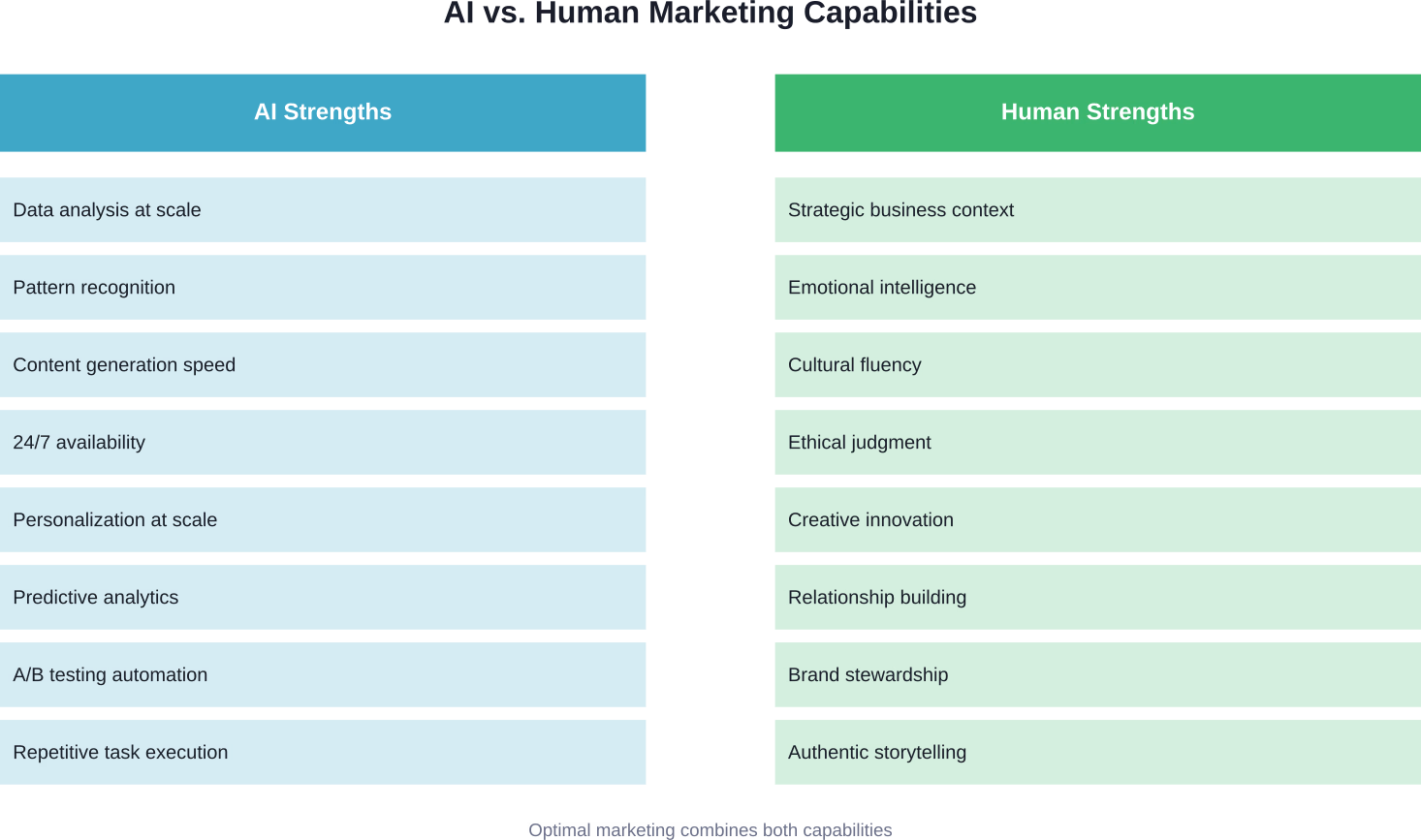
Not all marketing positions face the same level of AI disruption. Some roles will transform more dramatically than others.
Content creators focusing solely on production face substantial changes. Writing basic blog posts, creating simple graphics, producing product descriptions, and generating social media captions—these tasks are increasingly automated.
Entry-level digital advertising specialists who primarily manage bids and budgets also face pressure, as AI now handles much of campaign optimization automatically.
Market research analysts doing basic data collection and standard reporting will see their roles evolve, since AI can process surveys, aggregate data, and generate initial insights far faster than humans.
But transformation doesn't mean elimination. These roles are shifting toward higher-value activities.
Social media managers, email marketing specialists, SEO professionals, and marketing coordinators fall into this category. AI assists with scheduling, basic copywriting, keyword research, and performance tracking—but these roles require strategic judgment AI lacks.
Someone still needs to decide brand voice, navigate crisis communications, understand algorithm changes strategically, and coordinate cross-channel campaigns. These professionals will use AI as a productivity tool while focusing more on strategy and less on execution.
Brand strategists, marketing directors, creative directors, customer experience designers, and agency account managers remain largely protected. Their work centers on judgment, relationships, strategy, and creative direction—areas where AI provides support but can't lead.
According to the Bureau of Labor Statistics, AI may actually support demand for certain roles. Software developers are needed to develop AI-based business solutions and maintain AI systems. Database administrators and architects are expected to be needed to set up and maintain more complex data infrastructure.
The same logic applies to marketing: as AI capabilities expand, demand grows for professionals who can direct AI tools strategically and integrate them into broader business objectives.
Here's where the job replacement narrative falls apart.
Historically, automation doesn't simply eliminate jobs—it transforms markets and creates new forms of demand. The Bureau of Labor Statistics studied this pattern extensively when analyzing technology impacts on employment projections.
Consider digital cameras. They completely replaced film photography. The BLS projected employment declines for photographic process workers despite the absence of historical data showing such declines, because the technology shift was clear. That projection proved accurate.
But photography as a profession didn't disappear. Instead, the dramatically lower cost of taking photos created massive new demand—for smartphone photography, social media content, digital editing, and more. Total employment related to visual content creation actually increased.
AI follows a similar pattern in marketing.
When content creation costs drop, businesses don't produce the same amount of content with fewer people. They produce more content with the same people—or even more people focused on different aspects of content strategy, distribution, and optimization.
Lower costs for campaign testing mean more experiments, which requires more strategic thinking about what to test and how to interpret results. Faster data analysis means more opportunities to act on insights, which requires more people who can translate insights into strategy.
The World Economic Forum's Future of Jobs Report 2025 found that approximately 170 million new jobs will be created this decade globally. The macro trends driving labor market shifts include technological change—but also demographic changes, sustainability transitions, and economic development.
Marketing doesn't exist in isolation. As businesses grow and markets evolve, marketing roles expand alongside them.
Honesty matters here. Not everything about AI's impact is positive for marketing professionals.
Junior positions that once served as training grounds are being automated. New marketers historically learned by doing—writing dozens of basic blog posts, running simple campaigns, creating social graphics, and building tactical skills before advancing to strategy.
When AI handles those entry-level tasks, how do beginners gain experience? This creates a genuine challenge for career development in the field.
According to the World Economic Forum, employers expect 39% of key skills required in the job market will change by 2030. That's significant churn.
Marketing professionals need to continuously upskill just to maintain relevance. Not everyone has equal access to training, and the pace of change can be overwhelming. Analysis of nearly 3,000 global companies shows fewer than one-third are reskilling workers for AI.
The companies adopting AI fastest often lack practical safeguards for employee impacts such as job displacement, bias, or opaque decision-making. There's an execution gap between stated principles and actual workforce support.
Marketing professionals who successfully leverage AI see productivity gains that translate to higher compensation. Those who don't adapt face stagnant wages or displacement.
This creates a potential bifurcation in the profession: highly compensated strategic marketers who direct AI tools, and struggling practitioners whose skills are being commoditized.
The profession as a whole isn't disappearing, but individual careers can absolutely be disrupted without intentional skill development.
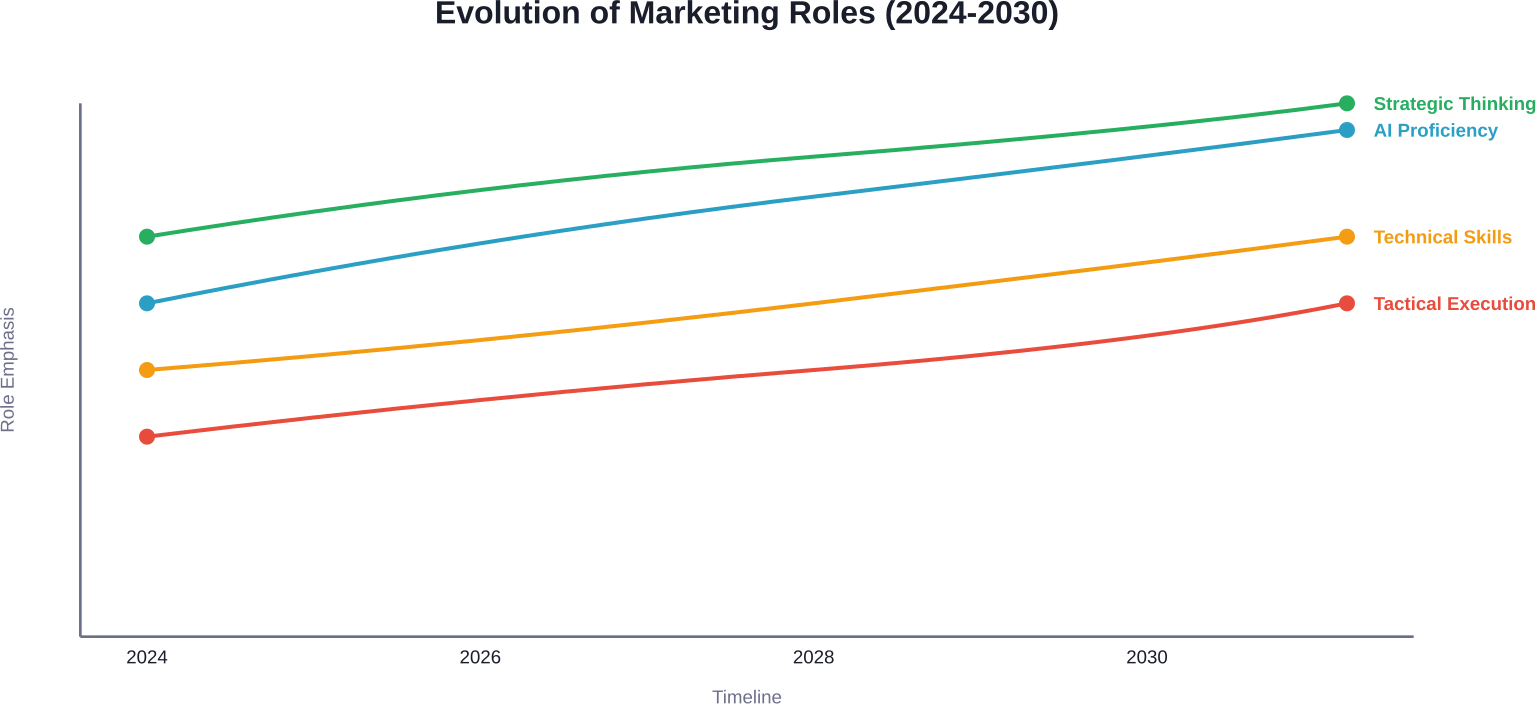
Adaptation isn't optional, but it's also not impossibly difficult. Specific strategies help marketing professionals remain valuable and competitive.
Understanding how AI works—its capabilities and limitations—matters more than technical expertise in building AI systems.
Marketing professionals should know what generative AI can and can't do, how to write effective prompts, when to trust AI outputs versus when to verify them, and what data privacy considerations apply.
This doesn't require coding skills. It requires curiosity and willingness to experiment with tools.
Capabilities that AI struggles with become more valuable, not less. Strategic thinking, emotional intelligence, creative judgment, ethical reasoning, and relationship building all increase in importance.
The World Economic Forum research on AI and talent strategies emphasizes that workforce transformation requires organizations to shift from training for roles to building capabilities that can be recombined into new solutions.
Marketing professionals should actively develop skills that complement AI rather than compete with it. Learn stakeholder management, develop strategic frameworks, practice creative direction, and build expertise in understanding customer psychology.
There's a difference between letting AI tools run on autopilot and strategically directing them toward business objectives.
Marketing professionals who can evaluate which AI tools solve which problems, integrate multiple AI capabilities into coherent workflows, quality-check AI outputs for accuracy and brand alignment, and translate AI capabilities into competitive advantages will command premium value.
This requires understanding both marketing strategy and AI capabilities deeply enough to bridge the gap.
Areas requiring significant judgment remain resistant to automation. Brand positioning, crisis communications, influencer relationship management, executive-level consulting, and cultural marketing all involve complexity that AI handles poorly.
Developing deep expertise in one of these domains provides insulation from automation while increasing professional value.
Relationships and reputation become differentiators when technical skills are commoditized.
Marketing professionals who actively share knowledge, contribute to professional communities, develop thought leadership, and maintain strong professional networks create opportunities that transcend any single role or employer.
People hire people they know and trust. AI can't replicate that dynamic.
Responsibility for successful AI integration doesn't rest solely on individual marketers. Organizations have obligations too.
According to an analysis of nearly 3,000 global companies, AI adoption is outpacing worker protections in most large organizations. Fewer than one-third of companies are reskilling workers for AI, and most lack practical safeguards for employee impacts.
Smart companies approach AI integration differently:
They invest in reskilling programs before displacing workers, not after. They establish clear governance around AI use in marketing, including quality standards, brand guidelines, and ethical boundaries. They redefine roles to emphasize strategic oversight of AI tools rather than eliminating positions entirely.
They also maintain transparency about how AI impacts workforce decisions and create pathways for employees to transition into higher-value activities.
Organizations that treat AI as a pure cost-cutting tool miss the bigger opportunity—using AI to amplify human capabilities and create competitive advantage through enhanced creativity and strategic thinking.
So what does marketing actually look like as AI capabilities continue advancing?
Based on current trends and authoritative research, several scenarios emerge.
Most likely for the next five years. Marketing teams maintain or slightly reduce headcount while dramatically increasing output and sophistication. AI handles execution and analysis; humans focus on strategy, creativity, and relationships.
According to Adobe research, agentic AI represents a new kind of collaborator that's redefining how marketing teams operate. The American Marketing Association's 2026 report describes this as a strategic inflection point where engagement, creative output, and growth are reimagined.
This scenario features marketers working alongside AI rather than competing with it.
As AI commoditizes basic marketing execution, differentiation comes from specialized expertise. Marketing professionals develop deep knowledge in specific industries, customer segments, or marketing domains that require significant context.
Generalists face pressure, but specialists who combine AI proficiency with domain expertise become highly valuable.
Emerging companies build marketing functions designed around AI from the start rather than retrofitting AI into existing structures. These organizations have smaller marketing teams with different skill profiles—more emphasis on data science, AI direction, and strategic oversight, less on production and execution.
This creates a two-tier market: traditional marketing organizations evolving slowly, and AI-native competitors operating with fundamentally different economics.
Probably all three simultaneously. Different organizations will adopt different approaches based on their industry, size, resources, and strategic priorities.
The World Economic Forum's research on AI and talent trends identifies four distinct scenarios for how AI might shape jobs by 2030, with varying risks and opportunities across industries. Marketing will likely follow a similar pattern—no single outcome, but rather a range of possibilities.
What remains consistent across scenarios: marketing as a profession continues, but the skill requirements shift significantly toward strategic thinking, AI literacy, and distinctly human capabilities.
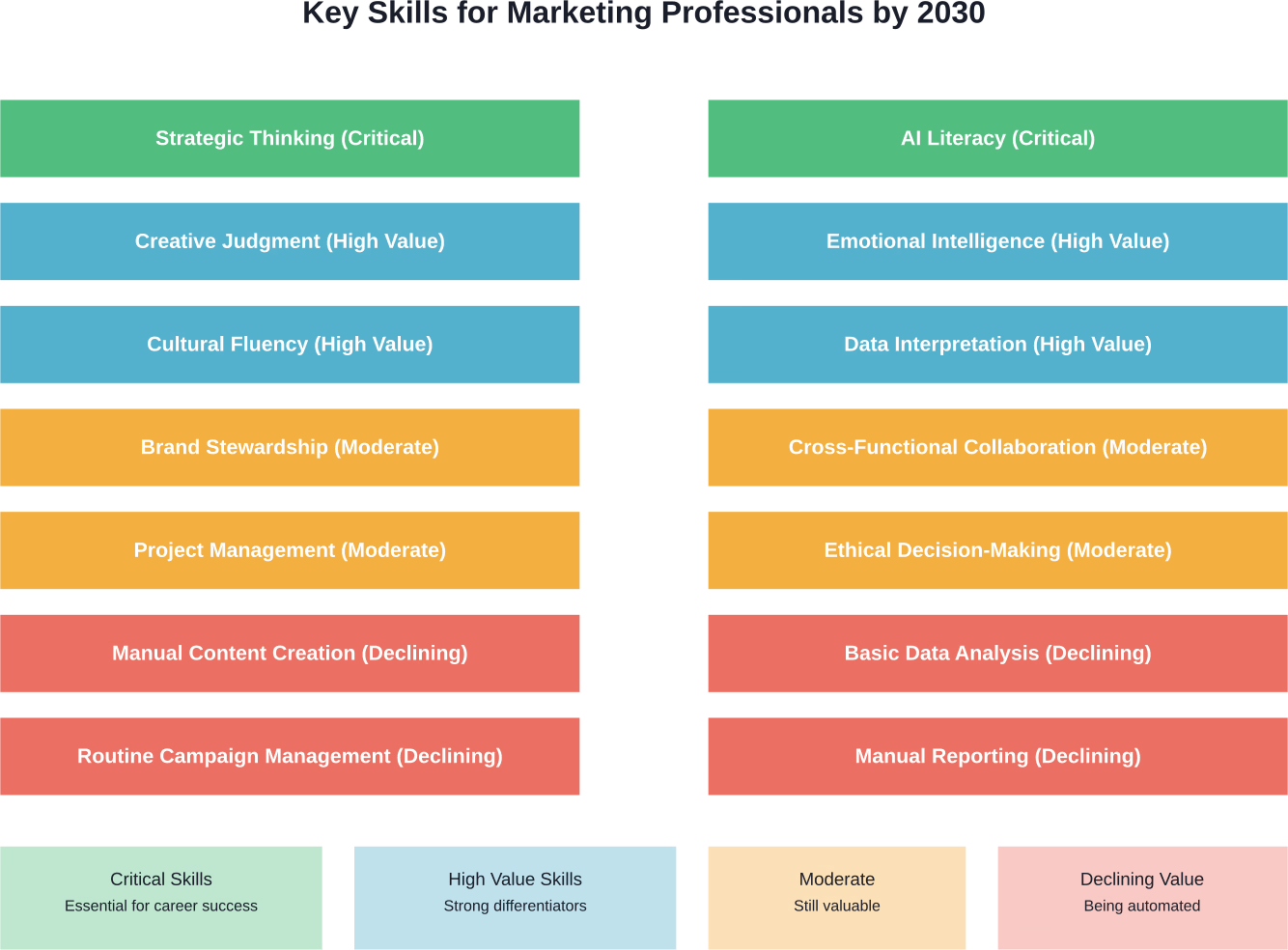
Several misconceptions dominate discussions about AI's impact on marketing. Setting the record straight matters. Here are the common myths:
Will marketing be replaced by AI? No.
Will marketing jobs change fundamentally? Absolutely.
The evidence from government employment projections, authoritative industry research, and current market dynamics points to transformation rather than elimination. AI will automate specific tasks and reshape role definitions, but the profession continues.
Marketing fundamentally involves understanding people, building relationships, creating meaning, and driving business strategy. These activities require judgment, creativity, emotional intelligence, and cultural awareness that AI cannot replicate.
What AI does exceptionally well—data analysis, pattern recognition, content generation, and optimization—complements rather than replaces human capabilities. The most effective marketing going forward will combine AI's computational power with human strategic thinking.
The challenge isn't whether marketing jobs exist in 2030. They will. The question is whether individual marketing professionals develop the skills, adaptability, and strategic perspective to thrive in an AI-augmented profession.
That outcome depends far more on personal choices than on technological capabilities.
Start developing AI literacy today. Double down on distinctly human skills. Learn to direct AI tools strategically rather than just using them tactically. Specialize in domains requiring significant judgment. Build relationships and reputation that transcend any specific technical capability.
Marketing's future belongs to professionals who can harness AI as a multiplier for human creativity and strategic thinking—not to those who compete with machines at tasks machines do better, nor to those who ignore AI's transformative potential.
The profession is changing. And that creates opportunities for marketing professionals ready to evolve alongside it.


