AI Creative Optimization: How Modern Ads Learn Before They Launch
Learn what AI creative optimization is, how it works, and why it helps ads perform better before budgets are spent.
Feb 5, 2026



Starting an AI company in 2026 requires identifying a clear problem, securing initial funding (bootstrapping or pursuing government grants like SBIR awards of ~$150,000), building a minimal viable product, and navigating technical and regulatory challenges. Success depends on strategic focus, technical capability, and understanding market needs rather than chasing AI trends.
The AI landscape has exploded. More than 10,000 AI startups now compete globally, with over 2,000 receiving first-round funding last year alone. That's more companies than there are cheetahs on Earth.
But here's the thing—most fail. Not because the technology isn't ready or the market isn't there. They fail because founders rush into building solutions without understanding the fundamentals of what makes an AI business viable.
Starting an AI company isn't the same as launching a traditional software business. The technical requirements are steeper, the data challenges are real, and the competitive pressure is intense. Yet opportunities remain massive for founders who approach this strategically.
This guide walks through exactly how to start an AI company—from initial concept to product launch—based on real experiences, government funding data, and lessons from founders who've built AI startups from scratch.
AI startups face unique challenges traditional software companies don't encounter. The technology stack is more complex, requiring specialized expertise in machine learning, data engineering, and model deployment.
Data becomes the core asset. Without quality training data, even the most sophisticated algorithms fail. This creates immediate hurdles around data acquisition, labeling, privacy compliance, and storage infrastructure.
According to RAND research investigating why AI projects fail, common root causes include inadequate data quality, misalignment between technical capabilities and business objectives, and underestimation of deployment complexity. Data scientists and engineers consistently point to these factors when explaining failed implementations.
Computational costs run higher too. Training large models requires significant GPU resources, which can quickly consume limited startup capital. Deployment at scale introduces additional infrastructure expenses that catch many founders off guard.
The regulatory environment adds another layer. IEEE standards emphasize the growing importance of ethical AI guidelines and procurement compliance. Organizations increasingly demand transparency, fairness assessments, and risk mitigation strategies from AI vendors.
Community discussions reveal the financial reality. One founder documented spending $47,000 over 18 months building an AI startup, covering development costs, cloud infrastructure, API expenses, and basic operational overhead.
That figure represents a relatively lean operation. Founders who bootstrap typically spend between $30,000 and $100,000 reaching a functional MVP, depending on technical complexity and whether they're paying for data, compute resources, or third-party AI services.
Cloud costs deserve special attention. AWS, Google Cloud, and Azure all charge for GPU instances, storage, and API calls. A modest training pipeline might cost $500-2,000 monthly. Production deployments with significant traffic can quickly reach $5,000-10,000 per month.
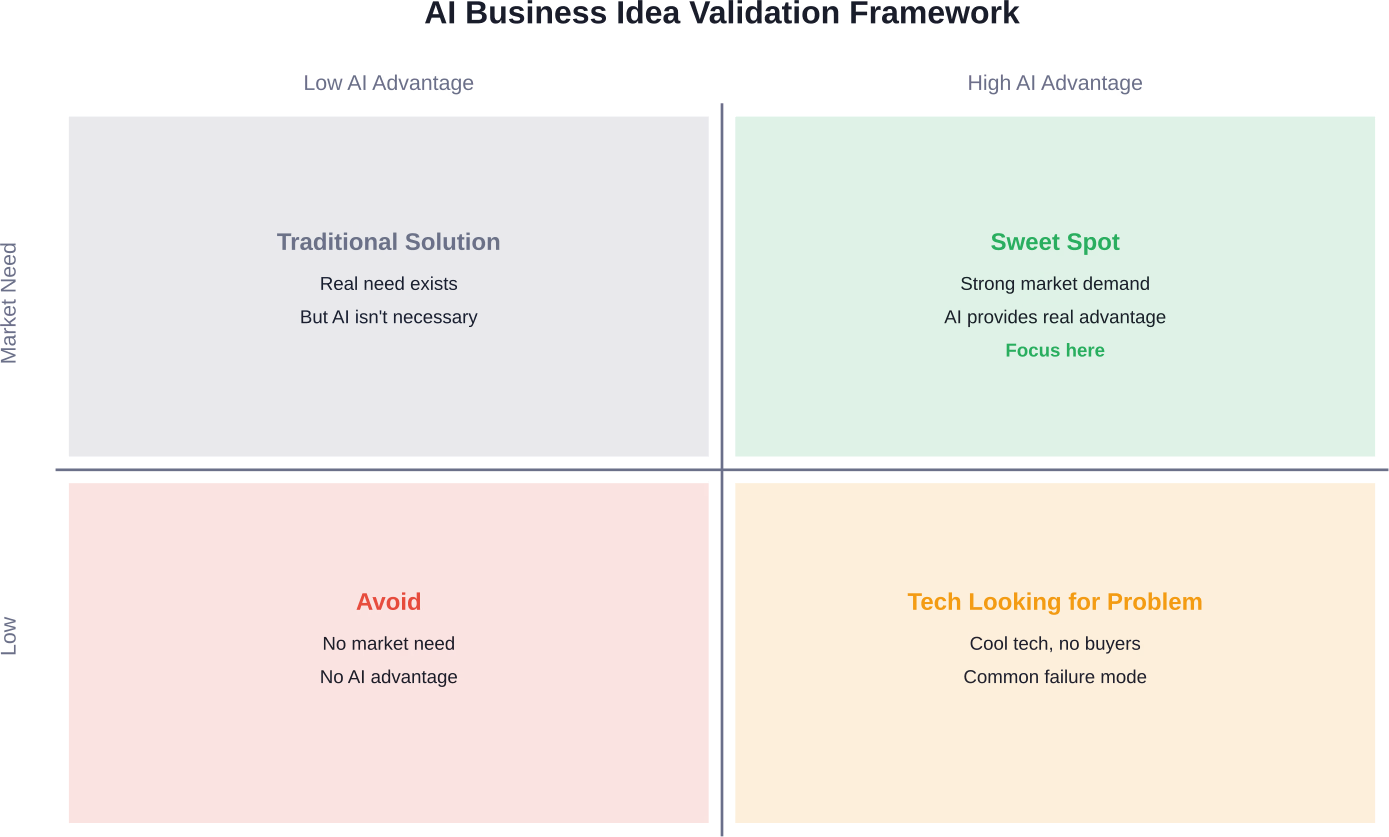
Not every problem needs an AI solution. The first mistake founders make? Starting with "let's build something with AI" instead of "here's a problem worth solving."
Look for problems where AI provides genuine advantage. Pattern recognition in large datasets, prediction tasks, natural language processing, computer vision, and automation of repetitive cognitive work—these represent areas where AI delivers measurable value.
Stanford research on navigating the AI revolution suggests entrepreneurs should focus on where AI complements rather than replaces human expertise. According to Ethan Mollick, AI currently performs around the 8th percentile for innovation, making it essential that people use AI to augment their ideation process rather than replace their thinking.
Validate before building. Talk to potential customers. Understand their workflows, pain points, and willingness to pay. Too many founders build impressive technology that solves problems nobody actually has.
Consider these promising areas:
The strongest opportunities sit at the intersection of specific domain expertise and AI capability. If you understand insurance underwriting and can apply machine learning to risk assessment, that's more defensible than generic "AI consulting."
Funding options vary significantly based on startup stage, technical maturity, and founder circumstances. According to the U.S. Small Business Administration, funding choices shape how businesses are structured and operated long-term.
Most early-stage AI founders choose between bootstrapping, government grants, angel investors, or venture capital. Each path carries distinct advantages and tradeoffs.
Self-funding remains viable, especially for technical founders who can build the initial product themselves. The $47,000 documented by one founder represents a realistic bootstrap budget for reaching MVP.
Advantages include maintaining full ownership, moving at your own pace, and avoiding premature pressure to scale. Disadvantages center on limited resources, slower growth, and personal financial risk.
Cloud providers offer startup credits that help. AWS, Google Cloud, and Microsoft Azure all run programs providing $1,000-100,000 in credits for qualifying startups. These programs can cover 6-18 months of infrastructure costs.
The Small Business Innovation Research (SBIR) program represents a significant opportunity for high-tech startups. Nearly 5,000 small businesses receive over $4 billion annually in federal grants and contracts for R&D through the SBIR and STTR programs
SBIR awards follow a three-phase structure:
The SBA notes that while they don't provide grants for general business starting and expansion, they do support scientific research and high-tech development through these specialized programs. Multiple federal agencies participate, including the Department of Defense, Department of Energy, NASA, and National Science Foundation.
One reported case involved a founder receiving $750,000 from a venture capitalist who reached out via LinkedIn, enabling them to focus full-time on their protein-based pesticide startup.
Such scenarios happen, but they're not typical. Most founders need to actively court investors through networking, warm introductions, and demo days.
VC interest in AI remains strong. More than 2,000 AI startups secured first-round funding last year. But investors have become more discerning, focusing on companies with clear paths to revenue rather than pure technology plays.
Prepare for the funding process by developing:
Technical execution determines whether AI companies succeed or become expensive learning experiences. The architecture decisions made early cascade throughout the product lifecycle.
Python dominates AI development. The ecosystem of libraries—TensorFlow, PyTorch, scikit-learn, Hugging Face—provides proven tools for building machine learning systems.
One founder with 5+ years of Python experience and 2+ years as a data scientist documented their stack choices: Python for backend ML work, frameworks like NextJS and React for frontend, and cloud deployment through providers like AWS Amplify or Vercel.
Frontend deployment options include:
Backend infrastructure matters more for AI companies than traditional SaaS. Model serving requires considerations around latency, throughput, and cost optimization that standard web apps don't face.
Quality data makes or breaks AI products. RAND research consistently identifies inadequate data quality as a primary reason AI projects fail.
Data acquisition strategies vary by use case. Some companies license existing datasets, others build data collection into their product, and many spend significant time on manual labeling.
Budget for data work. If the startup requires 10,000 labeled examples and outsourced labeling costs $1-5 per item, that's $10,000-50,000 just for training data. Many teams underestimate this expense.
Data privacy regulations add complexity. GDPR in Europe, CCPA in California, and emerging AI-specific regulations require careful handling of personal information. Building privacy controls into the architecture from day one saves painful refactoring later.
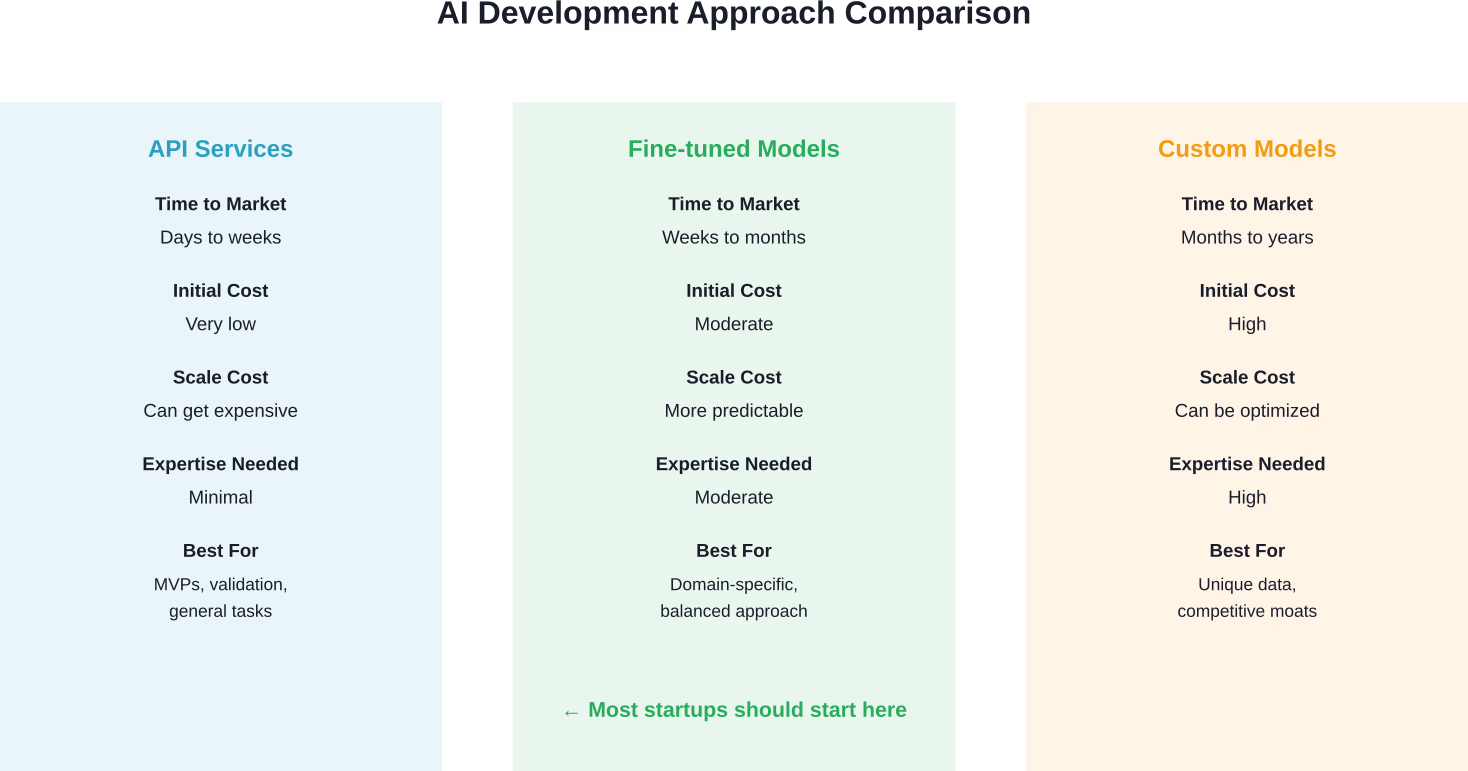
Building custom models from scratch makes sense only when existing solutions don't meet requirements. For many applications, pre-trained models or APIs provide faster, cheaper paths to market.
OpenAI's GPT models, Anthropic's Claude, Google's Gemini, and various open-source alternatives offer powerful capabilities through API calls. Costs range from $0.001 to $0.10 per thousand tokens depending on the model.
Fine-tuning pre-trained models often delivers the best balance. Start with a foundation model that understands general patterns, then adapt it to specific use cases with domain-specific data.
Building custom models requires more expertise but offers advantages when:
Understanding where AI companies fail helps avoid those same mistakes. RAND's research on AI project failures identifies recurring patterns worth studying.
Model performance in production often disappoints compared to development environments. Real-world data is messier, users behave unpredictably, and edge cases multiply faster than anticipated.
Plan for ongoing model maintenance. Performance degrades over time as data distributions shift. What engineers call "model drift" requires monitoring systems, retraining pipelines, and version control.
Deployment complexity surprises many technical founders. Getting a model working on a laptop differs vastly from serving predictions to thousands of concurrent users with millisecond latency requirements.
Building impressive technology without clear monetization paths dooms many AI startups. The "we'll figure out the business model later" approach rarely works.
Enterprise sales cycles run long. If the product targets large organizations, expect 6-18 month sales processes. Cash runway needs to account for this reality.
Pricing AI products presents unique challenges. Value-based pricing works best—charge based on customer outcomes rather than API calls or compute resources consumed. But determining willingness to pay requires extensive customer development.
Finding co-founders with complementary skills proves difficult. The ideal AI startup team includes technical AI expertise, software engineering capability, domain knowledge, and business development skills. That's a rare combination.
Hiring becomes competitive and expensive once funding arrives. Experienced ML engineers command $150,000-300,000+ in competitive markets. Equity compensation helps but doesn't fully offset salary expectations.
Remote work expands the talent pool but introduces coordination challenges. Distributed teams building complex technical products require strong processes and communication discipline.
The MVP for AI companies needs to demonstrate both technical feasibility and business value. That's a higher bar than typical software MVPs.
Start with the narrowest possible use case. Instead of "AI for healthcare," focus on "predicting readmission risk for diabetic patients at discharge." Specificity helps prioritize features and validate value.
One founder documented their approach: build core AI functionality first, create a simple interface to demonstrate it, then iterate based on user feedback. They spent roughly 60% of initial development time on the model and data pipeline, 30% on basic frontend, and 10% on deployment infrastructure.
Realistic timelines for reaching MVP vary by complexity. Simple applications using existing APIs might reach usable versions in weeks. Custom models with significant data preparation can take 6-12 months.
Break development into phases:
These ranges assume a technical founder working full-time or a small team. Add 50-100% to timelines when learning while building.
AI products require more rigorous testing than traditional software. Model accuracy, precision, recall, and other metrics need continuous monitoring.
But technical metrics don't tell the whole story. Does the product actually solve the problem? Will users trust the predictions? Can they integrate it into existing workflows?
Get the MVP in front of real users as quickly as possible. User behavior reveals problems that internal testing misses. One founder's advice: launch embarrassingly early, learn fast, iterate constantly.
AI regulation continues evolving rapidly. While comprehensive federal AI legislation remains pending in the U.S., organizations face increasing compliance requirements from existing laws and emerging standards.
According to IEEE standards work on AI procurement and ethics, regulatory compliance has become essential for AI vendors. Government agencies and large enterprises now require transparency, fairness assessments, and risk mitigation documentation.
The SEC has increased scrutiny of AI-related claims in financial services. Companies making AI capability assertions in filings face detailed questions about implementation, validation, and risk management.
Data privacy regulations impact AI companies significantly. GDPR requires explaining automated decisions to users. CCPA grants California residents rights around personal data used in AI systems.
Industry-specific regulations add layers. Healthcare AI must navigate HIPAA requirements. Financial services face oversight from multiple regulators. Government contractors deal with security clearances and FedRAMP compliance.
Emerging AI-specific rules deserve attention. The EU AI Act creates risk-based obligations. Several U.S. states have proposed AI regulations. Even without federal mandates, demonstrating responsible AI practices helps with enterprise sales.
According to LG AI Research's 2025 accountability report on AI ethics, leading organizations focus on translating ethical principles into operational practice through strengthened governance, expanded risk identification tools, and processes that make systems more reliable and fair.
IEEE's work on ethics of autonomous and intelligent systems emphasizes balancing vast potential benefits against the need for responsible development as AI integrates into critical infrastructure and societal functions.
Practical steps for startups include:
Technical excellence alone doesn't build successful companies. AI startups need effective go-to-market strategies that educate customers, demonstrate value, and overcome skepticism.
Avoid leading with "AI-powered" in marketing messages. Customers care about outcomes, not technology. Frame the value proposition around problems solved and results delivered.
Education becomes part of the sales process. Many potential customers don't fully understand what AI can and can't do. Setting realistic expectations prevents disappointment and churn.
Differentiation matters intensely in crowded markets. With 10,000+ AI startups competing, generic positioning fails. Specific domain expertise, unique data, or proprietary approaches provide defensible advantages.
Product-led growth works well for certain AI applications. Offer free tiers or trials that let users experience value directly. Conversion to paid plans follows once they're convinced.
Enterprise sales requires different approaches. Build case studies, offer proofs of concept, and prepare for extensive security reviews. Buyers want references from similar organizations before committing.
Pricing models vary:
Transparency helps overcome skepticism about AI capabilities. Share performance metrics, acknowledge limitations, and explain how the system works.
Social proof accelerates sales. Customer testimonials, case studies, and third-party validation all build credibility. Even small logos on a website signal legitimacy to prospects.
Technical content marketing establishes expertise. Write about approaches, share learnings, and contribute to open-source projects. Visibility in the developer community generates inbound interest.
Growth introduces new challenges. Infrastructure that worked for 100 users breaks at 10,000. Manual processes that seemed fine early on become bottlenecks.
Infrastructure costs grow faster than revenue early on. One founder noted that cloud expenses can quickly reach $5,000-10,000 monthly with production traffic.
Optimization becomes essential. Model compression reduces inference costs. Caching common predictions avoids redundant computation. Smart architecture choices pay dividends as volume increases.
Monitoring and observability matter more at scale. When thousands of predictions run hourly, understanding system behavior requires proper instrumentation. Track latency, error rates, model performance, and business metrics.
Initial hires shape company culture and capability. First engineering hires should be senior enough to work independently and help recruit additional team members.
Balance technical and business hiring. Pure technology focus leaves companies without sales capability. Pure business focus creates pressure on technical teams without adequate resources.
Remote vs. in-person remains contested. Distributed teams access wider talent pools but sacrifice some collaboration benefits. Hybrid approaches attempt to balance both.
Seed funding typically ranges from $500,000 to $2 million and supports building the MVP and getting initial customers. Series A ($2-15 million) finances go-to-market expansion and team growth. Later rounds fund aggressive scaling.
Each funding stage brings higher expectations. Seed investors accept experiments and pivots. Series A investors want demonstrated product-market fit and repeatable sales processes. Later investors demand efficient growth and clear paths to profitability.
According to Brookings research published in 2025, AI activity remains highly concentrated geographically. The Bay Area alone accounts for outsized innovation, talent, and investment compared to other U.S. regions.
But concentration creates opportunities elsewhere. Talent costs less in secondary markets. Competition for customers may be lower. Remote work enables distributed teams to access talent anywhere.
The research identified different regional profiles. Some metros excel at AI talent development and research but lag in enterprise adoption. Others show strong adoption activity despite less robust innovation ecosystems.
Consider geographic factors when starting an AI company. Proximity to customers matters for enterprise sales. Access to technical talent shapes hiring options. Local startup communities provide networking and support.
Stanford offers multiple programs supporting AI entrepreneurship. The Office of Technology Licensing provides resources for inventors pursuing startups based on university technology.
Stanford's online professional education includes courses on business opportunities and applications of generative AI, where expert faculty explore opportunities for businesses and organizations.
Other valuable resources include:
Starting an AI company in 2026 presents both significant opportunities and real challenges. Success requires more than technical prowess—founders need clear problem definition, viable business models, sufficient funding, and execution capability.
The AI startup landscape is crowded but far from saturated. Specific domain expertise combined with AI capability creates defensible positions. Understanding where AI provides genuine advantage over traditional solutions separates viable businesses from technology experiments.
Start lean. Validate demand before building. Use existing tools and APIs when possible. Get early versions in front of real users quickly and iterate based on feedback.
According to the U.S. Small Business Administration, funding choices shape how businesses are structured and operated long-term. Consider whether bootstrapping, government grants, angel investment, or venture capital best fits specific circumstances and goals.
Build responsibly. Data quality, privacy compliance, ethical considerations, and transparency aren't optional extras—they're fundamental to sustainable AI businesses.
The path from idea to working AI company is challenging but navigable. Thousands of founders are building AI startups right now. Some will fail, but many will create valuable companies that solve real problems. With clear strategy, adequate resources, and disciplined execution, joining the successful group is possible.
Ready to start? Begin with the problem, validate the opportunity, and take the first step.


