Best AI Sales Agents You Can Use Today
Discover the leading AI sales agents that automate prospecting, lead qualification, and deal closing. Find out which tools deliver real results for sales teams in 2026.
Apr 10, 2026



AI appears 'stupid' because current systems lack genuine understanding, consciousness, and common sense reasoning. They excel at pattern matching but fail at tasks requiring context, causal reasoning, or understanding beyond their training data. These limitations stem from fundamental architectural constraints—not bugs, but features of how modern AI actually works.
AI systems can solve complex mathematical problems, generate convincing text, and even create original images. Yet these same systems fail spectacularly at tasks a five-year-old handles effortlessly. An AI might confidently claim that France is larger than the sun or misidentify a turtle as a rifle.
So what gives?
The answer isn't what most people expect. AI isn't stupid because it needs more training data or bigger models. According to research from Goldsmiths, University of London, artificial intelligence in its current form fundamentally lacks understanding—and no amount of data will fix that core limitation.
Here's the thing though—calling AI "stupid" might actually be misleading. These systems aren't failing at intelligence. They're succeeding brilliantly at something entirely different: pattern matching at massive scale. The problem is we've mistaken that for actual thinking.
Modern AI systems demonstrate a peculiar pattern. They excel at tasks humans find difficult while failing at things humans find trivial. This isn't a bug. It's a fundamental characteristic of how these systems work.
Large language models can write poetry but can't reliably count the letters in a word. They can summarize research papers but might hallucinate citations that don't exist. Image recognition systems achieve superhuman accuracy on benchmark tests, then classify a 3D-printed turtle as a rifle from every angle.
Research published on arXiv demonstrates that even advanced reasoning models like OpenAI’s o3 and DeepSeek-R1 show consistent failure modes on challenging problems. These models can achieve around 90% accuracy on competition-level mathematics benchmarks such as AIME. While this sounds impressive, it’s important to note that individual AIME tests contain only 15 problems, though broader benchmarks like MATH consist of 5,000 test problems
Neural networks operate by finding statistical patterns in training data. They map inputs to outputs through millions or billions of weighted connections. This approach works remarkably well for tasks with clear patterns.
But human intelligence doesn't work this way.
When humans understand something, they build mental models of how things actually work. They grasp causation, not just correlation. They can reason about scenarios they've never encountered by understanding underlying principles.
AI systems don't do this. They recognize patterns they've seen before and interpolate between them. Show them something genuinely novel—outside their training distribution—and they fail in ways that reveal their lack of understanding.
Research from 2018 demonstrated this limitation dramatically. Scientists took a 3D-printed turtle and applied adversarial perturbations to its surface. These modifications were barely visible to humans. The turtle still clearly looked like a turtle.
Yet neural networks classified it as a rifle from every viewing angle.
This wasn't a one-off failure. It reveals something fundamental: these systems don't understand what turtles or rifles actually are. They've learned to map certain visual patterns to labels, but they lack any conceptual understanding of the objects themselves.
The concept of understanding sits at the heart of why AI seems stupid. Humans don't just process information—they comprehend it. They know what words mean, not just how they're used.
Neural networks don't understand in this sense. At all.
Philosopher John Searle's Chinese Room thought experiment illustrates this distinction perfectly. Imagine someone who doesn't speak Chinese sitting in a room with a rulebook. The rulebook contains instructions for responding to Chinese characters with other Chinese characters.
People outside the room pass in questions written in Chinese. The person inside follows the rulebook and passes back responses. To outside observers, the room appears to understand Chinese. But the person inside doesn't understand a single character—they're just following symbolic manipulation rules.
This is exactly how large language models work.
They've learned incredibly sophisticated rules for manipulating text tokens. They can produce outputs that look like understanding. But there's no comprehension happening under the hood. Just pattern matching at scale.
Modern AI systems represent words, images, and concepts as points in high-dimensional space. Words with similar meanings cluster together in these embedding spaces. The word "king" might be near "queen" and "monarch," while "car" sits near "vehicle" and "automobile."
This geometric representation captures statistical relationships beautifully. Systems can even perform analogical reasoning: king - man + woman ≈ queen.
But geometric proximity isn't semantic understanding.
These embeddings capture how words are used together, not what they actually mean. The system doesn't know that a king is a human being who rules a kingdom. It knows only that "king," "crown," "throne," and "castle" appear in similar contexts.
Real talk: this limitation becomes glaringly obvious when AI systems encounter novel situations. They can't reason from first principles because they don't grasp the principles. They can only interpolate between examples they've seen.
Research submitted in February 2026 (arXiv:2602.06176) documented large language model reasoning failures in detail. Despite remarkable benchmark performance, these systems exhibit consistent failure modes that reveal their limitations.
Mathematical proof serves as an excellent test case for genuine reasoning. Proofs require logical consistency, step-by-step deduction, and understanding of abstract relationships.
Advanced reasoning models demonstrate impressive capabilities here. But they also fail in revealing ways. They might correctly solve complex problems while making elementary errors. They might generate proofs that look superficially correct but contain subtle logical flaws.
The problem isn't lack of training data. Popular competition-level mathematics datasets like AIME-2024 and AIME-2025 contain only 30 problems each. When a state-of-the-art model achieves 90% accuracy, that leaves just three errors to analyze—insufficient for understanding systematic weaknesses.
Research from Hong Kong University of Science and Technology specifically addressed this limitation by developing more comprehensive test sets that reveal failure modes masked by small benchmark datasets.
AI systems struggle profoundly with context-dependent reasoning and common sense inference. These abilities feel effortless to humans because we build rich mental models of how the world works.
Consider a simple scenario: "The trophy doesn't fit in the suitcase because it's too big." What's too big—the trophy or the suitcase?
Humans instantly know the trophy is too big. They understand physical objects, spatial relationships, and the goal of fitting things into containers. Change one word—"it's too small"—and humans immediately flip their interpretation to mean the suitcase is too small.
AI systems can learn to handle these specific examples through training. But they don't develop the underlying common sense understanding that lets humans generalize to new situations automatically.
According to research from the United Nations University, AI that appears "too precise" may actually be overfitting—memorizing training data rather than learning generalizable patterns. This has profound implications.
Overfitted models perform excellently on test data similar to their training set. But they fail catastrophically on genuinely novel inputs. They've memorized rather than understood.
In fraud detection, algorithms sift through vast transaction data identifying abnormal patterns far more quickly than humans could. These systems occasionally flag legitimate transactions as suspicious, but they remain invaluable for detecting fraud at scale that would be impossible manually.
The limitation appears when fraudsters adapt their tactics. If the AI has merely memorized existing fraud patterns rather than understanding the underlying principles of fraudulent behavior, new fraud types slip through undetected.
Causal reasoning—understanding cause and effect relationships—represents one of AI's most significant blind spots. Pattern recognition can identify correlations, but correlation isn't causation.
Research published in Frontiers in Psychology argues that causal reasoning alone won't fix AI's fundamental limitations. But the absence of causal reasoning certainly contributes to AI appearing stupid.
Neural networks excel at finding correlations in data. If ice cream sales and drowning deaths both increase in summer, a naive system might predict that ice cream causes drowning.
Humans immediately recognize the confounding variable: warm weather causes both ice cream consumption and swimming, which increases drowning risk. This requires causal understanding that goes beyond statistical association.
Modern AI systems have sophisticated methods for handling confounders in their training data. But they're still fundamentally working with correlations. They don't understand the actual causal mechanisms underlying the data.
Some researchers argue that adding causal reasoning capabilities would solve AI's understanding problem. The University of London research strongly disputes this claim.
Causal reasoning requires building models of how systems work. But understanding involves more than causal models. It requires semantic knowledge—knowing what things actually are, not just how they relate to each other.
A system might learn the causal relationship between turning a key and starting a car without understanding what a car is, what starting means, or why humans want cars to start. This is sophisticated causal reasoning without genuine comprehension.
Given these limitations, how should organizations deploy AI systems reliably? Research submitted in July 2025 (arXiv:2507.14406) on human-in-the-loop systems engineering provides insights.
The "Fail Fast, or Ask" approach modifies traditional AI deployment. Instead of relying solely on reasoning models, the system includes a non-reasoning model that detects difficult queries. When confidence is low, the system defers to human experts immediately—failing fast without incurring the reasoning model's higher latency.
This approach yields approximately 40% latency reduction and substantial cost savings while maintaining accuracy. It acknowledges AI's limitations explicitly and designs around them rather than pretending they don't exist.
Research on organizational AI adoption reveals that hands-on experience with AI limitations leads to more realistic expectations and increased trust. Organizations that recognize both capabilities and constraints achieve more sustainable AI adoption.
The most successful implementations treat AI adoption as an ongoing learning process, not a one-time deployment. They establish feedback loops where human experts can identify failure cases, and systems can be improved iteratively based on real-world performance.
Research published in 2019 documented that training a single AI model might emit the equivalent of more than 284 tonnes of carbon dioxide. That's nearly five times the entire lifetime emissions of the average American car, including its manufacture.
These emissions are expected to grow substantially as models become larger and training becomes more intensive. And here's where the stupidity matters: much of this computational cost goes toward brute-force pattern matching rather than efficient understanding.
Humans learn concepts from relatively few examples because they understand underlying principles. AI systems require massive datasets and enormous computational resources to achieve narrow capabilities through statistical correlation.
If AI systems could actually understand rather than merely pattern match, they might achieve comparable or better performance with dramatically lower computational and environmental costs.
Users have tracked their AI usage for extended periods and reported shocking results. The pattern emerges clearly. People sit down to think and write, but nothing comes. They've become dependent on AI for tasks they previously handled independently. The tools designed to augment intelligence might actually be degrading it.
When cognitive tools are always available, humans naturally offload tasks to them. This isn't inherently bad—writing systems allow humans to offload memorization, freeing cognitive resources for other tasks.
But AI offloading may be different. Writing systems augmented memory while preserving other cognitive skills. AI systems can perform entire cognitive processes—research, analysis, writing, problem-solving—that previously required active engagement.
Users report that prolonged AI dependency affects their ability to think deeply, generate original ideas, and solve problems independently. The muscle atrophies from disuse.
Research institutions like Duke University have begun investigating AI's impact on critical thinking. The concern isn't hypothetical. When students can generate essays instantly, do they develop the analytical skills essays are meant to teach?
Primary source research provides another example. An archivist at Boise State University published research on teaching AI's limitations in primary source research in December 2025. The goal: equip instructors to inform students about what AI cannot do when analyzing historical documents.
AI systems can summarize documents but can't perform genuine historical analysis. They can't understand historical context, evaluate source reliability, or recognize significance. Yet students increasingly rely on them for these very tasks.
Research submitted in November 2025 (arXiv:2511.19933) developed a comprehensive taxonomy of failure modes in LLM systems. These failures occur not just at the model level but throughout the entire system implementing AI.
Large language models are being rapidly integrated into decision-support tools and automated processes. Understanding their failure modes becomes critical when stakes are high.
Model-level failures include hallucination, reasoning errors, and lack of common sense. But system-level failures involve how AI integrates with other components, handles edge cases, and fails gracefully when encountering situations outside its capabilities.
A model might perform acceptably in isolation but fail when integrated into a larger workflow. It might handle typical cases well but catastrophically fail on rare but important edge cases. It might lack appropriate confidence calibration, expressing equal certainty for correct and incorrect outputs.
According to NIST's AI Risk Management Framework, evaluating AI risks requires assessing models at multiple testing levels: model testing, red-teaming, and field testing. Each level reveals different failure modes.
AI systems that appear highly precise may actually be less reliable than those with appropriate uncertainty. A system that confidently provides wrong answers is more dangerous than one that expresses appropriate doubt.
Generally speaking, the most reliable AI systems aren't those with the highest raw accuracy. They're systems with well-calibrated confidence that know when they don't know.
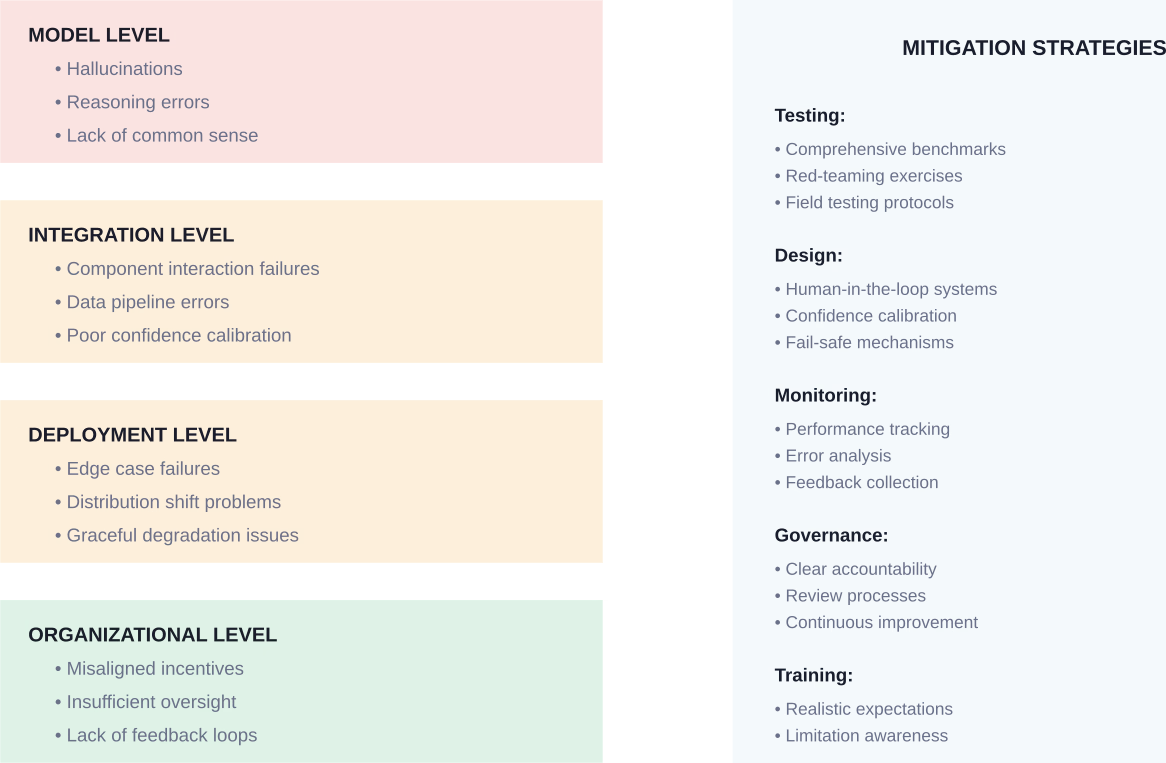
Taxonomy of AI failure modes and corresponding mitigation strategies
Understanding why AI systems fail requires looking inside them. But neural networks operate as black boxes, with billions of parameters interacting in ways that defy human comprehension.
OpenAI's interpretability research attempts to address this challenge. Researchers used GPT-4 to automatically write explanations for the behavior of neurons in large language models, with research published in May 2023. They scored these explanations and released a dataset covering every neuron in GPT-2.
This work represents progress, but the explanations themselves are imperfect. Using one AI system to explain another introduces additional complexity and potential errors.
More recent work published in June 2024 used scalable methods to decompose GPT-4's internal representations into 16 million interpretable patterns or "features." These features represent patterns of neural activity that correspond to recognizable concepts.
Research published December 1, 2025 applied sparse autoencoders to debug misaligned completions. The goal: identify which features cause particular behaviors, including unwanted or misaligned outputs.
Surprisingly, researchers found that a single "provocative" feature could cause multiple distinct problematic behaviors. Understanding these features helps explain why models fail and potentially how to fix those failures.
But wait. Even with these interpretability tools, researchers are using AI to understand AI. The fundamental question remains: can we trust explanations generated by systems that lack genuine understanding?
Some researchers argue that AI's limitations stem from its lack of consciousness. Conscious systems understand because they experience meaning subjectively. AI systems merely process symbols without any subjective experience.
This raises profound philosophical questions. Research on computation and consciousness explores whether computational systems could ever be conscious and whether consciousness is necessary for genuine understanding.
Some philosophers propose panpsychism—the idea that consciousness is a fundamental feature of reality, present to some degree in all physical systems. If true, might sufficiently complex computers possess some form of consciousness?
Research from Goldsmiths explores these questions through the lens of Gödelian arguments about computation and understanding. These arguments suggest that human mathematical understanding transcends what any computational system could achieve.
The short answer? We don't know. But current AI systems show no evidence of consciousness, subjective experience, or genuine understanding—regardless of their impressive performance on benchmarks.
So where does this leave AI development? If current approaches fundamentally cannot achieve understanding, what's next?
For years, the dominant strategy has been scaling: bigger models, more data, more compute. This approach has yielded remarkable improvements in capability.
But scaling appears to hit fundamental limits. A language model trained on the entire internet doesn't understand language. An image classifier trained on billions of images doesn't understand visual concepts. More of the same won't bridge the understanding gap.
Many experts suggest that future AI systems will combine multiple approaches. Neural networks for pattern recognition. Symbolic systems for logical reasoning. Knowledge graphs for structured information. Causal models for understanding cause and effect.
These hybrid systems might overcome some limitations of pure neural network approaches. But whether they achieve genuine understanding remains an open question.
Some researchers argue that understanding requires embodiment—physical interaction with the world. Humans develop common sense through bodily experience: falling down teaches gravity, touching hot stoves teaches cause and effect, manipulating objects teaches physics.
Disembodied language models trained purely on text might never develop genuine understanding because they lack grounding in physical reality. If true, achieving human-like AI might require robotic systems with rich sensory feedback and motor control.
Understanding AI's limitations has immediate practical importance. Organizations deploying AI systems need realistic expectations about what these systems can and cannot do.
AI excels at tasks with clear patterns, abundant training data, and well-defined success metrics. It handles scale beautifully—processing thousands or millions of cases that would overwhelm human analysts.
AI struggles with novel situations, tasks requiring genuine understanding, and decisions with high stakes and complex context. It fails when common sense matters, when causal reasoning is required, or when understanding underlying principles is necessary.
NIST's AI Risk Management Framework provides guidance for organizations deploying AI systems. The framework emphasizes understanding failure modes, implementing appropriate oversight, and maintaining human accountability.
Key principles include testing AI systems thoroughly before deployment, monitoring performance continuously, maintaining human oversight for high-stakes decisions, and establishing clear accountability when systems fail.
Organizations should approach AI adoption as an ongoing learning process. Early deployments should be low-stakes with robust monitoring. Gradually expand to higher-stakes applications only after demonstrating reliable performance and understanding failure modes.
AI appears stupid because it is—at least by human standards of understanding. Current systems excel at pattern recognition and statistical inference but fundamentally lack comprehension, common sense, and causal reasoning.
This isn't a temporary limitation awaiting better training methods or larger models. It reflects the fundamental difference between statistical correlation and genuine understanding.
That doesn't make AI useless. These systems perform valuable work at scales impossible for humans. But deploying them effectively requires honest assessment of both capabilities and limitations.
Organizations should embrace AI's strengths—pattern recognition, scalability, speed—while designing around its weaknesses. Implement human oversight for high-stakes decisions. Deploy comprehensive testing for failure modes. Maintain feedback loops for continuous improvement.
Understanding why AI seems stupid helps set realistic expectations and deploy these powerful tools responsibly. The goal isn't artificial general intelligence that matches human understanding. It's building reliable systems that augment human capabilities while acknowledging fundamental constraints.
Ready to implement AI thoughtfully in your organization? Start by identifying tasks with clear patterns and abundant data where mistakes have manageable consequences. Test thoroughly, monitor continuously, and maintain human accountability. Treat AI as a powerful tool with specific capabilities—not as artificial intelligence that truly understands.


