What Does Shopify Do and Why So Many Businesses Use It
What does Shopify actually do? A straightforward look at how the platform works, what it handles for you, and where its role begins and ends.
Mar 25, 2026



Property management marketing in 2026 demands a strategic blend of local SEO, digital advertising, referral programs, and technology adoption. Successful firms prioritize Google Business Profile optimization, virtual tours, tenant retention campaigns, and data-driven content marketing to attract high-value owners while reducing vacancy rates and building lasting brand authority in competitive markets.
The property management landscape is more competitive than it's ever been. The U.S. market is projected to reach $98.88 billion by 2029, climbing from $81.52 billion in 2025—that's a 3.94% annual growth rate that's bringing more players into every local market. Meanwhile, the global proptech market hit $44.59 billion in 2026 and is expected to surge to $104.57 billion by 2034, fundamentally reshaping how property managers attract clients and operate their portfolios.
Traditional marketing—yard signs, print ads, and word-of-mouth alone—won't cut it anymore. Property owners expect sophisticated digital presence, instant communication, and measurable performance data before they'll hand over their assets. Prospective tenants research properties online for weeks before scheduling a single showing.
So what actually works? Which marketing strategies deliver measurable ROI rather than just burning through budget? This guide walks through the most effective property management marketing ideas for 2026, backed by real market data and tested in competitive environments from gateway cities to emerging rental markets.
Local search engine optimization isn't optional anymore—it's the baseline requirement for visibility. When property owners search for management services, they're almost always adding geographic qualifiers: "property management in [city]" or "best property managers near me."
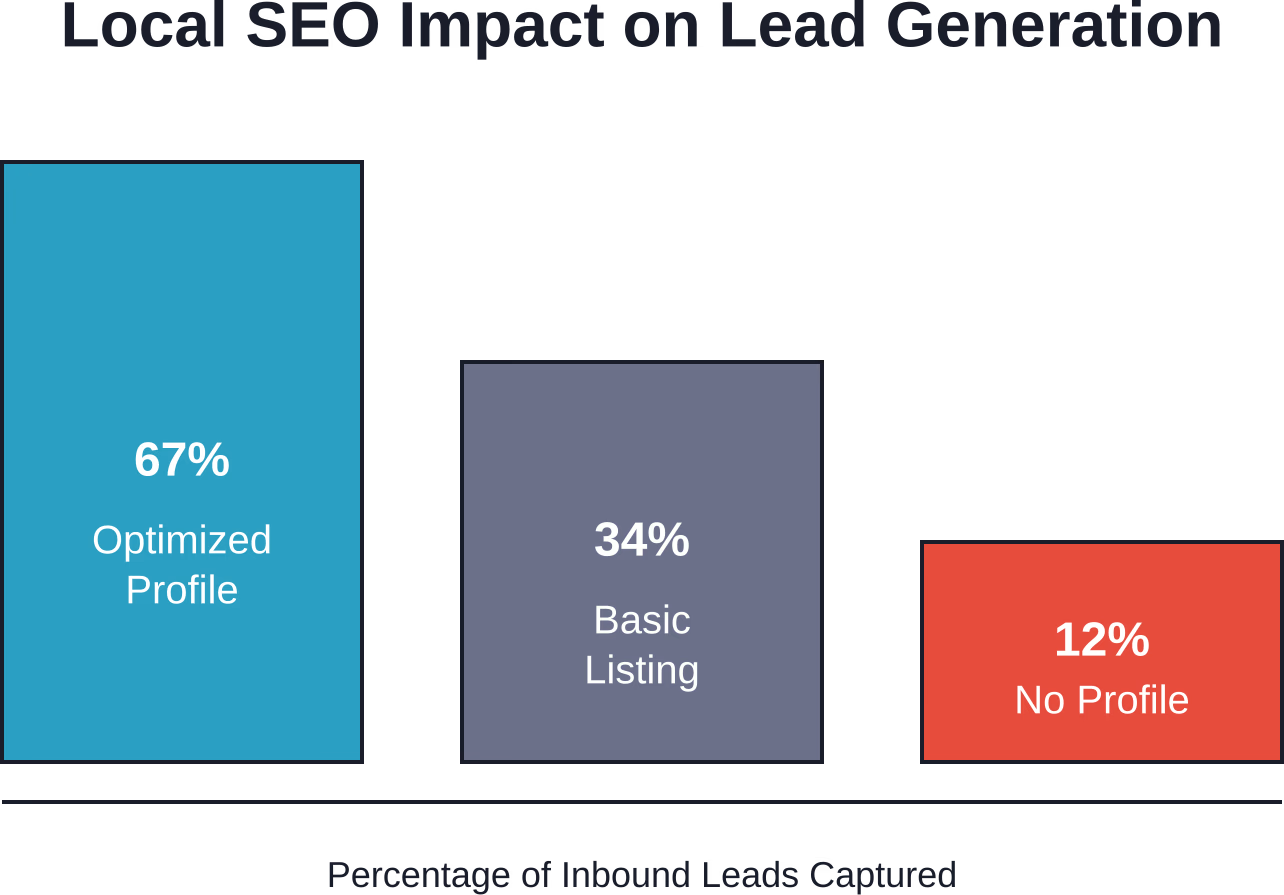
Google's local pack displays just three businesses at the top of search results. Landing in that coveted trio means capturing the majority of inbound leads from organic search. But here's the thing—most property management firms either ignore local SEO entirely or implement it so poorly they might as well have done nothing.
Your Google Business Profile (formerly Google My Business) is the single highest-impact marketing asset for local discovery. It's free, it ranks in both Google Maps and standard search results, and it directly influences whether potential clients trust your firm enough to make contact.
Complete every section. That means accurate NAP data (name, address, phone), service area specification, business hours, website link, and a detailed business description packed with relevant keywords. Add high-quality photos of your team, office, managed properties, and community events. Profiles with photos typically receive more requests for directions and click-throughs to websites.
The category selection matters more than most firms realize. Choose "Property Management Company" as your primary category, then add relevant secondary categories like "Real Estate Agency," "Commercial Real Estate Agency," or "Apartment Rental Agency" depending on your portfolio focus.
Reviews aren't just social proof—they're a direct ranking factor in local search algorithms. Properties with higher review volume and better average ratings consistently outrank competitors with similar or even superior SEO fundamentals.
Build a systematic review generation process. After successful lease signings, property acquisitions, or maintenance resolutions, send personalized review requests via email or text. Make it dead simple—include a direct link to your Google review page, not generic instructions to "find us and leave a review."
Respond to every review, positive and negative. Thank reviewers for positive feedback with specific mentions of what they appreciated. For negative reviews, respond professionally, acknowledge the concern, and offer to resolve issues offline. This demonstrates responsiveness to prospective clients reading your profile.
If you manage properties across multiple neighborhoods, suburbs, or cities, create dedicated landing pages for each geographic market. These pages should target keywords like "property management in [neighborhood]" and include neighborhood-specific content: rental market data, average vacancy rates, local amenities, school district information, and testimonials from owners in that area.
Each location page needs unique content—don't just swap out the city name in templated copy. Google's algorithms easily detect duplicate content and will devalue or ignore pages that don't offer genuine unique value. Include embedded Google Maps showing your service area, local market statistics, and case studies from properties you manage in that specific location.

Extuitive helps businesses predict which ads are more likely to get clicks and conversions before launch. It can test creative options at scale, compare them against performance signals, and help teams avoid putting budget behind weak ideas.
For property management teams, this can support rental, owner, or local campaign ideas without making every concept a paid test.
Extuitive can help with:
👉 Book a demo with Extuitive to review your ad ideas.
Property owners want to know they're working with experts who understand market dynamics, regulatory compliance, tenant management, and financial performance optimization. Content marketing demonstrates that expertise while simultaneously improving search rankings and generating inbound leads.
But here's where most property management firms go wrong: they publish generic, superficial blog posts that don't answer real questions or provide actionable value. That content gets ignored by both search engines and potential clients.
Property owners have specific, searchable questions: "How do I minimize vacancy periods?" "What's a reasonable property management fee?" "How do I handle difficult tenants legally?" "Should I allow pets in my rental property?"
Each question represents a content opportunity. Write comprehensive guides that genuinely answer these questions with local market context, legal considerations, financial analysis, and actionable recommendations. These articles attract owners who are actively researching property management solutions—they're already in the consideration phase.
Target long-tail keywords: "property management fees in [city]," "how to screen tenants in [state]," "rental property tax deductions [year]." These longer, more specific phrases have lower search volume but dramatically higher conversion intent. Someone searching "property management" might just be doing research. Someone searching "best property management company for single-family homes in Austin" demonstrates higher purchase intent.
Property owners are data-driven—they want to see numbers, trends, and market intelligence. Create quarterly or annual rental market reports for your service area: average rent prices by property type and neighborhood, vacancy rates, days on market, seasonal trends, and year-over-year changes.
These reports serve multiple purposes. They position your firm as the local market authority, they generate natural backlinks when local media and real estate blogs reference your data, and they provide shareable content for social media and email campaigns. Owners who download and read your market reports become warm leads with high conversion potential.
Nothing convinces prospective clients better than documented proof that property management services deliver results. Build detailed case studies showing how your firm improved performance for specific properties: reduced vacancy from X% to Y%, increased rental income by Z%, resolved chronic maintenance issues, or improved tenant retention.
Quantify everything. Before-and-after metrics matter: "We reduced vacancy days from 47 to 12, increasing annual revenue by $8,200 for this three-bedroom property." Include owner testimonials, specific strategies implemented, challenges overcome, and timelines. Case studies work especially well for attracting high-value commercial properties and multi-unit residential portfolios where owners demand evidence of capability.
Property management is a relationship business. Owners talk to other owners. Tenants talk to other tenants. A well-structured referral program transforms satisfied clients into active marketers for the firm, generating qualified leads at minimal cost.
Community discussions consistently highlight referral programs as one of the highest-ROI marketing channels, yet most firms either don't have formal programs or implement them so passively they generate almost no results.
For referral programs to work, the incentive must be meaningful enough to motivate action. Industry data shows that high-value property referrals typically require incentives of $500 or more—gift cards in the $250 range work for smaller properties but won't motivate referrals of premium assets.
Tier your incentives based on property value or portfolio size. Offer $500 for single-family home referrals, $1,000 for multi-unit properties, and $2,500+ for commercial properties or multi-property portfolios. For tenant referrals, consider rent discounts: $200-300 off next month's rent for successful referrals who sign leases and complete the first month.
Make the program easy to understand and track. Provide unique referral codes or links for clients and tenants, automate tracking, and clearly communicate when and how rewards are delivered. Ambiguity kills participation—people won't refer if they don't trust they'll actually receive the promised incentive.
The best referral program in the world generates nothing if nobody knows about it. Mention it during onboarding calls with new owners. Include it in tenant welcome packets. Feature it prominently on the website. Send quarterly email reminders to current clients highlighting the program and showcasing recent referral success stories.
Create simple marketing collateral: one-page flyers, email templates, social media graphics. Make it dead simple for clients to share information about the program with their networks. The easier sharing becomes, the more referrals flow in.
The rental search process is almost entirely digital now. Prospective tenants browse dozens of listings online, filter by price and amenities, and only schedule in-person showings for properties that look exceptional in photos and virtual tours. Poor visual presentation means longer vacancy periods, lower rental rates, and reduced portfolio performance.
Virtual tours aren't optional anymore—they're table stakes. Properties with 3D virtual tours or video walkthroughs receive significantly more inquiries, longer engagement times, and higher-quality tenant applications compared to listings with only static photos.
Use professional virtual tour platforms that create immersive 3D experiences prospective tenants can navigate at their own pace. These tours allow people to explore properties thoroughly before scheduling showings, which means the showings that do happen involve serious, pre-qualified applicants who've already decided they're interested.
For property managers, virtual tours also reduce showing workload. Leasing agents spend less time conducting tours for barely-interested prospects and more time processing applications from serious candidates. That efficiency translates directly to reduced vacancy days and lower operational costs.
Smartphone photos don't cut it anymore. Professional real estate photography—properly lit, correctly composed, with wide-angle lenses that showcase space—makes properties look significantly more appealing and commands higher rental rates.
Schedule professional shoots during optimal conditions: natural daylight, staged interiors, clean and decluttered spaces. Capture every room, key features, outdoor areas, amenities, and neighborhood context. First impressions form within seconds of viewing a listing—poor photos mean immediate rejection, no matter how great the actual property might be.
Video outperforms static content in engagement across every platform. Create short video tours (60-90 seconds) highlighting property features, neighborhood amenities, and unique selling points. Post these videos on the website, YouTube, social media, and listing platforms that support video content.
Don't overthink production quality—smartphone video works fine as long as it's stable, well-lit, and narrated clearly. Focus on showcasing what makes each property special: renovated kitchens, outdoor spaces, proximity to transit, pet-friendly features, smart home technology, whatever differentiates the property from competing listings.
Email remains one of the highest-ROI marketing channels, but manual email campaigns don't scale. Marketing automation allows property management firms to nurture leads systematically, onboard new clients consistently, and maintain relationships with existing portfolios—all without manual intervention for each interaction.
Not every prospective client is ready to sign immediately. Some are still researching options, comparing firms, or waiting for current management contracts to expire. Lead nurture campaigns keep the firm top-of-mind while providing value until prospects are ready to move forward.
Segment leads by property type (single-family, multi-unit, commercial), portfolio size, and engagement level. Send targeted educational content: market reports, management tips, case studies relevant to their property type, and periodic check-ins offering free portfolio evaluations or consultations.
Automation triggers ensure timely follow-up without manual work. When someone downloads a market report, they automatically enter a nurture sequence. When they visit pricing pages multiple times, the system flags them as high-intent and triggers outreach from the sales team.
Acquiring new tenants typically costs more than retaining existing ones. Automated tenant communication campaigns improve retention rates while reducing churn-related vacancy periods.
Send automated birthday and move-in anniversary messages. Deploy lease renewal campaigns starting 90 days before lease expiration, highlighting reasons to renew and making the process frictionless. Share community news, maintenance tips, and local event information that builds positive relationships and reminds tenants they're valued.
Retention doesn't happen by accident—it's the result of consistent positive interactions throughout the tenancy. Automation ensures those interactions happen systematically rather than sporadically or not at all.
Organic strategies—SEO, content, referrals—build sustainable long-term growth. But they take time. Digital advertising delivers immediate visibility and lead flow while organic efforts mature. The key is targeting precisely and measuring ruthlessly.
Property owners searching "property management companies in [city]" or "hire property manager [location]" are actively looking for services right now. Google Ads places the firm directly at the top of search results for these high-intent queries.
Focus campaigns on location-specific, service-specific keywords with clear commercial intent. Avoid broad generic terms that burn budget on informational searches. Use ad extensions—sitelinks, callouts, structured snippets, location extensions—to maximize ad real estate and provide multiple paths for engagement.
Landing pages must align precisely with ad messaging. If the ad promotes single-family home management services in a specific neighborhood, the landing page should feature exactly that—not a generic homepage. Message match and specificity directly impact conversion rates and Quality Score, which determines ad costs.
Social media advertising works differently than search—people aren't actively looking for property management services when they're scrolling Facebook or Instagram. But social platforms offer unmatched demographic and interest targeting for reaching property owners.
Build awareness campaigns targeting homeowners in specific zip codes, people interested in real estate investment, members of landlord groups, and individuals whose job titles include "real estate investor" or "property owner." Create carousel ads showcasing properties managed, video testimonials from satisfied owners, and before-and-after property transformation stories.
Retargeting campaigns capture people who've visited the website but haven't converted. These warm audiences convert at 3-5 times the rate of cold traffic. Show them case studies, special offers, client testimonials, and compelling calls to action that address common objections and hesitations.
Digital advertising only delivers ROI when it's measured and optimized constantly. Track not just clicks and impressions but actual business outcomes: leads generated, consultations booked, properties acquired, cost per acquisition, lifetime client value.
A/B test ad copy, images, targeting parameters, landing page designs, and calls to action. Small improvements compound—a 10% better conversion rate across five campaign elements results in a 60% overall improvement. Most firms set up campaigns once and let them run unchanged for months. Winners optimize weekly.
Trust is everything in property management. Owners are handing over their most valuable assets. Tenants are choosing where to live. Both groups rely heavily on reviews, testimonials, and third-party validation when making decisions.
Collect testimonials from satisfied property owners and tenants systematically. After successful outcomes—lease signings, property acquisitions, maintenance resolutions, lease renewals—request detailed testimonials that speak to specific results and experiences.
Don't bury testimonials on a single testimonials page nobody visits. Feature them throughout the website: on the homepage, service pages, location pages, and conversion-focused landing pages. Include photos of the people providing testimonials when possible—real faces increase credibility dramatically.
Video testimonials carry even more weight. A 60-second video of a satisfied property owner explaining why they chose the firm and the results they've experienced is exponentially more convincing than text alone. These videos work across multiple channels: website, YouTube, social media, email campaigns, and sales presentations.
Online reputation isn't set-it-and-forget-it. It requires continuous monitoring and proactive management. Set up alerts for brand mentions across Google, social media, review sites, and relevant forums or community discussion platforms.
Respond to negative reviews professionally and promptly. Acknowledge concerns, apologize where appropriate, and offer to resolve issues offline. Prospective clients read both reviews and responses—how the firm handles problems is an important factor in their decision-making.
For serious reputation issues, consider engaging reputation management services that can suppress negative content, promote positive content, and rebuild damaged online profiles. Prevention is cheaper than repair—consistently delivering excellent service and proactively requesting reviews from satisfied clients prevents most reputation problems before they start.
Technology is reshaping property management fundamentally. The global proptech market reached $44.59 billion in 2026 and is projected to hit $104.57 billion by 2034. Firms that adopt the right technologies gain massive operational efficiencies and competitive advantages. Those that don't fall further behind every quarter.
Modern property management platforms centralize everything: tenant screening, lease management, rent collection, maintenance requests, financial reporting, owner portals, and communication. This consolidation eliminates manual work, reduces errors, and provides real-time performance visibility.
Owners increasingly demand transparency and real-time data access. Cloud-based platforms with owner portals provide 24/7 access to financials, maintenance status, occupancy reports, and performance metrics. This transparency builds trust and reduces time spent fielding owner inquiries about routine information.
Integration capabilities matter enormously. The best platforms integrate with accounting software, listing syndication networks, payment processors, smart home devices, and marketing tools. Seamless data flow between systems eliminates duplicate entry and ensures consistent information across all channels.
Artificial intelligence is playing an increasingly significant role in property management operations. AI-powered chatbots handle routine tenant inquiries 24/7, screening questions and routing complex issues to human staff. Predictive maintenance algorithms analyze patterns to forecast equipment failures before they happen, reducing emergency repairs and extending asset life.
According to research from the MIT Center for Real Estate, property managers must approach AI integration strategically, focusing on governance, people, and organizational readiness—not just technology implementation. The firms that succeed with AI treat it as an organizational strategy rather than just a software purchase.
Automated tenant screening uses AI to analyze applications, verify information, assess risk, and flag potential issues faster and more consistently than manual processes. Dynamic pricing algorithms optimize rental rates based on market conditions, seasonal trends, and property-specific factors, maximizing revenue while minimizing vacancy.
Smart home features increasingly differentiate properties in competitive rental markets. Smart locks eliminate key management hassles and enable remote access control. Smart thermostats reduce energy costs while improving tenant comfort. Leak detectors and smart smoke alarms prevent damage and enhance safety.
These technologies serve dual purposes: they attract tech-savvy tenants willing to pay premium rents, and they reduce operational costs through remote management and early problem detection. Initial investment costs are declining rapidly, making smart home technology accessible even for modest single-family rental portfolios.
Property management firms don't operate in isolation. Strategic partnerships with complementary businesses create referral networks, expand service capabilities, and provide access to new client segments without proportional marketing costs.
Real estate agents work with investors constantly—people buying rental properties who need management services. Formal partnership programs with local agents create consistent referral flow. Offer competitive referral fees, provide excellent service that makes agents look good, and maintain communication so agents stay informed about partnership benefits.
Create agent-specific marketing materials: one-pagers explaining services, co-branded flyers, and quick reference cards agents can share with investor clients. Make referring to the firm as easy as possible—provide a dedicated agent portal or simple referral form that takes 60 seconds to complete.
Partner with businesses that serve similar audiences: mortgage brokers, home inspectors, contractors, moving companies, interior designers, and home staging firms. These partnerships can be formal (referral fee agreements) or informal (mutual promotion and recommendation).
Co-host educational events: property investment seminars, landlord workshops, market trend briefings. These events position all partners as experts while generating leads for everyone involved. Split costs, pool audiences, and leverage combined marketing reach.
Reliable, cost-effective contractor relationships are critical for property management operations. Build formal vendor partnerships with plumbers, electricians, HVAC technicians, landscapers, and general contractors. Negotiate volume pricing, priority service, and quality guarantees.
These relationships become marketing assets. Advertise the firm's vetted vendor network as a differentiator—property owners gain access to trusted contractors at negotiated rates, eliminating the hassle and risk of finding and vetting service providers themselves.
Social media isn't just a broadcasting channel—it's a community building platform. Property management firms that build engaged local communities generate consistent organic visibility, strengthen brand recognition, and create environments where referrals happen naturally.
Post content that local property owners and tenants actually want to see: neighborhood spotlights, local market updates, tenant tips, home maintenance advice, community event calendars, and local business features. This content gets shared, commented on, and expands reach organically.
Avoid constant self-promotion. The 80/20 rule applies: 80% valuable community content, 20% promotional content about services. People follow and engage with accounts that provide value, not those that constantly sell.
Respond to comments and messages promptly. Participate in local community groups and discussions (without spamming or hard-selling). Share and comment on posts from local businesses, community organizations, and residents. This active participation builds relationships and establishes the firm as a genuine community member rather than just another business.
Host or sponsor local events: charity fundraisers, neighborhood cleanups, holiday events, educational workshops. Document and share these activities on social media. Community involvement generates goodwill, strengthens local brand recognition, and differentiates the firm from competitors that operate purely transactionally.
Marketing without measurement is just spending money and hoping for results. Effective property management marketing requires clear metrics, consistent tracking, and data-driven optimization.
Establish specific KPIs that align with business objectives: number of new owner inquiries, consultation booking rate, owner acquisition cost, properties added to portfolio, vacancy rates, average days to lease, tenant retention rate, and lifetime client value. Track these metrics consistently month over month.
Different marketing channels serve different purposes and should be measured accordingly. Local SEO might generate the lowest-cost leads but with longer conversion cycles. Paid advertising delivers immediate results but at higher cost per acquisition. Referral programs produce the highest-quality leads with the best retention but require time to build momentum.
Use Google Analytics to track website traffic sources, behavior, and conversions. Implement call tracking to understand which marketing channels drive phone inquiries. Use CRM systems to track lead sources, progression through sales pipelines, and ultimate conversion outcomes.
Marketing attribution—understanding which touchpoints contribute to conversions—matters enormously but remains challenging. Most clients interact with multiple marketing touchpoints before converting: they might first discover the firm through local search, return via social media, download content, and finally convert after seeing a retargeting ad. Multi-touch attribution models provide more accurate understanding than simple last-click attribution.
Marketing isn't static—markets change, competition evolves, and audience preferences shift. Continuous testing and optimization separate winners from average performers. A/B test email subject lines, landing page designs, ad copy variations, and calls to action. Small incremental improvements compound into significant competitive advantages.
Quarterly strategy reviews ensure marketing efforts align with business goals and market conditions. What worked last quarter might not work next quarter. Stay agile, prioritize what's delivering results, cut what isn't, and always be testing new approaches.
Marketing requires investment, but the right investment delivers measurable returns while excessive or misdirected spending wastes resources. Property management firms should allocate marketing budgets strategically based on growth stage, market competition, and proven channel performance.
New firms entering markets need heavier investment in awareness-building activities: local SEO, content creation, digital advertising, and community partnerships. Established firms with strong organic presence can shift budgets toward optimization, automation, and retention rather than pure acquisition.
General guidance suggests allocating 5-10% of gross revenue to marketing for established firms, with higher percentages (10-15%) for growth-stage companies aggressively expanding portfolios. Within that budget, split allocation based on proven channel ROI: higher investment in channels delivering measurable results, experimental budgets for testing new approaches.
Digital advertising delivers immediate results but requires ongoing investment. SEO and content marketing take months to generate results but build sustainable long-term advantages with lower ongoing costs. Balanced marketing strategies invest in both: paid channels for immediate lead flow while organic strategies mature, then gradually shift toward organic as those channels deliver consistent results.
Professional development matters too. Organizations like IREM offer skill development courses that equip property management staff with specialized skills. Investment in team capability compounds—better-trained staff deliver superior service, which drives retention, referrals, and reputation—all of which reduce marketing costs over time.
Property management marketing must comply with fair housing laws, truth in advertising standards, and data privacy regulations. Violations carry serious legal and reputational consequences.
All marketing materials, property listings, and advertising content must comply with federal, state, and local fair housing laws. Never use language that could be construed as discriminatory based on race, color, religion, sex, national origin, familial status, or disability. Avoid terms like "perfect for young professionals" or "ideal for mature adults" that could imply age or familial status discrimination.
Use inclusive imagery in marketing materials that represents diverse populations. Review all content—websites, brochures, social media posts, advertisements—to ensure compliance. When in doubt, consult legal counsel specializing in fair housing law.
According to the Federal Trade Commission, claims in advertisements must be truthful, cannot be deceptive or unfair, and must be evidence-based. Don't make claims about services, results, or capabilities that can't be substantiated. If advertising guaranteed rent collection, the firm must actually guarantee it. If claiming to fill vacancies in X days, that claim must be backed by verifiable data.
Disclose material conditions clearly. If advertising a property management fee, disclose whether additional fees apply for maintenance coordination, leasing, or other services. Hidden fees and misleading pricing structures damage reputation and may violate consumer protection laws.
Property management firms collect extensive personal information: tenant applications, financial data, contact information. Marketing activities—email campaigns, retargeting ads, CRM systems—must comply with data privacy regulations including state laws like CCPA and sector-specific requirements.
Obtain proper consent for marketing communications. Include clear unsubscribe mechanisms in all emails. Secure data properly and don't share it with third parties without consent. Privacy violations carry severe penalties and destroy client trust irreparably.
Property management marketing in 2026 demands strategic thinking, multi-channel execution, and relentless optimization. The firms winning market share aren't those spending the most—they're those investing smartest, measuring systematically, and delivering exceptional service that turns clients into advocates.
Start with the fundamentals: local SEO and Google Business Profile optimization provide the foundation for organic visibility. Layer in content marketing that demonstrates expertise and attracts owners through valuable education. Implement referral programs that activate your existing client base as a sales force. Invest in virtual tours and professional visual marketing that reduce vacancy cycles. Deploy marketing automation that nurtures leads and retains clients without manual work.
Technology adoption separates leaders from laggards. The proptech market is growing from $44.59 billion in 2026 to a projected $104.57 billion by 2034—firms that strategically integrate the right technologies gain operational advantages competitors can't match. From comprehensive property management platforms to AI-powered automation to smart home technology, the tools exist to deliver superior service at lower operational cost.
But technology alone isn't enough. Marketing works when it's backed by genuinely excellent service. No amount of advertising compensates for poor property performance, unresponsive management, or unhappy clients. The most effective marketing strategy is delivering exceptional results that generate organic referrals, positive reviews, and long-term retention.


