Best Tools for Multi-Touch Attribution in Meta Ads
An honest look at the best multi-touch attribution tools for Meta ads and how teams use them to understand real performance.
Jan 26, 2026



Quick Summary: Ophthalmology practices need targeted marketing strategies to stand out in a competitive healthcare landscape. Effective tactics include optimizing local SEO and Google Business profiles, building patient referral programs, creating educational content, leveraging social media, and sponsoring community events. Data-driven approaches combined with strong patient education initiatives help practices attract new patients while retaining existing ones.
Over 2.2 billion people worldwide experience visual impairment or blindness. That's a massive patient population, but it also means competition among ophthalmology practices has never been fiercer.
Gone are the days when word-of-mouth and insurance directories were enough. Patients now research providers online before booking appointments, compare reviews, and expect practices to have a strong digital presence.
The challenge? Standing out requires more than clinical excellence. It demands strategic marketing that reaches the right patients at the right time.
According to the American Academy of Ophthalmology, practices typically allocate 3 percent to 8 percent of their budget to marketing, with 10 percent or more for practices entering new markets or offering elective services. But budget alone doesn't guarantee results. What matters is how you deploy that investment.
Before diving into specific tactics, successful ophthalmology marketing starts with a solid foundation. That means having a written marketing plan—both one-year and five-year versions.
Most practices skip this step. They jump straight into tactics without strategy, throwing money at Facebook ads or website redesigns without clear goals. This scattered approach wastes resources and delivers inconsistent results.
A proper marketing plan should identify your target patient demographics, define your service specializations, set measurable growth targets, and allocate budget across channels. Are you focused on cataract surgery for seniors? LASIK for young professionals? Pediatric ophthalmology?
Your answer shapes everything else. A practice targeting age-related conditions needs different marketing channels than one focused on elective refractive procedures.
When someone searches "ophthalmologist near me" or "cataract surgeon in [city]," your practice needs to appear. Local search engine optimization is non-negotiable for ophthalmology practices in 2026.
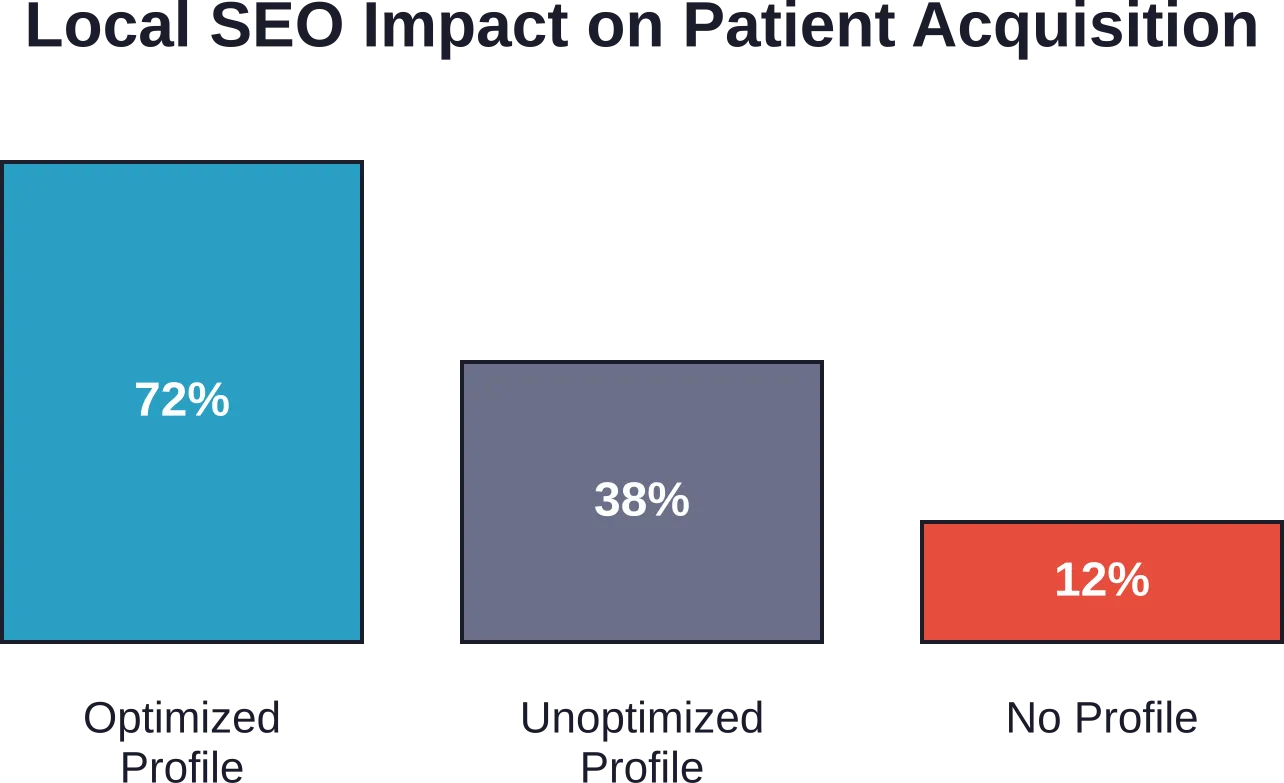
Start with your Google Business Profile. This free tool is the most powerful local marketing asset available. Claim and verify your listing, then optimize it completely.
That means accurate practice information (address, phone, hours), high-quality photos of your office and staff, regular posts about services and health tips, and consistent responses to every review—positive and negative.
Reviews matter enormously. Patients trust online reviews as much as personal recommendations. Make review generation a standard part of your patient experience. After successful procedures, ask satisfied patients to share their experience on Google.
Local SEO extends beyond Google Business. Ensure your practice appears accurately on health directories like Healthgrades, Vitals, and Zocdoc. Inconsistent information across platforms confuses search engines and hurts rankings.
Almost 50% of all American adults have trouble understanding information written above the 8th-grade reading level. That's a critical insight for content marketing.
Educational content serves two purposes: it helps patients make informed decisions about their eye health, and it establishes your practice as a trusted authority.
Start a blog focused on common eye conditions and questions. Write about cataracts, glaucoma, macular degeneration, diabetic retinopathy, and dry eye syndrome. Explain procedures like LASIK, cataract surgery, and retinal treatments in plain language.
Keep paragraphs short, use bullet points for lists, and avoid medical jargon. When technical terms are necessary, define them immediately.
Video content performs exceptionally well. Patient testimonials, procedure explainers, and "day in the life" videos humanize your practice and build emotional connections. Real talk: a three-minute video of a cataract surgery patient sharing their improved quality of life is worth more than ten pages of procedure descriptions.
According to the American Academy of Ophthalmology, effective patient education materials should use a pleasant, friendly, and respectful tone while presenting information clearly. This principle applies equally to marketing content.

Extuitive helps teams review ad concepts before launching campaigns. The platform uses AI models to forecast likely performance, compare creative options, and support better decisions around messaging and targeting.
For ophthalmology practices, this can be useful when choosing between service, appointment, or local awareness ads.
Extuitive can help with:
👉 Book a demo with Extuitive to review your ad ideas.
Social media marketing for ophthalmology isn't about posting randomly. It requires strategy, consistency, and understanding which platforms your target patients actually use.
But wait. Don't try to maintain active presences on every platform simultaneously. That's a recipe for burnout and inconsistent quality. Choose two platforms aligned with your target patients and do those well.
Your website isn't a digital brochure—it's a conversion tool. Every page should guide visitors toward booking appointments.
Email is still one of the highest-ROI marketing channels, especially for ophthalmology practices. It works well for patient retention, recall, and staying visible between visits.
Collect email addresses during initial consultations, follow-up visits, online appointment booking, and front desk check-ins. The more naturally it becomes part of the patient process, the stronger the list becomes over time.
Not every patient should receive the same emails. Cataract patients, LASIK candidates, and parents of pediatric patients all have different concerns.
Segmenting the list makes the content more relevant and usually improves engagement.
Create automated email sequences for key moments. For example, when someone books a consultation, send a short welcome series explaining what to expect, introducing the doctors, and outlining what makes the practice different.
This keeps patients informed without adding extra manual work for the team.
Regular newsletters can include eye health tips, practice updates, and reminders about annual exams.
Seasonal campaigns also work well, such as back-to-school eye exam reminders, summer UV protection tips, and winter dry eye advice.
Recall emails are especially important. Automated reminders help patients know when they are due for annual exams or follow-up care.
This keeps the practice top-of-mind and helps prevent gaps in preventive eye care.
In-person marketing still matters. Community visibility builds trust and establishes your practice as a local healthcare partner.
Sponsor local events aligned with your target demographic. Health fairs, senior center activities, school sports teams, and community festivals all provide exposure opportunities.
Consider hosting your own events. Free vision screening days, educational seminars about age-related eye conditions, or LASIK information sessions bring potential patients into your office in low-pressure settings.
Build strategic partnerships with complementary businesses and healthcare providers. Primary care physicians are particularly valuable referral sources. So are optometrists who don't perform surgery.
Develop a formal co-management program with local optometrists. They handle routine care and refer surgical cases to your practice. This model benefits everyone: optometrists retain patients for ongoing care, and you receive a steady stream of qualified surgical referrals.
Data-driven marketing separates growing practices from stagnant ones. The American Academy of Ophthalmology emphasizes using analytics to drive growth and improve patient engagement.
Track key metrics across all marketing channels: website traffic and conversion rates, cost per patient acquisition by source, return on investment for each marketing channel, patient lifetime value, and appointment show rates.
Use Google Analytics to understand how patients find and interact with your website. Which pages drive the most appointment bookings? Where do visitors drop off? What search terms bring qualified traffic?
Monitor your patient demographics continuously. Are you attracting the patient types you're targeting? If you're specializing in premium cataract surgery but most new patients are Medicaid beneficiaries, there's a disconnect between your marketing and your services.
Look, not every practice needs sophisticated analytics platforms. But even basic tracking reveals patterns that inform smarter budget allocation.
Online reputation can make or break a medical practice. Patients read reviews before choosing providers, and negative reviews disproportionately influence decisions.
Actively manage your online reputation across all platforms. Set up alerts for new reviews on Google, Healthgrades, Vitals, and other health directories.
Respond to every review—positive and negative—promptly and professionally. Thank patients for positive feedback. Address negative reviews with empathy, acknowledge concerns, and offer to resolve issues offline.
Never argue with reviewers publicly. Never violate HIPAA by discussing patient details. Keep responses brief, professional, and focused on demonstrating your commitment to patient satisfaction.
Proactively generate positive reviews by making requests a standard part of exceptional patient experiences. Train staff to identify highly satisfied patients and ask them to share their experiences online.
Differentiation is critical in competitive markets. Offering specialized services that competitors don't provides compelling reasons for patients to choose your practice.
Consider adding services that address unmet needs in your area: dry eye treatment centers, specialty contact lens fitting, low vision rehabilitation, or pediatric ophthalmology.
Premium service offerings also differentiate effectively. Advanced cataract surgery with premium IOLs, bladeless LASIK, or cutting-edge glaucoma treatments position your practice at the forefront of eye care technology.
Once you've developed specializations, market them aggressively. Create dedicated landing pages optimized for relevant search terms. Run targeted advertising campaigns. Educate referring providers about your specialized capabilities.
According to the American Academy of Ophthalmology, establishing yourself as an expert is one of the most successful marketing strategies for making your practice stand out.
Marketing isn't set-it-and-forget-it. What works today may not work next quarter. Patient behaviors shift, platforms evolve, and competition adapts.
Effective ophthalmology marketing requires strategic planning, consistent execution, and continuous optimization. The practices that thrive combine strong digital presence with authentic patient relationships and community engagement.
Start with the fundamentals: optimize your Google Business Profile, create valuable educational content, and build a systematic patient referral program. These high-impact, relatively low-cost strategies form the foundation for growth.
Layer in additional tactics based on your specific goals, budget, and competitive environment. Not every practice needs every marketing channel. Focus resources where they'll deliver the greatest return for your unique situation.
The healthcare landscape continues evolving rapidly. Patients expect more personalized, convenient experiences. Digital tools and platforms constantly introduce new capabilities. Staying informed and adaptable ensures your marketing remains effective as conditions change.
Ready to transform your practice's patient acquisition? Start by auditing your current marketing efforts against the strategies outlined here. Identify your biggest gaps, prioritize high-impact improvements, and commit to systematic implementation. The practices that invest strategically in marketing today position themselves for sustained growth tomorrow.


