Marketing Ideas for Garden Centers That Actually Work in 2026
Discover proven marketing ideas for garden centers that boost sales and customer loyalty. From social media strategies to seasonal promotions—grow your business.
Jun 5, 2026



Moving companies can grow faster by focusing on local SEO (especially Google Business Profile), building strong online reviews, partnering with real estate professionals, and investing in targeted digital ads. Smart movers spend $5K-$12K monthly on proven channels, track their cost per lead religiously, and convert 30-40% of customers into reviews to build trust in their communities.
Most moving companies throw money at marketing without a clear strategy. They pay for directories that don't convert, run ads nobody clicks, and wonder why their phone stays quiet during peak season.
Here's the reality: the top performers in the moving industry aren't spending more on marketing—they're spending smarter. They know exactly which channels bring in qualified leads, and they double down on what works.
According to digital marketing research, many brands have increased their digital marketing budgets in recent years, with significant portions making substantial increases. The moving industry follows this trend, with successful companies investing strategically in channels that deliver measurable returns.
The difference between a struggling moving company and one that's booked solid? A focused marketing strategy that builds local trust, captures high-intent searches, and turns happy customers into vocal advocates.
When someone types "movers near me" or "moving company in [city]," is your business showing up? If not, you're handing leads directly to competitors.
Local search dominates moving company lead generation. People don't browse through pages of results—they call one of the top three listings. That's it.
Start with Google Business Profile. This free tool is the single most powerful marketing asset for local moving companies. Claim your profile, verify your location, and fill out every section completely.
Upload high-quality photos of your team, trucks, and recent jobs. Add your service areas explicitly—Google needs to know you serve surrounding cities, not just your headquarters location.
Post updates weekly. Share moving tips, announce seasonal specials, or highlight a recent successful move. These posts signal to Google that your business is active and relevant.
The Federal Motor Carrier Safety Administration's Protect Your Move campaign emphasizes that legitimate movers should be transparent about their services and credentials. Make sure your USDOT number and licensing information appear clearly on your profile.
Respond to every review—positive or negative. Thank customers for five-star reviews. Address complaints professionally and offer to make things right. Potential customers read these responses and judge your customer service accordingly.
Build citations across local directories: Yelp, Angi, Thumbtack, and moving-specific platforms. Keep your business name, address, and phone number (NAP) identical everywhere.
Inconsistent information confuses search engines and tanks your rankings. If your website says "123 Main Street" but Yelp says "123 Main St," that's a problem.
Create location-specific pages on your website for each city you serve. Don't just duplicate the same content with different city names—that's thin content that Google penalizes. Write unique descriptions that reference local neighborhoods, landmarks, and community details.
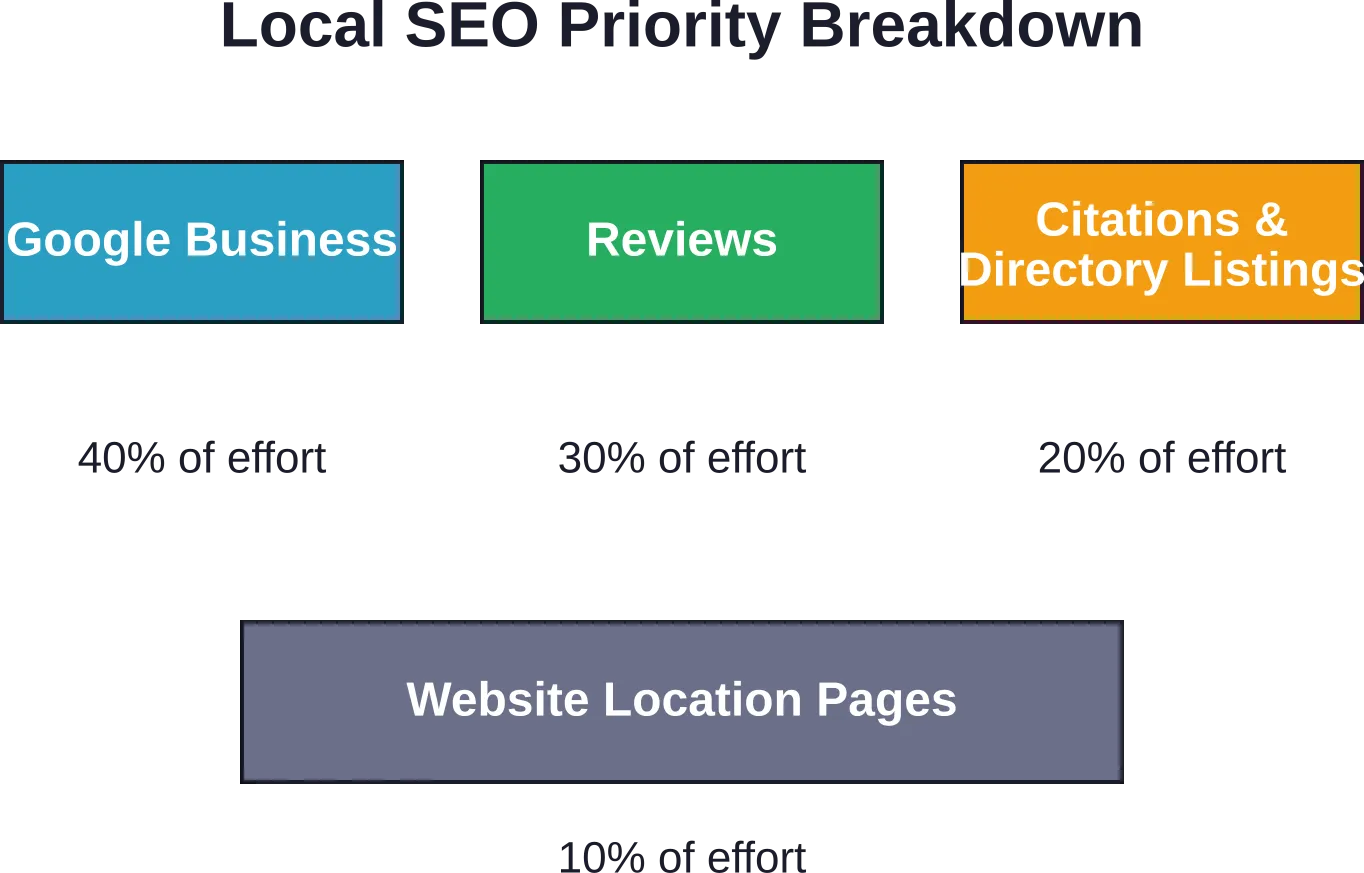
Online reviews are the new word-of-mouth. Potential customers trust them almost as much as personal recommendations from friends.
The Consumer Review Fairness Act protects customers' ability to share honest opinions about businesses in any forum, including social media. Smart moving companies embrace this transparency and actively encourage satisfied customers to share their experiences.
Top moving companies convert 30-40% of jobs into online reviews. That's not luck—it's a system.
Ask for reviews at the peak of customer satisfaction—right after a successful move when relief and gratitude are highest. Train your crew to mention it: "If we did a great job today, we'd really appreciate a quick Google review."
Send a follow-up email or text within 24 hours with direct links to your Google Business Profile and Yelp page. Make it ridiculously easy—one click should take them to the review form.
Don't violate Federal Trade Commission guidelines by offering incentives for positive reviews. The FTC banned fake reviews and testimonials in 2024, and penalties are serious. Ask for honest feedback, period.
But here's what you can do: offer a small thank-you gift for any review, positive or negative. A $5 coffee card for taking the time to share feedback keeps you compliant while showing appreciation.
Negative reviews happen. What matters is your response.
Respond within 24 hours. Acknowledge the issue, apologize genuinely, and offer to make it right. Take the conversation offline by providing a direct phone number or email.
Potential customers reading these exchanges see how you handle problems. A professional, empathetic response to criticism often builds more trust than a dozen five-star reviews.
Real estate agents are lead-generating machines for moving companies. Every closing means someone needs movers.
Build relationships with local agents, especially those who consistently close deals. Offer them something valuable: a referral discount for their clients, priority scheduling during busy season, or co-branded marketing materials.
Agents want to provide value to their clients beyond finding the right house. When they can confidently recommend a reliable moving company, it strengthens their client relationships.
Create a simple referral program. For every client an agent sends your way, send them a thank-you note and track the referrals. Consider a quarterly thank-you gift for your top referral partners—nothing extravagant, just genuine appreciation.
Show up at real estate networking events. Join the local chamber of commerce. Sponsor open houses or real estate appreciation events. Visibility matters in relationship-driven industries.
According to the Small Business Administration, small businesses have created a substantial majority of net new private sector jobs over recent decades. Building strong local business partnerships taps into this economic ecosystem and creates mutual growth opportunities.
Paid advertising works when done right. The keyword is "right."
Movers spending over $6K monthly on Google Ads with proper tracking and optimization see close rates around 50%. Those running ads without tracking waste most of their budget.
Social media ads work differently. These platforms excel at building brand awareness and retargeting website visitors.
Create ads targeting people who recently engaged with real estate content, joined local community groups, or indicated a recent move. Facebook's targeting is incredibly precise for life events.
Use video content showing your team in action—loading trucks carefully, wrapping furniture professionally, interacting positively with customers. Authentic behind-the-scenes content builds trust better than stock photos.
Research indicates that consumers spend significant daily time on smartphones. Mobile-optimized ads with clear calls-to-action capture this engaged audience.

A lot of moving ads end up looking interchangeable, especially during busy seasons when every company pushes similar offers at the same time. Instead of waiting for campaign results after launch, Extuitive helps teams assess creative direction earlier with predictive advertising analysis and AI consumer simulations.
What Extuitive helps businesses review before launch:
👉Book a demo with Extuitive and get earlier insight into which campaigns may deserve more budget.
Content marketing isn't about churning out blog posts nobody reads. It's about answering the questions your potential customers are already asking.
What do people search before hiring movers? "How much does it cost to move to a 3-bedroom house?" "What should I pack myself?" "How far in advance should I book movers?"
Write detailed, honest answers to these questions on your website. Use real data from your business—average costs for different home sizes in your area, typical booking timelines during peak vs. off-season.
Video content performs exceptionally well for service businesses. According to the Small Business Administration's Market Your Business with Video event description, businesses are increasingly preparing to add videos to their marketing messages as internet traffic increasingly comes from video.
Create short videos showing proper packing techniques, explaining how estimates work, or touring your warehouse. Authentic, helpful content builds trust before the first phone call.
Post these videos on YouTube with location-specific titles and descriptions. YouTube is the internet's second-largest search engine, and it's owned by Google—videos rank in both search results.
Moving companies thrive on local reputation. The more visible you are in your community, the more trusted you become.
Sponsor local youth sports teams. Your company name on jerseys costs less than you'd spend on a week of Google Ads, and it builds goodwill that lasts years.
Participate in community events. Set up a booth at farmers markets or street fairs. Hand out branded moving checklists and refrigerator magnets—practical items people keep.
Nextdoor has become a powerful platform for local service businesses. Neighbors recommend businesses to each other constantly, and these recommendations carry enormous weight.
Claim your business on Nextdoor. Respond to recommendations and messages quickly. Consider Nextdoor's local advertising options, which target specific neighborhoods within your service area.
Community discussions on platforms like Reddit reveal that moving company reputation spreads quickly through local networks. One great experience gets shared. So does one terrible experience. Consistency in service quality matters more than any marketing tactic.
Marketing without measurement is gambling. Top-performing moving companies track every lead source religiously.
Use unique phone numbers for different marketing channels. Google Ads gets one number, Facebook gets another, your website gets a third. Call tracking software shows exactly which channels drive qualified leads.
Cost per lead tells you how much you're paying to get someone interested. Cost per booking tells you how much you're paying to actually close business. These numbers vary widely by channel.
Close rate by source reveals which channels bring in the highest-quality leads. Real estate referrals might close at 70%, while broad Facebook ads might close at 20%. Both can be profitable if you price your marketing spend correctly.
Customer lifetime value matters more than single-job profit. Customers who use you once often use you again for future moves or refer friends. Calculate the total value, not just the initial booking.
Smart movers spend 70-80% of their budget on proven channels that consistently deliver results. The remaining 20-30% goes to testing new platforms and strategies.
If Google Ads consistently brings qualified leads at a profitable cost, that's your core spend. But allocate a testing budget to try Nextdoor ads, sponsor a local podcast, or experiment with direct mail to new homeowners.
Some tests will fail. That's fine. The goal is finding one or two new channels that work well enough to join the proven 70%.
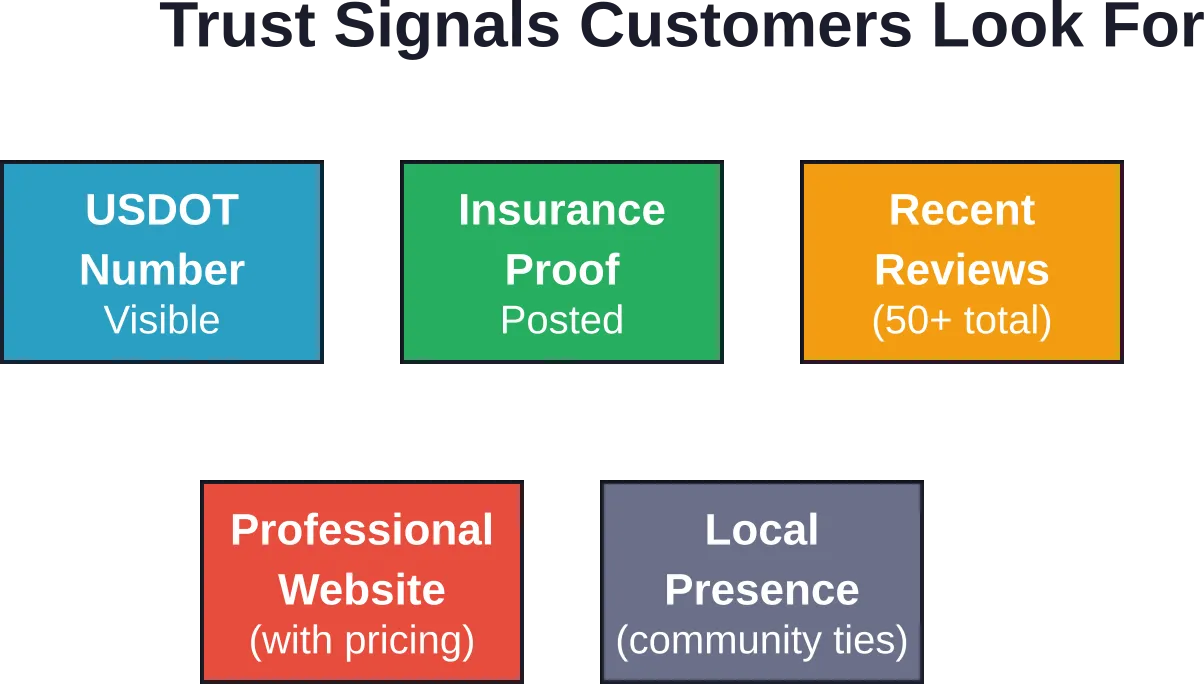
The moving industry faces scrutiny due to fraud and scams. Legitimate companies must differentiate themselves clearly.
Display your USDOT number prominently on every marketing asset—website, business cards, trucks, emails. This Department of Transportation identifier proves you're a registered interstate mover.
According to the Federal Motor Carrier Safety Administration, movers must be transparent about their services and credentials to help consumers avoid moving scams. Make your licensing information easy to find.
Show proof of insurance. Many customers don't know to ask about liability coverage until something goes wrong. Proactively displaying your insurance credentials builds immediate trust.
The FTC requires truthful advertising across all channels. Don't make unsubstantiated claims about being the "best" or "fastest" without evidence. Honesty in marketing protects your business and serves customers better.
Moving demand fluctuates dramatically by season. Smart marketing adapts to these cycles.
Summer is peak season—May through September accounts for roughly 70% of annual moves. Increase ad spend during these months to capture demand, but expect higher competition and cost per click.
Winter is a slow season. Rather than slashing marketing entirely, shift strategy. Target corporate relocations and military moves, which happen year-round. Offer off-season discounts to people with flexible timing.
Start ramping up marketing in February and March. People planning summer moves start researching 2-3 months in advance. Early visibility captures bookings before peak competition hits.
The gap between struggling moving companies and thriving ones isn't talent or truck count. It's a marketing discipline.
Companies that track every lead source, measure close rates by channel, and systematically optimize based on data consistently outperform competitors who spend blindly.
Start simple. Claim and optimize your Google Business Profile this week. Implement a review request system for every job. Reach out to three real estate agents in your area with a partnership proposal.
These foundational tactics cost almost nothing but time. They build a local presence and trust that expensive advertising can't buy.
Then layer in paid advertising once you have tracking systems in place. Test small budgets on Google Ads. Experiment with Facebook targeting. Measure everything.
Marketing for moving companies isn't complicated, but it does require consistency. The companies booking jobs months in advance aren't lucky—they're systematic. They show up in local searches, convert satisfied customers into reviewers, build strategic partnerships, and track what works.
Digital marketing represents a significant and growing portion of global advertising spending. Moving companies that embrace digital channels and measure their performance position themselves for sustainable growth.
Your next customer is searching right now. The question is whether they'll find you or your competitor.


