Tools to Scrape Competitor Facebook Ads: What Actually Works
Discover tools that help you analyze and track competitor Facebook ads, creatives, and strategies, without guessing what works.
Jan 26, 2026



Quick Summary: Aircraft service businesses must combine technical expertise with strategic marketing to stand out in a specialized industry. Digital channels, reputation management, targeted content, and relationship-based strategies deliver measurable results when tailored to aviation buyers' unique decision-making process. Successful campaigns focus on credibility, compliance expertise, and demonstrating operational reliability.
Aircraft service marketing operates in one of the most regulated, high-trust environments in any industry. When aircraft operators choose a maintenance provider, repair facility, or parts supplier, the stakes involve safety, compliance, and operational continuity. Traditional marketing playbooks don't translate directly.
So where does that leave aircraft service businesses trying to grow their customer base? The challenge isn't just standing out—it's building credibility with an audience that demands proof before they'll ever consider switching providers.
Here's the thing though: the fundamentals of effective marketing still apply. But they require adaptation to aviation's unique purchasing cycles, regulatory environment, and decision-making dynamics. The businesses gaining market share in 2026 are those that combine technical authority with strategic visibility.
Aircraft operators don't impulse-buy maintenance services. The typical decision cycle spans months, involves multiple stakeholders, and requires extensive due diligence. Flight departments, maintenance managers, and chief pilots each have distinct concerns—from regulatory compliance to turnaround time to cost predictability.
Most purchasing decisions begin with a specific need: scheduled maintenance events, unexpected repairs, parts sourcing, or capacity constraints with existing providers. Operators start researching capabilities, certifications, turnaround benchmarks, and reputation indicators long before they make contact.
This extended evaluation period creates marketing opportunities. When potential customers are researching, your business needs to be visible, credible, and helpful. That means showing up in search results, demonstrating expertise through content, and maintaining a reputation that withstands scrutiny.
Generic aviation content doesn't move the needle. What works is hyper-specific material that addresses real operational challenges your customers face. Think about the questions operators ask before selecting a service provider: certification scope, turnaround commitments, parts availability, AOG response capabilities.
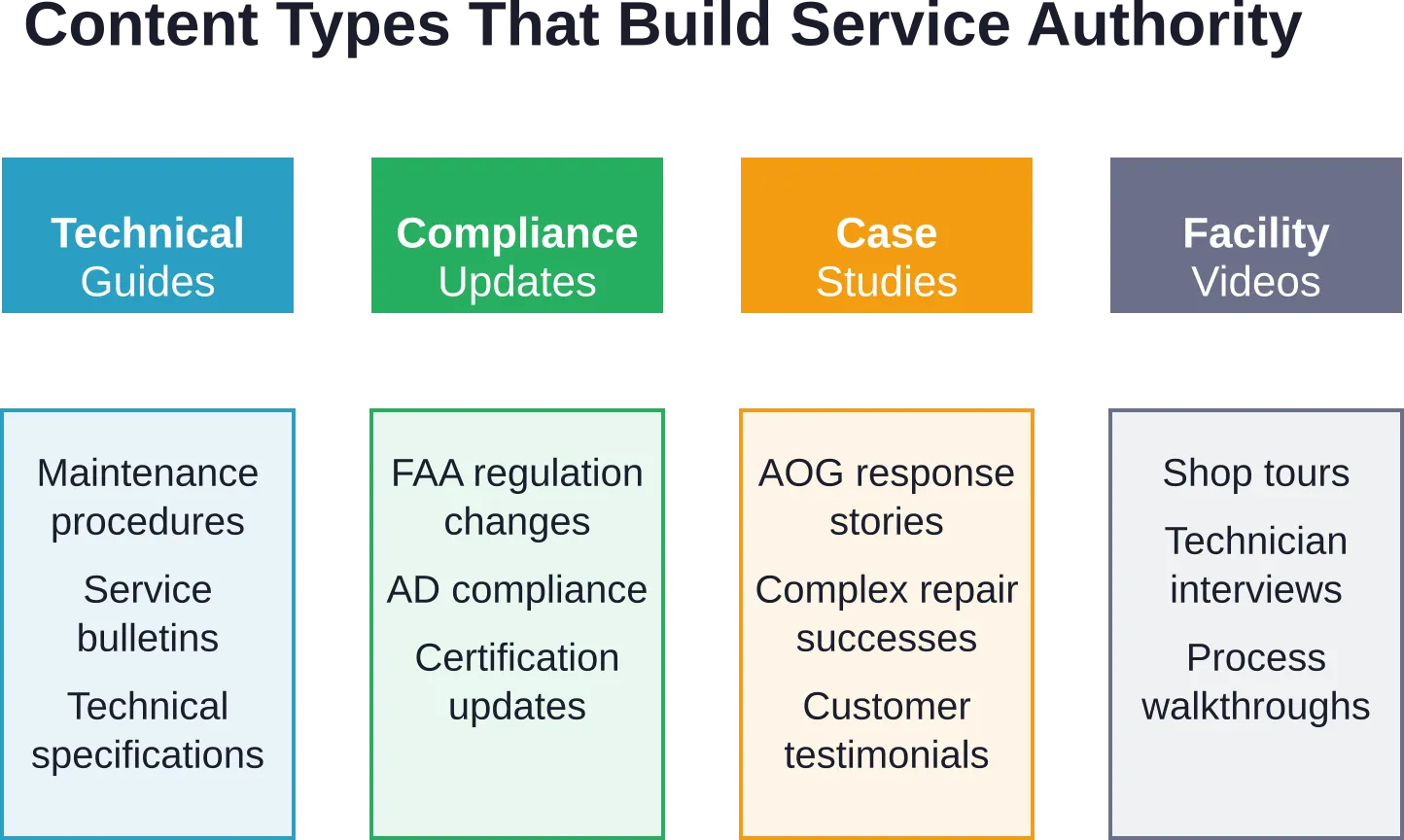
Create content that answers those questions before prospects ever pick up the phone. Technical blog posts explaining complex maintenance procedures, guides to regulatory compliance updates, case studies showing how you've solved specific problems—these establish credibility in ways that sales pitches never can.
Video content performs particularly well for aircraft services. Facility tours, technician interviews, time-lapse maintenance sequences, and equipment demonstrations give prospects transparency. They're evaluating not just your capabilities but your operation's professionalism and attention to detail.
The Federal Aviation Administration provides guidance on standardized communication materials for safety programs, emphasizing clear messaging to various audiences through multiple channels. This principle applies to customer-facing communications: standardization and clarity build trust.

Extuitive helps businesses predict how ad creatives may perform before they go live. It compares copy, visuals, offers, and audience angles, then shows which ideas look stronger or weaker before campaign budget is spent.
For aircraft service companies, this can help review maintenance, repair, inspection, or B2B campaign ideas before running them.
Extuitive can help with:
👉 Book a demo with Extuitive to review your ad ideas.
When an aircraft goes AOG (Aircraft on Ground), operators aren't browsing—they're searching desperately for qualified providers who can respond immediately. Local SEO becomes critical. If someone searches "Gulfstream maintenance near Dallas" or "King Air avionics repair Phoenix," can they find your facility?
Service pages need to be granular and keyword-specific. Don't just have one generic "aircraft maintenance" page. Create dedicated pages for each aircraft type, service category, and capability you offer. That means separate, detailed pages for different airframe families, specific avionics systems, engine programs, and component services.
Technical SEO matters more in aviation than most industries. Site speed affects mobile searches from FBOs and hangars where connectivity can be spotty. Schema markup helps search engines understand your certifications, service offerings, and location details. An SSL certificate isn't optional—security signals matter when prospects are evaluating trustworthiness.
Email remains one of the highest-ROI marketing channels for aircraft services. But generic newsletters don't cut it. Segmentation makes the difference between campaigns that get ignored and those that drive action.
Based on available data from aviation marketing campaigns, email performance varies significantly by targeting precision. Broadly targeted campaigns might see 29.7% open rates, while tightly segmented messages to specific aircraft owner groups can achieve 41.9% opens. Click-through rates, though modest in absolute terms, indicate genuine interest—campaigns have shown 0.3% to 0.8% CTR depending on offer relevance and audience match.
The most effective email strategies align with the maintenance calendar. Operators know when their next annual inspection is due, when avionics mandates take effect, when service bulletins require compliance. Timely, relevant reminders positioned as helpful service prompts perform far better than generic promotional messages.
In aviation, reputation is not just marketing - it is currency. Operators talk at conferences, in forums, and through industry groups. One missed deadline or poorly handled repair can affect how the market sees a business for years.
Good service comes first, but satisfied customers still need a simple way to share their experience. Request reviews after successful repairs, inspections, upgrades, or project completions.
Place testimonials on key website pages, especially near service details and contact forms. Case studies can also show how the company handles technical issues, tight timelines, or unusual repair needs.
Watch aviation forums, social media, review platforms, and professional groups. Respond to criticism calmly and address concerns publicly when appropriate.
Prospective customers often judge how a company handles problems as much as they judge its technical capabilities.
Organic visibility takes time to build. Paid search advertising delivers immediate positioning for high-intent searches. When operators search for emergency services, specialized capabilities, or time-sensitive maintenance, properly structured ads put your business front and center.
Many aircraft service sales happen through referrals rather than outbound marketing. Building formal and informal referral networks accelerates growth. Think about who already has relationships with your ideal customers: aircraft brokers, FBO staff, aircraft management companies, insurance brokers, training providers.
Create partnership programs that make it easy for referral sources to recommend your services. Provide them with information they can share with clients. Offer guaranteed response times or preferential scheduling for referred customers. Recognize and reward partners who send business your way.
Industry associations provide networking opportunities that lead to business relationships. Active participation in groups like the National Air Transportation Association, National Business Aviation Association, or aircraft type-specific clubs puts you in contact with decision-makers. Sponsor events, present at conferences, contribute to association publications.
Operators face constant regulatory changes, compliance deadlines, and technical decisions. Becoming a go-to resource for guidance builds relationships that eventually convert to service contracts. Develop resources that genuinely help your target customers navigate complexity.
The Federal Aviation Administration published guidance addressing procedural non-compliance—one of the most pervasive human factors issues in aviation maintenance, with documented research showing it as a leading cause of maintenance events. Creating content that helps operators understand and implement FAA guidance demonstrates both technical knowledge and commitment to safety culture.
Webinars work particularly well for educational marketing. Host sessions on upcoming regulatory changes, maintenance best practices, cost-management strategies, or technical deep-dives on complex systems. Record and repurpose the content. Gate some materials behind registration forms to capture lead information.
Downloadable resources—checklists, planning guides, compliance calendars, maintenance tracking templates—provide ongoing value while keeping your brand visible. Every time an operator references your guide, they're reminded of your expertise.
Aircraft operators want to see where their aircraft will be serviced and who will be working on them. Transparency builds confidence. Use photography and video extensively to document your facility, capabilities, and team credentials.
Facility tours shouldn't just show clean hangars—highlight specific capabilities that differentiate you. Advanced diagnostic equipment, specialized tooling, climate-controlled paint booths, parts inventory systems, quality assurance processes. The details matter to operators evaluating whether you can handle their aircraft properly.
Introduce your team. Profile senior technicians, inspectors, and customer service personnel. Highlight certifications, experience, and specialized training. Aviation is a relationship business—operators want to know the people they'll be working with, not just the company name.
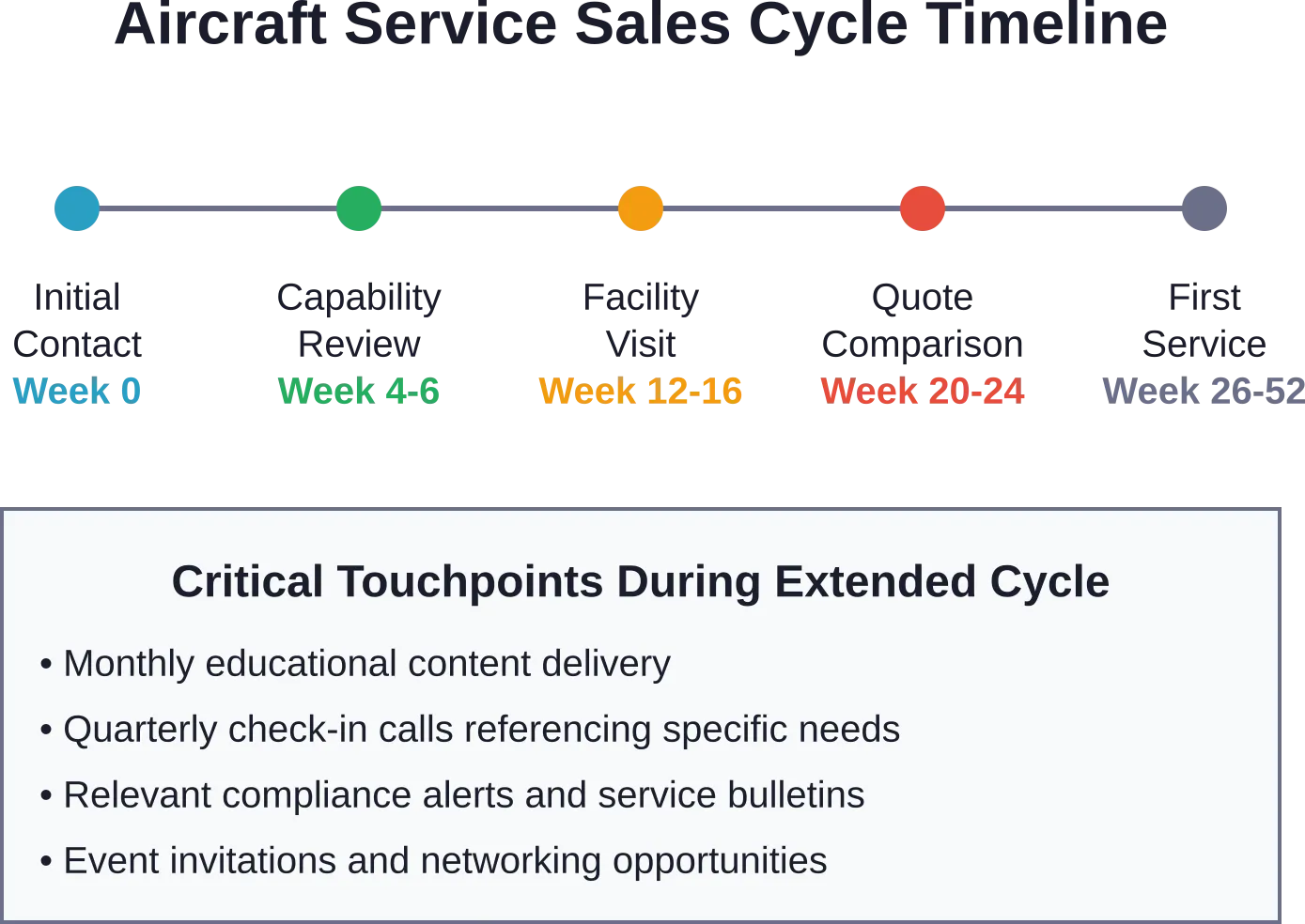
Aviation sales cycles can span six months to two years from initial contact to first service event. Managing these extended relationships manually leads to lost opportunities. Customer relationship management systems keep prospect interactions organized and ensure consistent follow-up.
Track where prospects are in their decision process. Note their aircraft type, typical mission profile, current service provider, contract renewal dates, and specific concerns they've mentioned. This intelligence guides personalized outreach that addresses their actual needs rather than generic pitches.
Automated workflows ensure prospects receive appropriate follow-up at the right intervals. But automation should feel personal. Template emails need customization. Scheduled check-ins should reference previous conversations. The goal is systematic relationship management, not robotic spam.
Marketing without measurement is just expense. Aircraft service businesses need clear visibility into which channels generate qualified leads, which campaigns drive revenue, and where marketing budget delivers return on investment.
Track metrics that matter for long-cycle B2B sales: lead source, lead quality score, time-to-conversion, customer acquisition cost, lifetime customer value. Vanity metrics like website traffic or social media followers don't directly correlate with revenue. Focus on measurements tied to business outcomes.
Attribution gets complicated with extended sales cycles and multiple touchpoints. First-touch attribution (what brought them in initially) and last-touch attribution (what finally converted them) both miss the complexity of the real journey. Multi-touch attribution models provide more accurate pictures of how various marketing activities contribute to conversions.
Aircraft service marketing faces constraints that don't apply in most industries. Regulatory compliance affects what claims businesses can make. Safety-critical nature means operators are inherently conservative about switching providers. Long customer evaluation periods strain marketing budgets.
Work within these realities rather than fighting them. Emphasize compliance credentials prominently. Document quality processes extensively. Provide references proactively. Make the switching decision as low-risk as possible by offering trial services or money-back guarantees where feasible.
Privacy and confidentiality matter more in aviation than many sectors. Corporate flight departments often serve executives who value discretion. Customer testimonials might need to be anonymous. Case studies may require details changed to protect client identity. Respect these sensitivities while still demonstrating capabilities.
Digital marketing drives much modern customer acquisition, but aviation remains a relationship-driven industry. Face-to-face interactions at trade shows, conferences, and fly-ins build trust in ways that online channels can't fully replicate.
Event participation requires strategy beyond just renting booth space. Plan pre-show outreach to schedule meetings with prospects. Host hospitality events that facilitate networking in more relaxed settings. Follow up promptly post-show while your conversations are still fresh in attendees' minds.
Speaking opportunities at industry events establish thought leadership more effectively than booth presence alone. Submit session proposals on topics where your team has genuine expertise. Present data-driven insights, not thinly veiled sales pitches. The credibility gained from platform visibility translates to inbound interest.
Marketing ideas for aircraft service businesses work when they respect the industry's unique characteristics: extended decision cycles, relationship-driven sales, regulatory environment, and high-trust requirements. Generic marketing playbooks require substantial adaptation.
The businesses gaining market share combine technical credibility with strategic visibility. They show up in search results when operators are researching. They provide educational content that positions them as helpful experts. They maintain relationships systematically throughout long evaluation periods. They measure results and refine based on data.
None of this happens overnight. Building marketing momentum takes consistent effort, realistic budgets, and commitment to serving customers before selling to them. But for aircraft service providers willing to invest strategically, marketing delivers measurable growth and competitive differentiation.
Start with the fundamentals: clear positioning, optimized digital presence, systematic content creation, and relationship management. Build from there based on what your metrics tell you works for your specific market and service offerings. The sky's not the limit—it's the opportunity.


