Best Tools to Create TV Video Ads with AI in 2026
Explore top platforms using AI to generate high-quality video ads for TV. Cut production costs and time while delivering professional commercial results.
Mar 24, 2026



Quick Summary: Effective marketing for divorce lawyers requires a multi-channel approach combining local SEO, empathy-driven content, strategic advertising, and reputation management. With 12% of attorneys self-employed and divorce rates fluctuating across states, family lawyers need targeted strategies that address emotionally vulnerable clients searching for legal help. The most successful divorce attorney marketing blends digital visibility with trust-building to convert high-intent searches into consultations.
Legal services employed 51% of all lawyers in 2024, according to Bureau of Labor Statistics data. That's intense competition. And for divorce attorneys specifically, the challenge doubles: potential clients aren't just comparing firms—they're navigating one of the most emotionally charged decisions of their lives.
Here's the thing though—divorce clients don't behave like other legal clients. They hesitate. They research obsessively. They need reassurance before they'll pick up the phone.
That means generic legal marketing won't cut it. Divorce attorney marketing demands strategies built around empathy, local visibility, and trust. This guide breaks down 19 actionable marketing ideas that can help family law practices attract qualified leads and convert them into long-term clients.
Most legal marketing follows predictable patterns: show expertise, list credentials, request a consultation. But divorce cases involve families, finances, children, and profound uncertainty.
Clients searching for "divorce lawyer near me" aren't impulse shopping. They're scared. According to U.S. Census Bureau research, parental divorce negatively impacts children well into adulthood—income drops 9% to 13% for children who experienced early childhood divorce, and teen birth rates jump 63% following the split. Parents know the stakes.
So marketing that leads with aggressive language or generic legal jargon misses the mark. What works? Empathy-first messaging. Educational content that demystifies the process. Transparent communication about costs and timelines.
The national divorce rate was 7.1 per 1,000 women aged 15 and older in 2022, down from 9.8 in 2012. However, rates vary by state—in 2022, Washington, D.C., had among the highest marriage rates and Arkansas had among the highest divorce rates. That geographic variation means local visibility isn't optional—it's foundational.

Divorce-related advertising usually fails when firms rely on aggressive legal language or generic consultation ads that sound the same as everyone else.
Extuitive helps businesses evaluate ad creatives before launch using campaign data and AI consumer simulations. For divorce lawyers, this can make it easier to understand which approaches, visuals, and campaign directions are more likely to connect with people looking for clarity and trust during a difficult decision.
Turn to Extuitive to:
Book a demo with Extuitive and see which campaigns are more likely to perform before launching your next ads.
When someone types "divorce attorney near me," that's the highest-intent search you can capture. They're ready to hire. Now.
Local SEO ensures your firm appears in that critical moment. Start with Google Business Profile optimization. Complete every field: hours, services, service areas, photos of your office, team headshots. Upload new posts weekly—case results (anonymized), legal updates, client testimonials.
But here's where most firms stumble: they claim their listing and forget it. Active profiles rank higher. Respond to every review within 24 hours. Add new photos monthly. Post Q&A answers to common divorce questions directly in your profile.
On your website, create location-specific pages. Not thin doorway pages—substantive content. "Divorce Attorney in [City]" pages should cover local court procedures, county-specific filing requirements, and hyperlocal concerns. Link to the actual county clerk's website. Mention the courthouse address.
More than 85% of people use the internet to search for local services. For divorce lawyers competing in major metros, local SEO separates firms that thrive from firms that struggle.
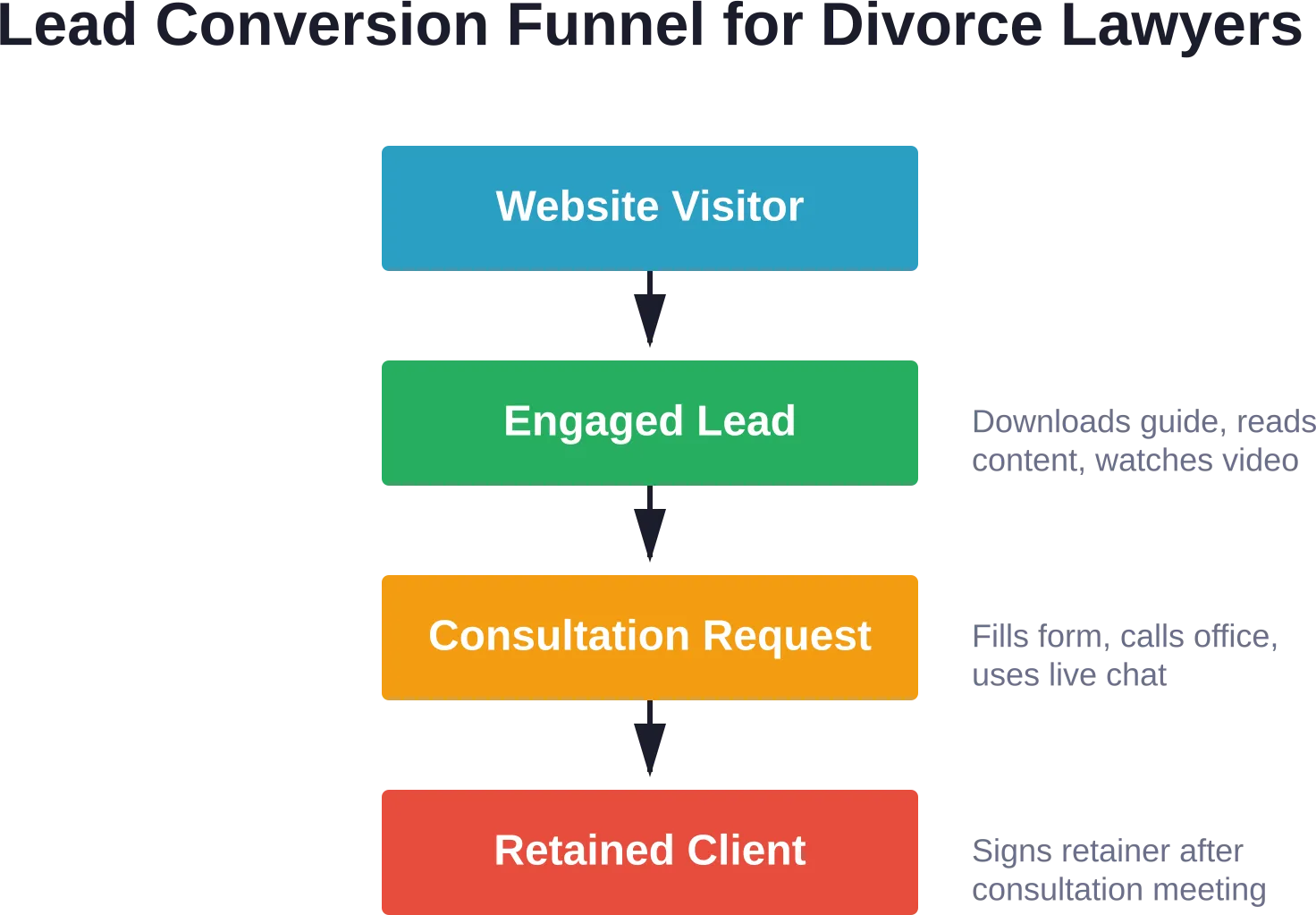
Traffic means nothing without conversions. A divorce attorney website must guide emotionally overwhelmed visitors toward a single action: scheduling a consultation.
Design principles that convert:
Remove distractions. Every page should have one primary call-to-action. Multiple competing buttons confuse visitors and tank conversion rates.
Real talk: most law firm websites bury the contact form three clicks deep. Don't do that. Make it impossible to miss.
Local Services Ads appear above regular Google Ads in search results, with a green "Google Guaranteed" badge. For divorce attorneys, that badge carries weight—it signals legitimacy to anxious searchers.
These ads operate on a pay-per-lead model, not pay-per-click. You're charged when someone calls or messages through the ad, not for every click. That often delivers better ROI than traditional PPC.
The vetting process requires background checks and license verification, but that friction becomes a competitive advantage once you're approved. Many competitors won't bother, leaving more visibility for firms that do.
Set your budget conservatively at first. Monitor which practice areas generate quality leads. Divorce consultations? Child custody modifications? Spousal support disputes? Adjust geographic targeting and budgets based on performance data.
Google Ads remains one of the fastest ways to generate divorce attorney leads. For every $1 spent in Google Ads, businesses make an average of $2. About 65% of clicks on a search results page go to one of the top 3 paid ads.
But legal keywords are expensive. "Divorce lawyer" can cost $50-150 per click in competitive markets. Make every click count.
Strategies that work:
Run ads during business hours when staff can answer phones immediately. A divorce client who reaches voicemail will call the next lawyer on the list.
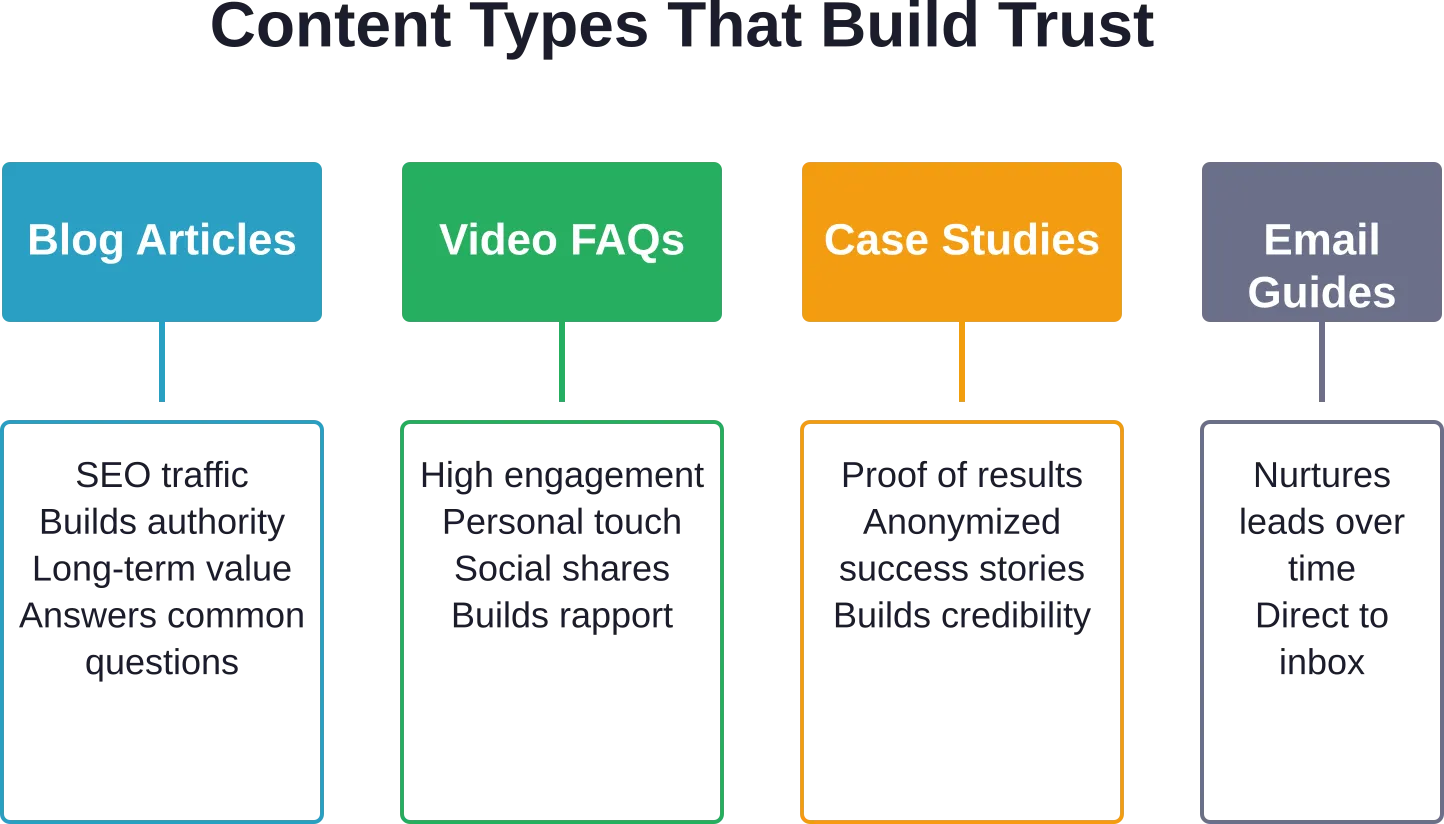
Content marketing builds trust before the consultation. Divorce clients consume massive amounts of information before contacting an attorney. Be the source they remember.
Blog topics that attract high-intent traffic:
Write in plain English. Legal jargon intimidates people who are already anxious. Explain processes step-by-step. Acknowledge emotions—"This process feels overwhelming. Here's what happens next."
Include clear next steps at the end of every article: "If you're ready to discuss your situation, schedule a confidential consultation."
Online reviews influence divorce attorney selection more than almost any other factor. Potential clients read reviews obsessively, looking for red flags and reassurance.
A systematic review generation process matters. After successful case resolution, send a follow-up email thanking the client and requesting a review. Make it easy—include direct links to Google, Avvo, Lawyers.com.
Timing matters. Request reviews when client satisfaction peaks: right after a favorable settlement, following a successful custody modification, when the final decree is signed.
What about negative reviews? Respond professionally, never defensively. Acknowledge the concern, offer to discuss offline, and demonstrate your commitment to client satisfaction. Future prospects read your responses as closely as the reviews themselves.
Monitor review sites beyond Google: Avvo, Martindale-Hubbell, Yelp, Facebook. Set up alerts so you can respond quickly.
Most divorce attorney website visitors leave without contacting you. They're researching, comparing, hesitating.
Retargeting ads keep your firm visible as they continue their search. Someone visits your child custody page? Show them ads highlighting your custody case experience. They read your blog post about high-net-worth divorces? Target them with ads about asset protection.
Retargeting works because divorce decisions have long consideration cycles. Prospects might research for weeks or months before hiring. Strategic ad reminders ensure your firm stays in consideration when they're finally ready.
Cap frequency to avoid irritation—three to five impressions per week is plenty. Too many ads feel creepy; the right amount feels helpful.
Email marketing nurtures leads who aren't ready to hire immediately. Build your list through website opt-ins: "Download our free guide to divorce in [State]" or "Get our child custody checklist."
Send valuable content, not sales pitches:
Segment your list by interest. Someone who downloaded your property division guide has different concerns than someone who requested your child custody checklist. Tailor content accordingly.
Professional presentation matters. Use clean design, proofread carefully, and include clear unsubscribe options. One typo-filled email undermines weeks of trust-building.
Social media for divorce lawyers isn't about going viral—it's about consistent visibility and community trust-building.
Focus on one or two platforms rather than spreading thin. For most family law practices, Facebook and LinkedIn deliver the best results. Facebook reaches potential clients directly; LinkedIn connects with referral sources like financial advisors and therapists.
Content ideas for social media:
Avoid political commentary and anything that could alienate potential clients. Divorce crosses all demographics.
Paid social advertising can target specific demographics and interests: married individuals, certain age ranges, specific locations. Facebook's targeting capabilities allow precise audience definition.
Video builds trust faster than text alone. Seeing an attorney speak creates connection before the first consultation.
Start simple. Record short answers to frequently asked questions: "What's the difference between contested and uncontested divorce?" "How is child support calculated in [State]?" "What should I bring to my first consultation?"
Equipment needs are minimal—a modern smartphone, good lighting, and a quiet room produce acceptable quality. Invest in a lavalier microphone for clear audio.
Publish videos on YouTube (the second-largest search engine), embed them on relevant website pages, and share on social media. Add transcripts for accessibility and SEO benefits.
Longer-form content works too: webinars on divorce planning, virtual Q&A sessions, detailed case study discussions (properly anonymized).
Referrals from trusted professionals carry enormous weight. Financial advisors, therapists, real estate agents, and accountants all encounter clients considering divorce.
Cultivate these relationships intentionally. Take referral sources to lunch. Provide them with your firm overview and practice area details. Offer to be a resource—answer quick questions, provide legal insights relevant to their work.
Make referring easy. Give them business cards to pass along. Create a simple one-page PDF overview of your divorce services they can email to clients.
Track referral sources and thank them when clients retain you. A handwritten note or small gift acknowledges their trust and encourages future referrals.
More than half of legal searches now happen on mobile devices. A website that's clunky on mobile loses clients before the conversation starts.
Mobile optimization requirements:
Test your website on multiple devices—iPhone, Android, tablets. Better yet, use Google's Mobile-Friendly Test tool for objective feedback.
Click-to-call functionality is essential. On mobile, every phone number should be immediately clickable.
Community workshops position attorneys as accessible experts while generating leads. Partner with libraries, community centers, or churches to host "Divorce 101" seminars.
Cover basics: the divorce process, common mistakes, how to choose an attorney, what to expect financially. Avoid giving specific legal advice—the goal is education and relationship-building.
Virtual webinars expand reach beyond your immediate area. Promote through social media, email lists, and local online community groups. Record sessions for later use as lead magnets.
Collect contact information at registration. Follow up with attendees offering a discounted or complimentary consultation.
General divorce attorney messaging blends into noise. Niche specialization cuts through.
Potential niches:
Create dedicated landing pages for each niche. Develop content addressing specific concerns. Build credentials relevant to that specialty—certifications, training, case experience.
Niche marketing often delivers higher-value clients willing to pay premium fees for specialized expertise.
Live chat captures leads who won't pick up the phone but have immediate questions. Divorce prospects often research outside business hours—evenings and weekends.
If 24/7 staffing isn't realistic, use chatbots for after-hours queries. A bot can collect contact information, answer basic questions, and schedule callbacks during office hours.
During business hours, human chat operators convert better. Train them to be empathetic, helpful, and skilled at transitioning conversations toward consultation bookings.
Response speed matters. Answer chat messages within seconds, not minutes. Every delay increases the chance prospects will click away.
Lead magnets—free downloadable resources—build email lists and demonstrate expertise simultaneously.
Effective lead magnet ideas:
Make them genuinely useful, not thinly veiled advertisements. Provide real value. Include your firm branding and contact information, but let the content speak for itself.
Gate these resources behind a simple form: name and email address. Then deliver via automated email sequence.
Without data, marketing becomes expensive guesswork. Track which channels generate consultations and which waste budget.
Essential metrics to monitor:
Use call tracking numbers to identify which marketing sources drive phone calls. Implement goal tracking in Google Analytics to measure form submissions.
Review data monthly. Double down on what works; cut what doesn't. Marketing effectiveness changes over time—what worked last year might underperform now.
Legal marketing faces stricter regulation than most industries. State bar associations enforce specific rules about attorney advertising.
Common requirements:
Review your state bar's advertising rules carefully. When in doubt, consult your malpractice insurance carrier or ethics counsel.
Ethical violations can result in disciplinary action, fines, or suspension. No marketing result is worth professional risk.
Effective marketing isn't set-and-forget. Markets change. Competitors adapt. Algorithms update.
Build a culture of continuous testing:
Small improvements compound. A 5% increase in website conversion rate might generate dozens of additional consultations annually.
Document what works. Create playbooks for successful campaigns so you can replicate results and train new team members.
Return on investment separates successful marketing from expensive hobbies. For divorce attorneys, ROI calculation requires tracking acquisition cost against lifetime client value.
Start with baseline metrics. What's your average case value? If you handle both contested and uncontested divorces, calculate separate averages—they differ dramatically.
Then track cost per retained client by channel. If you spend $3,000 monthly on Google Ads and generate 10 consultations resulting in 3 retained clients, your cost per client is $1,000. Compare that against your average case value.
But don't stop there. Consider lifetime value. Satisfied divorce clients refer to family and friends. They return for post-decree modifications. They recommend you to colleagues. A client acquired for $1,000 might generate $15,000 in direct fees plus $20,000 in referral business over five years.
That broader perspective changes investment decisions. Channels that seem expensive on first-client acquisition look different when calculating long-term value.
Even experienced practitioners make preventable marketing errors. Here are the costly ones:
Marketing continues evolving. Staying ahead requires awareness of emerging trends.
Artificial intelligence tools are changing content creation and customer service. Chatbots handle initial screening. AI-assisted writing speeds blog production. Predictive analytics identify high-value prospects.
But technology doesn't replace human connection—it enhances it. AI handles repetitive tasks, freeing attorneys to focus on relationship-building.
Video content continues gaining importance. Attention spans favor short-form video over long text articles. Attorneys comfortable on camera have a competitive advantage.
Privacy concerns are reshaping digital advertising. Cookie deprecation affects retargeting. First-party data—information collected directly from your audience—becomes increasingly valuable. Build email lists, loyalty programs, and direct relationships.
Voice search changes SEO. "Best divorce attorney near me" becomes "Hey Siri, who's the best divorce attorney nearby?" Optimize for conversational queries and question-based content.
Despite technological change, fundamentals remain: solve client problems, communicate clearly, build trust, deliver results. Technology amplifies these core principles but doesn't replace them.
Real-world examples illustrate how integrated strategies deliver results. Mueller Family Law implemented a data-driven advertising approach with strategic marketing support.
The results: 35% increase in leads, 63% jump in website traffic, and growth sufficient to hire three new attorneys.
Their strategy combined multiple channels: local SEO for organic visibility, targeted Google Ads for immediate leads, content marketing for authority building, and reputation management to convert prospects.
But success came from integration, not individual tactics. Their content marketing supported SEO. Their ad campaigns referenced blog articles. Their review generation system fed reputation marketing.
That holistic approach—where each element reinforces others—produces results greater than the sum of individual efforts.
Marketing for divorce lawyers isn't about gimmicks or aggressive sales tactics. It's about visibility, trust, and consistent value delivery.
The strategies outlined here work because they align with how divorce clients actually make decisions. They research extensively. They value empathy alongside expertise. They need reassurance before taking action.
Start with foundations: local SEO, a conversion-focused website, reputation management. Those three elements alone will outperform most competitors.
Then layer in additional channels based on resources and goals. Add Google Ads for immediate lead generation. Develop content marketing for long-term authority. Build referral networks for high-quality prospects.
Test, measure, refine. Marketing effectiveness comes from continuous improvement, not one-time campaigns.
Legal services employed 51% of all lawyers in 2024—competition is real. But most divorce attorneys still rely on outdated marketing approaches: Yellow Pages listings, basic websites, word-of-mouth alone.
Implementing even half the strategies in this guide will position your practice ahead of most competitors. Implementing all of them creates sustainable competitive advantage.
Ready to transform your divorce practice marketing? Start with one strategy today. Optimize your Google Business Profile. Write your first blog post. Set up a review generation system. Then build from there.
The clients are searching. Make sure they find you.


