AI Tools for Facebook Ads Optimization: A Practical Guide for Marketers
A practical look at AI tools for Facebook ads optimization, what they do well, where they fall short, and how marketers actually use them today.
Feb 6, 2026



Quick Summary: Email marketing for ecommerce delivers over 100% ROI when done right, combining automated sequences like welcome series and cart recovery with strategic campaigns for reviews, loyalty, and re-engagement. The most effective approaches leverage personalization, mobile optimization, and compliance with CAN-SPAM regulations to build owned audiences that convert at higher rates than rented social media followings.
Unlike social media audiences brands rent from platforms, an email list represents a direct asset under complete control. It's consistently one of the best-performing marketing channels available. Over half of marketers report at least 100% ROI from their email campaigns, making it essential for stores looking to maximize customer lifetime value.
But here's the challenge: average ecommerce open rates hover between 15-25%, and roughly 75% of subscribers ignore any given message. Standing out requires strategic thinking about what to send and when.
The digital marketplace continues evolving rapidly. In 2025, global advertising and marketing spend reached $1.15 trillion, yet advertisers are cutting display ad budgets by 30% as consumers increasingly avoid the open web. Meanwhile, 52% of US online adults actively pursue in-person, tactile brand experiences, creating tension between digital and physical touchpoints.
Real talk: email succeeds because it meets customers where they already are—their inbox. The key is sending the right message at the right stage of the customer journey.
Automation handles the heavy lifting while businesses focus on strategy. These triggered sequences respond to specific customer actions, delivering timely messages that drive measurable results.
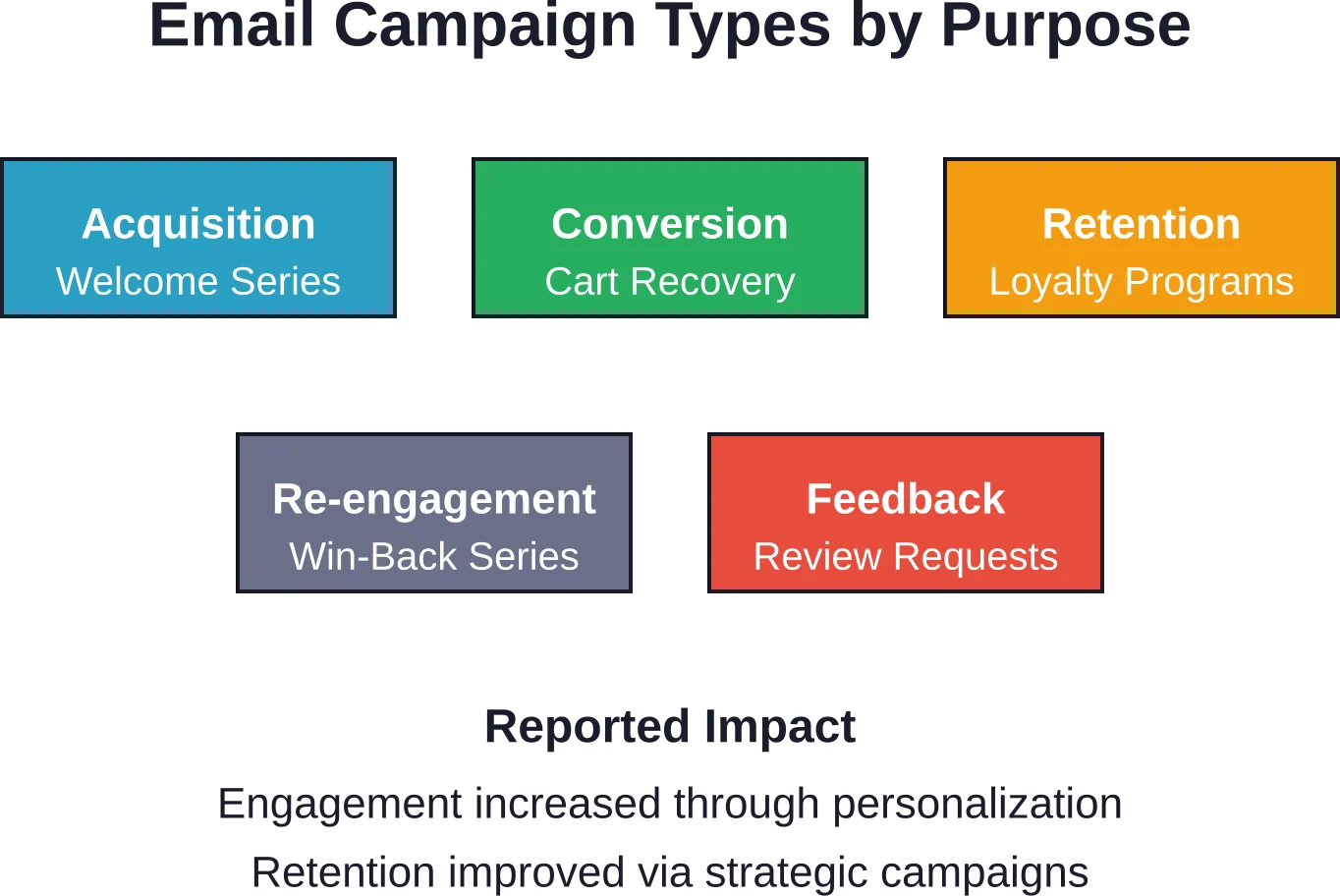
New subscribers represent fresh opportunities. A welcome sequence introduces the brand, sets expectations, and often includes a first-purchase incentive.
Research shows subscriber rate growth through targeted welcome journeys and dynamic content, generating significant three-year value from increased customer acquisition. That's significant.
The first email should arrive immediately after signup. Follow-ups might include brand story, best-sellers, or educational content about product categories. Keep the series to 3-5 emails over 7-10 days to avoid overwhelming new contacts.
On average, 70% of shoppers abandon their online carts before completing purchases. Sound familiar? That's a massive revenue leak.
Abandoned cart email sequences are remarkably effective at recapturing lost sales. Data shows 45% of these messages get opened, 21% get clicked, and 50% of those who click finish their purchase.
The first email should trigger 1-3 hours after abandonment, simply reminding customers what they left behind. A second message 24 hours later might address common objections—shipping costs, return policies, product questions. If appropriate, a third email at 48-72 hours could include a small discount, though not every store needs to discount.
Customers who browse without adding items to cart still show interest. Browse abandonment emails remind them about products they viewed.
These messages tend to have significantly higher open rates compared to standard promotional emails. The key is personalization—feature the exact products browsed, possibly with related recommendations.
The sale isn't the end of the relationship. Post-purchase emails confirm orders, provide shipping updates, and set expectations for delivery.
Beyond transactional confirmations, consider educational sequences that help customers get maximum value from their purchase. For products requiring assembly or setup, instructional content reduces support tickets and increases satisfaction.

Extuitive helps businesses review creative ideas before launching campaigns. The platform uses AI models to forecast likely performance, compare different messages, and support better decisions around copy, visuals, offers, and audience targeting.
For ecommerce email campaigns, this can help when several product, sale, or retention ideas are ready but only a few should move forward.
Extuitive can help with:
👉 Book a demo with Extuitive to review your campaign ideas.
While automation runs in the background, strategic broadcast campaigns keep the brand top-of-mind and drive periodic engagement spikes.
Social proof drives conversion. Customer reviews influence purchase decisions more than any marketing copy.
Send review requests 7-14 days after delivery—enough time for customers to experience the product but recent enough that it's still memorable. Make the process frictionless with direct links to review forms.
Incentivizing reviews raises compliance questions. The FTC requires disclosure of any compensation, and Amazon prohibits incentivized reviews entirely. Tread carefully.
Well-executed email marketing strategies can significantly improve retention rates. Loyalty programs turn one-time buyers into repeat customers.
Email keeps loyalty members engaged with points balances, tier status updates, and exclusive offers. Personalized campaigns acknowledging member milestones—anniversaries, birthdays, spending thresholds—strengthen emotional connections to the brand.
Customer retention through referral programs is a recognized strategy in email marketing. Consumers show increased engagement with brands offering rewards programs.
Subscribers go dormant for various reasons. Re-engagement campaigns attempt to revive interest before removing inactive contacts.
Retention strategies help preserve list health and deliverability by reducing unsubscribe rates. A win-back sequence might offer special incentives, ask for feedback about why they disengaged, or simply remind them what they're missing.
If subscribers remain unresponsive after 3-5 re-engagement attempts, remove them. Mailing inactive addresses hurts deliverability and wastes resources.
Holiday sales, flash promotions, and seasonal launches create urgency. Promotional emails work best when they're genuinely valuable rather than constant discount spam.
The calendar provides natural promotional hooks—Black Friday, Valentine's Day, back-to-school. But brand-specific events work too: anniversary sales, inventory clearances, new collection launches.
Scarcity and urgency increase conversion, but overuse breeds skepticism. If every email screams "FINAL HOURS," none of them land with impact.
Generic batch-and-blast emails underperform. Personalization drives results.
Targeted email marketing campaigns see 29% higher open rates and 41% higher click-through rates compared to unsophisticated bulk sends. That's substantial improvement from simply matching message to audience.
Engagement increased through personalized content and optimized send times, generating significant three-year value from improved customer engagement.
Effective segmentation goes beyond basic demographics. Consider:
Start simple. Even basic segmentation beats none. Add complexity as systems and data mature.
Dynamic content changes based on recipient attributes. One email template serves multiple segments with personalized product recommendations, imagery, or offers.
Product recommendations based on browse history or past purchases feel relevant rather than random. Location-based content shows weather-appropriate products or regional inventory.
Legal compliance isn't optional. The CAN-SPAM Act sets clear rules for commercial email, and violations cost up to $53,088 per separate email.
Commercial messages must include:
Transactional emails—order confirmations, shipping notifications, account updates—have different rules. They must contain primarily transactional content, though small promotional elements are permitted.
Most email opens happen on mobile devices. Designs must work on small screens.
Keep subject lines under 40 characters for mobile visibility. Use responsive templates that stack content vertically. Make CTAs large enough for thumb taps. Test across devices before sending.
Metrics reveal what works and what needs adjustment. Track the numbers that tie to business goals.
Testing removes guesswork. Systematically test subject lines, send times, content formats, CTAs, and personalization tactics.
Run one variable at a time for clean results. Test on a segment before rolling winners to the full list. Document findings to build institutional knowledge.
Email remains a cornerstone of ecommerce success because it delivers measurable results while maintaining direct customer relationships. The channel isn't going anywhere—it's evolving.
Start with fundamentals: build a quality list, segment thoughtfully, personalize content, optimize for mobile, and comply with regulations. Layer in automation for cart recovery and welcome sequences. Test systematically and measure what matters.
The stores winning with email in 2026 treat subscribers as valued community members rather than transaction targets. They balance promotional messages with genuine value, respect inbox space, and use data to serve relevance.
Implementation doesn't require perfection from day one. Begin with one or two automated sequences and a consistent broadcast schedule. Refine based on performance data. Build complexity as capabilities mature.
The owned audience built through email marketing becomes increasingly valuable as rented social media platforms change algorithms and raise advertising costs. That direct line to interested customers—permission-based, data-rich, and fully controlled—represents sustainable competitive advantage.
Start building that advantage today.


