AdGPT Review: Features, Pricing, and Who It's For
Read this AdGPT review to see how the AI ad tool works, what it offers, who it suits, and whether it is useful for ecommerce ad creation.
Jun 15, 2026



Quick Summary: Marketing in the entertainment industry requires unique strategies that build buzz, create emotional connections, and drive engagement across multiple platforms. From leveraging influencer partnerships and interactive content to timing campaigns around launch windows and using data-driven personalization, entertainment marketers must capture attention in an increasingly crowded landscape. This guide explores proven tactics including social media campaigns, experiential marketing, content strategies, and emerging technologies that help films, TV shows, music releases, and live events break through the noise and convert audiences into loyal fans.
The entertainment industry is experiencing unprecedented growth. According to the National Endowment for the Arts, the arts and cultural sector grew at more than twice the rate of the total economy between 2022 and 2023, adding $1.2 trillion in value. Performing arts organizations specifically saw a remarkable 31.6% growth during this period.
But here's the thing—growth doesn't guarantee success for individual projects. With attention spans shrinking and options multiplying, entertainment marketers face a brutal challenge: break through or get ignored.
Traditional advertising alone won't cut it anymore. The entertainment sector employs millions of people, with significant growth in recent years, and the competition for eyeballs has never been fiercer. Success demands a mix of timing, creativity, platform-specific strategies, and genuine audience connection.
This guide walks through actionable marketing ideas proven to work across films, television, music, live events, and digital entertainment platforms. Some tactics cost next to nothing. Others require investment. All of them prioritize what matters most: engaging your audience where they are and giving them reasons to care.
Entertainment marketing differs from traditional marketing in three critical ways. First, timing matters more than in almost any other industry. A film has a narrow launch window. A concert tour has fixed dates. Miss the momentum, and you've missed the opportunity.
Second, emotional connection drives everything. People don't just consume entertainment—they identify with it, talk about it, and build communities around it. Marketing that treats entertainment as just another product fundamentally misunderstands the relationship between content and audience.
Third, word-of-mouth amplification is non-negotiable. The entertainment industry has always run on buzz. What's changed is the speed and scale at which conversations spread through social platforms, fan communities, and influencer networks.
Content marketing delivers particularly strong results in this space. According to the American Marketing Association, institutions that invest in content marketing benefit from cost-effectiveness, with content marketing being 62% cheaper than traditional marketing, while 90% of organizations leverage content marketing.
Social media isn't optional anymore—it's the battlefield where entertainment properties win or lose audience attention. But simply posting won't cut it. Platform-specific strategies matter.
Each platform demands different content formats and engagement styles. Instagram and TikTok prioritize short-form video and visual storytelling. Twitter (X) thrives on real-time conversation and fan interaction. Facebook still delivers reach for event promotion and community building, particularly for audiences over 35.
The key is matching content format to platform culture. A behind-the-scenes TikTok works differently than a Facebook event listing, even when promoting the same project. Mobile traffic represents a significant portion of web traffic, making mobile-first content design non-negotiable.
Successful entertainment brands use teasers strategically. They don't dump all their content at once. They meter it out, building anticipation through carefully timed reveals that give fans something new to discuss at regular intervals.
Interactive elements transform passive viewers into active participants. Polls, quizzes, and challenges invite audiences to engage directly rather than scroll past.
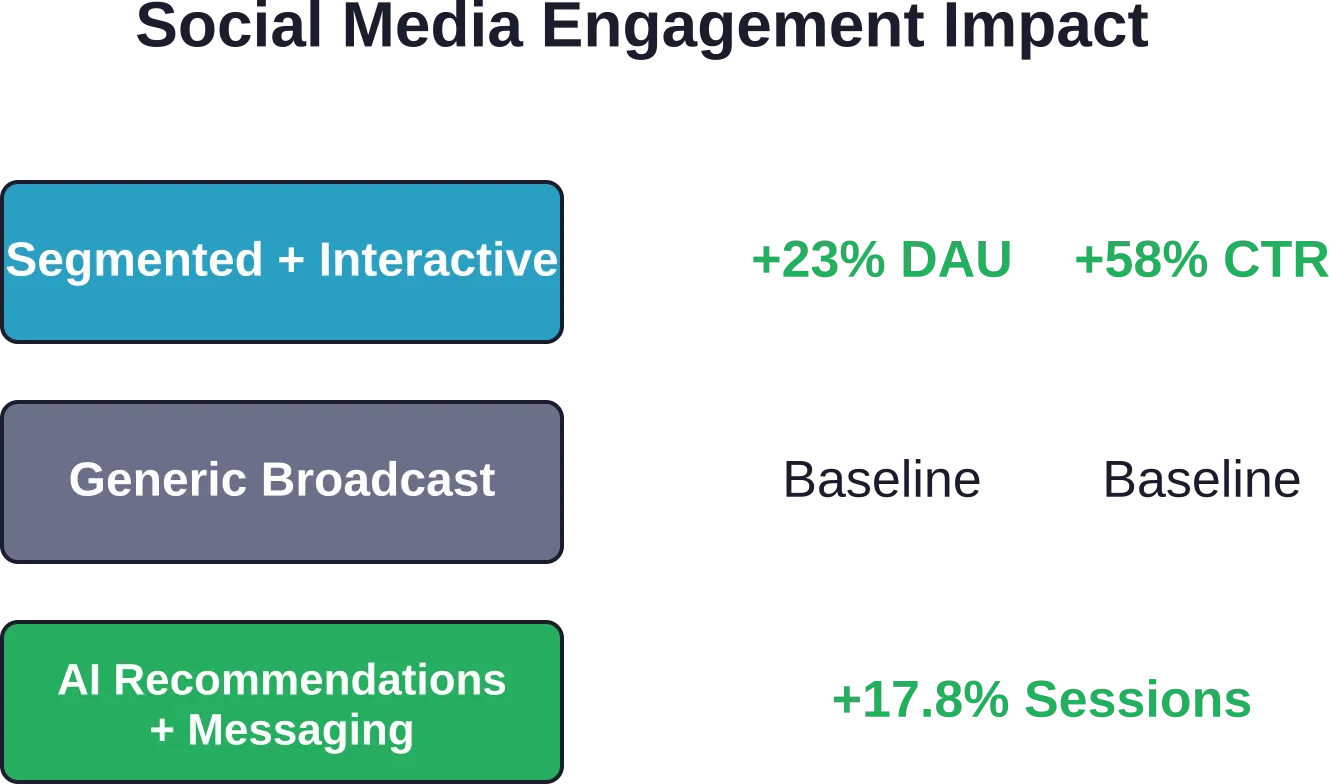
Real-world data shows this works. Publishers Corporation of Heritage (PCH) leveraged deep customer segmentation with in-app pop-ups and push messaging to deliver personalized experiences based on user loyalty status. The result? A 23% boost in daily active users and a 58% increase in in-app click-through rates.
Another example: Audiomack used customer journey orchestration with AI-based recommendations, in-app messaging, and push notifications to achieve a 17.8% increase in sessions per customer.
The pattern is clear—personalization combined with interactive elements drives measurable engagement increases. Generic broadcast messaging doesn't perform at the same level.
Influencer marketing bridges the gap between brands and consumers through trusted voices. In entertainment specifically, fandoms have transformed how audiences engage with content and how businesses connect with those communities.
The most effective influencer partnerships don't feel like ads. They feel like genuine recommendations from people audiences already trust. Micro-influencers (10,000-100,000 followers) often deliver better engagement rates than mega-influencers because their audiences are more niche and engaged.
When selecting influencer partners, alignment matters more than reach. An influencer whose content naturally fits with your entertainment property will drive better results than one with a bigger audience but weaker thematic connection.

Extuitive helps teams review ad concepts before launching campaigns. The platform uses AI models to forecast likely performance, compare creative options, and support better decisions around messaging and targeting.
For entertainment brands or projects, this can be useful when several creative directions are ready, but only a few should go live first.
Extuitive can help with:
👉 Book a demo with Extuitive to review your ad ideas.
Content marketing in entertainment extends far beyond promotional posts. It's about creating a narrative ecosystem around your property that gives audiences multiple entry points and reasons to engage.
Trailers remain the cornerstone of film and TV marketing, but distribution strategy matters as much as creative execution. Seeding video trailers through official websites first—before YouTube or social platforms—creates opportunities to integrate interactive elements, social apps, competitions, and other digital initiatives that pure video platforms don't support.
After the initial website premiere, strategic distribution across video platforms extends reach. But timing matters. Spacing out trailer releases (teaser, full trailer, final trailer) creates multiple waves of conversation rather than one spike that fades.
The same principle applies to behind-the-scenes content, cast interviews, and making-of documentaries. Each piece should serve a strategic purpose in the overall campaign timeline, timed to maintain momentum rather than dumped all at once.
Audiences crave insider access. Behind-the-scenes content satisfies that curiosity while building emotional investment in the creative process.
This content works particularly well for building anticipation during production, when traditional marketing materials don't exist yet. Set photos, rehearsal videos, costume tests, and production diaries keep projects in audience consciousness long before launch.
The production value doesn't need to match the main property. Authentic, rough-edged content often performs better than overly polished material because it feels more genuine and exclusive.
User-generated content (UGC) turns audiences into marketing partners. Memes, fan art, reaction videos, and social challenges extend reach organically while building community ownership of your property.
The best UGC campaigns provide clear creative prompts without being restrictive. They give fans a framework but leave room for individual creativity and interpretation. Hashtag challenges on TikTok exemplify this approach—simple enough to participate in, flexible enough to allow personal expression.
Acknowledging and resharing the best fan content reinforces participation. When audiences see their contributions featured on official channels, it validates their investment and encourages others to join in.
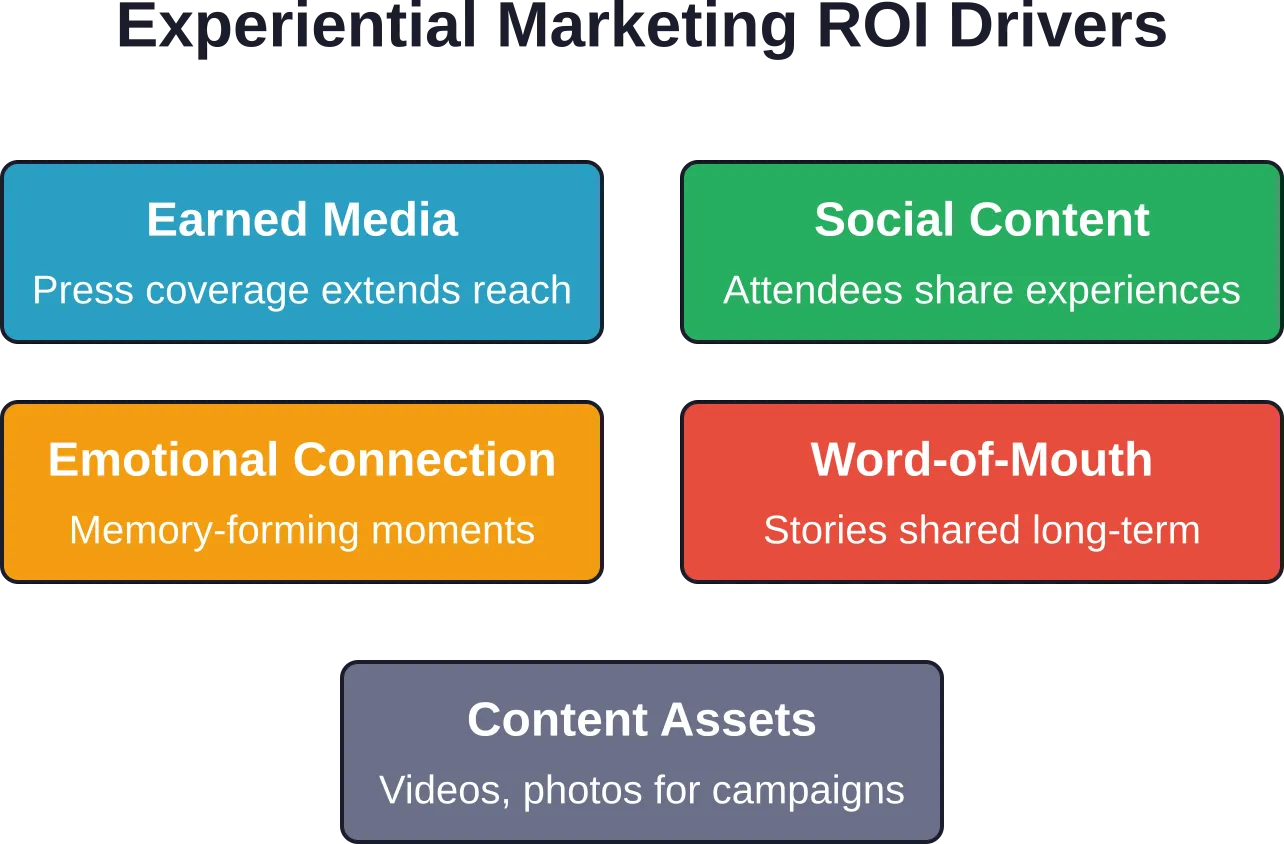
Digital marketing dominates budgets, but experiential tactics create memory-forming moments that digital alone can't match. Live experiences generate social content, press coverage, and word-of-mouth simultaneously.
A well-executed publicity stunt generates earned media worth multiples of its cost. The key is doing something remarkable enough to warrant coverage but relevant enough to connect meaningfully to the property being promoted.
Pop-up experiences, immersive installations, and location-specific activations work particularly well because they're inherently visual and shareable. Attendees document and share their experience, creating organic content that extends reach far beyond those physically present.
The risk with stunts is appearing desperate or crass. The best ones feel creative and clever rather than purely attention-seeking. They add value or entertainment for participants rather than just shouting for attention.
Interactive installations let audiences step into the world of your entertainment property. Photo opportunities, themed environments, and hands-on experiences create shareable moments while building emotional connection.
Location matters tremendously. High-foot-traffic areas maximize exposure, but targeting locations where your core audience congregates delivers better engagement. A pop-up at a relevant convention or festival reaches a self-selected group already interested in your genre.
Print materials with QR codes bridge physical and digital experiences. Posters that include scannable codes can direct engaged viewers to exclusive content, ticketing pages, or interactive experiences, turning passive viewing into active participation.
Entertainment industry festivals—from Sundance and Cannes to Comic-Con and SXSW—concentrate target audiences in one place. A strong festival presence generates press coverage, industry buzz, and fan excitement simultaneously.
Panels, screenings, and meet-and-greets provide direct audience interaction. These touchpoints create stories and memories that attendees share long after the event ends. They also generate content assets—panel videos, crowd reactions, celebrity moments—that fuel ongoing marketing efforts.
Even properties that don't premiere at festivals can leverage these events through strategic presence, parties, or activations that insert the brand into the conversation happening around the gathering.
Organic reach has its limits. Strategic paid advertising extends audience beyond existing followers and targets specific demographics with precision traditional media can't match.
Pre-roll ads on YouTube and streaming platforms put trailers directly in front of relevant audiences. The targeting capabilities let marketers reach people based on viewing history, interests, and demographics rather than broad demographic guesses.
The first five seconds determine success. Audiences can skip after that point, so front-loading the most compelling imagery and concepts is critical. Some campaigns intentionally create multiple versions optimized for different audience segments rather than one-size-fits-all creative.
Budget allocation matters. Concentrated spending around key campaign moments (trailer drops, premiere week, opening weekend) delivers better results than spreading the same budget thinly across months.
Social platform advertising excels at building awareness and driving specific actions—ticket purchases, streaming sign-ups, or content views. The targeting granularity lets campaigns reach niche audiences efficiently.
Creative format should match platform norms. Instagram Stories ads work differently than Facebook feed ads, which work differently than TikTok in-feed ads. Using the same creative across all platforms wastes money and underperforms.
Retargeting people who've engaged with organic content or visited websites converts at higher rates than cold targeting. Building custom audiences from email lists, website visitors, or social engagers provides high-value targeting pools.
Google Ads captures intent-driven search traffic. When people search for related content, cast members, or genre keywords, search ads can intercept that interest and redirect it toward your property.
Keyword strategy requires balancing volume and specificity. Broad genre keywords ("action movies") drive volume but face intense competition. More specific keywords ("sci-fi thriller 2026") deliver smaller but more qualified traffic.
Display advertising through Google's network extends visual reach across millions of websites. Display works particularly well for building awareness and reinforcing messaging after initial exposure through other channels.
Strategic partnerships multiply reach by tapping into established audiences that overlap with target demographics. The right partnerships feel natural rather than forced.
Celebrity partnerships extend beyond traditional press junkets. Social media takeovers, collaborative content creation, and celebrity-driven challenges leverage star power in formats audiences prefer.
The effectiveness depends heavily on authenticity. Forced celebrity endorsements feel transactional. Partnerships where the celebrity genuinely connects with the material deliver better results because the enthusiasm reads as real.
Press junkets remain valuable but should be executed strategically. Rather than cramming dozens of identical interviews into one day, creating varied content formats—long-form podcasts, social Q&As, interactive fan events—generates more diverse assets and reduces repetition fatigue.
Co-marketing with complementary brands splits costs while expanding reach into each partner's audience. Fast food promotions, product tie-ins, and retail partnerships have driven entertainment marketing for decades because they work.
The best partnerships integrate meaningfully rather than feeling tacked on. When product placement and promotional partnerships connect organically to story or theme, audiences accept them. When they're blatantly transactional, they generate cynicism.
Product placement within entertainment content itself represents another partnership avenue. When done well, it offsets production costs while adding authenticity. Clumsy execution disrupts immersion and draws negative attention.
Partnering with non-competing entertainment properties in similar genres expands reach efficiently. A horror film might cross-promote with a horror podcast. A music release might partner with a concert venue or festival.
These partnerships work because audiences overlap. People who love one property in a genre often consume others. Cross-promotion introduces each property to highly qualified potential audiences who've already demonstrated interest in the category.
Owned audience data represents one of entertainment marketing's most valuable assets. Email lists, app users, and website registrants provide direct communication channels that aren't subject to algorithm changes or platform policy shifts.
Email remains highly effective despite predictions of its demise. Entertainment properties can use email for exclusive content drops, early ticket access, special announcements, and ongoing engagement between major releases or events.
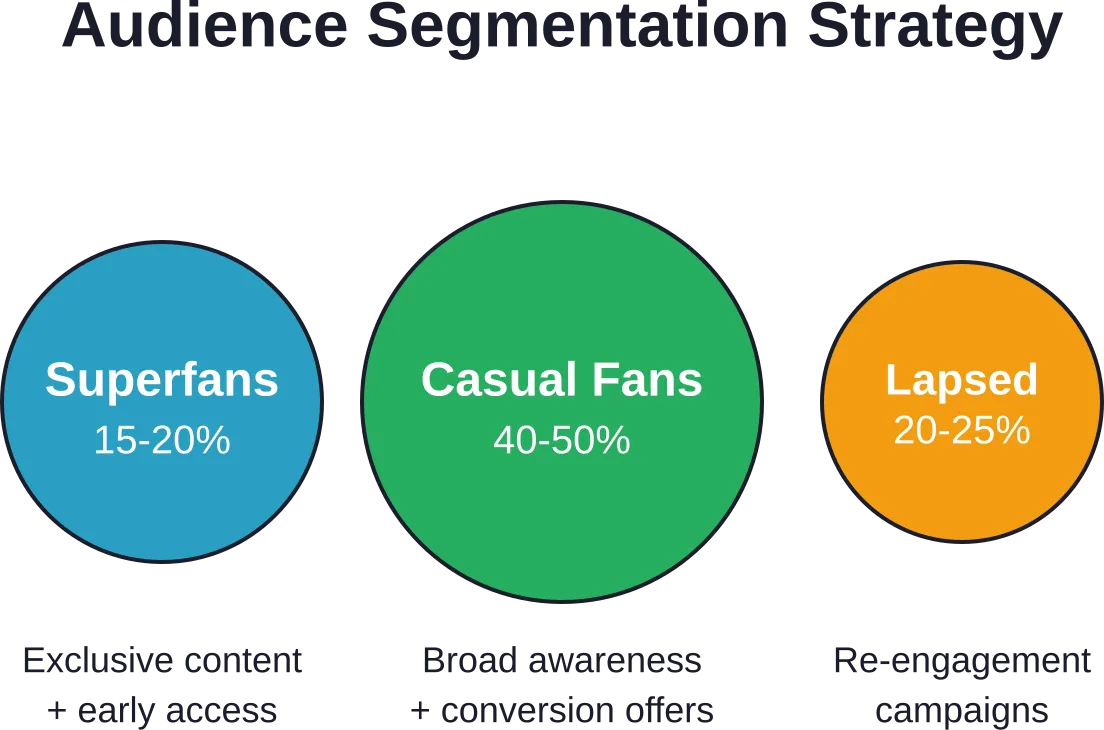
Segmentation dramatically improves performance. Sending different messages to superfans, casual followers, and lapsed audiences based on engagement history converts better than blasting identical messages to everyone.
The challenge is list building. Offering genuine value—exclusive content, early access, special perks—in exchange for email addresses works better than generic newsletter sign-up prompts. People protect their inboxes; the value proposition must be clear.
Fan communities on owned platforms (forums, Discord servers, dedicated apps) provide direct audience relationships independent of social platform changes. They also generate valuable feedback and user-generated content.
Moderation and community management require ongoing investment. Neglected communities die or turn toxic. Active, well-moderated communities become valuable assets that drive long-term engagement.
The most successful communities give members reasons to interact with each other, not just with official content. Facilitating fan-to-fan connection creates stickiness and organic activity that doesn't require constant official input.
Loyalty programs reward repeated engagement and purchases. Early ticket access, exclusive merchandise, behind-the-scenes content, and meet-and-greet opportunities create incentive structures that encourage ongoing participation.
These programs generate valuable data about audience preferences and behavior. Understanding what drives engagement for different segments enables more targeted marketing and product development.
Refer-a-friend programs leverage existing fans to recruit new ones. Offering rewards for successful referrals turns audiences into active marketing partners. The best programs reward both the referrer and the referred, creating mutual benefit.
While major platforms dominate attention, niche platforms often deliver better engagement for specific entertainment categories. Matching platform to content type matters.
IMDb remains the authoritative database for film and television. Maintaining accurate, complete listings with high-quality imagery serves both discovery and credibility.
IMDb advertising targets highly intent-driven audiences actively researching entertainment options. The platform's user base skews toward serious film and TV enthusiasts who influence broader audience decisions.
Encouraging audience reviews and ratings on IMDb influences discoverability and perception. While gaming the system damages credibility, legitimate efforts to drive genuine reviews from satisfied viewers provide social proof.
Platform selection should match content format and audience demographics. Pinterest works exceptionally well for fashion-forward and visually stylized content. Instagram prioritizes polished imagery and short video. TikTok rewards creativity and trend participation over production value.
The mistake is treating all platforms identically. Each has distinct culture, content norms, and algorithm preferences. Content optimized for one platform often underperforms on another without adaptation.
Emerging platforms present opportunities for early-mover advantage. Properties that establish presence on rising platforms before they saturate can build audiences efficiently. The risk is investing in platforms that fail to achieve sustainable scale.
Modern marketing technology enables personalization at scale. Entertainment marketers can deliver different messages, creative, and offers to different audience segments based on behavior, preferences, and engagement history.
Effective segmentation goes beyond basic demographics. Behavioral data—viewing history, engagement patterns, purchase behavior—predicts future actions better than age and location alone.
Common entertainment segments include superfans (highest engagement, most valuable), casual fans (periodic engagement), lapsed fans (previous engagement now dormant), and prospects (target demographic, no prior engagement). Each segment requires different messaging and tactics.
Dynamic segmentation updates based on behavior rather than static assignment. Someone who binges an entire season over a weekend might move from casual to superfan segment, triggering different marketing flows.
Testing creative variations, messaging approaches, and call-to-action buttons reveals what actually works versus what marketers assume works. Small improvements compound across campaigns.
Trailer testing before wide release helps identify the most compelling moments and strongest hooks. Cut-down versions emphasizing different elements can be tested against each other to determine which drives the strongest response.
Landing page optimization improves conversion from awareness to action. Testing different layouts, copy, and calls-to-action incrementally improves performance without additional media spend.
Understanding which marketing activities drive results enables smarter budget allocation. Multi-touch attribution models reveal how different touchpoints contribute to conversion rather than crediting only the last click.
Tracking should extend beyond vanity metrics. Follower counts and impressions matter less than engagement rates, conversion rates, and ultimately revenue or viewership generated per dollar spent.
Regular reporting and analysis should inform ongoing optimization, not just post-campaign reviews. Real-time dashboards enable mid-campaign adjustments that improve performance before budgets are exhausted.
New technologies continuously reshape entertainment marketing possibilities. Early adoption creates competitive advantages, but not every trend warrants immediate investment.
VR and AR enable immersive experiences that transport audiences into entertainment worlds. While adoption barriers remain high, costs are declining and use cases are expanding.
AR filters on social platforms (Instagram, Snapchat, TikTok) provide accessible entry points. Branded filters that let users interact with characters or environments generate engagement and organic sharing.
Full VR experiences work well for high-budget properties where the investment in development aligns with expected reach and impact. For smaller projects, simpler AR applications often deliver better ROI.
AI-powered recommendation engines drive content discovery on streaming platforms. Understanding how these algorithms work and optimizing content metadata improves discoverability.
Generative AI tools enable rapid creation of marketing assets—social posts, image variations, copy alternatives. These tools augment human creativity rather than replacing it, enabling higher output without proportional cost increases.
AI-driven chatbots and virtual assistants provide always-on audience engagement and customer service. They handle routine inquiries, freeing human team members for higher-value interactions.
Blockchain technologies enable new ownership and monetization models. NFTs provide digital collectibles and exclusive experiences that some fan communities value highly.
The challenge is distinguishing genuine innovation from hype. Some audiences respond enthusiastically to NFT drops and token-gated content. Others view them skeptically or even negatively. Understanding target audience perspective matters before investing heavily.
Decentralized fan communities and tokenized loyalty programs represent longer-term potential applications that may mature as the technology becomes more accessible and less speculative.
Effective entertainment marketing balances multiple tactics within realistic budget constraints. The optimal allocation varies based on property type, target audience, and competitive landscape.
Low-budget campaigns should prioritize organic social media, grassroots community building, and earned media through creative stunts or compelling stories. These tactics maximize impact per dollar invested.
User-generated content campaigns, social media challenges, and referral programs leverage existing audiences to drive growth without significant paid media spend. Platform tools are often free; the cost is creative development and community management.
Major releases require integrated campaigns across multiple channels. The timing and sequencing of different tactics matters as much as the tactics themselves.
Typical major release campaigns move through distinct phases: early awareness (6-12 months out), active promotion (2-6 months), launch push (2-4 weeks), and sustained engagement (ongoing). Budget allocation should reflect these phases with concentrated spending around launch.
Paid media becomes more important at scale. While organic tactics provide foundation, paid advertising multiplies reach to levels organic alone can't achieve. The ratio typically skews toward paid as budgets increase.
Return on investment in entertainment marketing isn't always straightforward. Some campaigns drive immediate ticket sales or streaming views. Others build long-term brand equity and audience relationships that pay off across multiple properties.
Establishing clear KPIs before campaign launch provides benchmarks for evaluation. These might include awareness metrics (reach, impressions), engagement metrics (clicks, shares, comments), conversion metrics (sales, sign-ups, views), or customer lifetime value.
Post-campaign analysis should compare actual performance against benchmarks and identify what worked versus what didn't. These learnings inform future budget allocation and tactical choices.
Even well-funded campaigns fail when they make predictable mistakes. Learning from common errors helps avoid repeating them.
Entertainment marketing requires lead time. Starting promotion only weeks before launch leaves insufficient time to build momentum, especially for properties without built-in audiences.
Generally speaking, major releases benefit from 6-12 months of advance marketing, while smaller projects need at least 3-6 months. Waiting until the last minute forces reliance on expensive paid advertising because there's no time for organic growth.
Making decisions based on assumptions rather than data leads to wasted spend and missed opportunities. Regular analysis of what's working and what isn't enables mid-campaign adjustments.
Some entertainment marketers fall in love with creative executions that don't actually resonate with target audiences. Testing and measurement reveal disconnects between creative vision and audience response.
Different platforms require different formats, but core messaging should remain consistent. When social, website, advertising, and PR tell different stories, audiences get confused.
Brand guidelines that define key messages, visual identity, and tone ensure consistency even when different team members or agencies execute on different channels.
Building audiences without engaging them wastes the opportunity. When fans comment, ask questions, or create content, acknowledging and responding to them strengthens relationships.
Negative feedback shouldn't be ignored or deleted unless it violates clear community standards. Thoughtful responses to criticism demonstrate that the brand listens and cares about audience perspective.
Entertainment marketing succeeds when it treats audiences as communities rather than targets. The tactics matter—social campaigns, influencer partnerships, experiential events, paid advertising, and content marketing all play roles. But strategy matters more.
Start by understanding the specific audience the property serves and where they already gather. Build presence on those platforms with content that provides genuine value rather than just promotional noise. Timing campaigns to build momentum toward key launch moments maximizes impact within finite attention spans.
The most effective entertainment marketing creates experiences worth discussing. It gives audiences reasons to care, opportunities to participate, and content worth sharing. It treats marketing not as interruption but as extension of the entertainment itself.
The arts and cultural sector continues growing, with performing arts organizations seeing 31.6% growth between 2022 and 2023. But individual success requires more than riding sector growth. It demands thoughtful strategy, creative execution, and relentless focus on genuine audience connection.
Start planning early. Test relentlessly. Listen to audiences. Adjust based on data. And remember that while tactics evolve, the fundamental principle remains constant: give people something worth their attention, and they'll give you their attention in return.
Ready to build buzz for your next entertainment project? Begin by identifying your core audience, selecting two or three high-impact tactics from this guide, and committing to execution excellence over tactical breadth. Depth beats width every time.


