How to Use Generative AI in Marketing (2026 Guide)
Generative AI transforms marketing through automated content creation, personalized customer experiences, data-driven campaign optimization, and predictive analytics. Marketing teams implement GenAI for social media content, email campaigns, SEO optimization, customer segmentation, and creative asset generation—delivering efficiency gains while maintaining strategic human oversight for brand consistency and ethical compliance.
Marketing teams face mounting pressure: more channels, tighter budgets, higher customer expectations. The solution gaining traction? Generative AI.
But here's the thing—most companies aren't just throwing ChatGPT at their content calendar anymore. They're integrating sophisticated GenAI systems across the entire marketing funnel, from audience research to conversion optimization.
According to an IBM survey in partnership with Momentive, 67% of CMOs reported they planned on implementing generative AI within 12 months, with 86% planning adoption within 24 months. That momentum has accelerated dramatically heading into 2026.
This guide breaks down exactly how marketing teams deploy generative AI, what works, what doesn't, and the regulatory considerations that can't be ignored.
Understanding Generative AI for Marketing
Generative AI refers to artificial intelligence systems that create new content—text, images, video, audio, code—rather than simply analyzing existing data. For marketing applications, this means tools that produce campaign assets, generate insights, and automate repetitive creative tasks.
The technology relies on large language models (LLMs) and other neural networks trained on massive datasets. When a marketer inputs a prompt, the model generates original output based on patterns learned during training.
What separates 2026 implementations from earlier experiments? Integration depth. Modern marketing teams combine generative models with analytical AI, customer data platforms, and marketing automation systems to create sophisticated workflows.
According to the American Marketing Association's 2024 training materials, GenAI makes near one-to-one personalization feasible even for smaller customer segments previously considered too costly to target effectively. That's the shift driving adoption.
Content Creation and Copywriting
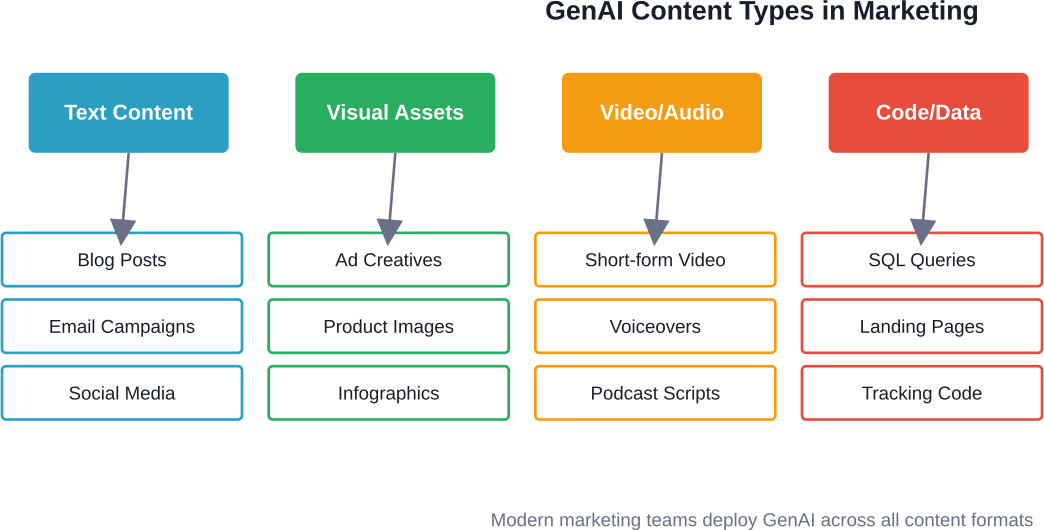
Content generation remains the most visible GenAI application in marketing. Teams deploy these tools across multiple content formats:
Blog posts and articles: AI generates first drafts, outlines, or section expansions that human writers refine. This accelerates production without eliminating editorial oversight.
Social media content: Generative models produce platform-specific captions, post variations for A/B testing, and trending topic angles. The volume requirements of social media make this particularly valuable.
Email campaigns: Subject line variations, body copy personalization, and sequence messaging all benefit from GenAI assistance. Testing multiple versions becomes trivial.
Product descriptions: For e-commerce brands with extensive catalogs, AI-generated descriptions maintain consistency while highlighting unique attributes across thousands of SKUs.
But there's a catch. The Federal Trade Commission has intensified scrutiny of AI-generated marketing content. In September 2024, the FTC announced Operation AI Comply, launching enforcement actions against operations using deceptive AI claims. Marketing teams must ensure accuracy and avoid misleading consumers about AI involvement.
The quality threshold has risen. Generic AI content no longer cuts through. Effective implementations combine AI efficiency with human expertise for brand voice, factual verification, and strategic positioning.
Visual and Multimedia Asset Generation
Generative AI extends well beyond text. Marketing teams now produce visual assets at scale:
Image creation: Tools generate custom imagery for ads, social posts, website headers, and marketing collateral. This eliminates stock photo reliance and reduces design bottlenecks.
Video production: AI assists with script writing, scene generation, voiceovers, and editing. Short-form video content for platforms like Instagram and TikTok particularly benefits.
Audio content: Podcast scripts, voiceovers, music beds, and audio ads leverage generative models. Voice cloning technology enables consistent brand voices across assets.
Design variations: A/B testing creative becomes faster when AI generates multiple ad variations, landing page layouts, or email templates from a single brief.
Real talk: quality varies dramatically. High-stakes visual content still requires professional design oversight. But for rapid prototyping, social content volume, and testing variations, generative tools deliver measurable efficiency.
Customer Segmentation and Personalization
Here's where GenAI delivers a serious competitive advantage. The technology enables granular customer segmentation and personalized experiences at previously impossible scale.
Audience modeling: AI analyzes customer data to identify distinct segments based on behavior patterns, preferences, and predicted lifetime value. These models surface segments human analysts might miss.
Dynamic content personalization: Generative systems adapt messaging, offers, and creative elements to individual users in real-time. Website content, email campaigns, and ad creative all adjust based on user attributes.
Predictive recommendations: AI predicts which products, content, or offers resonate with specific customer segments. MAC Cosmetics used Smart Recommender to show "frequently viewed", "purchased together", and "top sellers" on product and cart pages, which helped them achieve a 20.56% add-to-cart rate and a 2.3% increase in conversion rates, according to case study data.
Journey orchestration: GenAI maps optimal customer journeys, suggesting touchpoint sequences and message timing based on behavioral signals and conversion probabilities.
The American Marketing Association's December 2025 training on AI-powered marketing automation emphasized this capability: AI can segment audiences, create personas, suggest messaging, and even directly use insights to automate campaign execution.
Privacy considerations can't be ignored. Marketing teams must ensure data handling complies with regulations and company policies. The FTC has increased scrutiny of AI data practices, particularly around consumer-facing chatbots and companion products.
Campaign Optimization and Testing
Generative AI accelerates the testing and optimization cycle that drives marketing performance:
Automated A/B testing: AI generates multiple campaign variations—headlines, copy, creative, CTAs—and analyzes performance to identify winners. This happens faster and at a larger scale than manual testing.
Bid optimization: For paid campaigns, AI adjusts bids in real-time based on conversion likelihood, competition, and budget pacing. Performance improves while reducing manual oversight.
Budget allocation: Generative models recommend optimal budget distribution across channels, campaigns, and audience segments based on predicted ROI.
Creative iteration: AI identifies underperforming creative elements and generates alternatives for testing. The feedback loop continuously improves asset effectiveness.
The optimization extends to SEO as well. Generative tools analyze search trends, generate keyword strategies, create optimized content briefs, and even produce schema markup for enhanced search visibility.
Predictive Ad Testing
AI is starting to shift testing earlier in the process, not just after campaigns go live:
Pre-launch evaluation: In practice, tools like Extuitive use historical campaign data to estimate how new creatives are likely to perform before launch.
Creative filtering: Instead of pushing every variation into A/B tests, teams can remove weaker concepts upfront and focus only on stronger candidates.
Reduced testing cycles: With fewer low-performing variants entering campaigns, optimization becomes faster and more controlled, with less budget spent on trial-and-error.
This approach doesn’t replace traditional testing, but it changes the starting point. Campaigns begin with higher-quality inputs, which makes everything that follows more efficient.
Conversational Marketing and Customer Service
AI-powered chatbots and conversational interfaces handle customer interactions across the marketing funnel:
Lead qualification: Chatbots engage website visitors, ask qualifying questions, and route promising leads to sales teams. This captures opportunities that might otherwise bounce.
Product recommendations: Conversational AI guides customers through product selection based on stated needs and preferences. The experience feels personalized without requiring human agents.
FAQ automation: Common questions get instant AI-generated responses, freeing human teams for complex inquiries. Knowledge bases continuously improve through machine learning.
Post-purchase engagement: Chatbots handle order status, troubleshooting, feedback collection, and upsell opportunities throughout the customer lifecycle.
But watch the ethics. The FTC launched an inquiry in September 2025 into AI chatbots acting as companions, issuing 6(b) orders to seven companies that operate consumer-facing AI chatbots, examining advertising, safety, and data handling practices. Regulators want transparency about AI involvement and safeguards against manipulative emotional engagement.
According to OpenAI's safety guidelines, the company requires that people must be 18 or older—or 13 or older with parental approval—to use their AI tools. Marketing teams using these tools inherit responsibility for appropriate deployment.
Data Analysis and Insight Generation
Generative AI transforms how marketing teams extract insights from data:
Sentiment analysis: AI processes customer reviews, social media mentions, support tickets, and survey responses to gauge brand sentiment and identify emerging issues.
Trend identification: Models spot patterns in customer behavior, market dynamics, and competitive activity that inform strategic decisions.
Report generation: AI automatically produces performance reports, executive summaries, and data visualizations from raw analytics data.
Query assistance: Natural language interfaces let marketers ask questions and receive data-driven answers without SQL knowledge or technical dependencies.
Meeting transcription capabilities also support this function. AI transcribes customer calls, focus groups, and internal meetings, extracting key insights and action items automatically.
Implementation Best Practices
Successful GenAI marketing implementations follow several patterns:
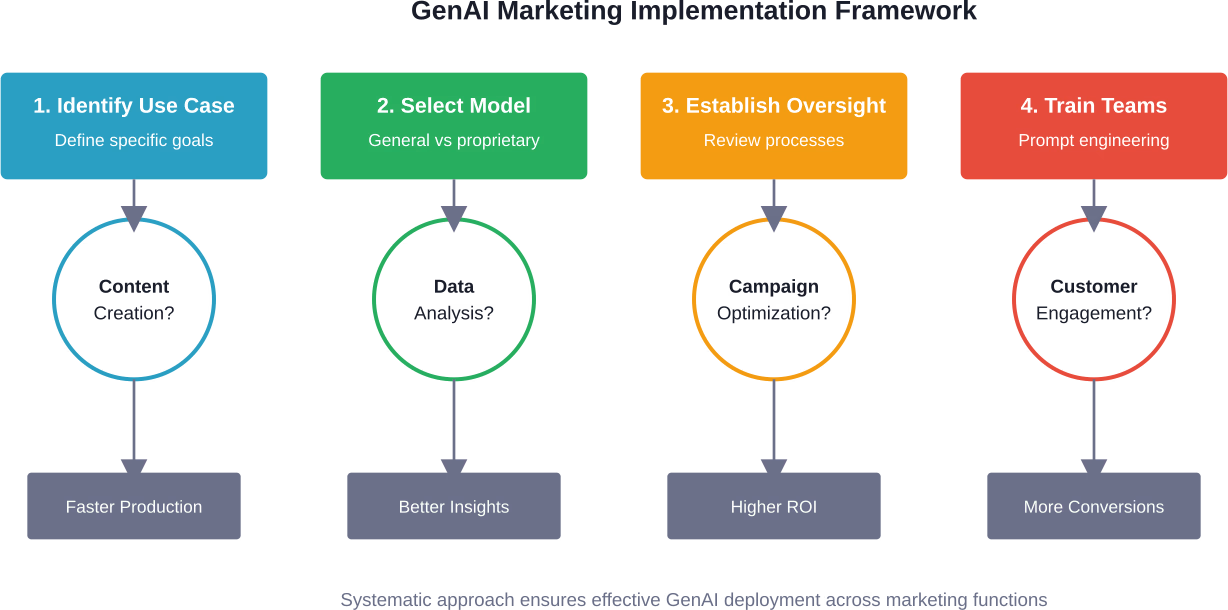
Start with clear use cases: Don't implement AI for its own sake. Identify specific pain points—content bottlenecks, personalization gaps, optimization inefficiencies—and deploy targeted solutions.
Maintain human oversight: AI generates, humans validate. Establish review processes appropriate to risk level. Low-stakes social posts might need light review while legal-sensitive content demands rigorous oversight.
Train teams properly: Marketing staff need prompt engineering skills, output quality assessment capabilities, and understanding of AI limitations. The American Marketing Association offered training specifically on prompt engineering to achieve better results.
Establish governance: Define policies for AI use, data handling, brand voice consistency, and regulatory compliance. Document decisions about general versus proprietary models.
Measure incrementally: Track specific metrics tied to each AI application. Content production velocity, testing throughput, personalization lift, cost per asset—quantify the impact.
Use Case
Primary Benefit
Human Oversight Level
Typical ROI Timeline
Social Media Content
Production speed
Medium
1-2 months
Email Personalization
Conversion rate
Medium-High
2-3 months
SEO Content
Organic traffic
High
3-6 months
Ad Creative Testing
Testing velocity
Medium
1-2 months
Customer Segmentation
Campaign efficiency
High
2-4 months
Chatbot Qualification
Lead volume
Medium
1-3 months
Choosing Between General and Proprietary Models
Marketing teams face a strategic choice: use general-purpose AI models or invest in proprietary training.
General models like ChatGPT, Claude, or Gemini offer immediate capability with no training investment. They handle most content generation and analysis tasks adequately. Cost remains relatively low, and updates happen automatically.
The tradeoff? Generic outputs, limited brand voice consistency, potential data privacy concerns, and no competitive differentiation.
Proprietary models trained on company data deliver better brand alignment, industry-specific knowledge, and competitive advantage. Custom training incorporates approved messaging, product details, customer insights, and performance data.
But proprietary development requires significant investment in data preparation, model training, ongoing refinement, and technical infrastructure.
Most marketing teams adopt a hybrid approach: general models for commodity tasks, proprietary fine-tuning for strategic applications where differentiation matters.
Regulatory and Ethical Considerations
The regulatory environment around marketing AI has intensified heading into 2026.
The FTC's Operation AI Comply in September 2024 signaled serious enforcement intent. The agency filed actions against companies making deceptive AI claims or using AI in schemes that mislead consumers.
In March 2026, the FTC announced that Air AI and its owners will be banned from marketing business opportunities to settle FTC charges the company misled entrepreneurs and small businesses. In June 2024, the FTC filed suit against FBA Machine and Bratislav Rozenfeld for falsely guaranteeing that consumers could make money operating online storefronts using AI-powered software.
Key compliance principles:
Don't make false claims about AI capabilities or results
Disclose AI involvement where material to consumer decisions
Ensure AI-generated content accuracy, especially for factual claims
Avoid manipulative emotional engagement in AI chatbots
Protect consumer data used for AI training and personalization
Monitor for discriminatory outputs in targeting and personalization
The FTC launched an inquiry in September 2025 into AI chatbots acting as companions, issuing 6(b) orders to seven companies that operate consumer-facing AI chatbots, examining advertising, safety, and data handling practices. Marketing teams deploying conversational AI should expect scrutiny.
OpenAI requires that people must be 18 or older—or 13 or older with parental approval—to use their AI tools. Marketing to younger audiences introduces additional compliance complexity.
Common Pitfalls to Avoid
Marketing teams implementing GenAI encounter predictable challenges:
Over-automation: Removing humans entirely from creative processes produces generic, off-brand content that fails to connect. AI assists; it doesn't replace strategic thinking.
Insufficient training: Teams lacking prompt engineering skills or AI literacy generate poor outputs and blame the technology. Investment in capability building pays dividends.
Ignoring bias: AI models reflect biases present in training data. Outputs can perpetuate stereotypes or exclude segments if not actively monitored.
Data quality neglect: Garbage in, garbage out remains true. AI personalization and segmentation only work with clean, comprehensive customer data.
Privacy shortcuts: Using customer data without proper consent or security invites regulatory action and reputation damage.
Lack of measurement: Implementing AI without tracking specific performance metrics makes optimization impossible and ROI unclear.
A February 2026 guide by Copyleaks for media and publishing organizations highlighted another risk in combating AI-generated hoaxes: AI-generated content becoming indistinguishable from reality creates potential for sophisticated misinformation. Marketing teams need detection tools and workflows to safeguard institutional integrity.
The Future of Generative AI in Marketing
What's coming next? Several trends are reshaping how marketing teams think about GenAI:
Multimodal integration: Next-generation models process and generate across text, image, video, and audio simultaneously. Campaign creation becomes truly integrated rather than format-siloed.
Real-time personalization: Faster inference and better integration enable personalized content generation at the moment of interaction rather than batch processing.
Autonomous campaign management: AI systems handle end-to-end campaign execution—strategy, creative, targeting, optimization, reporting—with human oversight at decision points rather than task level.
Enhanced predictive capabilities: Combining generative AI with advanced analytics produces better forecasting of customer behavior, market trends, and campaign performance.
Tighter martech integration: GenAI becomes embedded throughout marketing technology stacks rather than existing as separate tools. CRM, automation, analytics, and content systems all incorporate generative capabilities.
Regulation will continue evolving. Expect clearer guidelines on disclosure requirements, data usage, bias mitigation, and accountability for AI-generated marketing communications.
Measuring GenAI Marketing Success
How do marketing teams know if GenAI investments deliver results? Track metrics tied to specific use cases:
Application Area
Key Metrics
Success Indicators
Content Production
Assets per hour, cost per asset, time to publish
50-80% efficiency gain
Personalization
Click-through rate, conversion rate, engagement time
15-30% performance lift
Campaign Optimization
Cost per acquisition, ROAS, testing velocity
20-40% efficiency improvement
Customer Service
Response time, resolution rate, satisfaction score
60-70% automation rate
Insight Generation
Analysis time, actionable findings, decision speed
70-85% time reduction
Beyond operational metrics, track business outcomes: revenue impact, customer lifetime value, market share movement, brand perception shifts. GenAI is a means, not an end.
Conclusion
Generative AI has moved from experimental technology to essential marketing capability. Teams that master implementation gain measurable advantages in efficiency, personalization, and performance.
But success requires more than adopting tools. It demands strategic thinking about which problems AI solves, disciplined governance ensuring quality and compliance, investment in team capabilities, and commitment to human oversight where it matters.
The regulatory environment will continue tightening. Marketing teams must prioritize transparency, accuracy, and ethical deployment alongside efficiency gains.
Start small. Identify one high-impact use case, implement with appropriate oversight, measure results, and expand based on what works. GenAI adoption is a journey, not a destination.
The competitive question isn't whether to use generative AI in marketing—it's how quickly teams can deploy it effectively while maintaining brand integrity and customer trust.
Ready to transform marketing operations? Begin with content creation or personalization use cases, establish clear quality standards, and scale based on demonstrated ROI. The technology is ready. Is this a strategy?
Frequently Asked Questions
What's the difference between generative AI and analytical AI in marketing?
Generative AI creates new content, while analytical AI processes data to find patterns and make predictions. Both are often used together in marketing.
Do I need technical expertise to implement generative AI for marketing?
Basic tools require little technical skill, but advanced integrations may need technical expertise or support.
How much does generative AI for marketing cost?
Costs range from free tools to enterprise solutions depending on scale, features, and customization.
Can generative AI replace human marketers?
No. AI supports execution, but human creativity, strategy, and decision-making remain essential.
What are the biggest risks of using AI in marketing?
Risks include inaccurate content, bias, privacy issues, and over-reliance on automation.
How do I ensure AI-generated marketing content maintains brand voice?
Use clear prompts, brand guidelines, and review outputs to ensure consistency with brand tone and messaging.
Is generative AI suitable for B2B marketing or just B2C?
Generative AI works for both B2B and B2C, though B2B often requires more human oversight due to complexity.
How much are you wasting on Meta ads? Connect your ad account. See your ad efficiency.