Generative AI Tools for Marketing Explained Simply
A practical look at generative AI tools for marketing, how teams use them, and where they fit into real workflows today.
Jan 7, 2026



AI will not replace teachers but will transform how they work. Research from UNESCO and the U.S. Department of Education confirms that while AI handles routine tasks like grading and lesson planning, human teachers remain essential for critical thinking, emotional support, and meaningful student connections that technology cannot replicate.
The question keeps educators up at night: will artificial intelligence eliminate teaching jobs?
Here's what's actually happening. AI adoption in K–12 schools jumped dramatically—one report shows 40% of teachers now use generative AI, up from just 16% previously. That's a massive shift in a short time.
But increased AI use doesn't mean teacher replacement. The reality is far more nuanced.
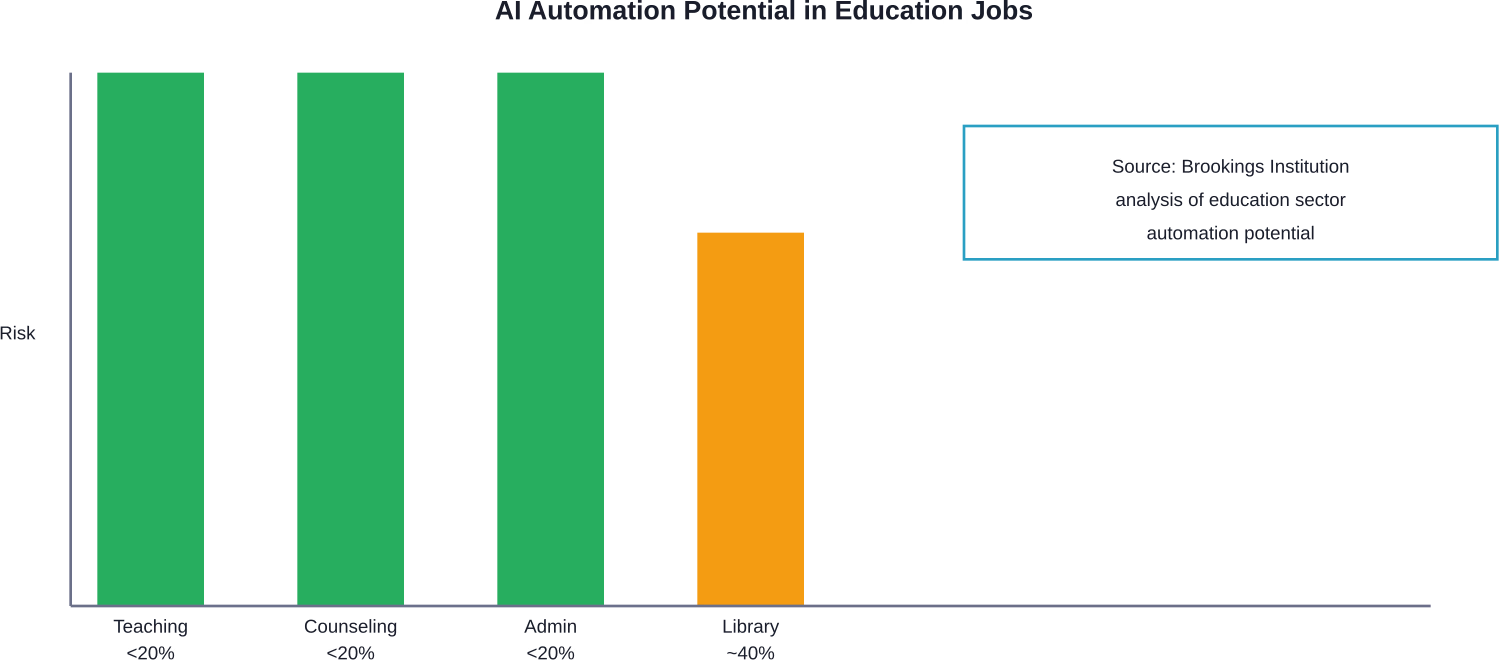
According to data from the Brookings Institution, most education jobs face low automation potential. Nearly all teaching occupations show less than 20% automatable tasks. The two education roles with higher automation risk? Library jobs involving cataloging and information retrieval—not classroom teaching.
UNESCO's research on AI and the future of education emphasizes that education serves multiple irreplaceable functions: socializing students, developing critical thinking, and fostering human connection. Generative AI can write reports and solve equations, but it cannot replicate these fundamental educational purposes.
The U.S. Department of Education issued guidance in July 2025 on leveraging AI to improve education outcomes. The focus? Using AI as a tool to enhance teaching effectiveness, not replace educators.
Competent, research-driven teachers possess qualities that artificial intelligence cannot replicate. Think about what actually happens in effective classrooms.
Teachers provide authentic human connection. They read facial expressions, detect when students struggle emotionally, and adjust their approach in real-time based on dozens of subtle social cues.
Professional judgment matters enormously. Educators make hundreds of nuanced decisions daily—when to push a student harder, when to offer support, how to navigate complex interpersonal dynamics. AI lacks this contextual wisdom.
UNESCO research emphasizes that social-emotional competencies developed through human interactions are essential, as AI technologies cannot currently replicate these qualities. Students need mentorship, encouragement, and the modeling of critical thinking processes. Technology can deliver information, but it cannot inspire curiosity or model intellectual courage.
Thomas Toch, director of FutureEd at Georgetown University, notes that post-pandemic students need connection more than ever. Connection to peers, family, and yes—their teachers. AI chatbots don't fill this fundamental human need.
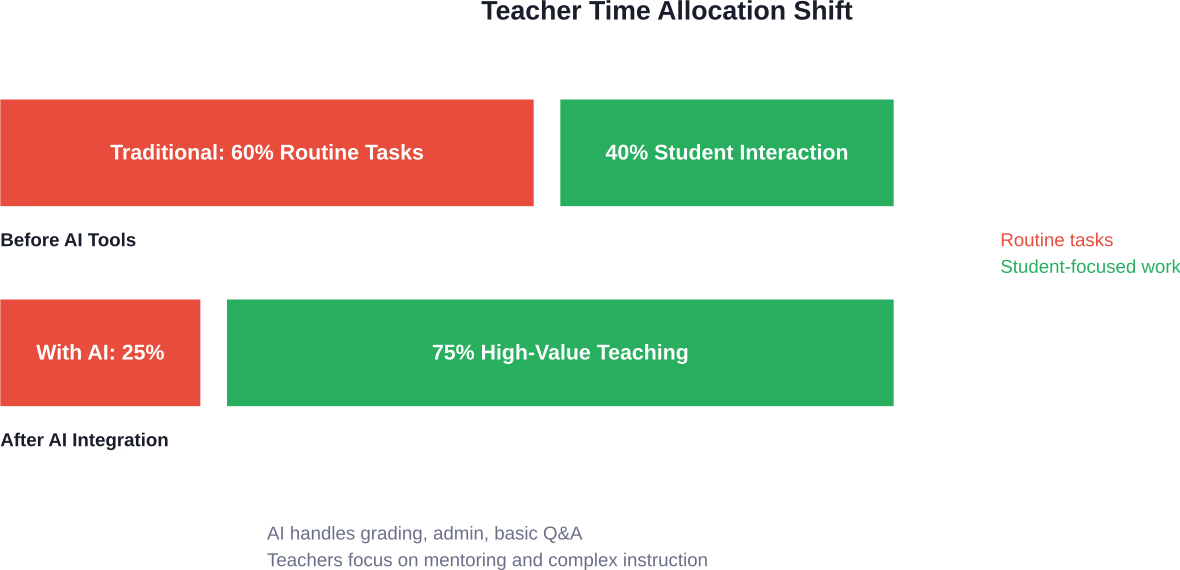
Rather than replacing teachers, artificial intelligence handles specific routine tasks. This shift is already underway.
Teachers using AI tools weekly save nearly six hours of work per week. That's substantial time freed up for the work that truly requires human expertise.
Think of AI not as a substitute teacher but as a classroom assistant. It handles the mechanical work while educators focus on what only humans can provide.
The profession won't disappear. It'll transform.
According to RAND Corporation research surveying nationally representative samples of teachers, school leaders, district leaders, students, and parents, AI guidance and training currently lag behind adoption rates. This creates challenges but also opportunities.
Teachers who develop AI literacy will thrive. Understanding how to work effectively with AI tools—while avoiding potential pitfalls around data protection, ethics, and privacy—becomes increasingly valuable.
The role shifts toward higher-level work. Less time grading routine assignments means more time for substantive feedback. Less time on administrative tasks means more capacity for one-on-one student support.
UNESCO's Campus team gathered nearly 800 teachers and educators from 97 countries to explore AI's opportunities and challenges. The consensus? AI empowers teachers rather than replaces them—when implemented thoughtfully.
Current teacher training hasn't caught up with technology. Many educators feel unprepared to integrate AI effectively.
This creates urgency around professional development. Teachers need training not just in using AI tools, but in understanding their limitations, ethical implications, and appropriate applications.
The European Union's Artificial Intelligence Act employs a risk-based approach that bans unacceptable threats, mandates transparency for limited-risk systems, and regulates high-risk applications, while requiring protections for users' personal information and enforcing age limits for adult-oriented AI. Education falls into the high-risk category, requiring protections for student data and age-appropriate safeguards.
These regulatory frameworks recognize what research confirms: AI in education requires careful human oversight. Technology serves students best when guided by trained educators who understand both its potential and its risks.
Here's something interesting. When researchers survey students, they consistently value human teachers—even as AI becomes more prevalent.
Students recognize differences that adults sometimes overlook. They know when they're interacting with a chatbot versus a person who genuinely cares about their progress. They understand that AI can provide information, but teachers provide meaning.
The pandemic highlighted this. Remote learning with technology couldn't replace in-person instruction not because the tech was inadequate, but because human connection matters fundamentally to learning.
So what should teachers actually do? Waiting until AI feels comfortable isn't an option—the technology is already here.
Start experimenting with AI tools for routine tasks. Use them for generating quiz questions, creating assignment rubrics, or drafting parent communications. See where they save time.
Develop critical AI literacy. Understand how these systems work, where they fail, and what biases they might contain. This knowledge helps educators use AI responsibly and teach students to do the same.
Focus on irreplaceable skills. Double down on the work AI can't do: building relationships, fostering creativity, teaching critical thinking, providing emotional support, and making complex pedagogical decisions.
The actual danger isn't that AI will replace teachers wholesale. It's that poorly implemented AI could widen educational inequalities.
Schools with resources can afford both advanced AI tools and well-trained teachers who use them effectively. Under-resourced schools might face pressure to substitute technology for human educators as a cost-cutting measure.
This is where policy matters enormously. The U.S. Department of Education's guidance on leveraging federal grant funds for AI emphasizes improving education outcomes—not reducing teacher headcount.
Effective AI integration requires investment in both technology and teacher development. One without the other creates problems.
Will artificial intelligence eliminate teaching jobs? The evidence says no. Will it fundamentally change what teachers do daily? Absolutely.
The teachers who thrive won't be those who resist technology. They'll be educators who embrace AI as a tool while doubling down on uniquely human capabilities.
Think of it this way: calculators didn't eliminate math teachers. They changed what math teachers focus on, shifting emphasis from computation to problem-solving and conceptual understanding.
AI represents a similar shift. The routine parts of teaching become automated, freeing educators to focus on the complex, creative, emotionally intelligent work that makes great teaching truly transformative.
Research from UNESCO, the U.S. Department of Education, and leading academic institutions consistently points to the same conclusion: the future of education lies in synergy between human teachers and AI technologies. Not replacement, but transformation.
The narrative that AI will replace teachers misunderstands both technology and education. Artificial intelligence excels at routine tasks but fails at the complex human work that defines great teaching.
The real story? Teaching is evolving. Educators who develop AI literacy and leverage these tools strategically will find themselves with more time for the meaningful work that drew them to the profession.
Start exploring AI tools now. Experiment with using them for administrative tasks. Focus irreplaceable human energy on building relationships, inspiring curiosity, and developing critical thinking in students. That's work no algorithm can do—and it's more important than ever.


