Top AI Chatbots for Shopify That Actually Help Your Store Grow
Discover the top AI chatbots for Shopify that boost sales, automate support, and keep your customers happy - fast, smart, and hassle-free.
Dec 29, 2025



AI will not replace project managers, but it will fundamentally transform the role. While AI can automate up to 80% of administrative tasks like scheduling, reporting, and basic resource allocation, project managers remain essential for leadership, strategic decision-making, stakeholder management, and navigating complex human dynamics that AI cannot replicate.
The question haunts project management forums, LinkedIn discussions, and boardrooms everywhere: will AI replace project managers?
It's a legitimate concern. AI tools are already handling tasks that once consumed hours of a PM's day. Automated scheduling. Instant status reports. Predictive risk analysis. Technology keeps getting smarter.
But here's the thing—the answer isn't as simple as yes or no.
The reality sits somewhere more nuanced. AI is reshaping project management in profound ways, automating significant portions of traditional PM work. According to industry analysis, AI tools can already handle up to 80% of PM activities like scheduling, reporting, logging hours, tracking progress, and even managing routine communications.
That sounds alarming until you understand what that 80% actually represents.
This article examines the evidence—from government employment projections to current AI capabilities—to answer what's really happening to project management jobs and what the future holds for PMs willing to adapt.
Let's start with the concrete capabilities. AI isn't some distant threat. It's already integrated into project management workflows.
Modern AI tools handle administrative tasks with remarkable efficiency. They generate status reports by pulling data from multiple systems, send automated reminders to team members about upcoming deadlines, and track time spent on tasks without manual input.
Resource allocation becomes data-driven rather than gut-driven. AI analyzes historical project data to forecast how long tasks will actually take, identifies potential bottlenecks before they become critical, and suggests optimal team member assignments based on skills and availability.
Risk identification happens continuously. Machine learning algorithms scan project communications for early warning signs, analyze patterns from thousands of past projects to predict likely failure points, and flag budget overruns before they spiral out of control.
According to community discussions among project managers, many report positive ROI from AI tools within one year, according to community discussions among PM professionals. That's not speculation. That's measured impact.
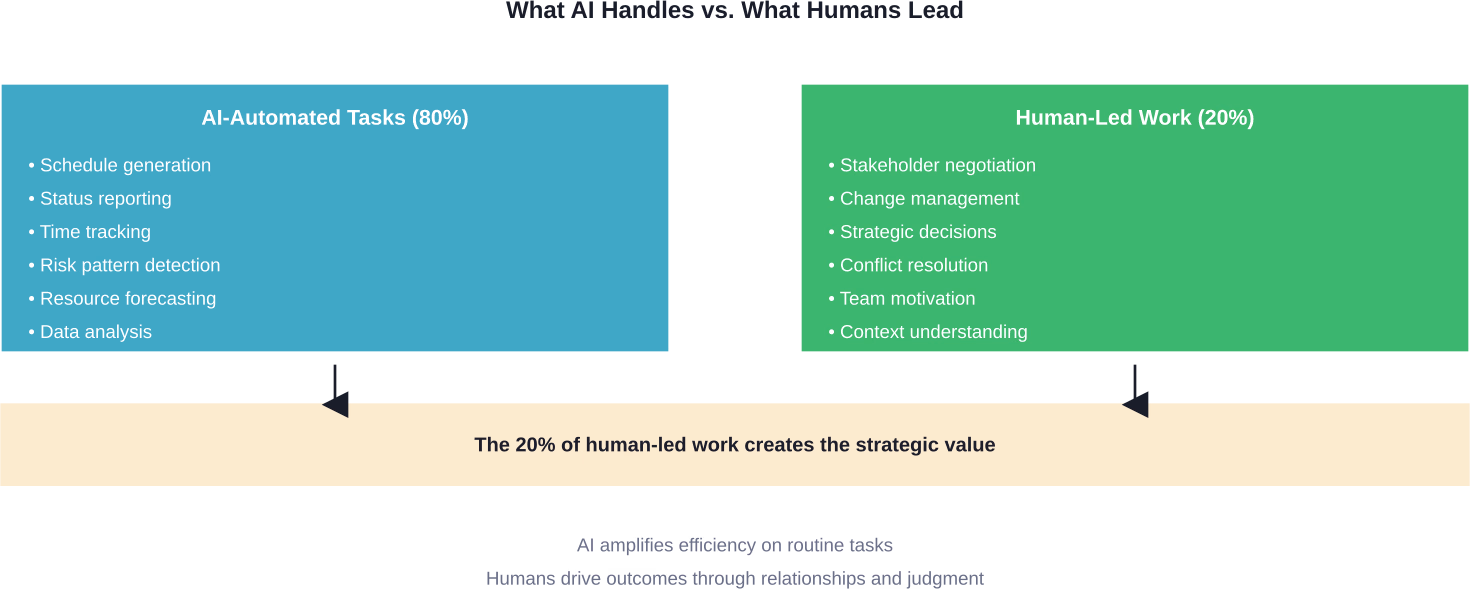
The pattern-recognition capabilities extend beyond simple data analysis. AI can monitor team communication channels to detect sentiment shifts that might indicate morale problems, review past project documentation to suggest best practices for similar initiatives, and even draft initial project charters based on scope inputs.
But this is where the limitations become apparent.
Administrative efficiency isn't leadership. Data analysis isn't a strategy. Pattern recognition isn't wisdom.
Project management has always been fundamentally about people. AI struggles profoundly with the human elements that determine whether complex projects succeed or fail.
Consider stakeholder management. Real projects involve navigating competing interests—executives who want features fast, finance teams demanding budget adherence, technical leads pushing for quality, and clients changing requirements mid-flight. AI can't read the room during a tense steering committee meeting. It can't sense when to push back on unrealistic demands versus when to find creative compromises.
Change management requires understanding organizational culture, identifying informal influencers, and timing communications for maximum acceptance. These aren't algorithm-solvable problems. They require emotional intelligence and political savvy developed through experience.
Trust-building happens through consistent human interaction. Team members need to believe their project manager understands their challenges, advocates for their needs, and makes decisions with their interests in mind. You can't automate trust.
Strategic thinking involves connecting dots across ambiguous information. When a project faces unexpected obstacles, effective PMs don't just follow the plan—they reassess assumptions, explore alternative approaches, and make judgment calls about acceptable trade-offs. AI can present options based on historical data, but it can't weigh the unique contextual factors that make each project situation different.
Community discussions among project managers consistently highlight what AI cannot do: navigate complex human dynamics on the fly, build genuine stakeholder relationships, manage resistance to organizational change, and understand deep context and nuanced team dynamics without extensive manual input.
The World Economic Forum notes that while organizations are rapidly adopting AI, 65% still believe they lack the organizational readiness to fully leverage the technology. The gap isn't technical capability—it's human integration.
Not all project management positions face equal disruption from AI. The impact varies significantly based on what the role actually entails.
Project coordinators and PMO support roles face the most immediate pressure. These positions traditionally focus on exactly what AI excels at—administrative tasks, documentation, basic reporting, and schedule maintenance.
When 80% of routine PM activities can be automated, entry-level roles that consist primarily of those activities become vulnerable. Organizations can reassign that work to AI tools and redirect those human resources elsewhere.
This doesn't mean these jobs disappear overnight. But the career path changes. Fewer entry-level positions exist, and the ones that remain require higher-level skills from day one.
Industries with abundant digital data face faster AI adoption. According to World Economic Forum analysis, industries with abundant data could see higher AI adoption rates, while sectors without substantial data may experience slower adoption.
Software development project management is experiencing significant impact. Code repositories, sprint data, deployment metrics, and bug tracking systems provide exactly the kind of structured data AI thrives on. Tools can automatically generate burndown charts, predict sprint completion likelihood, and flag integration risks.
Financial services project management faces similar pressures. Transaction data, regulatory compliance requirements, and historical project performance create rich datasets for AI analysis.
But even in these high-risk sectors, the human PM role evolves rather than vanishes. The focus shifts from data compilation to data interpretation and strategic response.
Senior project managers leading organizational transformations, culture change initiatives, and complex stakeholder environments face less immediate AI threat.
These roles involve orchestrating change across resistant systems, aligning diverse stakeholder groups with conflicting incentives, and making high-stakes decisions with incomplete information. AI can support these activities with data and analysis, but it can't lead them.
For project managers in creative industries, the job becomes less about task tracking and more about orchestrating entire workflows. That includes aligning stakeholders on campaign narratives before assets are created, coordinating rapid test-and-learn cycles across channels, and weaving campaigns across multiple platforms with different success metrics.
The PM becomes a conductor, not an administrator.
Beyond industry speculation, actual employment projections provide a grounded perspective on AI's impact across the workforce.
The U.S. Bureau of Labor Statistics projects total employment to grow from 170.0 million in 2024 to 175.2 million in 2034, an increase of 3.1 percent. This represents much slower growth than the 13.0-percent employment growth recorded over the 2014–24 decade.
The economy is projected to add 5.2 million jobs from 2024 to 2034, according to BLS data released in August 2025. But the distribution of that growth varies dramatically by sector.
Certain industries face employment declines driven partly by productivity gains through emerging technologies. Mining, quarrying, and oil and gas extraction sectors expect 1.6 percent declines, partly driven by productivity gains through adoption of emerging technologies such as robotics and drones.
Retail trade projects 1.2 percent decline, with automation playing a significant role in workforce reduction.
These projections don't break out project management specifically, but they illustrate a broader pattern: industries that can effectively digitize and automate are doing so, resulting in slower job growth or actual declines even as economic output increases.
The critical question for project managers isn't whether automation is coming—it's already here. The question is whether individual PMs develop the skills that remain valuable as the routine components of their work get automated.
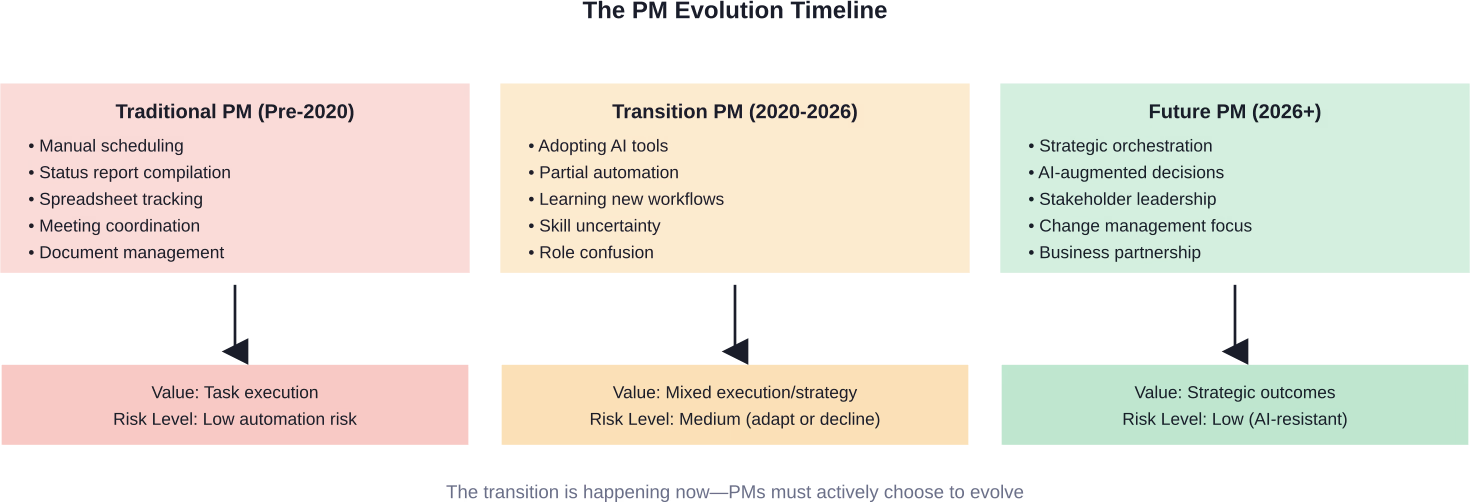
AI isn't making project managers obsolete. It's forcing a redefinition of what project management actually means.
The future PM role looks fundamentally different from the traditional one. Less time spent in spreadsheets and status meetings. More time spent on strategic planning, stakeholder alignment, and team development.
This shift creates both opportunity and pressure. PMs who embrace AI as leverage can accomplish far more than previous generations. They offload the administrative burden and focus energy on high-value activities that actually move projects forward.
But PMs who resist this evolution—who cling to administrative tasks as proof of their value—face obsolescence. AI will make average project managers redundant. It will make exceptional project managers indispensable.
The World Economic Forum emphasizes that successful AI adoption depends on empowering people, not just deploying technology. Organizations must redesign roles and workflows to combine human creativity and critical thinking with AI-driven insights.
For project managers, that means developing capabilities in areas where humans maintain decisive advantages.
As AI handles more routine project management work, certain human skills become exponentially more valuable.
Understanding what motivates different team members, recognizing when someone is struggling before they say anything, and creating psychological safety for honest communication—these capabilities separate effective PMs from algorithmic task managers.
Projects fail more often from people problems than technical problems. Miscommunication. Conflicting priorities. Low morale. Resistance to change. AI can flag some of these issues through data analysis, but resolving them requires human connection.
Senior leadership doesn't need another status report. They need project managers who understand business strategy, connect project outcomes to organizational objectives, and make recommendations that balance technical feasibility with market opportunity.
This requires seeing beyond the immediate project to understand competitive dynamics, customer needs, and strategic positioning. AI provides data inputs for these decisions, but it can't make the judgment calls that define successful business strategy.
Every project encounters unexpected obstacles. Effective PMs don't panic—they reassess, explore alternatives, and find creative paths forward.
This kind of adaptive thinking requires combining information from multiple domains, recognizing when standard approaches won't work, and improvising solutions tailored to specific situations. AI struggles with true novelty because it relies on pattern recognition from past data.
Large organizations are complex political systems. Getting things done requires understanding informal power structures, building coalitions, and timing initiatives for maximum receptivity.
AI can't teach you which executives to brief before a steering committee meeting or how to position a budget request to match department priorities. These skills develop through experience and relationship-building.
Translating between technical teams and business stakeholders, crafting messages that resonate with different audiences, and persuading people to support initiatives they initially resist—these are fundamentally human skills.
AI can draft communications, but it can't read a room and adjust messaging on the fly based on audience reaction.
The World Economic Forum emphasizes that from training for specific roles to building capabilities that can be recombined into new solutions, this shift in focus is where AI begins to change the economics of work.
Organizations need project managers who can work with AI tools, yes. But more importantly, they need PMs who can do what AI cannot—lead people through uncertainty toward outcomes that didn't exist before.
Understanding the shift is one thing. Adapting to it requires concrete action.
The fastest way to become obsolete is refusing to work with AI. Project managers should actively explore AI-powered project management platforms, experiment with AI assistants for routine tasks, and learn how to prompt AI effectively for useful outputs.
This isn't about replacement—it's about augmentation. PMs who leverage AI accomplish more than those who don't.
As AI handles more administrative work, redirect that reclaimed time toward stakeholder relationship building, team coaching and mentoring, strategic planning and business case development, and cross-functional collaboration.
The PMs who thrive are those who recognize that freed-up time is an opportunity to become more strategic, not an excuse to manage more projects simultaneously.
Generic project management knowledge becomes less differentiating. Industry-specific expertise becomes more valuable.
Understanding healthcare regulations, financial services compliance, software architecture, or supply chain logistics makes a PM more valuable than just knowing PMBOK or Agile frameworks. AI can learn the frameworks. It can't replace deep domain knowledge combined with PM skills.
Take courses in negotiation, conflict resolution, and organizational psychology. Seek feedback on communication style and emotional intelligence. Practice difficult conversations in low-stakes environments.
These capabilities don't develop through online tutorials. They require deliberate practice and real-world application.
Start thinking like a COO, not just a project manager. Understand the P&L implications of project decisions. Learn how projects connect to market strategy and competitive positioning. Develop fluency in business metrics beyond schedule and budget.
Executive leadership values PMs who understand business strategy and can translate it into executable initiatives.
This is controversial, but worth considering: traditional PM certifications like PMP may become less valuable as AI automates the technical skills they emphasize.
Some project managers in community discussions suggest that practical experience and soft skills may become more important than traditional certifications as AI changes the nature of project management work. The credential that proves you know how to create a work breakdown structure matters less when AI can generate one in seconds.
This doesn't mean certifications are worthless. But they should be viewed as baseline credentials, not differentiators.
AI's impact on project management isn't uniform across industries. Context matters.
Tech project management is experiencing the most immediate AI disruption. Software development already had abundant data, mature tooling, and digital workflows—everything AI needs to be effective.
AI can analyze code repositories to estimate development time, review pull requests for potential integration conflicts, and even suggest optimal sprint planning based on team velocity and complexity analysis.
But software PMs who focus exclusively on sprint mechanics face pressure. Those who combine technical knowledge with product strategy, user empathy, and cross-functional leadership remain valuable.
The role evolves toward product management—understanding what to build and why, not just managing the building process.
Physical construction projects generate less digital data than software projects, which slows AI adoption. But the trend is clear.
Building Information Modeling systems, IoT sensors on job sites, and digital project documentation are creating the data foundation for AI tools. These systems can monitor construction progress through image recognition, predict material delays based on supply chain data, and optimize crew scheduling for efficiency.
Construction PMs still need deep expertise in building codes, contractor management, and on-site problem-solving. AI augments this expertise but doesn't replace the need for someone who understands how buildings actually get built.
Healthcare project management faces unique complexity—regulatory requirements, patient safety considerations, and organizational resistance to change.
AI can help with clinical trial management, regulatory compliance tracking, and resource optimization across hospital systems. But healthcare PMs need a deep understanding of medical workflows, clinical stakeholder management, and change management in risk-averse environments.
The human elements matter more in healthcare than in many industries. Patients aren't software features. Clinical staff have legitimate concerns about workflow changes affecting patient care. AI can't navigate these sensitivities.
Banking and finance projects involve substantial data, making them prime candidates for AI augmentation. Transaction data, risk metrics, and regulatory reporting provide rich datasets.
AI excels at regulatory compliance monitoring, risk assessment for project portfolios, and financial forecasting for project budgets. But financial services PMs must understand complex regulations, manage relationships with regulators and auditors, and navigate highly political organizational environments.
The industry rewards PMs who combine technical project skills with regulatory expertise and business acumen.
This transformation isn't just about individual PMs adapting. Organizations need to rethink how they structure project management.
According to the World Economic Forum, nearly three-quarters of executives recognize that their organizations must change significantly to harness AI's full potential. Recognition is easy. Actually changing is hard.
Organizations should redefine PM job descriptions to emphasize leadership and strategy over administration, invest in training programs focused on emotional intelligence and stakeholder management, and create clear career paths for PMs to develop strategic capabilities.
They also need to resist the temptation to simply eliminate PM positions because AI handles administrative tasks. The work doesn't disappear—it shifts. Organizations still need someone ensuring projects align with strategy, stakeholders stay aligned, and teams navigate obstacles effectively.
The mistake is thinking AI replaces the need for project leadership. It doesn't. It changes what that leadership looks like.
Companies should also establish clear governance around AI tool adoption, create feedback loops where PMs help improve AI systems rather than compete with them, and measure PM performance on strategic outcomes rather than administrative outputs.
The organizations that get this right will have massive competitive advantages. They'll execute strategy faster, waste less money on failed projects, and retain top PM talent who want to do strategic work rather than administrative drudgery.
Project management exists within a broader labor market transformation. The U.S. Bureau of Labor Statistics provides context on overall employment trends.
Total U.S. employment growth from 2024 to 2034 is projected at 3.1 percent—dramatically slower than the 13.0 percent growth from 2014 to 2024. This slowdown reflects multiple factors, including demographic shifts, productivity improvements, and yes, automation.
The economy will add 5.2 million jobs over the decade, but the distribution is uneven. Some sectors grow while others contract.
Industries facing employment declines often cite productivity gains through emerging technologies as contributing factors. When organizations can accomplish the same output with fewer workers, they do.
This doesn't mean mass unemployment. But it does mean job displacement and the need for workforce adaptation. Project managers are part of this broader pattern.
The question isn't whether AI will change work—it already is. The question is whether individual workers and organizations adapt quickly enough to navigate the transition successfully.
Let's strip away the theory and talk practically.
If you're currently a project coordinator or entry-level PM doing mostly administrative work, you face real risk. Not immediate job loss necessarily, but career path disruption. There will be fewer positions like yours in five years. Plan accordingly.
That means accelerating your skill development, taking on more strategic responsibilities whenever possible, and building relationships with senior leaders who can advocate for your advancement.
If you're a mid-career PM comfortable with your current routine, complacency is dangerous. The PMs who thrive in the next decade won't be those who defend the status quo. They'll be those who embrace change, even when it's uncomfortable.
Experiment with AI tools now. Learn what they can and can't do. Find ways to use them that make you more effective rather than viewing them as threats.
If you're a senior PM or PMO leader, you have responsibility beyond your own career. You're setting direction for your organization's approach to project management in the AI era.
That means advocating for investments in PM skill development, resisting short-sighted decisions to cut PM roles just because AI handles some tasks, and creating career paths that recognize the evolving nature of the profession.
The PMs who treat AI as leverage rather than replacement will accomplish more, deliver better results, and build more valuable careers.
But that requires active choice. Passive acceptance of automation without skill development leads to obsolescence.
So will AI replace project managers?
No. But that answer requires important qualifications.
AI will replace project managers who are essentially highly-paid administrators. If your value proposition is creating Gantt charts and compiling status reports, AI can do that cheaper and faster.
AI won't replace project managers who lead people, navigate complexity, build stakeholder alignment, and make strategic decisions under uncertainty. These capabilities remain fundamentally human.
The profession is experiencing forced evolution. The administrative components of project management—historically a significant portion of the role—are being automated. That leaves the strategic, interpersonal, and leadership components as the core of what project management means.
This is actually a positive development for the profession, even though the transition is uncomfortable. Project managers can focus on work that creates real value rather than busy work that merely demonstrates activity.
Organizations get better project outcomes when PMs spend time on strategy and stakeholder management rather than spreadsheet updates.
But the transition requires adaptation from both individual PMs and the organizations that employ them. Skills that were nice-to-have become essential. Capabilities that were peripheral become central.
The future belongs to project managers who can think like executives, lead like coaches, and leverage AI like power tools—using technology to amplify their impact rather than viewing it as competition.
The transformation of project management through AI isn't coming—it's here.
The question isn't whether your role will change. It's whether you'll adapt proactively or reactively.
PMs who embrace this shift, who develop the strategic and interpersonal skills that AI cannot replicate, who learn to leverage automation as a force multiplier rather than viewing it as a threat—these professionals will thrive.
They'll deliver better project outcomes, build more fulfilling careers, and create more value for their organizations than was possible in the pre-AI era.
But PMs who resist change, who cling to administrative tasks as proof of their worth, who view AI as something to avoid rather than adopt—they face a difficult future.
The profession is evolving whether any individual wants it to or not. The only choice is whether you evolve with it.
Start today. Experiment with an AI project management tool. Take a course in strategic thinking or emotional intelligence. Have a conversation with senior leadership about how your role could create more strategic value.
The future of project management isn't predetermined. It's being shaped right now by the choices that PMs and organizations make about how to integrate AI into their work.
Make choices that position you for the future, not the past.


