Shopify Email Marketing Automation Tools That Actually Convert
Best Shopify email marketing automation tools to engage customers, recover carts, and grow your store effortlessly
Jan 6, 2026



AI will not replace engineers entirely, but it will fundamentally transform how engineering work gets done. Data from the U.S. Bureau of Labor Statistics projects total employment to grow through 2034, with AI creating new engineering roles while automating routine tasks. Engineers who adapt by combining technical expertise with AI tools, critical thinking, and strategic problem-solving will thrive in this evolving landscape.
The question isn't new. Every technological leap—from electricity to computers—sparked the same anxiety about job displacement.
But here's the thing: AI is different. It's not just automating physical tasks. It's writing code, suggesting system designs, and generating solutions to complex problems that once required years of engineering expertise.
So what's actually happening to engineering jobs right now? Let's cut through the hype and look at the data.
The U.S. Bureau of Labor Statistics projects total employment to grow from 170.0 million in 2024 to 175.2 million in 2034. That's a 3.1 percent increase—much slower than the 13.0 percent growth recorded over the previous decade.
But employment is still growing, not shrinking.
Here's what matters for engineers: AI is expected to primarily affect occupations whose core tasks can be most easily replicated by Generative AI in its current form. However, the same government data reveals something critical—AI may actually support demand for computer occupations, as software developers are needed to develop AI-based business solutions and maintain AI systems.
Database administrators and architects are expected to be needed to set up and maintain more complex data infrastructure. The technology creates its own job market.
According to the World Economic Forum's Future of Jobs Report 2025, approximately 170 million new jobs will be created by 2030. Broadening digital access is expected to be the most transformative trend, with 60 percent of employers expecting it to transform their business by 2030.
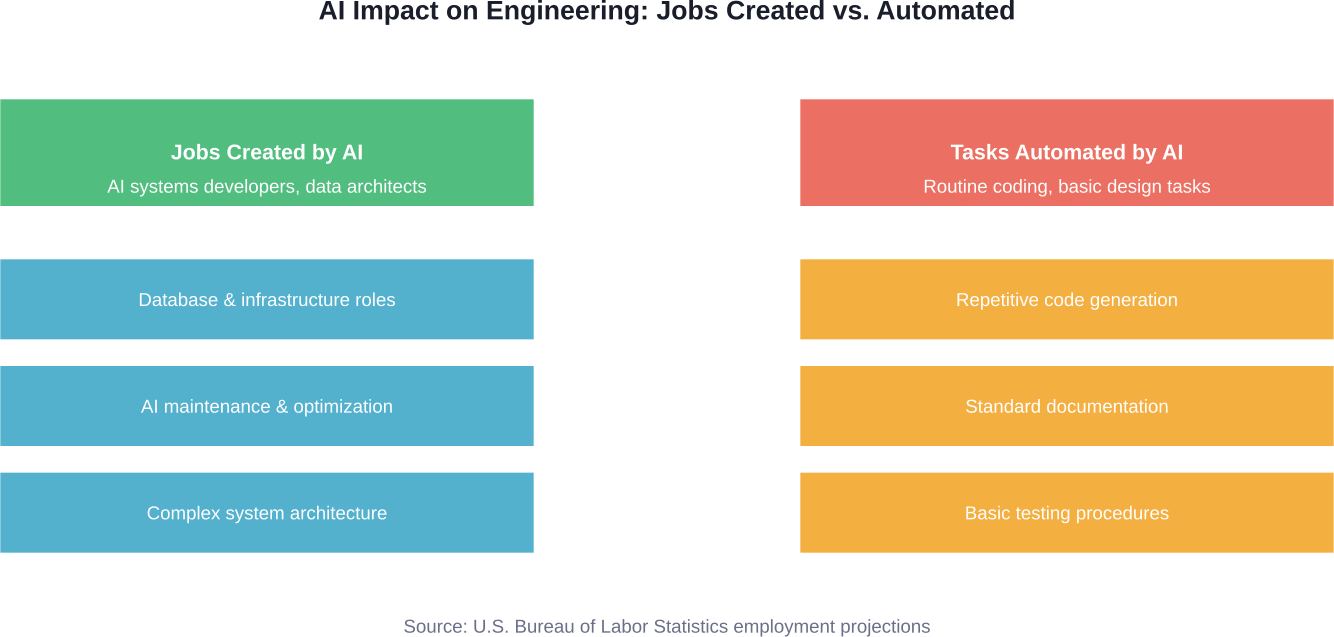
Not all engineering roles face equal exposure to AI disruption.
Research from Brookings Institution analyzing workers' capacity to adapt to AI-driven job displacement found that among workers in the top quartile of occupational AI exposure, 26.5 million have above-median adaptive capacity. They're positioned to make a job transition if displacement occurs.
However, the analysis also documents that approximately 6.1 million workers (4.2 percent of the workforce in the study) face both high AI exposure and below-median adaptive capacity. That's a concentrated pocket of potential vulnerability.
Here's the pattern emerging from the data: tasks that involve repetitive processes, standard procedures, and well-defined outputs face higher automation risk. Engineering work that requires judgment, creativity, system-level thinking, and human collaboration remains difficult for AI to replicate.
Research analyzing over 10 million UK job postings shows that candidates with AI-related skills command, on average, an advertised salary 23 percent higher than otherwise comparable candidates without those skills. The market is already rewarding engineers who can work effectively with AI tools.
Software developers are experiencing AI's impact most directly. Research on AI-powered software development found that developers using AI assistance completed tasks 55.8 percent faster on average than the control group.
That's a massive productivity increase. But faster doesn't mean replaced.
New enterprise usage data from Anthropic illustrate the complexity. While about half of Claude chatbot usage was for augmenting purposes, the overwhelming majority (77 percent) of the tasks that business clients using Claude's API deployed were for automation purposes.
The reality? AI is handling the boilerplate, the routine patterns, the standard implementations. Senior engineers are moving up the value chain to architecture, system design, and strategic decisions that AI can't make independently.
Mechanical engineering faces different dynamics. AI can optimize designs, run simulations, and suggest improvements. But it can't replace the hands-on testing, the physical intuition, or the understanding of how materials behave in real-world conditions.
Community discussions among mechanical engineers consistently highlight this point. The design process involves iterative testing, failure analysis, and tacit knowledge that's difficult to encode in training data.
That said, AI tools are becoming essential for competitive mechanical engineering work. Simulation software powered by machine learning can test thousands of design variations in hours. Engineers who can't leverage these tools will fall behind those who can.
Employers expect 39 percent of workers' core skills to change by 2030, according to the World Economic Forum data. While this represents significant ongoing disruption, it's begun to stabilize at a high level rather than accelerating further.
The skills that matter most aren't purely technical anymore.
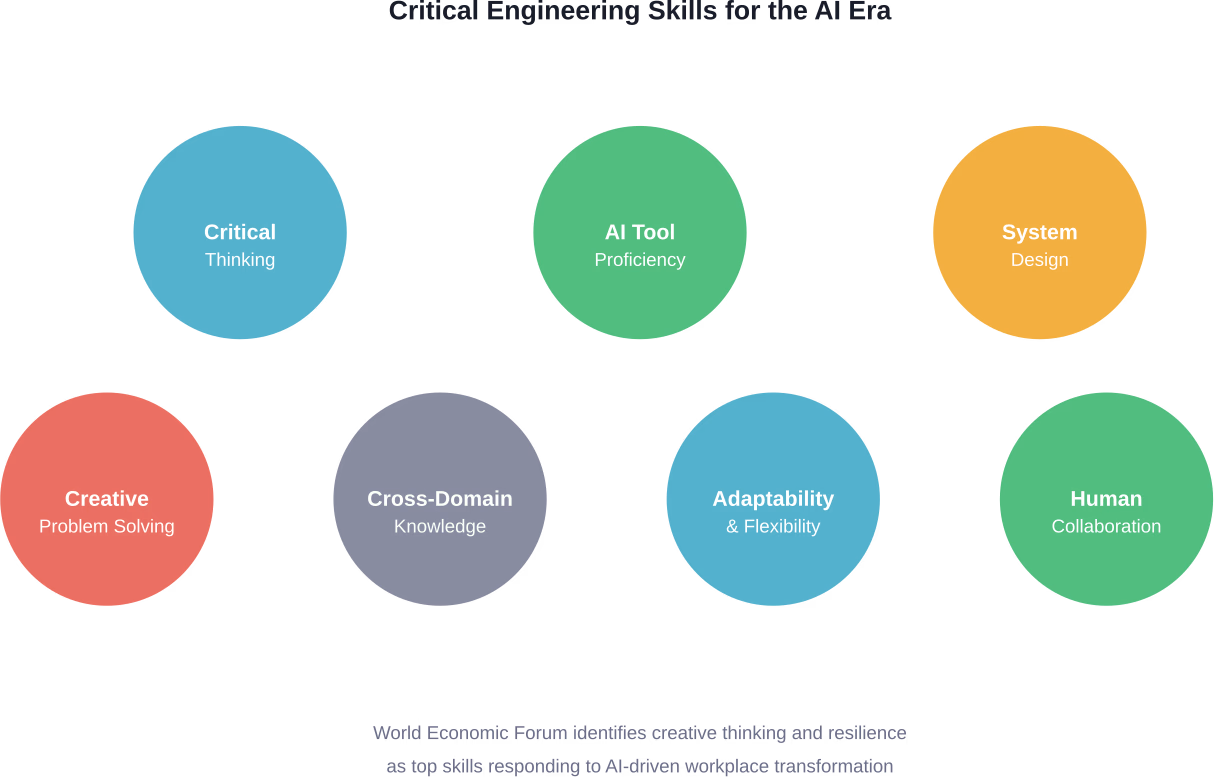
Creative thinking and resilience top the list of skills needed for the future. These two impacts on job creation are expected to increase demand for those specific capabilities.
But there's something else happening that's equally important: the engineers who thrive won't be the ones who rely on AI blindly. They'll be the ones who use AI for speed while keeping human judgment firmly in the loop.
Here's what that looks like in practice:
AI makes engineers faster. It does not make them smarter.
That's the uncomfortable truth emerging from real-world AI adoption in engineering teams. The risk isn't that AI will replace engineers outright—it's that engineers will quietly outsource their thinking and become less capable over time.
According to competitive content analysis, engineering leaders note that AI tools can now write code, suggest system designs, generate features, and speed up development. But great engineers still own system design, architecture decisions, debugging and edge cases, and tradeoffs and judgment calls.
The engineers who stop practicing those skills—who let AI do the thinking—will find themselves replaceable. Not by AI directly, but by engineers who use AI as a tool while maintaining their own expertise.
Research by Babina and Fedyk tracking individual companies' investments in artificial intelligence and accompanying changes in firms' operations found that AI has spurred firm growth and increased employment overall.
Companies using AI effectively hired more people, not fewer. But the composition of those teams changed.
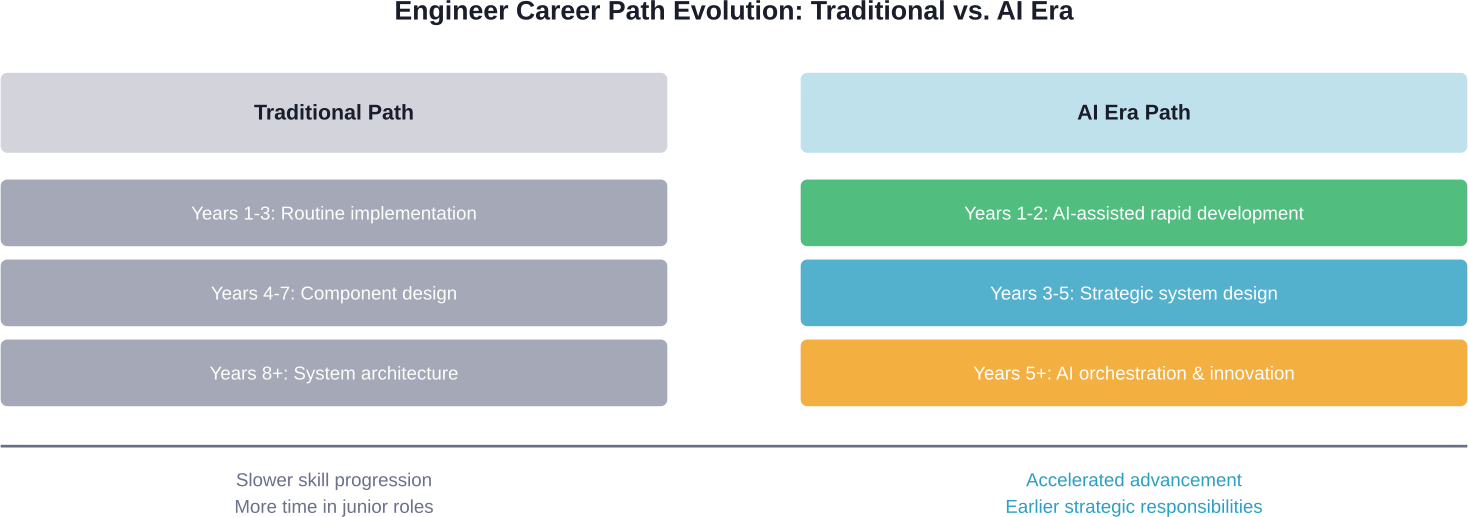
Routine implementation work decreased. Strategic roles increased. The engineers who could only execute predefined tasks found fewer opportunities. Engineers who could define the tasks, evaluate solutions, and make architectural decisions became more valuable.
In practice, this creates a sorting mechanism. Junior engineers who would have spent years building foundational skills through repetitive coding now risk skipping that phase entirely—and missing the deep understanding that comes with it.
Different engineering disciplines face different timelines and risk levels.
Highest immediate exposure to AI automation. Code generation tools are already mainstream. But demand for software engineers continues to grow because AI creates new technical challenges that require engineering solutions.
The role is evolving rapidly from implementation to orchestration—engineers increasingly manage AI-generated components rather than writing everything from scratch.
Lower immediate automation risk due to physical world constraints. AI can optimize designs and run simulations, but can't replace hands-on testing, material science expertise, or regulatory knowledge.
These fields will see AI as a powerful augmentation tool rather than a replacement threat in the near term.
Moderate automation exposure. Circuit design and simulation are already heavily computerized, making AI integration natural. But system-level design and troubleshooting require expertise AI can't replicate yet.
AI excels at pattern recognition and optimization—both valuable in these fields. But regulatory requirements, safety considerations, and experimental validation create strong human oversight requirements.
Based on the data and emerging patterns, here's what actually works:
First, learn to use AI tools effectively. Not superficially—deeply. Understand their strengths, weaknesses, and failure modes. Engineers who master AI augmentation will have a significant competitive advantage.
Second, double down on skills AI can't replicate. System-level thinking. Creative problem-solving. Cross-domain knowledge. The ability to understand business context and translate technical capabilities into business value.
Third, stay technically hands-on. The temptation to let AI handle all the implementation details is strong. Resist it. Engineers who lose their ability to understand what's happening under the hood become less effective at every level.
Fourth, develop specialized expertise. Generalist skills become less defensible as AI improves. Deep domain knowledge in specific industries, technical specializations, or problem spaces creates value AI can't easily capture.
Looking at the 2024-2034 employment projections from BLS, total employment growth is slowing—but still positive. The 3.1 percent increase represents 5.2 million new jobs across all sectors.
For engineering specifically, the pattern is clear: roles focused on AI development, data infrastructure, and system architecture are growing. Roles centered on routine implementation are declining or shifting toward AI augmentation models.
Climate-change mitigation ranks as the third-most transformative trend overall according to World Economic Forum data. This creates substantial demand for engineers with specialized knowledge in energy systems, sustainable design, and environmental engineering—domains where AI serves as a tool but can't replace human expertise.
The skills disruption will continue. Employers expect 39 percent of core skills to change by 2030. But that disruption creates opportunity for engineers who actively develop the skills the market values.
One thing's certain: the engineering profession won't disappear. It's transforming into something different—more strategic, more AI-augmented, more focused on judgment and creativity rather than routine implementation.
AI won't replace engineers. But it will replace engineers who stop thinking.
The data is clear: engineering employment continues to grow even as AI capabilities expand. New roles emerge as fast as routine tasks automate. Companies investing in AI hire more engineers, not fewer—but they hire different types of engineers.
The engineers who thrive will combine technical expertise with AI proficiency. They'll use automation for speed while maintaining deep understanding. They'll focus on the creative, strategic, and judgment-intensive work that AI can't replicate.
This isn't a crisis. It's a transition. And like every previous technological shift in engineering—from slide rules to CAD software—the professionals who adapt early will have the strongest careers.
Start building those AI-era skills now. Your future self will thank you.


