Best OpenClaw Alternatives 2026: Security to Speed
Explore top OpenClaw alternatives in 2026. Compare NanoClaw, Nanobot, memU, and more for security, performance, and real-world execution.
Apr 8, 2026



While AI is transforming the job market, roles requiring human judgment, emotional intelligence, physical dexterity, and creative problem-solving remain largely automation-resistant. According to the Bureau of Labor Statistics, jobs most resistant to AI include healthcare professionals, skilled trades, educators, and roles demanding complex interpersonal skills. The World Economic Forum projects significant growth in agriculture, education, and healthcare sectors through 2027, emphasizing that the human body and brain's unique capabilities give workers advantages that machines can't replicate.
The fear is real. Every few months, another headline screams about AI taking jobs, displacing workers, and fundamentally reshaping entire industries. ChatGPT writes marketing copy. Generative AI creates artwork. Algorithms diagnose diseases.
But here's what the panic misses: AI isn't a universal job-killer. It's a tool that excels at specific, narrow tasks.
According to the Bureau of Labor Statistics, total employment is projected to grow from 170.0 million in 2024 to 175.2 million in 2034, representing a 3.1 percent increase. That's slower than the previous decade's 13.0 percent growth, but it's still growth. Over the 2023–33 projections period, BLS research shows AI primarily affects occupations whose core tasks can be most easily replicated by Generative AI in its current form.
The jobs AI struggles with? Those require human bodies, human emotions, human judgment, and human creativity. According to the World Economic Forum's Future of Jobs Report 2023, there is expected to be a 15%-30% rise in jobs for agricultural professionals in the coming five years. Physical work, manual dexterity, and tasks requiring nuanced human interaction aren't disappearing anytime soon.
Real talk: some jobs will change. Some will disappear. But many careers remain fundamentally resistant to automation, and understanding why helps identify which paths offer genuine long-term security.
Not all tasks are created equal in the eyes of artificial intelligence. MIT economist David Autor's research into task classification reveals why some jobs resist automation while others don't.
His framework divides work into three categories: abstract tasks requiring creativity, reasoning, and interpersonal skills; routine tasks following clear, predictable rules; and manual tasks demanding physical dexterity and adaptability. AI dominates the middle category. Routine cognitive work gets automated first.
According to Pew Research Center data from October 2025, 21% of U.S. workers say at least some of their work is done with AI, up from 16% roughly a year ago. But the share who say all or most of their work is done with AI remains just 2 percent. The share who say some of their work is done with AI increased from 14% to 19%.
That tells us something important: AI assists, but rarely replaces entirely.
The World Economic Forum's research suggests one of the human brain's biggest advantages over AI is the fact it's attached to a real human body. Expectations that physical and manual work could be displaced by machines have actually decreased among surveyed companies.
Jobs that resist automation share common characteristics. Understanding these pillars helps predict which careers remain secure:
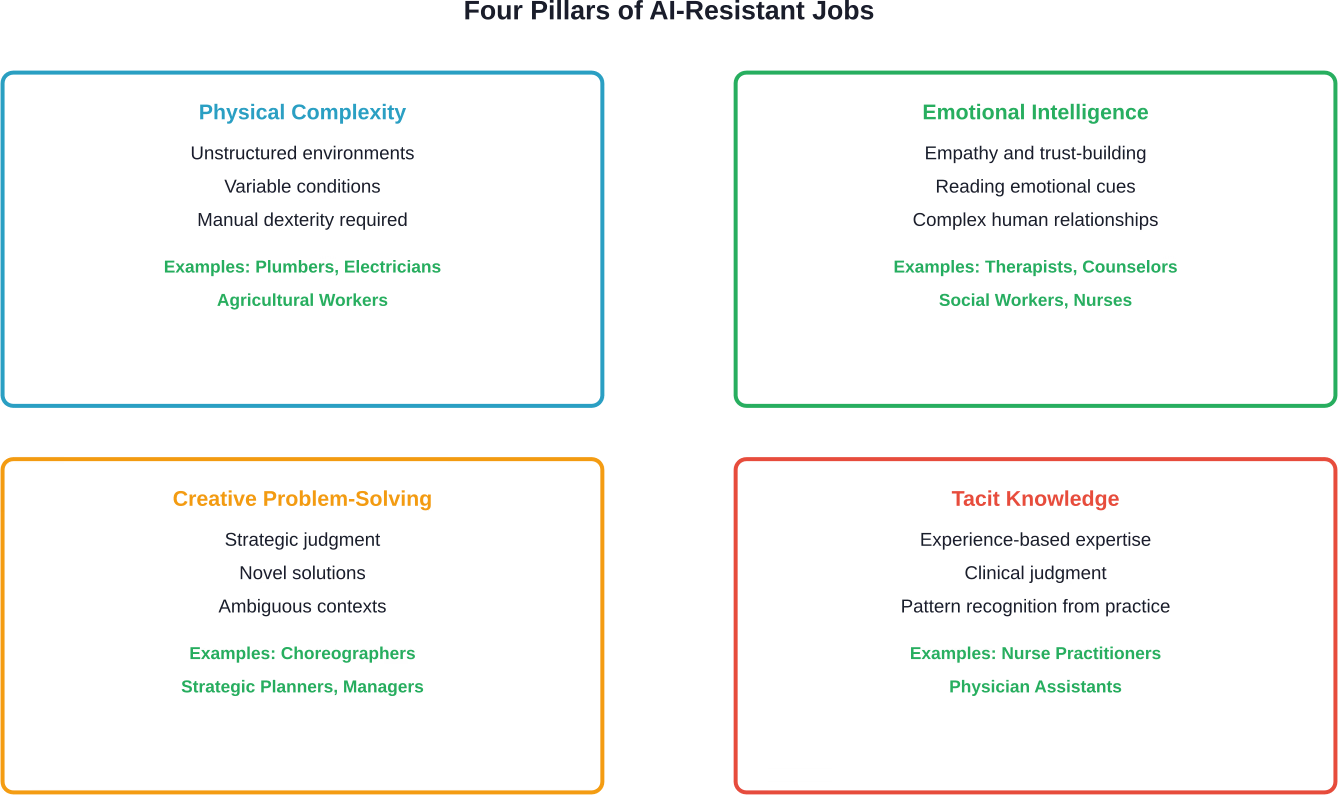
Healthcare dominates lists of automation-resistant careers. The reasons go beyond technical capability.
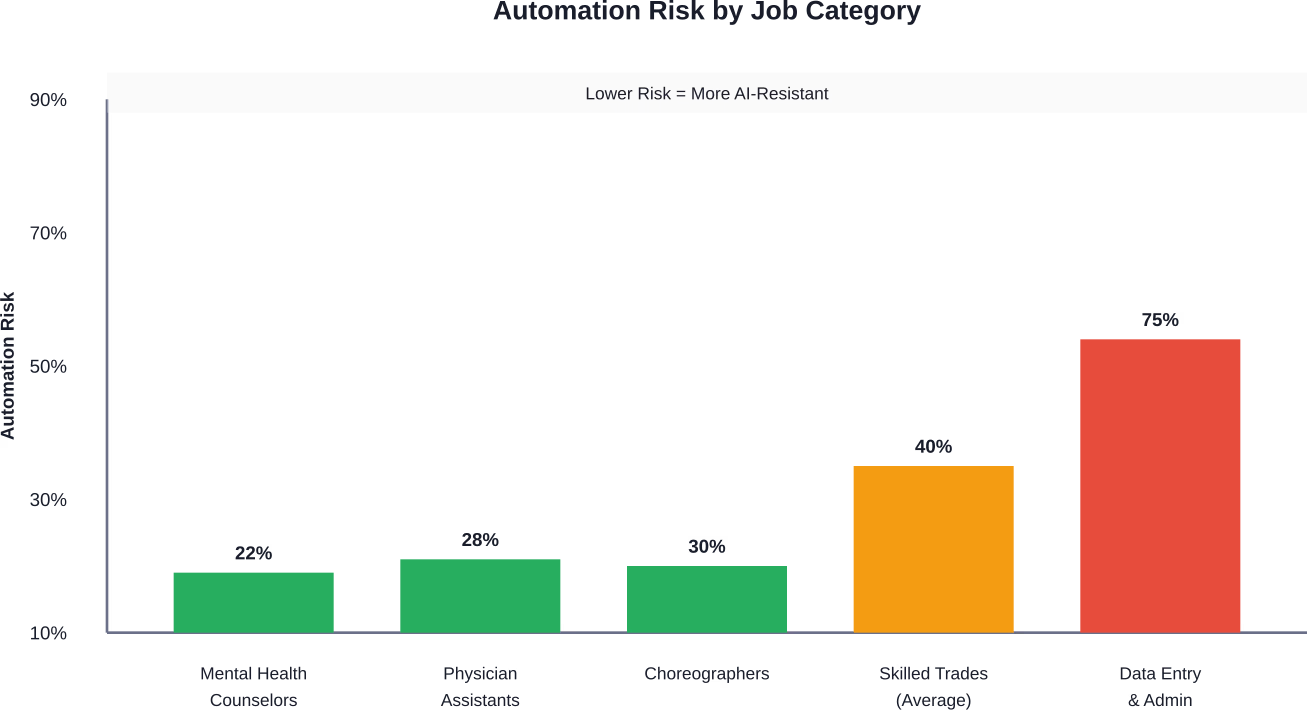
Nurse practitioners show a 45.7 percent automation risk according to available labor data. Mental health counselors face 22.1 percent automation risk according to available labor data. Nursing instructors and teachers in post-secondary settings have 21.5 percent automation risk according to labor data.
Why? Because healthcare requires the entire package of AI-resistant traits.
Consider a mental health therapist. Sure, AI chatbots can offer gentle help between sessions through self-guided exercises. They handle notes and routine administrative work. They spot early risk patterns and suggest relevant resources or referrals.
But everything else remains in the hands of the therapist, where human understanding leads the way. Task-level analysis shows therapists remain human-led for 85 percent of their core work, with only 15 percent supported by AI tools.
Nurses provide physical care that demands dexterity, mobility, and real-time decision-making in unpredictable environments. They read patient distress beyond what monitors show. They comfort anxious families. They coordinate complex care across multiple providers.
Robot nurses exist in limited pilot programs, but they handle narrow tasks like medication delivery in controlled hospital environments. The messy reality of patient care—managing IVs on difficult veins, repositioning immobile patients without causing injury, recognizing subtle changes in condition—remains stubbornly human.
Research indicates that healthcare professionals may benefit from AI support tools rather than facing displacement. Software developers are needed to create AI-based healthcare solutions, and database administrators maintain the complex data infrastructure supporting medical AI.
Physician assistants have 27.6 percent automation risk according to labor data. That's remarkably low for a profession dealing heavily with data and diagnostics.
The reason? Clinical medicine isn't just pattern matching. It's integrating contradictory information, considering patient preferences and values, accounting for social determinants of health, and making judgment calls when evidence is incomplete or conflicting.
AI diagnostic tools excel at reading X-rays or analyzing lab values. But the physician synthesizes those inputs with patient history, physical examination findings, knowledge of local disease patterns, and understanding of what treatments a specific patient will actually adhere to.
That synthesis represents exactly the kind of complex, multi-modal reasoning AI struggles with.
Here's where the disconnect between AI hype and reality becomes clearest. The World Economic Forum reports that expectations of physical and manual work displacement have actually decreased.
Electricians, plumbers, HVAC technicians, and construction workers operate in environments that confound automation. Every job site differs. Materials vary. Weather changes. Building codes evolve. Customer needs require on-the-spot adaptation.
Try teaching a robot to run electrical wiring through a 100-year-old house with irregular framing, asbestos insulation, and no blueprints. Good luck.
Factory robots work because factories are controlled environments. Standardized parts arrive at predictable intervals. Movements repeat precisely. Sensors monitor consistent conditions.
A plumber responding to a burst pipe in a residential basement encounters none of that predictability. The pipe might be copper, PVC, or galvanized steel. It might be accessible or buried behind finished walls. The shutoff valve might be corroded. The homeowner might have a crawl space full of stored belongings.
Solving that problem requires assessing the situation, adapting the approach, and using tools flexibly in cramped, awkward positions. Physical dexterity in unstructured environments remains a massive challenge for robotics.
Skilled trades aren't just manual labor. They're diagnostic problem-solving combined with customer service.
An HVAC technician doesn't just replace parts. They listen to the homeowner describe symptoms, inspect the system, test components, diagnose the underlying issue, explain options in terms non-experts understand, and provide cost-benefit analysis for repair versus replacement.
That combination of technical knowledge, physical work, and interpersonal communication creates multiple layers of automation resistance.
Online courses existed long before AI. Khan Academy, Coursera, and YouTube made educational content freely available. Yet teachers didn't disappear.
Why? Because education isn't just information delivery.
Teaching involves reading student comprehension in real-time, adapting explanations to different learning styles, managing classroom dynamics, motivating disengaged students, identifying learning disabilities, communicating with parents, and fostering social-emotional development.
The World Economic Forum's Future of Jobs Report 2025 indicates education jobs are among those with strong projected growth in certain areas. Despite—or perhaps because of—the rise of educational technology, human educators remain central.
Preschool and kindergarten teachers work with students whose primary developmental tasks are social and emotional, not academic. Learning to share, manage emotions, follow routines, and interact with peers requires patient human guidance.
No AI can provide the warmth, physical safety, and emotional attunement that early childhood education demands. These jobs combine caregiving with teaching in ways fundamentally resistant to automation.
Special education teachers create individualized education plans, adapt materials for diverse learning needs, collaborate with therapists and specialists, and advocate for student services. The work requires deep understanding of individual students, creative problem-solving, and emotional intelligence.
AI tools might generate practice exercises or track progress data. But the human relationship between teacher and student, the patience required to work through learning challenges, and the ability to celebrate small victories remains irreplaceable.
AI generates content. No question about that. It writes marketing copy, creates images, composes music, and even produces code.
But creation and curation aren't the same thing.
Choreographers face 29.7 percent automation risk according to labor research. Creative directors, art directors, and senior designers maintain strong employment prospects despite generative AI tools.
The reason? Creative work isn't just making stuff. It's making the right stuff for a specific audience, purpose, and context.
A graphic designer doesn't just arrange visual elements. They solve communication problems. They understand brand strategy, audience psychology, cultural context, and business objectives. They iterate based on stakeholder feedback and market response.
AI can generate 50 logo variations in seconds. But it can't tell which one will resonate with the target market, differentiate from competitors, and remain relevant for years. That requires judgment, taste, and strategic thinking.
Film directors, museum curators, creative directors, and choreographers share a common function: they make aesthetic and strategic choices that shape experiences.
A choreographer doesn't just string movements together. They create emotional arcs, consider dancer strengths, respond to music, and develop artistic vision. That holistic creative judgment remains distinctly human.
Generative AI might suggest movement sequences. But the artistic choice of what serves the piece, what challenges audiences appropriately, what pushes boundaries versus what alienates—that's human territory.
This one surprises people. According to the World Economic Forum's Future of Jobs Report 2025, there is expected to be a 15%-30% rise in jobs for agricultural professionals in the coming five years. Farmworkers top the table of largest growing jobs in the Future of Jobs Report 2025.
Wait, what? Agriculture, one of the oldest human occupations, is growing in the age of AI?
Absolutely. And it makes sense when considered carefully.
Farming involves working with living systems in uncontrolled outdoor environments. Weather varies. Soil conditions differ. Plants grow unpredictably. Pests adapt. Equipment malfunctions in muddy fields.
Automated harvesting exists for specific crops in ideal conditions—think large-scale wheat or corn operations. But specialty crops like berries, tree fruits, and vegetables require delicate handling that robotic systems struggle with. Distinguishing ripe from unripe produce, navigating irregular terrain, and adapting to plant variation creates ongoing automation challenges.
Demographic trends, especially aging working-age populations, drive agricultural labor demand. The need for food production doesn't diminish. If anything, concerns about food security and supply chain resilience increase local agricultural employment.
Agricultural equipment operators, farmworkers, and food production specialists engage in physical work that AI can assist with but not fully replace. Precision agriculture uses AI for crop monitoring and yield prediction, but human operators still drive equipment, make planting decisions, and manage operations.
Social workers combine emotional intelligence, advocacy, crisis intervention, and resource coordination. The work involves navigating complex social systems, building trust with vulnerable populations, and making judgment calls in ambiguous situations.
According to available labor data, social workers maintain strong employment projections with low automation risk.
Social workers assess client needs, coordinate services across multiple agencies, advocate within bureaucratic systems, and build long-term supportive relationships. The work requires understanding individual circumstances, cultural competence, and the ability to navigate both formal systems and informal community resources.
AI might help track case information or identify available resources. But the human relationship—the trust that allows clients to share struggles, the advocacy that challenges systemic barriers, the creative problem-solving that finds solutions when standard approaches fail—remains fundamentally human work.
Child protective services workers, domestic violence counselors, and crisis intervention specialists respond to high-stakes situations requiring immediate human judgment. They assess safety, de-escalate conflicts, and make decisions with incomplete information under time pressure.
These situations demand emotional intelligence, physical presence, and the ability to read subtle behavioral cues that indicate risk. No algorithm replicates that combination of skills.
Mid-level management faces automation pressure. Routine supervisory tasks—scheduling, basic performance tracking, resource allocation within fixed parameters—can be systematized.
But strategic leadership remains human territory.
Senior managers set organizational direction, navigate complex stakeholder relationships, make decisions with incomplete information, and inspire teams through change. That work combines analytical thinking with emotional intelligence, political savvy, and vision.
Leading organizations through technological change, market disruption, or cultural transformation requires understanding both systems and people. Managers communicate vision, address resistance, solve unforeseen problems, and maintain team morale.
AI might analyze organizational data or model scenarios. But rallying people around difficult changes, making tough calls about resource allocation, and maintaining organizational culture through transitions remains distinctly human work.
Executive leaders manage relationships with boards, investors, regulators, community partners, and the public. They represent organizational values, negotiate complex agreements, and build trust across diverse groups.
That relationship work—reading political dynamics, adapting communication styles, building coalitions—defies automation. It requires social intelligence developed over decades of experience.
Let's cut through the hype and look at what research actually demonstrates.
The Bureau of Labor Statistics projects total employment growth from 170.0 million in 2024 to 175.2 million in 2034. That's a 3.1 percent increase. Not massive growth, but growth nonetheless.
Over the 2023–33 employment projections period, BLS research indicates AI primarily affects occupations whose core tasks can be most easily replicated by Generative AI in its current form. But AI may also support demand for computer occupations, as software developers are needed to develop AI-based business solutions and maintain AI systems.
Pew Research Center data from February 2025 shows workers have mixed feelings about AI. About half of workers (52%) say they're worried about the future impact of AI use in the workplace, and 32% think it will lead to fewer job opportunities for them in the long run, according to a Pew Research Center survey from February 2025.
But here's the critical nuance: Pew Research Center data from October 2025 shows 21% of U.S. workers say at least some of their work is done with AI, up from 16% roughly a year ago. Yet only 2 percent say all or most of their work is done with AI. The share who say some of their work is done with AI increased from 14% to 19%.
That pattern—AI as an assistant rather than replacement—appears across multiple sectors.
MIT economist David Autor's research highlights an important distinction. His paper warns against focusing on exposure alone, arguing it misses nuances of how experts and non-experts experience task shifts.
When expertise requirements rise, automation doesn't eliminate jobs—it increases barriers to entry. The work becomes more complex, requiring higher skill levels. That's different from job elimination.
Pew Research Center's 2023 analysis found 19 percent of American workers in jobs most exposed to artificial intelligence, where important activities may be either replaced or assisted by AI. Women, Asian workers, college-educated workers, and higher-paid workers have more exposure to AI.
But workers in the most exposed industries are more likely to say AI will help more than hurt them personally. That suggests a recognition that exposure doesn't equal replacement.
The World Economic Forum's Future of Jobs Report 2025 indicates employers expect 39% of key skills required in the job market will change by 2030, down from 44% in 2023.
So what skills matter? What separates automation-resistant workers from those facing displacement?
AI excels at well-defined problems with clear parameters. Human workers thrive in messy situations where the problem itself isn't clearly defined, constraints conflict, and optimal solutions don't exist.
Developing the ability to navigate ambiguity, synthesize contradictory information, and make judgment calls with incomplete data remains valuable across sectors.
Reading emotional states, building trust, navigating conflict, and adapting communication styles to different audiences—these remain distinctly human capabilities.
Jobs requiring these skills maintain low automation risk regardless of industry. Customer service roles that require empathy and problem-solving resist automation better than transactional support roles.
Workers who can operate effectively in unstructured physical environments, adapt to changing conditions, and perform delicate manual tasks maintain automation resistance.
This isn't just construction and trades. It includes roles like laboratory technicians, dental hygienists, and surgical technologists—jobs combining physical precision with technical knowledge.
Distinguishing between many possible options, making aesthetic judgments, considering long-term implications, and evaluating ideas in context requires human judgment.
Workers who develop taste, strategic thinking, and the ability to evaluate creative work maintain value even as AI generates raw options.
Here's what the panic about AI job replacement misses: most technological change throughout history has augmented human capability rather than eliminated human work.
The Bureau of Labor Statistics notes that some observers in the 1950s and 1960s argued computers and industrial automation could lead to massive job losses. Congressional hearings and studies by BLS examined these concerns.
History shows technology transforms jobs more than it eliminates them. BLS noted that despite the absence of historical data showing employment declines for photographic process workers, employment projections correctly anticipated decline as digital cameras replaced film.
The pattern isn't job elimination. It's a task transformation.
Research from MIT Sloan School of Management published in March 2025 presents a different perspective—moving beyond simply identifying jobs at risk from AI and highlighting areas where human expertise remains important and complementary to technological advancements.
The paper offers a framework of human-machine complementarities at work, emphasizing collaboration rather than simple replacement.
For most workers exposed to AI, the technology handles routine cognitive tasks while humans focus on judgment, relationship, and complex problem-solving work.
A mental health therapist uses AI for note-taking and resource suggestions but provides the therapeutic relationship. A physician uses AI diagnostic support but makes treatment decisions considering patient values and circumstances. A graphic designer uses AI to generate options but makes creative judgments about which approaches serve client objectives.
This pattern of augmentation—AI handling defined tasks while humans manage complexity—appears across sectors.
The BLS notes AI may support demand for computer occupations. Software developers are needed to develop AI-based business solutions and maintain AI systems. Database administrators and architects are expected to set up and maintain more complex data infrastructure.
But it's not just technical roles. AI implementation creates demand for trainers who teach workers to use AI tools effectively, ethicists who guide responsible AI deployment, and managers who oversee human-AI workflows.
The World Economic Forum's Future of Jobs Report 2025 indicates about 170 million new jobs will be created in the near future by global macro trends. Many of those jobs don't exist yet. They will emerge as technology creates new possibilities and new problems requiring human solutions.
So what does this mean for career planning?
First, recognize that no job is completely immune to technological change. The question isn't whether AI will affect work, but how much and in what ways.
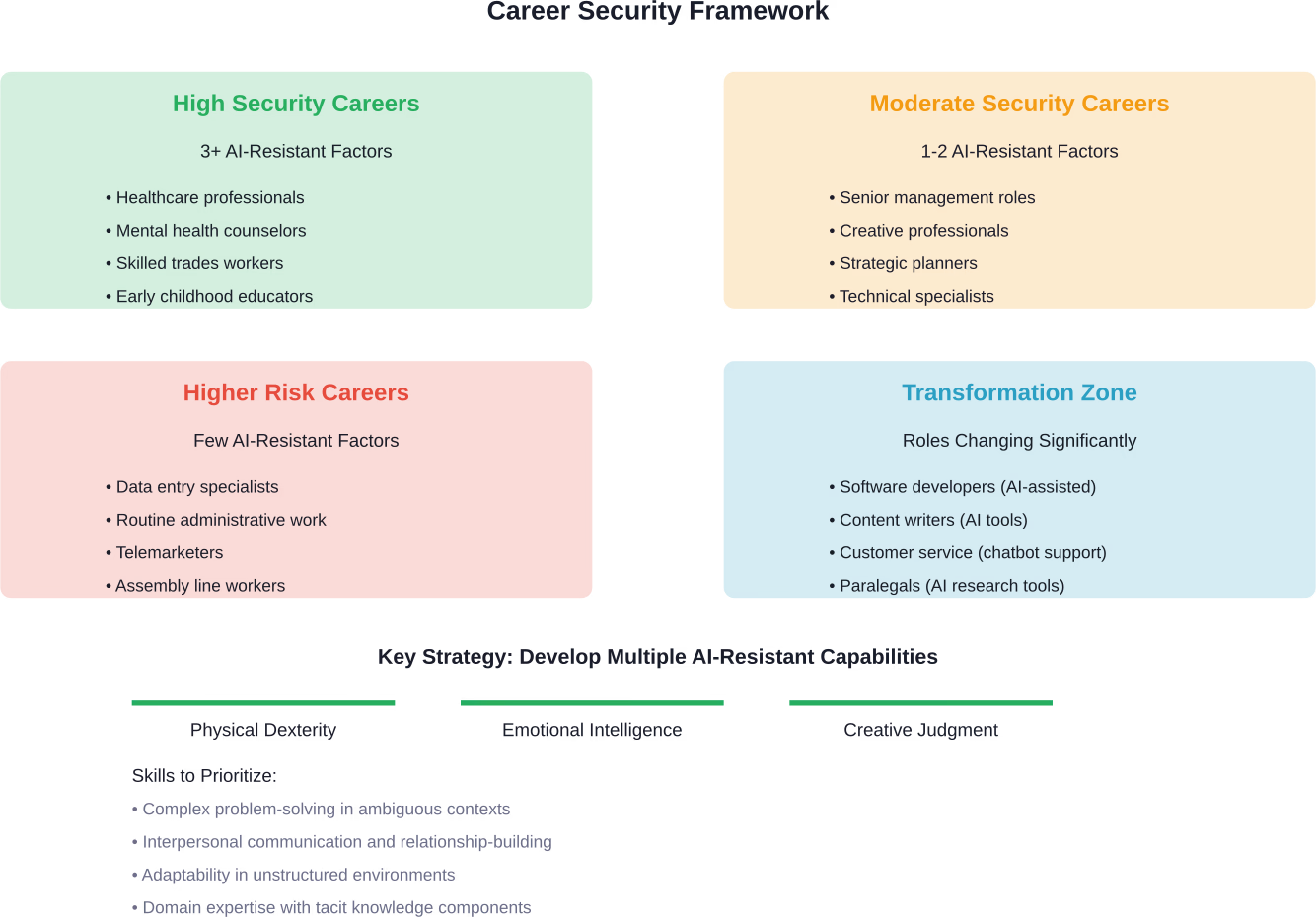
Second, focus on developing capabilities AI can't replicate: emotional intelligence, creative judgment, physical dexterity in unstructured environments, and complex problem-solving in ambiguous contexts.
Third, understand that exposure to AI isn't the same as replacement risk. Jobs most exposed to AI often become more valuable as workers use AI tools to enhance their capabilities.
When considering a career, ask these questions:
Careers answering yes to multiple questions maintain strong long-term prospects regardless of AI advancement.
Even in automation-resistant careers, workers benefit from understanding how AI tools can augment their work. The goal isn't avoiding AI but developing complementary capabilities.
A nurse who understands how AI monitoring systems work can use them more effectively while maintaining the human care that defines nursing. A teacher who uses AI assessment tools can spend more time on individual student support. A plumber who adopts AI diagnostic tools can solve problems faster while maintaining the manual expertise that defines the trade.
The most valuable workers will likely combine domain expertise with understanding of how AI tools enhance their capabilities.
The conversation about AI and jobs tends toward extremes. Either AI will eliminate work entirely, or it won't affect anything. Both perspectives miss reality.
AI will transform work significantly. Many tasks will be automated. Some jobs will disappear. But the evidence suggests most careers will evolve rather than vanish.
The workers who thrive will be those who understand their unique human capabilities—the judgment, creativity, emotional intelligence, and physical presence that algorithms can't replicate—and develop those capabilities intentionally.
Healthcare professionals who combine clinical expertise with compassionate care. Skilled trades workers who blend technical knowledge with diagnostic problem-solving. Educators who foster not just academic learning but social-emotional development. Creative professionals who make strategic judgments about which AI-generated options serve their purposes.
These careers don't just survive technological change. They become more valuable as routine tasks get automated and human expertise becomes the differentiator.
The question isn't whether AI will change work. It will. The question is whether workers develop the distinctly human capabilities that create lasting value regardless of technological advancement.
For those choosing careers or considering transitions, the data offers clear guidance. Look for work that requires presence in physical environments, building human relationships, making complex judgments in ambiguous situations, or applying expertise that can't be easily codified.
Those careers offer not just jobs, but meaningful work that leverages uniquely human capabilities. And that's job security no algorithm can threaten.


