Facebook Ads Agencies in India: A Look at Top Options
Explore Facebook ads agencies in India that manage Meta campaigns for businesses. See overviews of leading options with their typical services and practical approaches.
Mar 20, 2026



AI cannot reliably predict lottery numbers because lotteries use truly random generation methods designed to be unpredictable. While AI can analyze historical data and identify statistical patterns, each draw is independent with equal probability for all number combinations. Some players have won using AI-generated numbers, but these are statistical coincidences rather than proof of predictive capability.
The dream sounds perfect: plug a few prompts into ChatGPT, get winning lottery numbers, and retire early. When Tammy Carvey opened ChatGPT on September 6th and asked for Powerball numbers, she won $100,000. Three university students in Lecce, Italy, reportedly won more than $50,000 using an algorithm that examined past drawings.
So naturally, everyone wants to know: can AI actually predict lottery numbers?
Here's the thing—lotteries are specifically designed to be unpredictable. According to NIST research on quantum-based random number generation, true randomness forms the foundation of modern lottery systems. The NIST beacon provides random numbers for applications like "selecting jury candidates or assigning resources through a lottery," achieving a 99.7% success rate in generating truly random outputs.
Every lottery draw is an independent event. The probability of any combination winning remains exactly the same, regardless of past results.
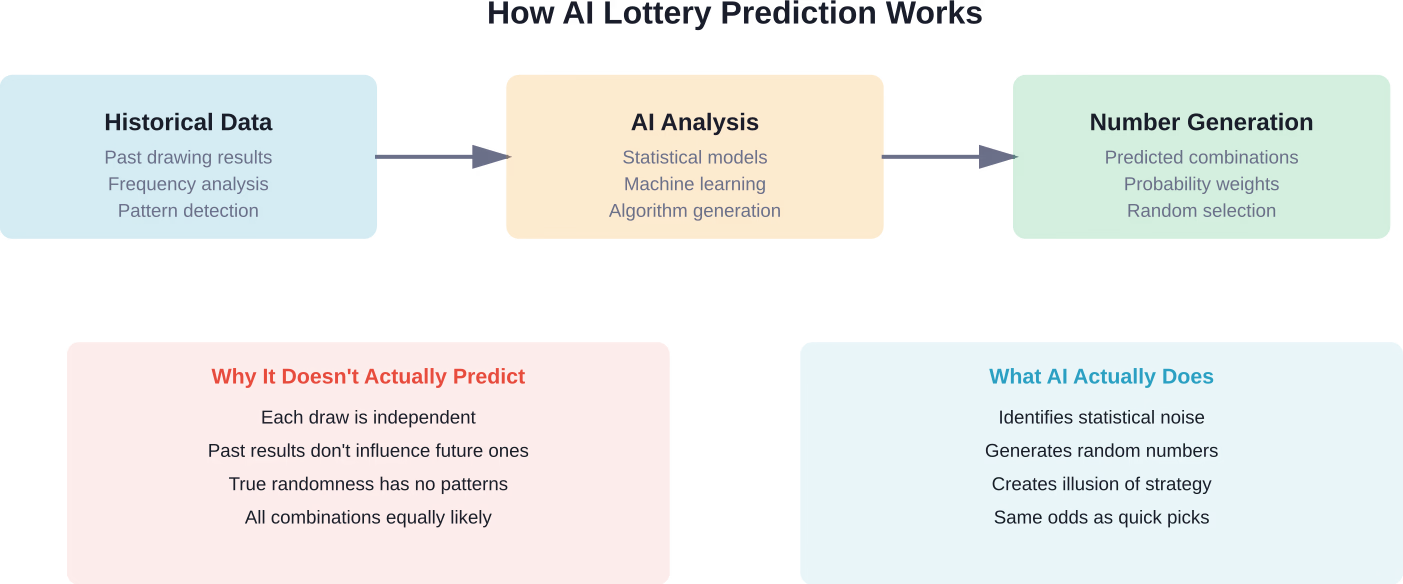
But AI can still generate numbers. The difference? It's sophisticated guessing, not prediction.
Tammy Carvey's $100,000 win makes headlines precisely because it's extraordinary. Correlation isn't causation.
Think about it: millions of people play Powerball. Some use birthdays, some use quick picks, and now some use ChatGPT. Winners emerge from all groups. The AI didn't create an advantage—Carvey just happened to get lucky with AI-generated numbers instead of randomly selected ones.
The Italian students' algorithm might've analyzed patterns, but that doesn't mean those patterns predicted the future. Random data contains apparent patterns that don't persist.
Absolutely. AI excels at pattern recognition.
But here's where things get tricky. Statistical analysis can show that certain numbers appear more frequently in historical data. That's descriptive, not predictive. The lottery ball machine doesn't remember what it rolled last week.
Powerball odds sit at roughly 1 in 292 million. Mega Millions? About 1 in 290.5 million.
AI can't change fundamental probability. No amount of historical analysis makes a specific combination more likely when balls are drawn from a machine engineered for randomness.
The FTC has announced crackdowns on deceptive AI claims, noting how operations use "AI hype" to sell technology in misleading ways. Lottery prediction apps fall into this category.
Real talk: AI creates the illusion of control. Picking numbers feels more strategic than admitting it's pure chance. When someone wins using AI, confirmation bias kicks in. When thousands lose, nobody writes articles.
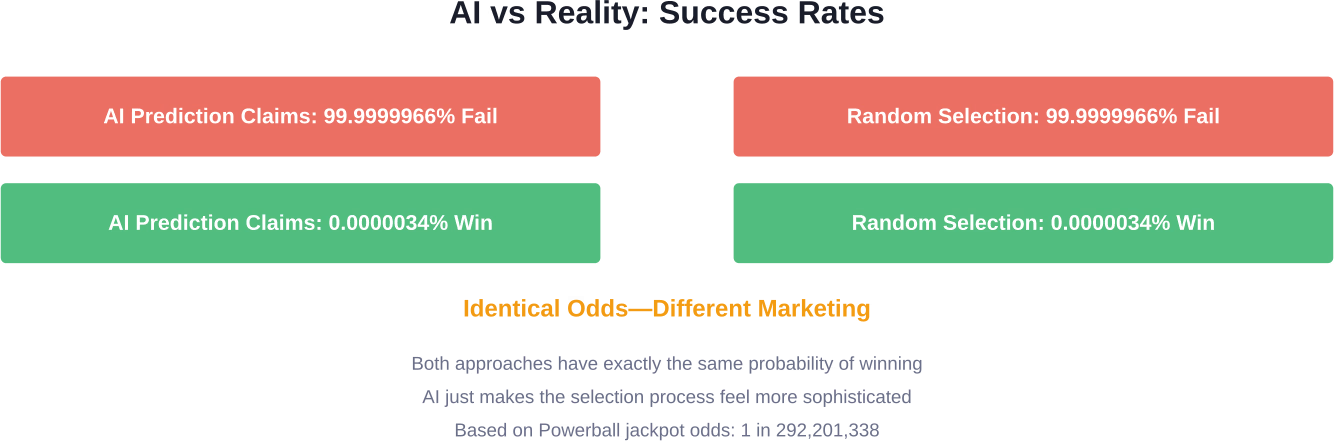
If they're free? Sure, why not. They generate numbers as effectively as closing your eyes and pointing.
But don't pay for lottery prediction software. The FTC warns about prize scams and notes that legitimate lotteries never require payment to claim winnings. Similarly, legitimate statistical analysis doesn't require subscriptions to "unlock" winning numbers.
Many AI lottery generators exist as entertainment or convenience tools. They save time compared to manually picking numbers. That's their actual value—not predictive power.
Mathematicians and statisticians consistently emphasize that lottery drawings use true random number generation. Each combination has equal probability.
According to research on random rule models, even sophisticated machine learning approaches achieve only marginal improvements in prediction tasks—and that's for non-random systems. Lotteries specifically engineer randomness to prevent prediction.
Many observers note that AI lottery tools provide entertainment value rather than competitive advantage. Most experienced players recognize this distinction when evaluating lottery number selection methods.
Can AI predict lottery numbers? No. Can it generate lottery numbers? Absolutely.
The distinction matters. AI can analyze historical data, identify statistical anomalies, and create number combinations based on patterns. None of that translates to predicting future random events.
Those rare wins using AI-generated numbers? They happen at the same rate as wins using any selection method. The AI didn't crack a code—someone just got extraordinarily lucky.
Play the lottery for entertainment if that's your thing. Use AI to generate numbers if it makes the process more fun. But don't confuse sophisticated number generation with actual prediction. The odds remain astronomical regardless of your selection strategy.


