How to Become a Shopify Partner and Start Earning
Learn how to become a Shopify partner, earn with apps, themes, or services, and start growing your business with Shopify’s partner program.
Feb 3, 2026



Free shipping sounds simple. Customers want it, competitors offer it, and Shopify makes it easy to turn on. But once you’re actually running a store, it quickly gets more complicated than a single toggle.
The real question isn’t can you offer free shipping on Shopify. It’s how to do it without quietly bleeding margin or creating rules you’ll regret later. Free shipping can increase conversion rates and average order value, but only when it’s set up with intent.
In this guide, we’ll walk through the practical ways to offer free shipping on Shopify, how each option behaves in real use, and what to think about before you turn anything on. No theory dumps. Just the setups that store owners actually use.
Free shipping is not a trend. It is a baseline expectation.
Most shoppers do not compare shipping strategies in detail. They simply react when a shipping fee appears at checkout. That reaction is often enough to kill a sale, even if the fee is reasonable.
What makes free shipping powerful is not that it is free. It is that it removes friction at the worst possible moment: checkout. When people abandon carts, shipping cost is almost always part of the reason.
At the same time, free shipping is never truly free. Someone always pays for it. The only real question is whether you control that cost or let it surprise you later.
Before touching Shopify settings, answer this honestly:
What problem are you trying to solve with free shipping?
Different goals require different setups.
If you skip this step, you will likely copy a competitor’s setup and end up with rules that do not fit your store.

At Extuitive, we built our platform around a simple idea: testing should not be the bottleneck. Too many Shopify brands spend weeks launching ads, waiting for data, and shutting down ideas that never had a real chance to perform. We help teams predict outcomes before they spend budget, using AI models trained and validated against live campaign results.
Instead of guessing which creatives or messages might work, brands use our platform to forecast real-world performance in advance. That applies to messaging, creative direction, and audience alignment. By identifying likely winners early, teams can focus their spend on ideas that have momentum instead of spreading budget thin across endless experiments.
We also help brands test at scale without the usual risk. By analyzing large volumes of creatives upfront, our system filters out underperforming concepts before they ever go live. The result is higher CTR, stronger ROAS, and faster decision-making. For Shopify teams under pressure to move quickly and prove results, that shift from trial-and-error to informed action makes a measurable difference.
Shopify offers three main ways to provide free shipping. They look similar from the customer’s side, but they behave very differently behind the scenes.
Each one has strengths, limitations, and edge cases. Choosing the wrong one is where most stores run into trouble.
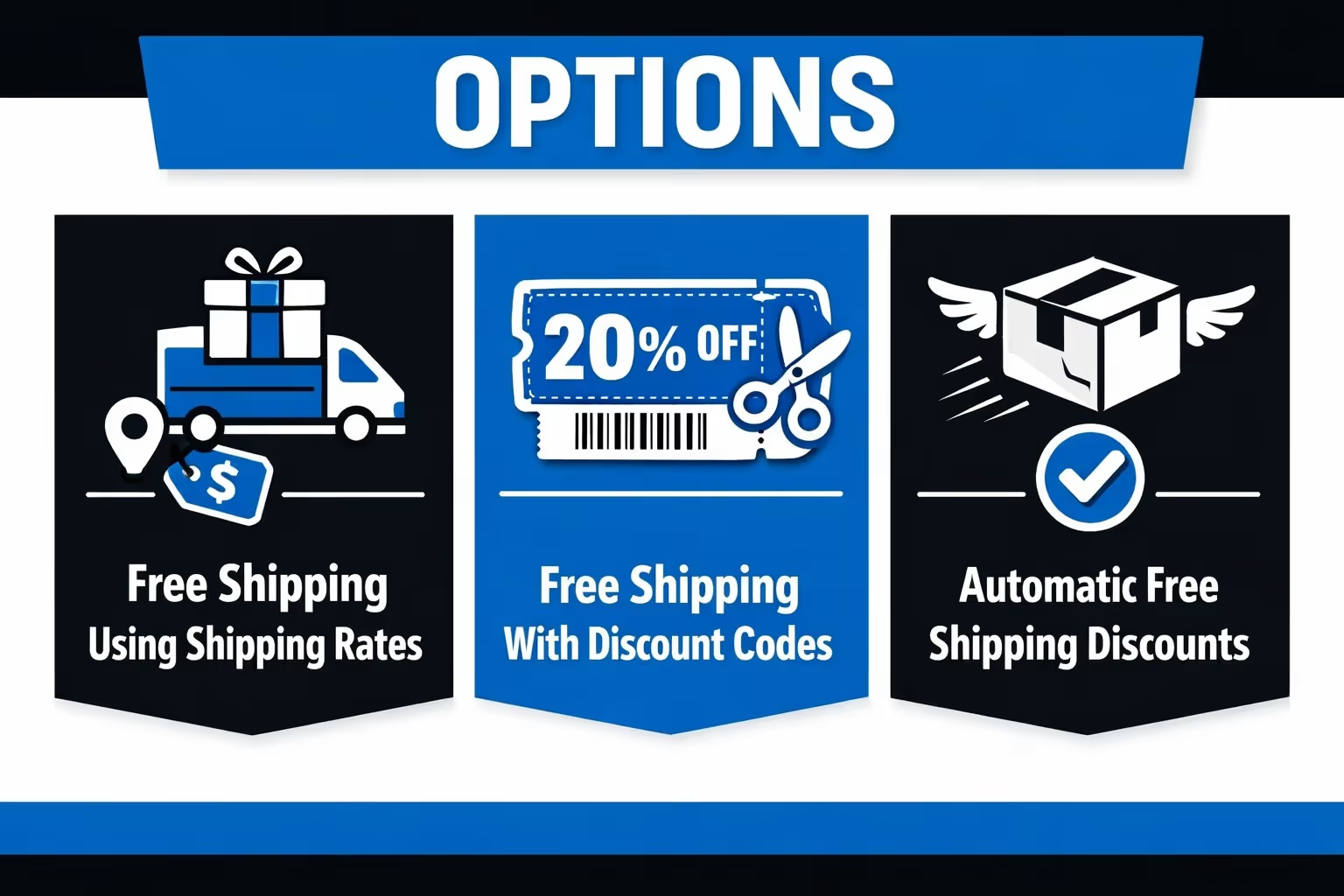
This is the most straightforward method and the one many stores start with.
You create a shipping rate with a price of zero. Shopify shows it automatically when the order meets your conditions.
Shipping rates are blunt instruments. They work well for simple rules, but they lack flexibility once your store becomes more complex. If you sell a mix of heavy and lightweight products, ship internationally with big cost differences, or operate across multiple warehouses or fulfillment partners, a single free shipping rate can turn expensive fast. In those cases, Shopify has no way to intelligently adjust in the background. This approach works best when your shipping costs are relatively stable, predictable, and easy to model ahead of time.
Free shipping discount codes remove the shipping cost only when a customer enters a code at checkout.
Discount codes add friction.
Even when customers know a code exists, many forget to apply it. Some only realize after paying. That leads to refunds, support tickets, and frustration.
If free shipping is core to your value proposition, discount codes are usually the wrong choice. If free shipping is a reward, they can work well.
Automatic discounts apply free shipping when conditions are met, without requiring a code.
This option sits somewhere between shipping rates and discount codes.
Automatic discounts apply broadly.
If you are not careful with conditions, you may end up giving free shipping to customers who would have paid for it anyway. That is not always bad, but you should be aware of it.
If you use a minimum order value, the number you choose matters more than most people realize.
Set it too low, and you lose money. Set it too high, and customers ignore it.
Start with your current average order value.
Your free shipping threshold should usually sit slightly above it. Not dramatically higher. Just enough to encourage one extra item.
If your average order value is $45, a $50 or $55 threshold often works better than $75.
Customers do not do complex math at checkout. They react emotionally. Small gaps feel achievable. Large gaps feel manipulative.
One of the biggest misconceptions is that free shipping must apply to everything.
It does not.
Many profitable stores limit free shipping in ways customers rarely question.
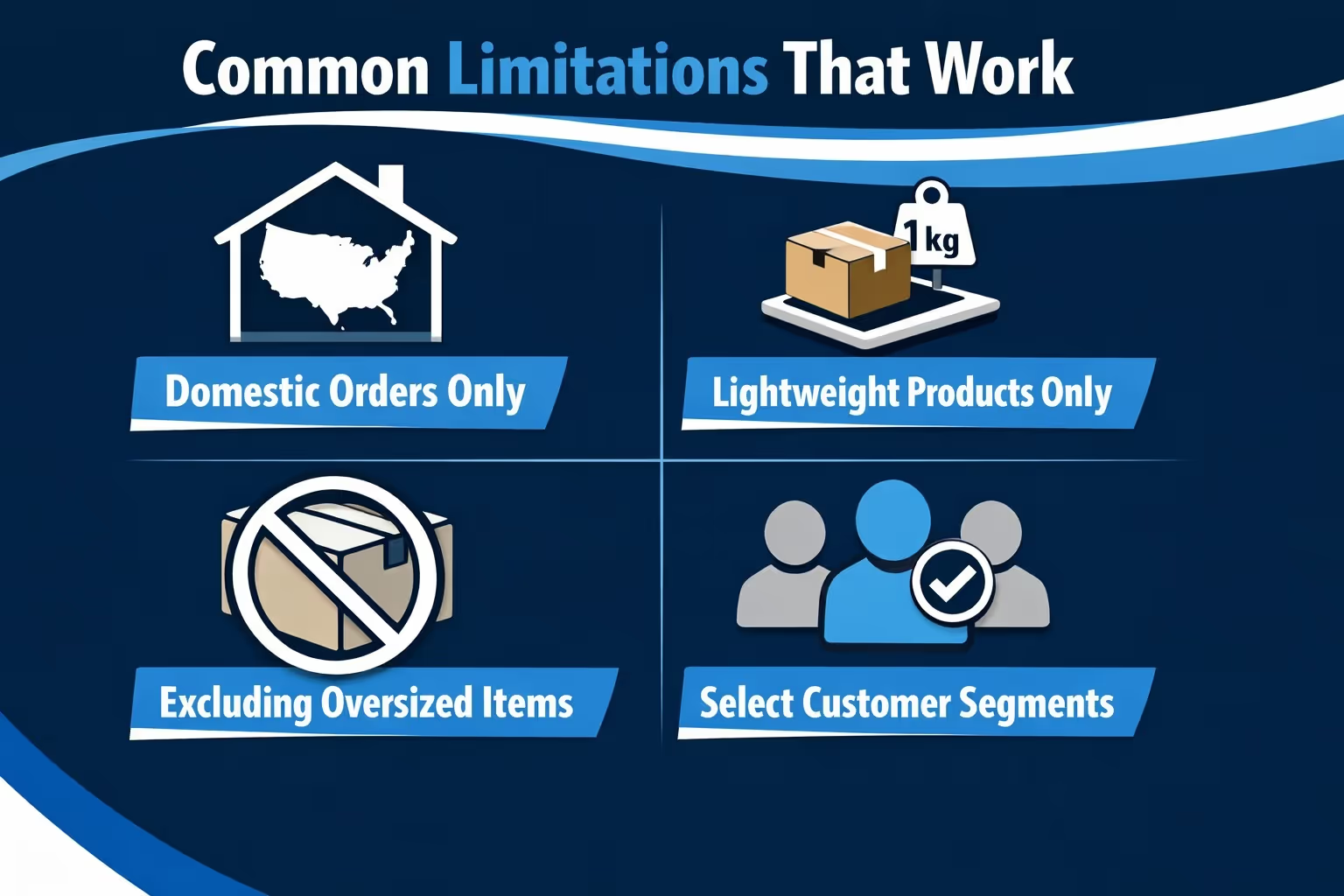
As long as the rules are clear and visible, customers tend to accept them.
If shipping costs vary wildly by location, blanket free shipping can be dangerous.
Instead, consider location-aware setups.
Offer free shipping only in regions where costs are manageable. This works especially well if most of your customers are clustered geographically.
Free local pickup is often overlooked.
For stores with physical locations, it removes shipping cost entirely while giving customers a fast option. Many shoppers prefer it, even when shipping is available.
Free shipping almost always increases order volume, but it often brings a secondary effect that catches stores off guard: higher return rates. When customers do not pay for shipping upfront, the mental barrier to ordering goes down. That same lowered friction can apply to returns, especially for categories like apparel, home goods, or anything size-dependent. This is not a downside in itself, but it does change the math behind fulfillment.
The key is planning for it instead of reacting later. If return shipping is also free, those costs stack quickly and can eat into margins faster than expected. Clear return policies help control this. Customers tend to accept reasonable limits as long as they are explained upfront. Ambiguity, on the other hand, leads to frustration, refund requests, and unnecessary support tickets once orders start coming back.
Free shipping should not be permanent just because you turned it on once.
Track its impact.
Key metrics to watch:
Compare performance before and after changes. If margins suffer without meaningful conversion gains, adjust the rules.
Free shipping is a lever, not a law..
There are cases where free shipping does more harm than good.
If margins are extremely tight, or shipping costs are highly unpredictable, forcing free shipping can destabilize your business.
In those cases, transparency can work better than incentives. Clear shipping costs shown early often perform better than surprise fees at checkout.
Free shipping is powerful, but it is not mandatory.
Free shipping on Shopify is easy to enable and easy to get wrong.
The difference between a profitable free shipping strategy and an expensive one usually comes down to intent and clarity. Know what you are trying to achieve. Choose the method that supports it. Revisit your setup as your store evolves.
Free shipping works best when it feels natural to the customer and controlled by the business. When those two things align, it stops being a cost center and starts becoming a growth tool.
That is when it actually works.


