What Are the Best Alternatives to Shopify in 2026?
Shopify might be the go-to name in eCommerce, but it’s not always the best fit for every business. Maybe the monthly costs are adding up. Maybe you’re feeling boxed in by themes or tired of juggling apps. Whatever the reason, you’re not stuck. There are plenty of other platforms out there – some simpler, some more flexible, and some built for growth from day one.
In this guide, we’ll walk through the most reliable Shopify alternatives available right now, each with its own strengths. Whether you're building your first store, scaling a product line, or just tired of playing by Shopify's rules, this breakdown will help you figure out which option actually works for your business, not just the one that gets talked about the most.
What Is Shopify and Why Look for Alternatives?
Shopify is a popular platform for building and running online stores. It gives sellers a way to manage products, payments, shipping, and promotions without needing tech skills. It’s user-friendly and works well for both beginners and growing businesses.
Still, it’s not perfect for everyone. Some find the design options too limiting or the extra costs from apps and fees too high. Others want more control over how their store works behind the scenes. That’s why many people explore alternatives. Whether it’s for more flexibility, better pricing, or specific features, other platforms can offer a setup that fits better with how you want to run your business.
What Makes a Good Shopify Alternative?
Before we jump into the list, let’s get clear on what we’re even comparing. Not every seller needs the same toolkit. Some want total creative freedom. Others need simplicity. Some are building content-heavy sites, while others are pushing high-SKU catalogs across multiple channels.
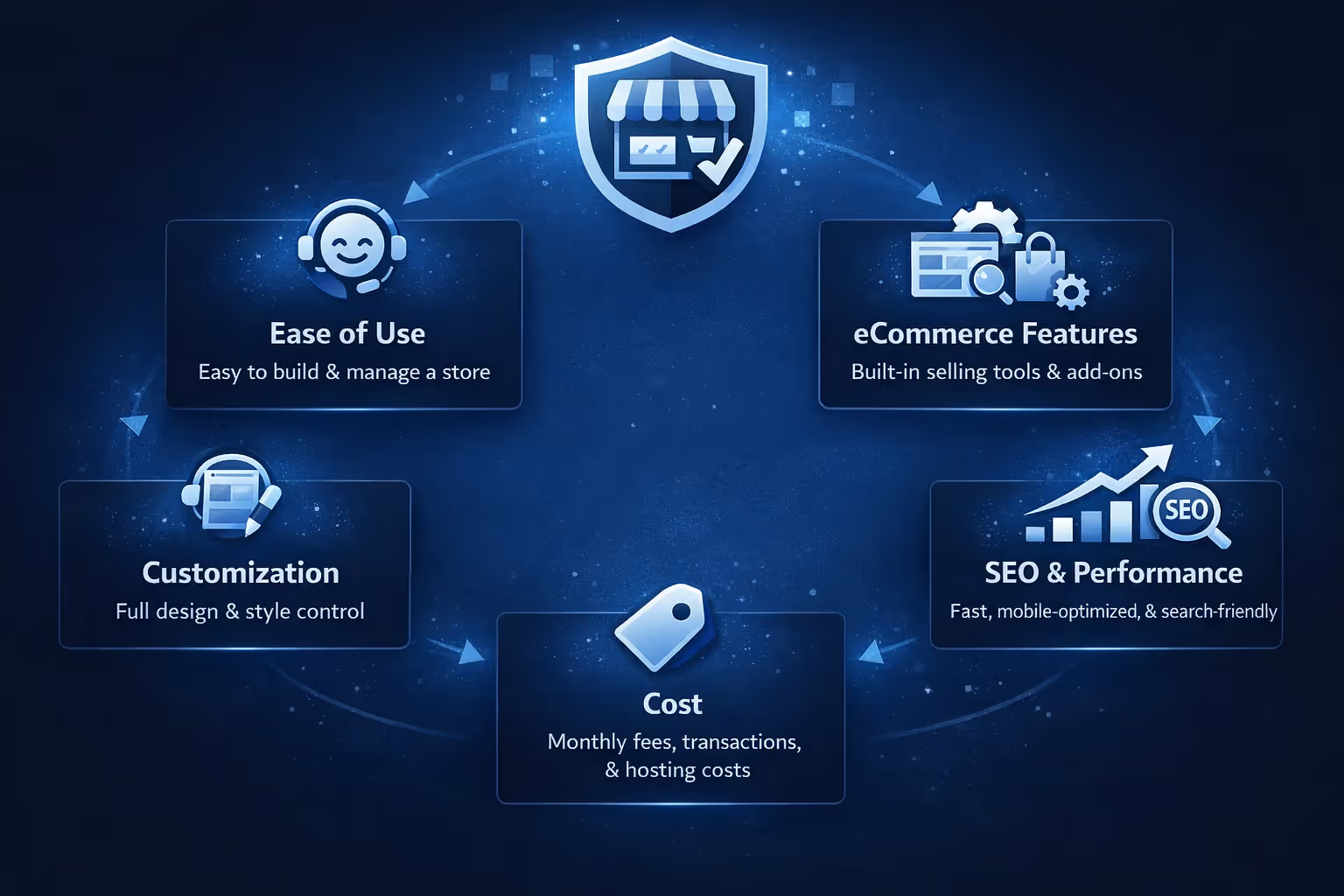
Here’s what to think about when evaluating a Shopify alternative:
Ease of use: Can you actually build and manage a store without headaches?
Customization options: Do you get full design control or are you stuck with templates?
eCommerce features: What’s included by default? What needs plugins or add-ons?
Scalability: Can the platform grow with your business or will you need to replatform?
SEO and performance: Will your store be fast, mobile-ready, and optimized to rank?
Costs: Beyond monthly fees, what about transaction charges, apps, or hosting?
We’ll keep all of that in mind as we go.
Top Alternatives to Consider
Here are the most well-known and reliable platforms to keep in mind.
1. BigCommerce
BigCommerce is one of the few platforms that can genuinely go toe-to-toe with Shopify on core eCommerce features, especially for stores with large product catalogs or more complex needs.
It offers strong multichannel tools, so you can manage listings across Amazon, eBay, and Facebook from one dashboard. Unlike Shopify, many of BigCommerce’s advanced features are built in, so you don’t have to rely heavily on apps.
Key Highlights:
No transaction fees, even if you use third-party payment processors
Google Play: play.google.com/store/apps/details?id=com.bigcommerce.mobile
2. Wix
Wix started as a simple site builder, but it has grown into a surprisingly capable eCommerce platform, especially for small businesses or anyone new to online selling. What it lacks in deep backend features, it makes up for in ease of use. The setup process is fast, the editor is intuitive, and templates are plentiful.
There’s also an AI-powered builder called Wix ADI that can help you get a basic site up in minutes. You probably wouldn’t use Wix to run a 20,000-product store, but for a small brand or local business, it hits the sweet spot.
Key Highlights:
Beginner-friendly interface with drag-and-drop editing
Multiple templates and visual customization tools
Supports physical and digital product sales natively
Built-in SEO, email marketing, and analytics
AI tools for faster setup and basic content generation
Google Play: play.google.com/store/apps/details?id=com.wix.admin
3. Squarespace
Squarespace has carved out a niche with its sleek, designer-focused templates. It’s the platform of choice for creatives, small brands, and service providers who want a polished, modern site without hiring a developer.
ECommerce on Squarespace is more focused on simplicity than scalability, but it covers all the basics – digital products, memberships, scheduling – and wraps it all in a user-friendly dashboard.
Key Highlights:
Stunning pre-built templates for visually-driven brands
Built-in tools for email marketing and member areas
Supports digital products and appointments
Easy-to-use backend with minimal setup friction
No need to manage hosting or security
Contact Information:
Website: www.squarespace.com
Facebook: www.facebook.com/squarespace
Twitter: x.com/squarespace
LinkedIn: www.linkedin.com/company/squarespace
Instagram: www.instagram.com/squarespace
Address: Squarespace Portugal Aveiro, Portugal Rua Pedro Antonio Rebocho, №5, 3800-404 Aveiro
Google Play: play.google.com/store/apps/details?id=com.squarespace.android.squarespaceapp
4. Webflow
Webflow sits somewhere between a no-code builder and a full developer tool. It lets you visually design a website that outputs clean, production-ready code.
For eCommerce, Webflow works best if you want a high-end storefront with complex interactions, custom product layouts, or design that feels closer to a web app than a standard online shop.
Key Highlights:
Visual interface for front-end design with clean code output
Google Play: play.google.com/store/apps/details?id=com.phoneflow
5. WooCommerce
WooCommerce is another platform that deserves a mention. As a plugin for WordPress, it’s free to install and gives you full control over your eCommerce experience.
The tradeoff? You’re responsible for everything: hosting, maintenance, security, and design. But for those who want freedom over convenience, WooCommerce delivers.
Key Highlights:
Open-source and fully customizable
No platform transaction fees
Supports thousands of plugins and themes
Great for content-rich sites with a store component
Google Play: play.google.com/store/apps/details?id=com.woocommerce.android
6. GoDaddy
GoDaddy’s builder is built for speed and simplicity. It’s not flashy, but if you want to throw up a site in an afternoon, it gets the job done
It comes bundled with domain tools, email marketing, and hosting – all managed from a single dashboard. Not the best choice for serious scaling, but useful for early-stage side hustles.
Key Highlights:
Simple, guided setup process for fast launches
Bundled with GoDaddy domains, email, and hosting
AI-assisted content generation tools
ECommerce features available in higher tiers
Good for basic business sites with light selling needs
Contact Information:
Website: www.godaddy.com
Email: legal@godaddy.com
Facebook: www.facebook.com/godaddy
Twitter: x.com/godaddy
Instagram: www.instagram.com/godaddy
Address: 100 S. Mill Ave, Suite 1600, Tempe. AZ 85281 USA
Google Play: play.google.com/store/apps/details?id=app.over.editor
7. Zoho Commerce
Zoho Commerce is part of the larger Zoho ecosystem, making it a convenient choice for store owners who want to manage everything in one place – from building the site to handling CRM, analytics, and marketing. It’s designed with small and midsize businesses in mind, especially those already using other Zoho apps.
The platform includes an AI-powered product recommendation tool that helps personalize the shopping experience based on user behavior. While it doesn't offer full trend forecasting or deep order analytics out of the box, its integrations and bundled features make it a practical option for teams looking for simplicity and centralization.
Key Highlights:
AI-driven product recommendations based on shopper behavior
Strong integration with Zoho CRM, Campaigns, and other tools
Responsive drag-and-drop website builder
Hosting, SSL, and basic SEO tools included
Phone and email support with access to a knowledge base
Contact Information:
Website: www.zoho.com
E-mail: sales@eu.zohocorp.com
Facebook: www.facebook.com/ZohoCommerce
Twitter: x.com/ZohoCommerce
LinkedIn: www.linkedin.com/company/zoho-commerce
Instagram: www.instagram.com/zohocommerce
Address: 979 Springdale Rd, Suite 123, Austin,TX 78702
Google Play: play.google.com/store/apps/details?id=com.zoho.commerce
8. PrestaShop
PrestaShop offers an open-source eCommerce platform designed for flexibility and control. Users can choose from different setups, including a downloadable version for full customization or a hosted option for a quicker start.
The platform supports a wide range of modules and themes, giving users the ability to adjust their store’s look and functionality. In addition to core features, PrestaShop provides optional services like payment integration, marketing automation, and shipping tools. A large user community and access to expert support options help store owners manage both the technical and operational side of their eCommerce setup.
Key Highlights:
Offers both self-hosted and fully hosted versions
Wide selection of add-ons and themes through its marketplace
Payment, shipping, and marketing modules available for extended features
Google Play: play.google.com/store/apps/details?id=com.webkul.mobikul_prestashop_app
9. OpenCart
OpenCart is a free and open-source eCommerce solution built to be lightweight and extendable. Users can download and install the software themselves or choose a cloud-hosted version managed by the OpenCart team. It includes built-in store management tools for products, customers, orders, and promotions.
The marketplace offers multiple extensions covering everything from themes to payment gateways and shipping providers. For support, OpenCart provides an active community forum and optional dedicated assistance for more complex needs.
Key Highlights:
No monthly fee for the core platform
Cloud version available for hands-off setup
Large extension marketplace with numerous modules and themes
Built-in tools for SEO, taxes, discounts, and order management
Choice between free community help and paid technical support
Contact Information:
Website: www.opencart.com
E-mail: support@opencart.com
Facebook: www.facebook.com/opencart
Twitter: x.com/opencart
Address: OpenCart Limited, Unit G 2/F Tower 2 Avignon, 1 Kwun Chui Road, So Kwan Wat, Tuen Mun, Hong Kong
Google Play: play.google.com/store/apps/details?id=webkul.opencart.mobikul
10. Shift4Shop
Shift4Shop provides a full-featured eCommerce platform aimed at businesses that want everything in one place from the start. Their system includes tools for website building, inventory tracking, SEO, marketing, and secure payments.
The platform offers a wide range of free themes, all of which can be customized through a visual editor or by editing code directly. It also includes integrated payment processing, fraud protection, and customer support. The service is designed as a hosted solution, removing the need for separate hosting or third-party apps in many cases.
Key Highlights:
Hosted platform with built-in features included by default
Integrated payment processing and fraud protection
It’s easy to get overwhelmed by feature lists and pricing charts, so here’s a better way to narrow it down: match the platform to the kind of business you’re running.
If you're just getting started:
Wix
GoDaddy
If design and branding are your priority:
Squarespace
Webflow
If you’re scaling or running B2B:
BigCommerce
WooCommerce
If you want full control (and don’t mind doing the work):
WooCommerce
Webflow
Smarter Ad Decisions with Extuitive
At Extuitive, we work with eCommerce brands that want more clarity before launching their ads. If you're exploring alternatives to Shopify, it's not just about the store itself. It's also about how you bring traffic in, how you test ideas, and how you make marketing more predictable. That's where we come in.
Our platform uses AI to forecast how your ads will perform before they go live. No more guesswork or “wait and see” campaigns. We let you test ad creatives at scale, compare projected outcomes, and reach the audiences most likely to convert. Shopify users come to us when they want faster results and more confidence in their spend. Whether you’re sticking with Shopify or testing out a new platform, Extuitive helps you build smarter ad strategies around it.
For teams trying to reduce wasted budget, improve ROAS, or simply stop rolling the dice on every campaign, we offer a practical, no-fluff solution. We’ve already helped a wide range of Shopify brands make better decisions upfront, and we’re ready to help more brands do the same, wherever they choose to build their store.
Final Thoughts
Shopify’s a great platform, but it’s not the only path forward. Whether you're chasing design flexibility, lower fees, or just want to run your store your way, there's no shortage of capable alternatives.
The key is to choose based on your own needs, not just the loudest name in the room. Each platform on this list can build a successful online business. The real difference is how much freedom, simplicity, or scalability you want along the way.
Take your time, try the demos, and pick what feels right for how you want to sell.
FAQ
1. Is Shopify still worth using, or should I switch?
Shopify still works well for many businesses, especially if you want something easy to set up and run. But if you’ve outgrown it, need more control, or want to cut down on costs and app dependencies, it might be time to look elsewhere. The answer really depends on where your store is heading.
2. What’s the biggest reason people look for a Shopify alternative?
It’s usually not one single reason. Some folks want lower transaction fees, others need more flexibility with design or backend code. A lot of store owners just want to avoid getting locked into too many paid apps to make things work the way they want.
3. Are Shopify alternatives good for beginners too?
Some are, yes. Platforms like Wix and Squarespace tend to be easier for beginners, while tools like WooCommerce have a steeper learning curve. It’s about balancing what you need now with what you’ll need later as your store grows.
4. Do Shopify alternatives have the same level of support?
Support quality varies a lot. Some platforms offer great live chat and help centers, while others rely more on community forums or documentation. If support is a big deal for you, it’s worth checking what kind of help you can expect before making the switch.
5. Can I migrate my store from Shopify to another platform easily?
“Easily” is doing a lot of work here. You can move products, customers, and orders, but there’s usually some cleanup involved. Expect to spend time adjusting themes, settings, and integrations. It’s doable, but not plug-and-play.
6. How do I know which platform is right for me?
Start with your priorities. Is it pricing? Custom features? Built-in tools? Make a short list of what matters most, then compare platforms based on that. It’s not about finding the “best” one out there, just the one that fits your business best right now.
How much are you wasting on Meta ads? Connect your ad account. See your ad efficiency.