How to Promote Your Shopify Store Without Guesswork
Learn practical and proven ways to promote your Shopify store without wasting time or budget. Covers multiple strategies.
Mar 25, 2026



When people ask how many users Shopify has, they’re usually looking for a single, clean number. The problem is that Shopify doesn’t have just one type of user. There are merchants who run stores, shoppers who buy from them, and teams who work behind the scenes on those stores. Each group gets counted differently, and that’s where a lot of confusion starts.
In this article, we break down what “Shopify users” actually means in 2026, how the most common figures are calculated, and why the headline number can change depending on who’s doing the counting. No hype, no inflated claims - just a clear look at how big the Shopify ecosystem really is.
In its own reporting and product communication, Shopify rarely treats everyone as a single audience. Instead, it talks about merchants, shoppers, partners, and buyers, depending on what part of the platform is being discussed.
Each of these groups uses Shopify in a different way. Merchants log into admin dashboards to manage products, payments, and fulfillment. Shoppers interact only with storefronts, often without realizing Shopify is powering the experience. Partners and developers work through APIs, apps, and partner tools, while buyers are counted based on purchasing activity across stores.
Because these groups behave differently and are measured differently, Shopify keeps them separate in its data. A merchant account, a shopper purchase, and a partner login are not interchangeable signals. Treating them as one combined “user” category would flatten important differences in how the platform is actually used.
Understanding these distinctions makes it easier to interpret Shopify’s numbers correctly. It also explains why user counts can vary so widely depending on whether the focus is on store owners, consumers, or the broader ecosystem supporting them.
Merchants are the core users of Shopify. These are individuals or businesses that pay for a Shopify plan and operate a store on the platform.
Based on aggregated data from Shopify investor reports, BuiltWith tracking, and industry analysis, Shopify supports approximately 5.5 to 6 million merchants globally as of 2025–2026. This number fluctuates because not all merchants operate continuously, and Shopify does not publish an exact live count every quarter.
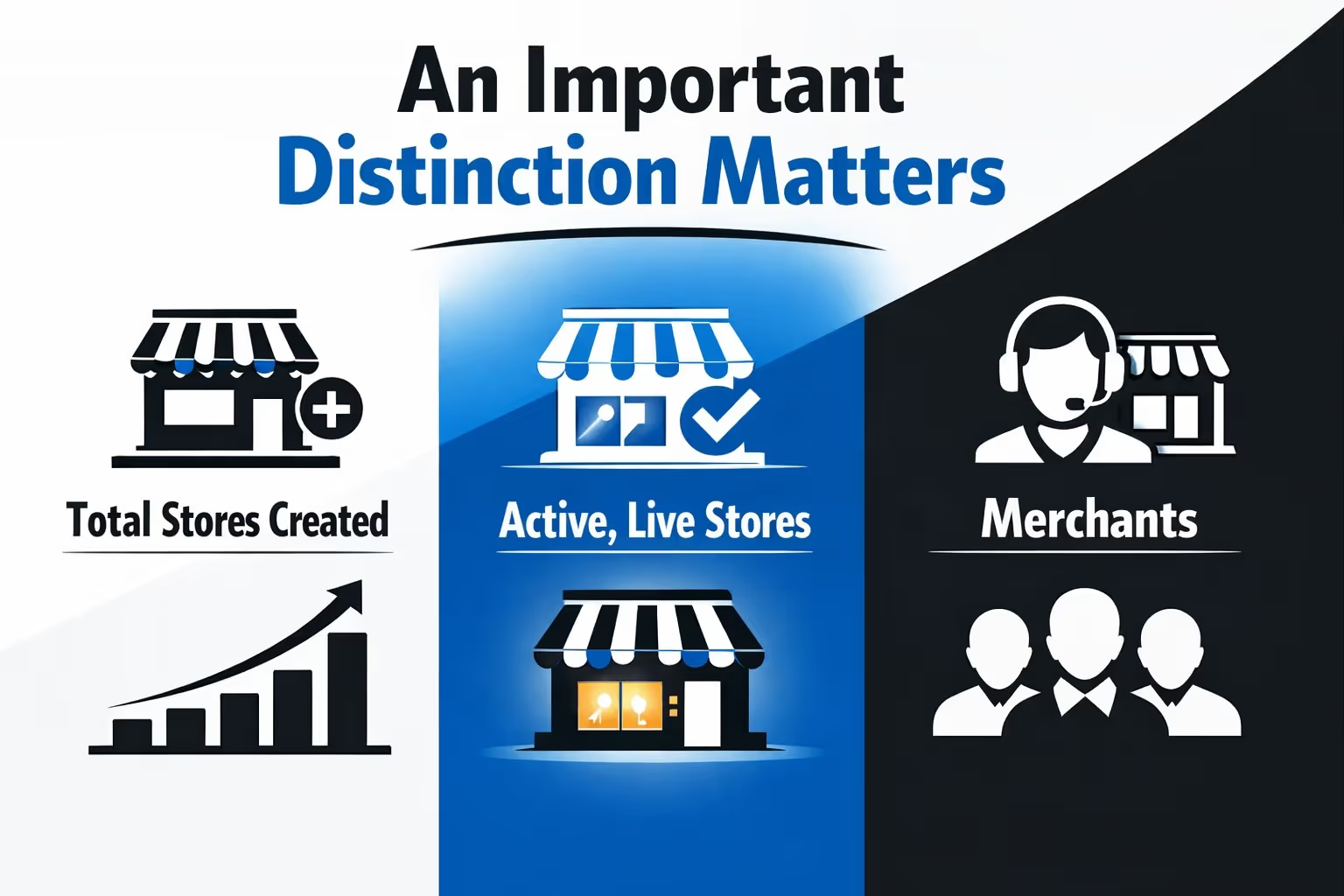
An important distinction matters here:
This is where many articles oversimplify. A store is not always a unique merchant. Agencies, large brands, and international sellers often run multiple storefronts under a single merchant organization.
So when you see “6.8 million Shopify stores,” that does not automatically mean 6.8 million independent businesses.
One of the most important insights from your sources is the difference between stores that exist and stores that actually operate.
Shopify has crossed 9.5 million total stores created, but roughly 30 percent are inactive at any given time. These include:
This matters because raw store counts exaggerate Shopify’s active footprint. The more meaningful figure is active live stores, which currently sits closer to 6.5 to 6.8 million worldwide.
From a platform health perspective, this is still enormous. But it also highlights how easy Shopify is to enter, and how competitive it has become.
If merchants are the engine, shoppers are the volume.
In 2026, Shopify-powered stores collectively serve over 875 million unique shoppers per year, according to aggregated estimates from Shopify, Demandsage, and ecommerce analytics providers.
This is the number that often appears in headlines because it sounds dramatic. It should be treated carefully.
A Shopify shopper is not a registered Shopify user in the traditional sense. These are consumers who buy from at least one Shopify store in a given year. They do not have Shopify accounts. They do not log into Shopify. Many of them do not even realize Shopify is involved.
A single shopper might purchase from multiple Shopify stores, or only one. Shopify does not publicly disclose how often individuals repeat across merchants, so the number represents estimated unique buyers, not guaranteed unique humans.
Still, the scale matters. Roughly one out of every four online shoppers globally has purchased from a Shopify-powered store.
Some articles cite Shopify having 2.1 million daily active users. This figure causes confusion because it sounds like a social platform metric.
In reality, this number refers to daily active logged-in interactions across the Shopify ecosystem. It includes:
It does not include shoppers browsing stores.
This metric is useful internally for Shopify, but it is not a good headline number for understanding platform reach. It reflects operational usage, not adoption.
Geographically, Shopify remains heavily concentrated in North America, though international growth continues to accelerate.
Approximate merchant distribution:
The United States alone accounts for over half of all Shopify stores, making it Shopify’s most mature and competitive market.
International growth is driven largely by localization features, regional payment support, and cross-border selling tools like Shopify Markets.
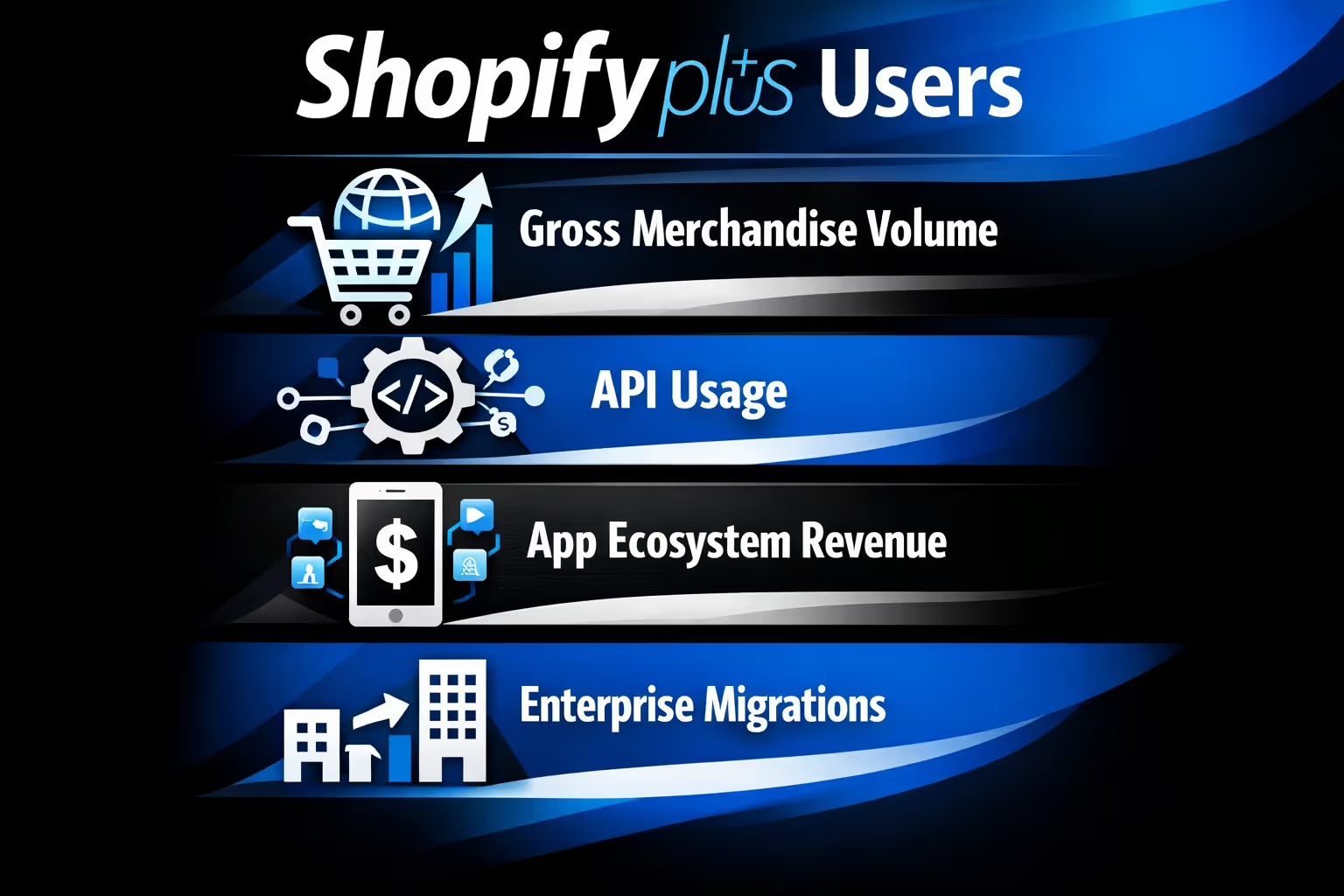
Shopify Plus deserves special mention because it distorts averages.
As of early 2026, there are 67,333 live stores running Shopify Plus, with approximately 44,888 distinct merchants operating on this plan. That is less than 1 percent of total stores.
Yet these stores account for a disproportionately large share of:
In other words, Plus merchants are not numerous, but they matter far more than their count suggests.
Another overlooked detail is that many people counted in Shopify usage numbers are not store owners at all. A single store often involves several roles working behind the scenes. There may be a founder overseeing strategy, staff members managing products and orders, an external marketing agency handling campaigns, a developer maintaining integrations, and a fulfillment partner coordinating shipping.
All of these people can log into Shopify, interact with the platform daily, and appear in usage metrics. That overlap is one of the main reasons Shopify avoids publishing a single, all-purpose “user” number. It would collapse very different types of activity into one figure and create a distorted picture.
In practice, Shopify functions less like a simple website builder and more like a shared operating system for running an online business.
One of the biggest sources of confusion across articles is the word “customer.”
For Shopify:
These are not interchangeable.
When you read that Shopify has “over 700 million customers,” that refers to shoppers. When you read that Shopify has “millions of customers,” that often refers to merchants.
Understanding which one is being discussed is essential to interpreting the data correctly.
Yes, but the growth is uneven. Merchant adoption has slowed since the pandemic surge of 2020 and 2021, when ecommerce expanded rapidly across almost every industry. That spike was unusual, and what followed has been a return to a more sustainable pace.
New stores are still being created, just not at the same breakneck speed. At the same time, store churn remains high, particularly among low-effort dropshipping businesses that struggle to compete long term. On the other end of the spectrum, enterprise adoption through Shopify Plus continues to accelerate as larger brands move away from legacy platforms. International markets are also growing faster than the United States, driven by better localization and cross-border tools.
Shopper numbers, meanwhile, continue to rise steadily. That growth is tied less to Shopify-specific features and more to the ongoing expansion of ecommerce as a whole.
When stripped of marketing spin, Shopify’s numbers tell a more interesting story:
In short, Shopify’s real strength is not raw user count. It is the breadth of use cases it supports.

At this scale, Shopify is no longer about getting online. It is about making better decisions faster than the competition. With millions of stores, rising ad costs, and shorter attention spans, guessing no longer works, especially in paid acquisition.
That is where we come in. At Extuitive, we help Shopify brands understand what is likely to work before budget is spent. Using AI models trained on real campaign outcomes, we forecast ad performance ahead of launch so teams can stop testing losers and focus on what is most likely to win. Our predictions are grounded in live campaign data and benchmarked against each brand’s own historical performance, not generic averages.
As campaigns grow in volume and complexity, scale becomes critical. Our platform supports bulk analysis across hundreds or thousands of creatives, combining performance prediction with intelligent audience targeting. This helps brands improve CTR and ROAS without increasing spend, cut through a crowded market, and turn reach into measurable results.
So how many users does Shopify have? The honest answer depends on who you are talking about. From a merchant perspective, the platform supports roughly 5.5 to 6 million businesses worldwide. Looking at storefronts instead of businesses, the number of active stores sits closer to 6.5 to 6.8 million. On the consumer side, Shopify-powered stores serve well over 875 million shoppers each year. And behind the scenes, around two million people log into Shopify tools and dashboards on a daily basis.
Each of these figures is accurate in its own context, and each becomes misleading when taken on its own. That distinction matters whether you are evaluating Shopify as a platform, building a Shopify-focused product, analyzing ecommerce trends, or deciding whether to launch a store yourself.
Shopify is not defined by a single user number. It is defined by the scale and diversity of its ecosystem. That range of activity, more than any headline statistic, explains why the platform continues to shape modern ecommerce in 2026.


