Marketing Ideas for Psychologists: 2026 Strategies
Discover ethical marketing strategies for psychologists. Learn proven tactics to attract clients, build authority, and grow your practice in 2026.
May 18, 2026



Quick Summary: Service industry marketing demands a strategic mix of digital visibility, customer relationship building, and local presence optimization. Effective tactics include Google Business Profile optimization, content marketing, referral programs, and targeted social media engagement. Data shows 78% of customers respond positively to personalized offers, while service businesses that combine quick-win strategies with sustainable growth tactics see the strongest ROI.
Service businesses face unique marketing challenges. Unlike product-based companies, service providers can't showcase physical inventory. Potential customers can't touch, test, or try before they buy.
This makes trust-building absolutely critical. And traditional marketing tactics often fall flat.
But here's the good news: service businesses have advantages product companies don't. Every customer interaction becomes a marketing opportunity. Referrals carry enormous weight. Local presence matters more than national reach for most service providers.
The U.S. Bureau of Labor Statistics projects 26,100 employment changes for advertising, promotions, and marketing managers between 2024-2034, with employment growth projected at 6% (Faster than average). The service sector continues expanding, creating both opportunities and fierce competition.
So what actually works? Which marketing ideas deliver results without draining resources?
Marketing services differ fundamentally from marketing products. Services are intangible, perishable, and inseparable from the provider. A plumber's expertise can't be inventoried. A consultant's time can't be returned if unused.
This changes everything about marketing strategy.
Service businesses must emphasize credibility, expertise, and relationship-building over feature lists and specifications. Prospects evaluate service providers through reviews, testimonials, case studies, and personal recommendations far more than promotional messaging.
According to the American Marketing Association, 90% of organizations utilize content marketing and 80% of consumers prefer custom content. For service providers, content demonstrates expertise before prospects ever make contact.
Service marketing strategies fall into distinct categories based on two factors: speed to results and investment required.
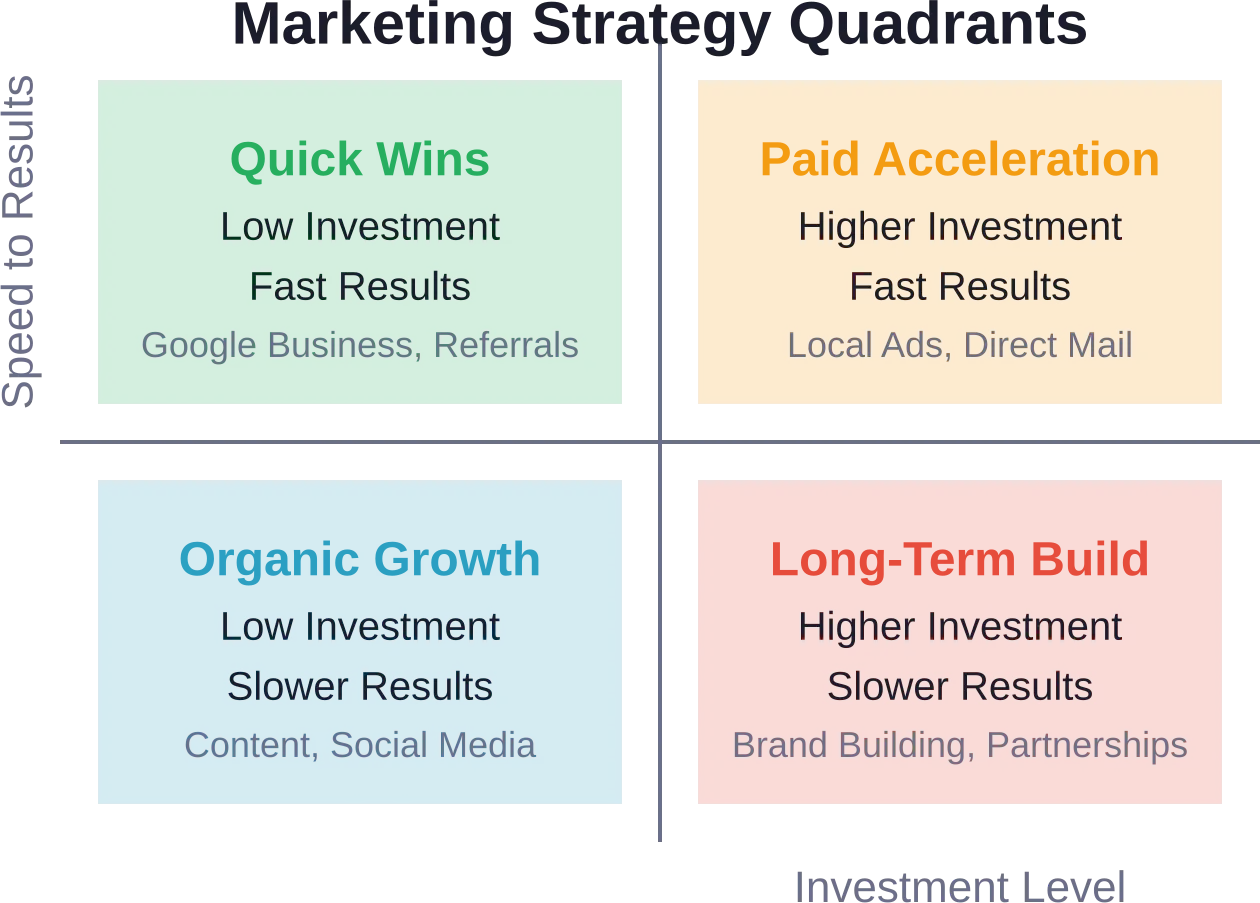
The most successful service businesses operate in multiple quadrants simultaneously. Quick wins generate immediate revenue. Long-term builds create sustainable competitive advantages.
For service businesses serving local markets—those within roughly a 75-mile radius—local visibility determines success. Prospects searching for service providers prioritize proximity, availability, and reputation.
Google Business Profile represents the single highest-impact marketing activity for local service providers. This free tool appears prominently in local search results and Google Maps.
Complete optimization includes accurate business hours, service area definitions, comprehensive service lists, and regular photo updates. Businesses should post weekly updates showcasing completed projects, seasonal offerings, or helpful tips.
Response time matters. Answering Google Business messages within hours signals availability and professionalism to prospects comparing multiple providers.
Referrals convert at dramatically higher rates than cold leads. Existing customers already trust the business and understand service quality.
Effective referral programs make asking easy and rewards meaningful. Simple approaches work best: "Refer a neighbor and receive $50 off your next service" or "Both you and your referral get 20% off."
The U.S. Small Business Administration recommends starting referral incentives modestly and tracking which offers generate actual referrals. Not every discount structure motivates customers equally.
Paid advertising delivers immediate visibility when organic reach takes time to build. Local service businesses benefit from tightly targeted geographic campaigns.
The Small Business Administration suggests starting with a modest $100 budget for test campaigns on platforms like Facebook. This allows businesses to evaluate ad performance before committing larger budgets.
Google Local Services Ads place service providers directly at the top of search results with Google's screening badge. These pay-per-lead ads only charge when prospects actually contact the business.
Complementary businesses serving the same customer base create natural partnership opportunities. A landscaping company and a deck builder both serve homeowners investing in outdoor spaces.
Partnership approaches include cross-referrals, joint promotions, or bundled service packages. Real estate agents often build referral networks with moving companies, cleaning services, and contractors.
These relationships require mutual benefit. The best partnerships deliver value to customers while expanding reach for both businesses.
Digital channels allow service businesses to demonstrate expertise, build trust, and stay visible between active purchase cycles.
Content marketing works particularly well for service businesses because it showcases expertise prospects can't evaluate until after purchase. A blog post explaining "5 Signs Your HVAC System Needs Professional Attention" demonstrates knowledge while identifying prospects who need service now.
According to the American Marketing Association, 90% of organizations utilize content marketing. But consistency matters more than volume. Publishing one helpful article monthly beats sporadic posting of promotional content.
Content formats include blog posts, how-to videos, downloadable guides, infographics, or case studies. The format matters less than addressing real questions prospects ask.
Service business websites must accomplish three goals: establish credibility, explain services clearly, and make contact effortless.
Essential website elements include prominent contact information on every page, specific service descriptions rather than vague overviews, customer testimonials with photos and names, and clear calls-to-action.
Mobile optimization isn't optional. Prospects searching for service providers increasingly use smartphones exclusively. Websites that load slowly or display poorly on mobile devices lose opportunities immediately.
Social media effectiveness varies dramatically by service type and customer demographics. Research indicates that 24% of Boomers discover new products through social media, compared to 46% of Gen X consumers.
Service businesses should focus on platforms where target customers actually spend time. Professional services might prioritize LinkedIn. Home service providers often find Facebook's local groups and community connections more valuable.
Posting frequency matters less than consistency and relevance. Three valuable posts monthly outperform daily promotional content that audiences ignore.
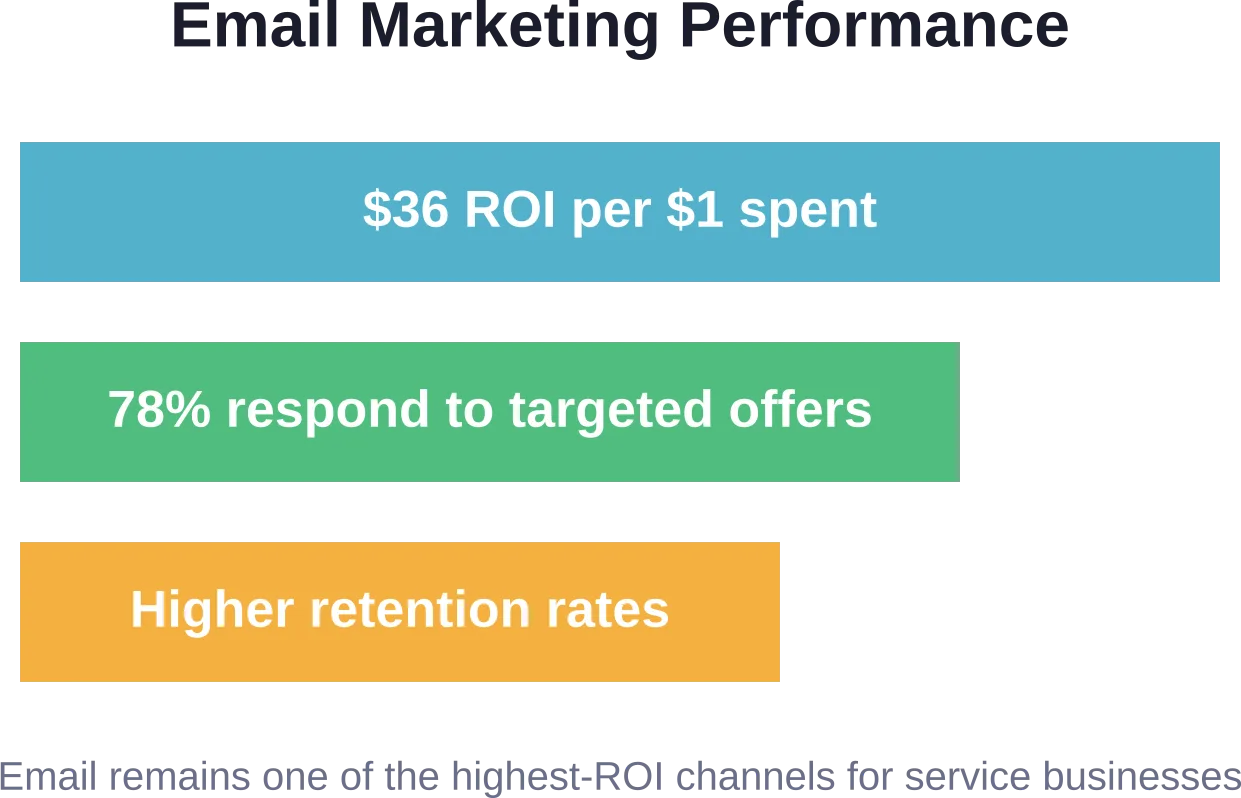
Email marketing delivers exceptional ROI for service businesses. The American Marketing Association reports email generates $36 for every dollar spent.
Service businesses benefit from segmented email strategies: monthly tips for all subscribers, seasonal reminders for specific services, exclusive offers for past customers, and re-engagement campaigns for prospects who requested quotes but didn't convert.
Email collection happens through website forms, in-person service appointments, and checkout processes. The key is making signup valuable with exclusive content or offers.

A lot of service businesses end up spending too much budget learning which campaigns do not work after ads are already live. Extuitive uses predictive advertising technology and AI consumer simulations to help teams identify stronger campaign opportunities before launch instead of relying only on delayed performance feedback.
What Extuitive helps businesses uncover earlier:
👉Book a demo with Extuitive and explore which service campaigns may have stronger potential before launch.
Service businesses can't separate marketing from service delivery. Every customer interaction either builds or damages reputation.
Online reviews function as modern word-of-mouth referrals. Prospects researching service providers read reviews extensively before making contact.
Effective review generation requires systematic processes, not occasional requests. Businesses might send review requests via email 48 hours after service completion, include review links on invoices, or ask satisfied customers during final walkthroughs.
Responding to all reviews—positive and negative—demonstrates professionalism and customer commitment. Prospects often judge businesses as much on response quality as on the reviews themselves.
Service businesses compete largely on execution and experience. Small touches create memorable moments that drive referrals and reviews.
Examples include sending follow-up care instructions after service completion, leaving properties cleaner than found, offering unexpected value-adds like minor adjustments at no charge, or providing seasonal tips relevant to services performed.
These moments cost little but create differentiation competitors struggle to match.
Loyalty programs for service businesses reward repeat purchases and encourage referrals. Structure varies by service type and purchase frequency.
Annual maintenance customers might receive priority scheduling and discounted emergency service. Cleaning services could offer every tenth cleaning free. Professional services might provide existing clients first access to new offerings.
According to research from Harvard University, 78% of customers are more likely to make future purchases when offered targeted incentives matching their interests and needs.
Service businesses rooted in local communities benefit from visibility and reputation building beyond traditional advertising.
Community sponsorships build brand awareness while demonstrating community commitment. Options range from youth sports teams to charity events to school programs.
Effective sponsorships align with target customer demographics and company values. A family-focused service business might sponsor little league teams. A professional services firm might support business networking events.
Sponsorship value comes from sustained visibility, not one-time exposure. Multi-year commitments build stronger community associations.
Free educational events position service businesses as trusted advisors rather than just vendors. A financial planner might host retirement planning workshops. A landscaping company could teach seasonal lawn care classes.
Workshop formats work both in-person and virtually. Virtual events expand geographic reach while in-person sessions create stronger personal connections.
The goal isn't immediate sales but relationship building with prospects not yet ready to purchase.
Partnerships with complementary service providers create referral networks serving customer needs comprehensively. An interior designer partnering with a general contractor provides clients complete remodeling solutions.
These arrangements work best when formalized with clear referral processes, mutual expectations, and quality standards all partners maintain.
Certain marketing approaches work exceptionally well for specific service business types.
Services producing visible transformations benefit enormously from visual documentation. Landscaping, remodeling, cleaning, organizing, and similar businesses should photograph every project.
These images populate websites, social media, advertising, and sales presentations. They provide concrete proof of capabilities when services themselves are intangible.
Systematic documentation requires getting customer permission, using consistent photography approaches, and organizing images for easy retrieval.
Professional services, consulting, and B2B service providers benefit from detailed case studies showing specific client challenges, solutions implemented, and measurable results achieved.
Effective case studies follow a problem-solution-result structure, include specific metrics when possible, and feature client quotes adding credibility.
According to the American Marketing Association, customer-focused content builds trust more effectively than company-focused promotional messaging.
Many service businesses experience seasonal demand fluctuations. Strategic marketing addresses both peak preparation and off-season promotion.
HVAC companies market heating services before winter arrives and cooling services before summer. Tax professionals begin outreach in early January, not mid-March when prospects have already chosen providers.
Off-season marketing might include special pricing, bundled services, or maintenance packages encouraging prospects to schedule during traditionally slow periods.
Resource constraints force service businesses to prioritize marketing investments carefully. Not every tactic delivers equal returns for every business type.
The Small Business Administration recommends starting with modest budgets and scaling successful tactics rather than spreading limited resources across too many channels.
Service businesses must track marketing performance to optimize spending and effort allocation.
Essential metrics include lead source tracking, conversion rates by channel, cost per acquisition, customer lifetime value, and marketing ROI by tactic.
Simple tracking systems work better than complicated ones. Many service businesses successfully track marketing performance using basic spreadsheets recording where customers heard about the business.
Service businesses often make predictable marketing errors that waste resources and limit effectiveness.
According to the SBA, a survey found that marketers spend on average just 21 percent of their marketing budgets on existing customers despite these customers accounting for the majority of their revenues. Acquisition costs substantially exceed retention costs for most service businesses.
Balanced marketing addresses both new customer acquisition and existing customer retention, referral generation, and upselling opportunities.
Service businesses operating across multiple marketing channels sometimes present inconsistent messaging, visual identity, or service positioning. This confusion weakens brand recognition and dilutes marketing effectiveness.
Clear brand guidelines covering visual elements, messaging tone, and core value propositions ensure consistency across all customer touchpoints.
Marketing without measurement means businesses can't identify what works and what doesn't. Resources continue flowing to ineffective tactics while high-performing channels remain under-utilized.
Even basic tracking—asking every new customer how they found the business—provides actionable insights for marketing optimization.
Businesses sometimes adopt marketing tactics simply because competitors use them. But different service businesses have different target customers, competitive positions, and resource constraints.
Effective marketing aligns with specific business goals, target audiences, and available resources rather than following competitors blindly.
One-off marketing campaigns deliver temporary results. Sustainable growth requires systematic approaches that generate consistent leads over time.
Effective systems include regular content publication schedules, automated review request sequences, consistent social media presence, ongoing referral program promotion, and seasonal campaign calendars planned quarterly.
Service businesses should dedicate specific weekly time blocks to marketing activities rather than handling marketing only when business slows. Consistent effort compounds over time.
Marketing priorities shift as businesses mature. Startup service businesses need visibility and initial customers. Established businesses benefit more from retention, referral optimization, and market positioning.
Service business marketing continues evolving with technology and consumer behavior changes.
Video content increasingly dominates social media feeds and search results. Service businesses use video for customer testimonials, service demonstrations, educational content, and behind-the-scenes glimpses building personal connections.
Video production no longer requires expensive equipment. Smartphone cameras and simple editing apps enable professional-quality content creation.
Research indicates high adoption of influencer marketing among marketers in recent years. Service businesses partner with local influencers, industry experts, or complementary businesses reaching shared target audiences.
Micro-influencers with smaller but highly engaged audiences often deliver better results for local service businesses than larger influencers with broader but less targeted followings.
Marketing automation tools enable service businesses to maintain consistent customer communication without overwhelming staff time. Automated email sequences, review requests, and appointment reminders improve customer experience while reducing manual work.
But automation requires personalization to remain effective. Generic mass communications get ignored. Segmented, personalized automated messages based on customer behavior and preferences drive engagement.
Service business marketing success doesn't require massive budgets or complex strategies. It requires consistent execution of proven tactics aligned with business goals and target customer behavior.
Start by auditing current marketing efforts. Which channels generate leads now? What's working that deserves more investment? What's consuming resources without delivering results?
Then prioritize three tactics from this guide: one quick win delivering immediate results, one organic growth tactic building sustainable advantages, and one customer retention initiative maximizing existing relationship value.
The U.S. Bureau of Labor Statistics projects continued growth in service sector employment and marketing roles supporting it. Competition will intensify. Service businesses that build systematic marketing approaches now will capture disproportionate market share as competitors continue relying on referrals alone.
Marketing isn't an expense—it's the growth engine for service businesses willing to invest time and resources strategically. The question isn't whether to market but how to market most effectively given available resources and business goals.
Start small. Test systematically. Scale what works. That's the formula service businesses use to transform marketing from cost center to competitive advantage.


