Does Shopify Have a Loyalty Program? A Clear Answer for Store Owners
Learn whether Shopify offers a built-in loyalty program and how store owners handle rewards, points, and repeat customers in practice.
Feb 10, 2026



While AI continues to advance, jobs requiring human empathy, physical dexterity, creative judgment, and unpredictable problem-solving remain highly resistant to automation. Healthcare roles like nurses and therapists, skilled trades, emergency responders, and creative professionals are among the safest from AI displacement. The Bureau of Labor Statistics projects employment to grow 3.1% from 2024 to 2034, with AI primarily affecting routine cognitive tasks rather than eliminating entire occupations.
The concern is real. Around 7% of the U.S. workforce is expected to lose their jobs to AI by 2035, according to Goldman Sachs research. But here's what the headlines miss: AI isn't coming for entire occupations. It's targeting specific tasks within jobs.
And that distinction matters enormously when you're planning your career.
According to the U.S. Bureau of Labor Statistics, total employment is projected to grow from 170.0 million in 2024 to 175.2 million in 2034. That's a 3.1% increase, much slower than the 13% growth recorded over the previous decade. The slowdown isn't just about AI—it's demographics, economic shifts, and yes, automation. But total employment is still growing.
So which careers offer genuine protection against AI displacement? Let's look at what recent research actually tells us.
MIT economist David Autor's research using large language models identified three distinct task categories in jobs: abstract tasks requiring creativity and interpersonal skills, routine tasks following clear rules, and manual tasks requiring physical presence and adaptability.
AI excels at routine tasks. It struggles with everything else.
The International Labour Organization's 2025 study with Poland's National Research Institute found that 1 in 4 jobs worldwide faces transformation from Generative AI. Notice that word: transformation, not elimination.
Jobs most resistant to AI share four common characteristics:
When a job combines multiple characteristics, automation risk drops significantly.
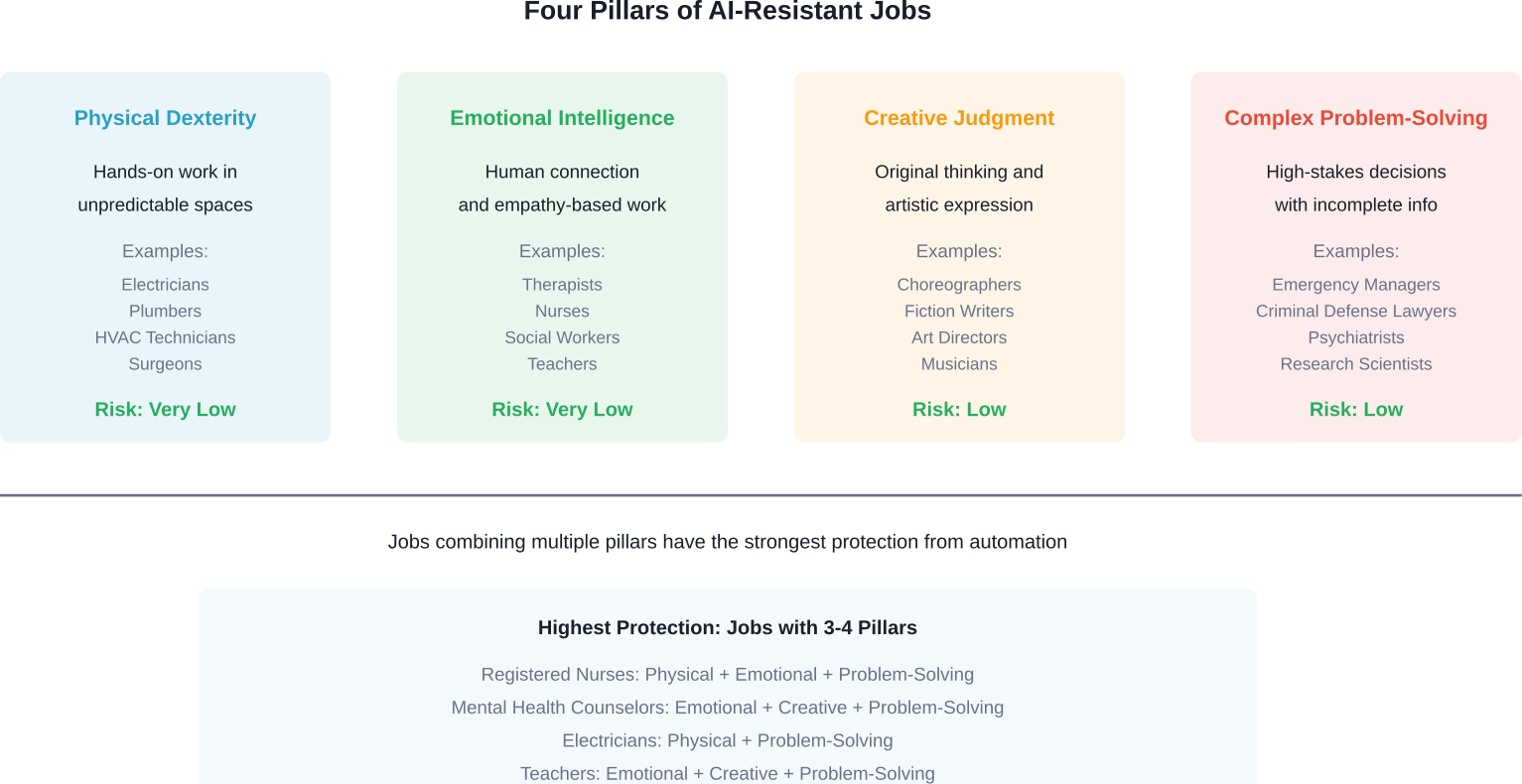
Healthcare dominates every list of AI-resistant jobs. There's a reason for that.
Nursing, for instance, combines physical tasks (starting IVs, wound care, patient mobility), emotional intelligence (comforting anxious patients, family communication), and constant problem-solving (recognizing subtle condition changes, coordinating complex care).
AI can handle notes and administrative work. It can spot early risk patterns in data. But the core nursing tasks? Still entirely human-led.
According to occupational analysis, nursing roles combine physical tasks, emotional intelligence, and constant problem-solving that remains largely human-led, with AI primarily supporting documentation and pattern recognition rather than direct patient care.
The pattern is consistent: these roles require physical presence, human connection, and real-time judgment in unpredictable situations. That's not what AI does well.
Here's where the hype about robots taking jobs runs into physical reality.
An electrician diagnosing a wiring problem in a 1940s building, working in tight crawl spaces, adapting to unexpected conditions—that's not getting automated anytime soon. The physical world is too messy, too variable, too unpredictable.
According to research cited by The Independent, jobs requiring hands-on physical tasks in varied environments are among those most likely to be AI-proof. Installing HVAC systems in different building types, plumbing repairs in older homes, automotive diagnostics on various vehicle models—these demand adaptability robots don't have.
But there's another advantage: trade jobs can't be outsourced. An electrician in Ohio can't wire a house in Texas remotely. Physical presence is mandatory.
Many of these roles offer six-figure potential without requiring a four-year degree. That combination—high pay, low automation risk, accessible training—makes trades increasingly attractive.
Can AI deliver educational content? Absolutely. Khan Academy and similar platforms prove that.
Can AI replace a teacher managing 25 students with different learning styles, emotional needs, family situations, and behavioral challenges while adapting lesson plans in real-time based on classroom dynamics?
Not even close.
Teaching combines emotional intelligence (recognizing when a student is struggling beyond academics), creative problem-solving (finding new ways to explain difficult concepts), relationship-building (earning trust and motivating engagement), and classroom management (handling conflicts and maintaining focus).
According to U.S. Career Institute research, teachers and school administrators consistently rank among jobs with the lowest automation risk. The Bureau of Labor Statistics includes nursing instructors and post-secondary teachers in projections showing positive growth despite AI advancement.
AI might handle grading and administrative tasks. But the core teaching relationship? Still fundamentally human.
This category gets complicated. AI can generate images, write text, compose music. So aren't creative jobs vulnerable?
The answer depends on what kind of creative work we're discussing.
Choreographers rank among the safest occupations with very low automation risk according to occupational data. Why? Because choreography requires understanding human movement, spatial relationships, artistic vision, and collaboration with dancers—it's deeply embodied creative work.
Fiction writing remains largely protected. AI can generate text, but it can't develop original narrative voice, create emotionally resonant character arcs, or produce work with genuine artistic vision. Generative AI in its current form replicates patterns from training data; it doesn't originate authentic creative expression.
The distinction matters: creative work requiring client collaboration, physical understanding, or genuine artistic innovation remains protected. Generic content production? Much more vulnerable.
When situations are unpredictable, stakes are high, and decisions must be made with incomplete information, humans still hold the advantage.
Emergency management professionals coordinate responses to disasters, making rapid decisions as conditions change. Firefighters assess structural stability, rescue logistics, and safety priorities in real-time. Police officers navigate complex social situations requiring judgment, de-escalation, and community knowledge.
These roles combine physical demands, emotional intelligence, split-second decision-making, and accountability in ways AI can't replicate. An algorithm can't run into a burning building or talk down someone in crisis.
Crisis management roles are fundamentally human and likely to remain so for the foreseeable future.
Here's an interesting paradox: some computer occupations face AI pressure while others benefit from it.
According to Bureau of Labor Statistics analysis, AI may support demand for computer occupations. Software developers are needed to create AI-based business solutions and maintain AI systems. Database administrators and architects are expected to be needed for increasingly complex data infrastructure.
But it's not uniform. Entry-level coding tasks face automation pressure. Senior roles requiring architectural thinking, business problem-solving, and system design? Those remain strong.
AI-related research and engineering positions are obviously protected—you can't automate the work of advancing AI itself. Computer science research, machine learning engineering, and AI safety work are growth areas.
The distinction: routine coding tasks are vulnerable, but complex software engineering requiring business understanding and system-level thinking remains relatively safe.
Some work carries stakes too high to delegate to algorithms without human accountability.
Criminal defense lawyers make judgment calls about strategy, negotiate with prosecutors, read jury reactions, and build client trust. The legal reasoning might get AI assistance, but the courtroom work and ethical responsibility? Entirely human.
Similarly, psychiatrists prescribe medications with significant side effects, assess suicide risk, and make involuntary commitment decisions. These require not just medical knowledge but ethical judgment and legal accountability that can't be delegated to software.
When professional licensing, legal liability, and ethical responsibility are central to a role, human decision-makers remain mandatory.
Exposure isn't the same as displacement. That's what most AI risk discussions miss.
Brookings Institution research from January 2026 examined workers' adaptive capacity—their ability to transition if displacement occurs. Among workers in the top quartile of AI exposure, 26.5 million have above-median adaptive capacity. But 6.1 million workers (4.2% of the workforce) face both high exposure and low adaptive capacity.
That's where concentrated vulnerability exists.
What determines adaptive capacity?
Two people in similar roles might face very different outcomes based on these factors. Understanding your personal situation matters more than general automation statistics.
Predictions are one thing. Real employment data is another.
According to Brookings Institution research from October 2025, actual data shows stability, not disruption, in AI's labor market impacts in the near term. Jobs that are highly AI-exposed haven't seen the employment declines or wage collapses predicted by some analysts.
MIT research tracking AI adoption from 2010 to 2023 found that firms using AI extensively tend to be larger, more productive, and pay higher wages. They also grow faster: a large increase in AI use is linked to approximately 6% higher employment growth and 9.5% more sales growth over five years.
But here's the catch: that could change at any point. The research emphasizes this is a snapshot, not a guarantee.
Historical employment data for photographic process workers showed stable numbers right up until digital cameras matured—then employment dropped sharply. The Bureau of Labor Statistics projected those declines before they appeared in the data, based on technological trajectory rather than current employment trends.
The same pattern could emerge elsewhere. Stability today doesn't guarantee stability tomorrow.
So how should this shape career decisions?
First, recognize that AI impact is task-level, not occupation-level. Most jobs will transform rather than disappear. That transformation might mean some tasks get easier (AI handles documentation) while expertise requirements for other tasks increase.
Second, prioritize roles combining multiple AI-resistant characteristics. A job requiring physical dexterity AND emotional intelligence has stronger protection than one with just routine cognitive tasks.
Third, consider accessibility of training. Many highly protected careers—electricians, nurses, therapists—offer clear training pathways that don't require four-year degrees or create massive debt.
Fourth, build adaptive capacity regardless of current role. Develop transferable skills, maintain learning habits, build professional networks, and create financial buffers for potential transitions.
The goal isn't finding a job AI will never touch. It's finding work where human capabilities remain central and building the flexibility to adapt as technology changes.
The Bureau of Labor Statistics 2024-2034 employment projections offer perspective. Total employment growth of 3.1% is slower than historical averages, partly due to AI and automation, but also demographics and economic factors.
Healthcare occupations continue showing strong growth despite—and sometimes because of—technological advancement. Skilled trades maintain steady demand driven by infrastructure needs and worker shortages. Education roles remain stable with localized variations.
Meanwhile, clerical occupations face headwinds. Routine cognitive work continues declining. But even here, it's nuanced: some administrative roles requiring client interaction and judgment remain stable while pure data entry positions shrink.
The overall picture: employment keeps growing, but the mix of jobs is shifting toward work requiring distinctly human capabilities.
The panic about AI destroying all jobs doesn't match the evidence. Neither does complacency.
Real talk: AI will change most occupations by automating specific tasks. Some jobs will shrink or disappear. But employment overall continues growing, and roles requiring distinctly human capabilities—physical dexterity, emotional intelligence, creative judgment, complex problem-solving—show remarkable resilience.
Healthcare, skilled trades, teaching, crisis response, and creative work requiring collaboration remain strongly protected. Some computer and AI-engineering roles are actually growing because of AI advancement, not despite it.
The smartest approach isn't finding a guaranteed AI-proof job—no such thing exists. It's choosing work that leverages human strengths AI can't replicate while building the adaptive capacity to navigate whatever changes emerge.
Physical presence matters. Emotional connection matters. Creative originality matters. Complex judgment in unpredictable situations matters.
Those capabilities remain fundamentally human. Build a career around them, and automation becomes a tool rather than a threat.
Ready to explore training programs for AI-resistant careers? Research apprenticeships in skilled trades, nursing programs at community colleges, or certification paths in mental health counseling. The jobs are there. The question is whether you'll position yourself for them.


