How to Sell Clothes on Shopify Without Overcomplicating It
Learn how to sell clothes on Shopify step by step, from setting up your store to marketing and fulfillment, with practical tips that actually work.
Mar 16, 2026



AI is transforming social media marketing through automated content creation, intelligent scheduling, audience analysis, and personalized engagement. According to Harvard research, AI enables marketers to personalize customer experiences at scale while improving efficiency. Businesses can leverage AI tools for content generation, sentiment analysis, trend prediction, and analytics to enhance their social media strategies in 2026.
Social media marketing has become exponentially more complex. Multiple platforms, constant content demands, shifting algorithms, and rising audience expectations create challenges that traditional methods struggle to address.
Artificial intelligence has emerged as a transformative force in this space. Research from Harvard's Division of Continuing Education confirms that AI presents marketers with opportunities to personalize customer experiences and build technological skills. But the shift isn't just theoretical.
According to The State of Social Media 2024 report, 63% of US B2B marketers credited AI with boosting their revenue and lead generation. That's a substantial impact. And 75% of marketers are planning to use AI to enhance customer experience moving forward.
So what does practical AI implementation actually look like? How can marketing teams harness these capabilities without falling into common pitfalls?
This guide breaks down actionable approaches to using AI for social media marketing, covering everything from content creation to analytics to ethical considerations.
Artificial intelligence in social media marketing encompasses machine learning algorithms, natural language processing, computer vision, and predictive analytics working together to automate and optimize marketing activities.
These technologies don't replace human creativity. Instead, they handle repetitive tasks, surface insights from data, and enable personalization at scale that would be impossible manually.
The University of Iowa's Tippie College research highlights how AI is reshaping both what audiences see in their feeds and how marketers create content. From feed algorithms to content generation, AI influences the entire social media ecosystem.
Northwestern University's analysis emphasizes that data privacy and evolving regulations are reshaping how businesses approach digital marketing in the AI era. With third-party cookie deprecation and rising ad blockers, marketers must stay ahead of technological shifts while maintaining ethical standards.
Here's what makes AI particularly valuable for social media teams: speed, scale, and pattern recognition. AI processes massive datasets in seconds, identifies trends humans might miss, and executes tasks across multiple platforms simultaneously.
Several specific AI capabilities drive value in social media marketing:
IEEE research on machine learning algorithms for recommender systems shows how these technologies power personalization engines that determine what content reaches which users.
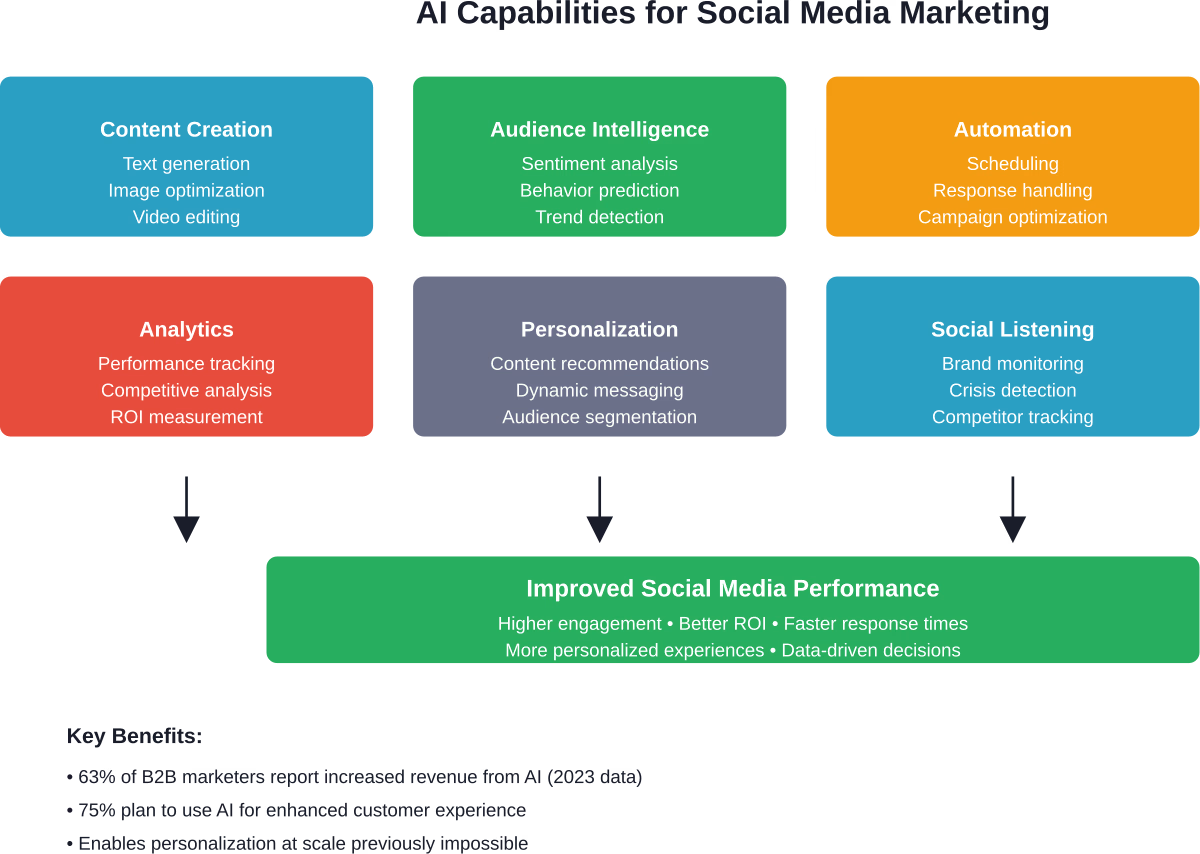
Content creation consumes massive amounts of time and resources for social media teams. AI dramatically accelerates this process while maintaining quality standards.
But here's the thing: AI-generated content works best as a starting point, not a finished product. The most effective approach combines AI efficiency with human creativity and brand understanding.
AI writing assistants can generate post copy for various platforms, adapting tone and length to match each channel's requirements. Tools analyze successful content patterns and create variations that align with those patterns.
The process typically involves providing context about the topic, target audience, and desired tone. The AI then generates multiple options for review and refinement.
According to research findings, AI tools can detect which channel content is intended for and adapt output accordingly. This channel-specific optimization saves time that would otherwise be spent manually reformatting content for different platforms.
That said, human oversight remains essential. AI can occasionally produce generic or off-brand content. Review everything before publishing.
AI image generation tools create custom visuals from text descriptions. Marketing teams use these for social posts, ads, and campaigns without extensive design resources.
AI also enhances existing images through automatic editing, background removal, and optimization for different platform specifications. Some tools analyze top-performing visual content and suggest improvements to new images.
Video content benefits from AI as well. Automated editing tools can create short clips from longer videos, add captions, and optimize for mobile viewing.
AI monitors thousands of sources to identify trending topics, relevant news, and shareable content for specific audiences. This helps teams stay on top of their content topics without manually searching multiple sources daily.
Recommendation engines suggest content ideas based on audience interests, past performance data, and emerging trends. Some tools predict which topics will perform well before they peak in popularity.
For brands operating in multiple markets, AI translation tools quickly adapt content to different languages while maintaining tone and context. These tools go beyond literal translation to consider cultural nuances and idioms.
Example applications include adapting Instagram captions for different regions, localizing promotional messages, and ensuring brand voice consistency across languages.
When and how often to post significantly impacts social media performance. AI eliminates guesswork from scheduling decisions.
AI analyzes historical engagement data to identify optimal posting times for specific audiences. Instead of following generic best practices, teams get customized recommendations based on when their actual followers are most active and engaged.
Advanced systems continuously learn and adjust recommendations as audience behavior changes. This adaptive approach maintains performance as algorithms and user patterns evolve.
Some platforms automate the entire scheduling process, distributing content at calculated optimal times without manual intervention.
AI identifies high-performing evergreen content suitable for republishing. Tools can automatically reschedule this content at strategic intervals, maximizing value from successful posts.
Conditional posting features allow setting rules for when content should or shouldn't be published based on external factors like weather, events, or news cycles.
Managing presence across multiple platforms becomes complex quickly. AI helps coordinate multi-channel strategies by adapting content for each platform while maintaining message consistency.
Systems can plan and execute campaigns across channels simultaneously, adjusting messaging for platform-specific best practices while tracking unified performance metrics.
Engagement drives social media success, but responding to every comment, message, and mention doesn't scale manually.
AI-powered chatbots handle common questions, provide instant responses, and route complex inquiries to human team members. This ensures fast response times while freeing staff for higher-value interactions.
Natural language processing enables these systems to understand context, detect sentiment, and respond appropriately to various situations.
However, research from MIT's Center for Constructive Communication reveals important limitations. A study published on February 19, 2026 found that state-of-the-art AI chatbots — including OpenAI's GPT-4, Anthropic's Claude 3 Opus, and Meta's Llama 3 — provide less-accurate information to users with lower English proficiency, less formal education, or non-US origins. The research shows that negative effects compound in concerning ways, suggesting that models deployed at scale risk spreading harmful behavior or misinformation to those least able to identify it.
This finding underscores the importance of human oversight in customer-facing AI applications.
AI monitors conversations about brands in real-time, analyzing sentiment to detect potential issues before they escalate. This early warning system allows teams to address concerns proactively.
Sentiment tracking also reveals what audiences genuinely appreciate, helping teams double down on successful strategies.
AI enables personalized interactions with thousands of users simultaneously. Systems can segment audiences based on behavior, interests, and engagement history, then deliver tailored content to each segment.
Recommendation engines suggest which users to engage with, which comments deserve responses, and which conversations present opportunities for deeper relationship building.
Data drives effective social media strategy, but raw metrics don't tell the full story. AI transforms data into actionable insights.
AI analytics platforms automatically track performance across all channels, identifying patterns and anomalies that manual analysis might miss. Systems generate comprehensive reports highlighting what's working and what isn't.
Advanced analytics go beyond surface metrics to measure true business impact, connecting social media activities to revenue, conversions, and other key business outcomes.
AI monitors competitor activities across social platforms, tracking their content strategies, engagement rates, and audience growth. This intelligence reveals gaps in competitor strategies and opportunities for differentiation.
Some tools benchmark performance against competitors automatically, providing context for whether results are truly strong or just acceptable.
Machine learning models predict future trends based on historical data and current patterns. Teams can anticipate which content types will perform well, when engagement will peak, and how campaigns will likely perform before launch.
Predictive capabilities enable proactive strategy adjustments rather than reactive responses to underperformance.

Most predictive models focus on audiences, timing, or budget allocation. But creativity itself is often the biggest variable and also the hardest to evaluate before launch.
This is where platforms like Extuitive introduce a slightly different layer. Instead of waiting for campaigns to run and then optimizing, the system evaluates creative concepts in advance using past performance data and simulated testing environments. It gives teams an early signal of which ads are likely to resonate and which ones may underperform, before any budget is spent.
In practice, this shifts part of the workflow from reactive optimization to upfront filtering. Rather than testing dozens of variations live, teams can narrow down options earlier and focus on a smaller set of stronger candidates.
AI analyzes audience demographics, behaviors, and preferences to build detailed profiles. These insights inform targeting decisions, content strategy, and overall marketing approach.
Systems identify micro-segments within broader audiences, enabling highly targeted messaging that resonates with specific groups.
The AI tools landscape has expanded dramatically. Different tools excel at different tasks.
Selection depends on specific needs, budget, and existing tech stack. Key considerations include:
Community discussions reveal that many marketing teams combine multiple specialized tools rather than relying on a single all-in-one solution. This approach allows optimization for each specific function.
AI social media tools generally fall into several categories:
Effective AI implementation requires more than just adopting tools. Strategic approach matters.
AI should augment human creativity, not replace it. Always review AI-generated content before publishing. The most successful approaches use AI for efficiency while preserving human judgment for strategy and brand decisions.
Real talk: AI occasionally produces inappropriate, off-brand, or factually incorrect content. Human review catches these issues before they reach audiences.
Generic AI output lacks the distinctive voice that differentiates brands. Customize AI tools with brand guidelines, tone preferences, and style examples. Train systems on successful past content to maintain consistency.
The goal isn't just acceptable content—it's content that sounds authentically like the brand.
Define what success looks like before implementing AI tools. Specific objectives guide tool selection and ensure AI capabilities align with actual business needs.
Common objectives include: reducing content creation time, improving engagement rates, increasing posting frequency, better audience understanding, or faster response times.
AI performance improves with use and refinement. Start with limited applications, measure results, and expand based on what works. This iterative approach minimizes risk while maximizing learning.
Track performance metrics specifically related to AI-assisted activities to isolate impact.
The most effective content combines AI efficiency with human creativity and strategic thinking. Use AI to handle repetitive tasks, generate options, and surface insights—then apply human judgment to refine, strategize, and innovate.
AI adoption brings responsibility. Ethical considerations and regulatory compliance can't be afterthoughts.
The Federal Trade Commission has emphasized that AI companies must uphold privacy and confidentiality commitments. Data is at the heart of AI development, and misuse carries serious consequences.
In September 2024, the FTC announced Operation AI Comply, launching law enforcement actions against operations using AI hype or selling AI technology in deceptive and unfair ways. The agency continues cracking down on deceptive AI claims.
Marketing teams must ensure transparency about AI use where appropriate and avoid misleading claims about AI capabilities.
AI systems process vast amounts of user data. Northwestern research highlights how data privacy has taken the spotlight recently, reshaping how businesses approach digital marketing. Federal and state regulations, combined with changing technology like third-party cookie deprecation, make it increasingly important for marketers to stay ahead.
Ensure AI tools comply with relevant privacy regulations including GDPR, CCPA, and other applicable laws. Understand what data tools collect, how they use it, and what security measures protect it.
AI systems can perpetuate or amplify biases present in training data. The MIT study showing AI chatbots provide less accurate information to vulnerable users demonstrates how these biases manifest in concerning ways.
Regularly audit AI outputs for bias. Ensure content serves all audience segments fairly and accurately.
The FTC has taken action against companies making false guarantees about AI-powered business opportunities. In cases filed by the FTC, defendants falsely guaranteed that consumers could make money operating online storefronts using AI-powered software.
Make realistic claims about AI capabilities. Don't oversell what technology can deliver.
AI's role in social media marketing continues evolving rapidly. Several trends are shaping the next phase.
AI personalization will become increasingly granular, moving beyond demographic segments to individual-level customization. Real-time content adaptation based on user context, behavior, and preferences will become standard.
AI systems will better understand and generate content across multiple formats simultaneously—combining text, images, video, and audio in cohesive ways. This enables richer, more engaging social media experiences.
As AI-generated content becomes ubiquitous, systems for detecting and labeling synthetic content will advance. Platforms may require disclosure of AI-generated material, changing how marketers approach content creation.
AI won't exist as separate social media tools but will integrate deeply across all marketing functions. Unified AI systems will coordinate social media with email, advertising, content marketing, and customer service for cohesive experiences.
Expect increased regulation around AI use in marketing. The FTC's Artificial Intelligence Compliance Plan, published in 2025, outlines strategic approaches to AI adoption emphasizing transparency, accountability, and public benefit focus. Similar frameworks will likely emerge from other regulatory bodies.
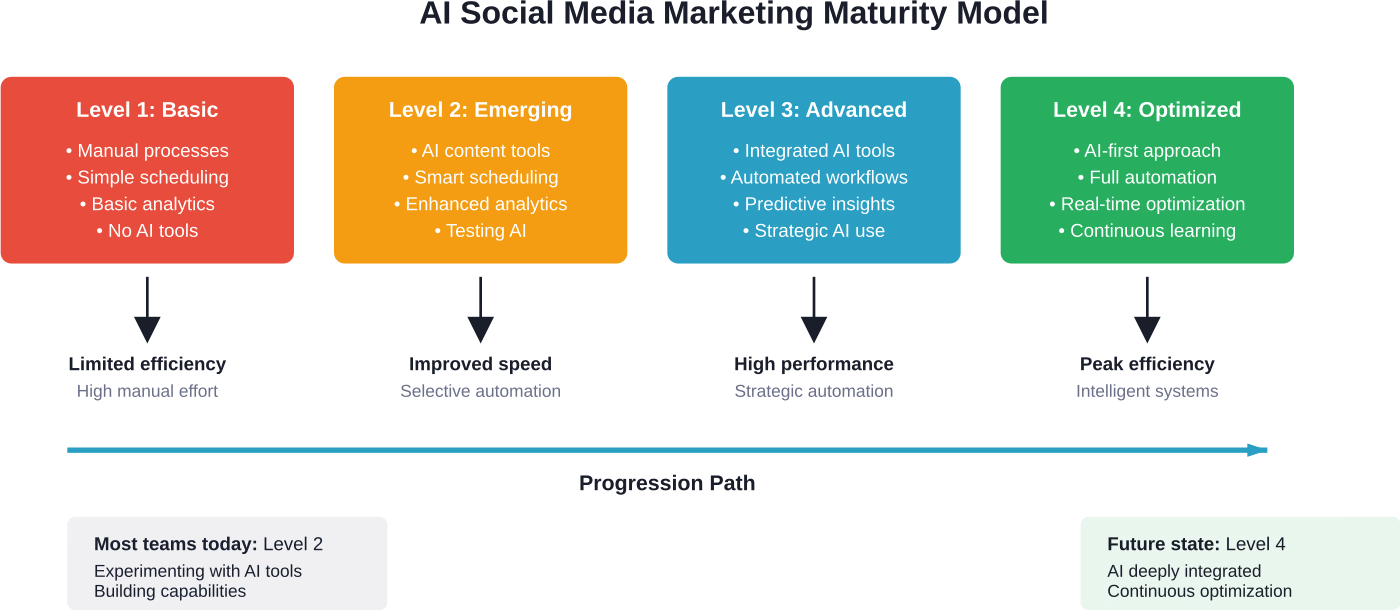
AI implementation isn't without obstacles. Understanding common challenges helps teams prepare and adapt.
AI has fundamentally transformed social media marketing, moving from experimental technology to essential capability. The data is clear: organizations using AI effectively see measurable improvements in efficiency, engagement, and business results.
But success requires more than just adopting tools. Effective AI implementation combines technology with strategy, maintaining human creativity and judgment while leveraging automation and insights.
Start with clear objectives. Identify specific challenges AI can address and select tools aligned with those needs. Begin with limited applications, measure results carefully, and expand based on what works.
Maintain ethical standards and regulatory compliance. The FTC and other agencies are actively monitoring AI use in marketing, and violations carry serious consequences. Transparency, privacy protection, and honest claims about capabilities aren't optional.
Remember that AI works best as an augmentation tool. The human elements—creativity, strategy, empathy, and judgment—remain irreplaceable. The goal isn't to remove humans from social media marketing but to free them from repetitive tasks so they can focus on high-value activities that truly move the business forward.
As AI capabilities continue advancing, early adopters who develop expertise now will have significant competitive advantages. The technology will only become more sophisticated, more integrated, and more essential to social media success.
The question isn't whether to use AI for social media marketing. It's how to use it effectively, ethically, and strategically to achieve specific business objectives while maintaining authentic connections with audiences.
Ready to start? Choose one area where AI could immediately improve efficiency or performance. Test tools designed for that specific use case. Measure results. Refine the approach. Then expand to additional applications. This methodical progression builds capabilities while minimizing risk and maximizing learning.
The future of social media marketing is AI-augmented. Teams that embrace this reality while maintaining focus on authentic human connection will thrive in the evolving landscape.


