Marketing Ideas for Aircraft Repair That Win Customers
Discover proven marketing ideas for aircraft repair shops to attract more clients, build trust, and stand out in a competitive aviation maintenance market.
Jun 7, 2026



Dropshipping is a retail fulfillment method where sellers don't keep products in stock—instead, when a customer makes a purchase, the seller orders the item from a third-party supplier who ships it directly to the customer. This model allows entrepreneurs to start an online store with minimal upfront investment, eliminating inventory management and warehousing costs, though it comes with trade-offs like lower profit margins and less control over shipping.
The global dropshipping market was valued at USD 365.67 billion in 2024 and is projected to reach USD 1,253.79 billion by 2030, growing at a CAGR of 22.0% from 2025 to 2030, according to Grand View Research. That's not a typo—this fulfillment method has gone from niche strategy to mainstream business model.
But what makes dropshipping so attractive? More importantly, how does it actually work behind the scenes?
This guide breaks down the entire dropshipping process, from the moment a customer clicks "buy" to when the package arrives at their door. Whether considering this model for a new venture or trying to understand the mechanics, here's everything about how dropshipping operates in 2026.
Dropshipping is a retail fulfillment method that fundamentally changes the traditional business model. Instead of purchasing inventory upfront and storing products in a warehouse, sellers partner with suppliers who handle the entire product fulfillment process.
Here's how it differs from traditional retail: In conventional ecommerce, businesses buy products in bulk, store them, manage inventory, pack orders, and ship to customers. With dropshipping, none of that happens.
The seller's role becomes purely transactional and marketing-focused. The physical product never touches the retailer's hands. According to data from authoritative sources, over 27% of online retailers now use dropshipping as their primary fulfillment method.
Think of dropshipping as being the middleman between customers and manufacturers. The seller creates an online storefront, lists products with marked-up prices, and handles marketing and customer service. When orders come in, those orders get forwarded to suppliers who ship directly to customers.
This eliminates several traditional retail headaches: no need to lease warehouse space, hire fulfillment staff, manage inventory tracking systems, or worry about unsold stock gathering dust.
The model appeals particularly to new entrepreneurs because barriers to entry are remarkably low. No massive capital investment required. No complex logistics operations. Just a website, supplier relationships, and marketing know-how.

When people explain how dropshipping works, they usually talk about sourcing products, setting up a store, and launching ads. What often gets overlooked is the messy part in between – figuring out which ideas actually have a chance. Most stores do this after launch, which means part of the budget goes into dead ends. Extuitive approaches this differently. It runs your product through predictive models trained on consumer behavior, giving you an early read on what’s likely to connect before anything goes live.
That small shift changes how the whole process feels. Instead of reacting to results, you’re making decisions with some direction already in place. You still test, but you’re not starting from scratch every time or repeating the same mistakes. If you’re trying to understand how dropshipping really works in 2026, it’s worth checking your ad ideas before launching with Extuitive.
Understanding the workflow is essential. Here's exactly what happens when someone buys from a dropshipping store.
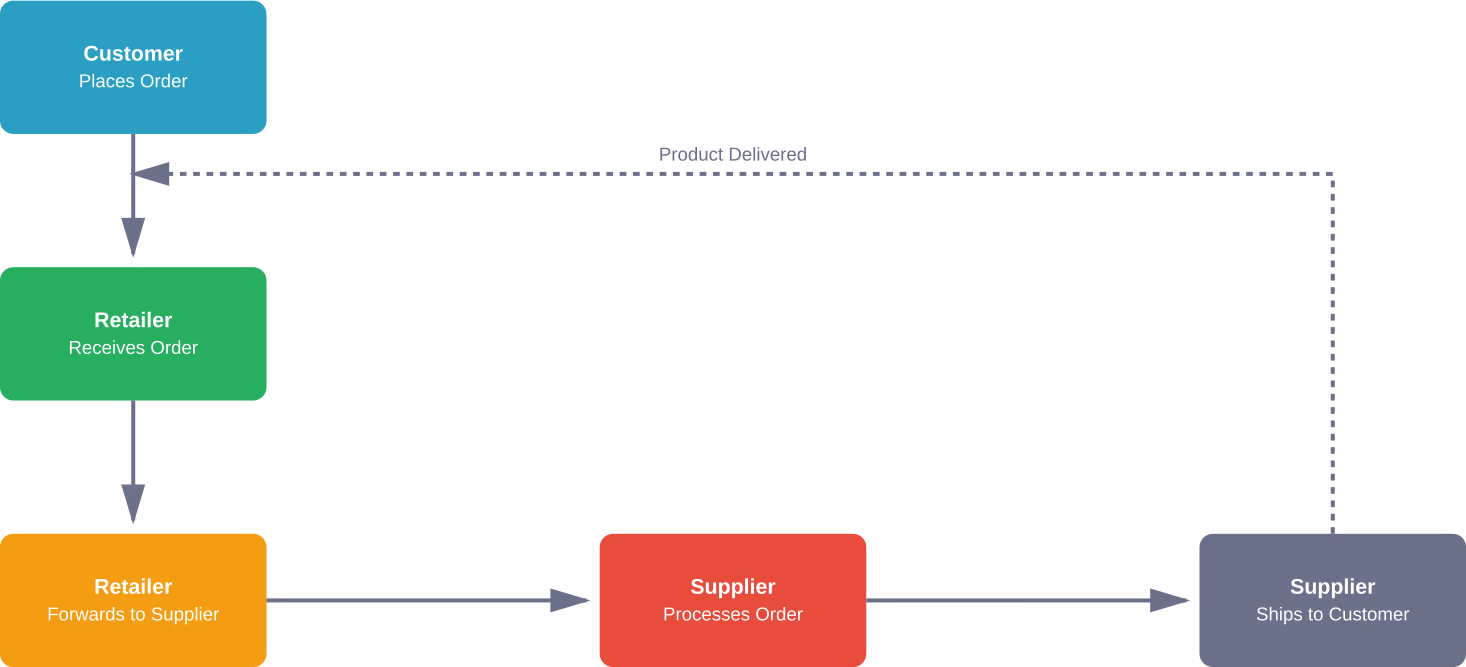
Someone visits the online store, browses products, and decides to make a purchase. They add items to their cart and complete checkout, paying the retail price set by the store owner.
From the customer's perspective, this looks identical to shopping at any other ecommerce site. They have no idea the store doesn't physically stock the products.
The store owner gets notification of the sale through their ecommerce platform. This includes all customer information: shipping address, product details, and any customization requests.
At this point, the retailer has collected payment from the customer at the marked-up retail price. Now comes the fulfillment part.
The retailer logs into their supplier's system (or uses automated integration software) and places the order. They pay the wholesale price—significantly lower than what the customer paid.
This price difference represents the retailer's profit margin. The retailer includes the customer's shipping information so the supplier knows where to send the package.
The supplier receives the order, picks the product from their warehouse, packages it, and ships it directly to the end customer. Some suppliers include the retailer's branding on packing slips, while others use generic packaging.
Shipping times vary dramatically depending on supplier location. Domestic suppliers typically deliver within 3-7 days, while international suppliers (particularly from Asia) can take 2-4 weeks.
The package arrives at the customer's doorstep. If everything goes smoothly, they're satisfied with their purchase and the retailer earns positive reviews.
But here's the thing—the retailer never physically handled the product. Their entire role was facilitating the transaction and managing the customer relationship.
The profit model is straightforward but comes with specific challenges that traditional retailers don't face.
Dropshippers make money through markup—the difference between wholesale cost from suppliers and retail price charged to customers.
Industry data suggests profit margins can be as low as 10% in highly competitive niches. However, margins vary significantly based on product category, marketing costs, supplier location, and competition level.
Here's a realistic example: A supplier offers a product for $15. The retailer lists it for $30. After the sale, the retailer pays the supplier $15, keeps $15. From that $15, they need to cover marketing costs (ads, SEO), platform fees (Shopify, WooCommerce), payment processing fees (2-3%), and customer service expenses.
Real talk: those margins shrink quickly when factoring in all costs.
Because individual transaction profits are modest, successful dropshipping businesses rely heavily on volume. Moving hundreds or thousands of units monthly becomes necessary to generate meaningful income.
According to a ZipRecruiter report, the average hourly pay for professional dropshipping in the U.S. is $19.70 an hour, suggesting moderate earnings for most operators rather than the overnight wealth some marketing materials promise.
Despite the challenges, dropshipping continues growing rapidly. The model offers distinct advantages that traditional retail can't match.
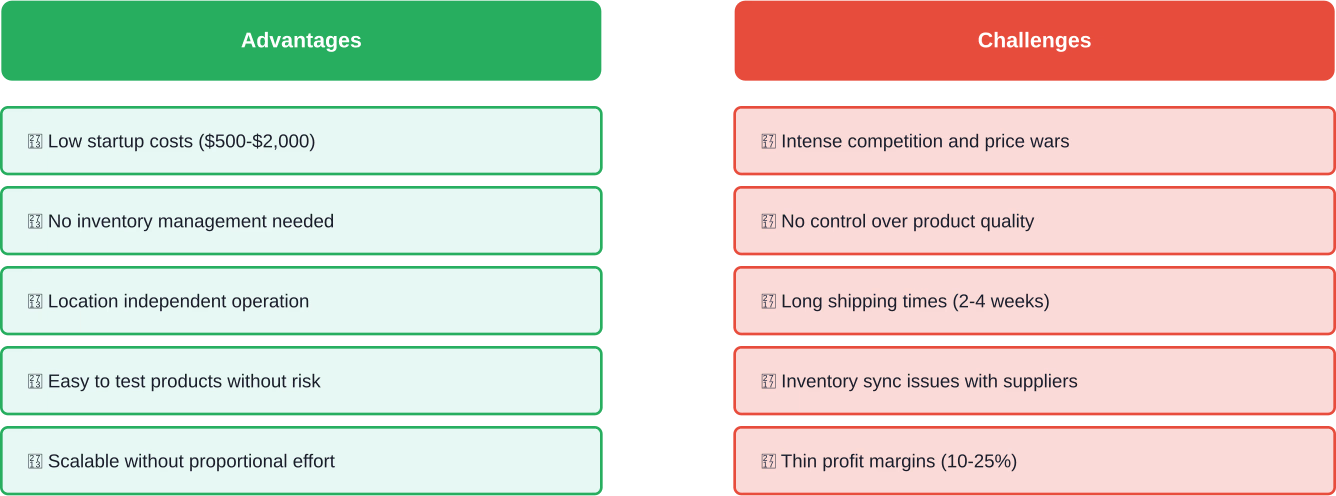
This is the biggest draw. Starting a traditional retail business might require $50,000-$100,000+ for inventory alone. Dropshipping requires maybe $500-$2,000 to cover website setup, initial marketing, and business registration.
No need to buy inventory speculatively. No warehouse rent. No staff to manage shipments. The financial risk drops dramatically.
Dropshipping businesses can operate from anywhere with internet connection. Beach in Thailand? Apartment in Denver? Coffee shop in Berlin? Doesn't matter.
The entire operation runs digitally. Communication with suppliers happens via email or platform messaging. Customer service can be handled remotely. Marketing runs through online channels.
Traditional retailers must commit to inventory before knowing if products will sell. Dropshippers can test dozens of products with zero upfront investment.
Not working? Remove it from the store. No sunk costs. No clearance sales to recoup losses. This flexibility enables rapid testing and pivoting based on market response.
Growing a traditional retail operation means more warehouse space, more staff, more complexity. Dropshipping scales differently.
Selling 10 items or 10,000 items requires roughly the same effort from the retailer. The suppliers handle the increased fulfillment load. This creates interesting growth dynamics—revenue can scale significantly without proportional increases in workload.
Now for the less glamorous reality. Dropshipping comes with significant downsides that cause many ventures to fail within the first year.
The low barriers to entry that make dropshipping attractive also create massive competition. Hundreds of stores often sell identical products from the same suppliers.
This commoditization drives prices down. Customers comparison shop easily. Competing solely on price erodes already-thin margins to nearly nothing.
Standing out requires strong branding, superior customer service, or unique product curation—all of which demand skills beyond simply setting up a store.
The retailer never sees or touches the products. Quality control becomes impossible. If a supplier ships defective items or changes product specs without notice, the retailer only discovers this through customer complaints.
Returns and refunds eat into profits while damaging reputation. Unlike traditional retail where quality issues can be caught before shipping, dropshippers discover problems after customers receive disappointing products.
Long delivery times remain a persistent issue, particularly with overseas suppliers. Customers accustomed to Amazon Prime's 2-day shipping won't happily wait 3-4 weeks.
Shipping costs multiply when customers order from multiple suppliers in a single transaction. Each supplier ships separately, each charges shipping, yet customers expect unified shipping fees.
Managing customer expectations around delivery becomes a constant challenge.
Suppliers don't always update inventory availability in real-time. A product might show as available on the retailer's store but actually be out of stock at the supplier.
The retailer then faces an awkward situation: cancel the order and disappoint the customer, or scramble to find the product elsewhere at potentially higher cost.
Already mentioned, but worth emphasizing: margins are tight. Every additional cost—higher advertising prices, increased platform fees, payment disputes—directly threatens profitability.
Building a sustainable business on 10-15% margins requires significant volume and tight operational efficiency.
Ready to launch? Here's the realistic roadmap, minus the hype.
Generic stores selling everything rarely succeed. The winning approach focuses on specific niches where targeted marketing works efficiently.
Research product categories with these characteristics: sufficient demand (use Google Trends, Amazon bestsellers), acceptable profit margins (products priced $30-$200 work well), not dominated by major brands, and solvable customer pain points.
According to market research data, the food and personal care segment is expected to grow at a significant CAGR of 23.6% over the forecast period through 2030. Electronics, fashion, and hobby products also show strong growth trajectories.
Avoid oversaturated markets unless bringing genuinely unique angles. The 10,000th generic phone case store won't succeed.
This makes or breaks the business. Supplier quality directly determines customer satisfaction, shipping speed, and ultimately, profitability.
Popular supplier platforms include AliExpress (massive selection, longer shipping), Spocket (faster shipping, Western suppliers), SaleHoo (directory of vetted suppliers), and Modalyst (integrates with major platforms).
Vet potential suppliers carefully. Order sample products. Test shipping times. Evaluate packaging quality. Check communication responsiveness. Read reviews from other retailers.
Red flags include: no phone contact information, frequent inventory issues, poor English communication (if that matters for operations), unusually low prices (often signals quality problems), and unwillingness to provide samples.
Several platforms cater specifically to dropshipping. Shopify remains the most popular, offering extensive dropshipping integrations and relatively easy setup. WooCommerce (WordPress plugin) provides more control but requires technical comfort. BigCommerce and Wix also support dropshipping.
The store needs professional design, clear product descriptions, high-quality images, transparent shipping policies, and trust signals (secure checkout, return policies, contact information).
Remember: customers can't differentiate between dropshipping stores and traditional retailers. The site needs to inspire confidence that justifies the wait and price.
Operating legally matters, despite the digital nature of the business. Requirements vary by location but generally include business registration, obtaining necessary licenses and permits, collecting and remitting sales tax, and proper tax filing.
The IRS provides guidance on digital platform tax obligations. For high-volume sellers, the INFORM Consumers Act (enforced by the FTC as of 2023) requires online marketplaces to collect and verify information from sellers who meet certain thresholds.
Consulting with a tax professional experienced in ecommerce saves headaches later.
This is where most dropshippers actually spend their time. Building the store takes days or weeks. Marketing it profitably takes months or years of continuous effort.
Effective channels for dropshipping include paid social media advertising (Facebook, Instagram, TikTok), search engine optimization for organic traffic, content marketing (blogs, videos, guides), influencer partnerships, and email marketing.
Paid advertising often drives initial sales but can be expensive. Customer acquisition cost needs to stay well below customer lifetime value for sustainable growth.
The FTC has increased scrutiny of dropshipping operations, particularly around consumer protection and transparency.
Enacted to combat organized retail crime and protect consumers, this law requires online marketplaces to collect and verify information from high-volume third-party sellers.
Under the INFORM Consumers Act enforced by the FTC, a "high-volume third-party seller" is defined by the law as a seller in an online marketplace that meets certain thresholds in any continuous 12-month period (with FTC guidance published August 15, 2023).
Marketplaces must collect and verify: bank account information, contact information, tax ID, and working email and phone number. This information must be provided to consumers upon request.
Truth-in-advertising standards apply fully to dropshipping businesses. Claims about product benefits, shipping times, or business practices must be accurate and substantiated.
The FTC has taken action against multiple dropshipping schemes that made misleading income claims or misrepresented business opportunities. In October 2024, the FTC took action against a business opportunity scheme that had cost consumers millions and operated for years under various names.
Dropshippers using overseas suppliers need awareness of import regulations. While the supplier typically handles customs clearance, the retailer should understand potential delays and additional costs.
Customs duties and import taxes can surprise both retailers and customers if not properly anticipated and disclosed.
Dropshipping isn't the only way to run an online store. Understanding alternatives helps determine the best fit.
Similar to dropshipping but focused on customizable products like t-shirts, mugs, and books. Products are manufactured only after orders are placed. Margins are typically better than dropshipping because products feel more unique.
The retailer buys inventory but outsources storage and fulfillment to a 3PL provider. More control than dropshipping with faster shipping, but requires capital for inventory.
Send inventory to Amazon warehouses; they handle storage, picking, packing, and shipping. Access to Prime customers, but fees can be substantial and competition is intense.
The honest answer: it depends on expectations and skills.
Dropshipping works for entrepreneurs who understand it's a real business requiring marketing expertise, customer service skills, and persistence. It's not passive income. It's not a get-rich-quick scheme.
The model works best for those who bring skills in digital marketing (particularly paid advertising), have patience for thin margins and slow initial growth, can handle customer service challenges gracefully, and view it as a learning experience or side income initially.
It's probably not ideal for those expecting quick wealth, lacking marketing skills or budget, unable to handle customer complaints, or looking for truly passive income.
Market data shows the industry growing robustly—the global market size was valued at USD 290.7 billion in 2025 and is expected to reach USD 1.84 trillion by 2035 according to Global Market Insights, representing a 20.6% CAGR from 2026-2035.
That growth indicates opportunity exists. But opportunity doesn't equal easy money.
Learning from others' failures saves time and money.
What seems cool often doesn't sell. Market demand matters more than personal preference. Validate demand before committing to products.
Partnering with unreliable suppliers destroys customer relationships faster than anything else. Always order samples. Test shipping times. Verify quality before listing products.
Competing primarily on price rarely works with dropshipping's thin margins. Focus on value, branding, and service rather than being the cheapest option.
Since product quality and shipping are outsourced, customer service becomes the main controllable factor in customer satisfaction. Responding quickly and professionally to issues makes a massive difference.
74% of online store visits occur on mobile devices, with some markets like Mexico seeing 78% of ecommerce transactions on mobile. Stores that don't work smoothly on phones lose sales constantly.
Relying entirely on paid advertising means constantly paying for new customers. Building an email list creates an owned audience that can be marketed to repeatedly at minimal cost.
The right technology stack makes operations significantly smoother.
Shopify dominates the dropshipping space with extensive app integrations. WooCommerce offers flexibility for WordPress users. BigCommerce provides robust features for growing businesses.
Google Trends reveals search interest over time. Jungle Scout (for Amazon) shows sales estimates and competition. AliExpress Dropship Center highlights trending products.
Oberlo (Shopify) automates product imports and order fulfillment. Spocket connects retailers with US and EU suppliers for faster shipping. Printful handles print-on-demand products seamlessly.
Google Analytics tracks website traffic and conversion rates. Facebook Ads Manager manages paid social campaigns. Klaviyo handles email marketing automation effectively.
Zendesk and Gorgias provide customer support ticketing systems. Tidio offers live chat functionality. Help Scout works well for small teams.
Dropshipping remains a viable business model in 2026, despite increasing competition and evolving challenges. The fundamentals work: connect customers with suppliers, facilitate transactions, and earn margin on the difference.
But success requires realistic expectations. This isn't passive income or overnight wealth. It's a legitimate business model requiring real skills in marketing, customer service, and operations management.
The market continues growing robustly—the global dropshipping market was valued at USD 365.67 billion in 2024 and is projected to reach USD 1,253.79 billion (approximately $1.25 trillion) by 2030. That growth indicates sustained opportunity for entrepreneurs who approach the model strategically.
Focus on these success factors: choose niche markets where targeted marketing works efficiently, partner with reliable suppliers who deliver quality and speed, build genuine brand value beyond just listing products, master digital marketing to acquire customers profitably, and provide excellent customer service to build loyalty and reviews.
The entrepreneurs succeeding with dropshipping in 2026 aren't necessarily the ones who started first. They're the ones who treat it as a real business, continuously improve their skills, and persist through initial challenges.
Ready to start? Begin with thorough market research, identify products with genuine demand, vet suppliers carefully, and launch with modest expectations and learning mindset. The opportunity exists—whether capturing it depends on execution.


