How to Run A/B Tests in Meta Ads Without Wasting Your Time and Budget
Learn how to run effective A/B tests in Meta Ads to boost performance, improve messaging, and stop wasting budget on guesswork.
Feb 5, 2026



Dropshipping is a low-risk ecommerce model where retailers sell products without holding inventory—suppliers ship directly to customers. This guide covers everything from choosing profitable niches and finding reliable suppliers to building your store and ensuring legal compliance, providing a complete roadmap for launching a successful dropshipping business in 2026.
The dropshipping business model has transformed how entrepreneurs approach ecommerce. No warehouses. No inventory risk. No upfront product costs.
But here's the thing—success in dropshipping isn't automatic. The barriers to entry are low, which means competition is fierce. Thousands of beginners launch stores every month, yet only a fraction build sustainable, profitable businesses.
What separates the winners from the rest? Strategic planning, supplier relationships, and understanding the operational realities of this business model.
This comprehensive guide walks through everything needed to start and scale a dropshipping business in 2026. From niche selection and supplier vetting to legal compliance and order fulfillment, each section provides actionable steps backed by real-world data and regulatory requirements.
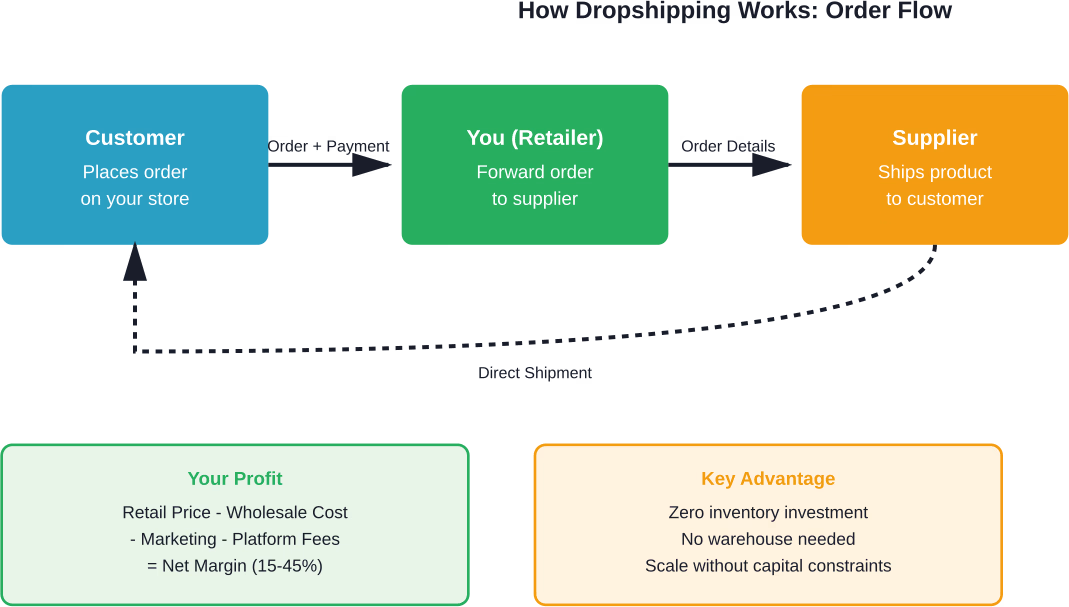
Dropshipping is a supply chain management method where retailers don't stock products. Instead, when a customer places an order, the retailer forwards it to a third-party supplier who ships directly to the customer.
The process follows a straightforward sequence:
The retailer never physically handles the product. This eliminates traditional retail overhead like warehouse space, inventory management, and fulfillment staff.
Profit margins in dropshipping typically range from 15-45%, depending on niche and competition. A product purchased from a supplier for $20 might sell for $35-50 after marketing costs and fees.
Unlike traditional retail where inventory ties up capital for months, dropshipping operates on a pay-as-you-sell model. Capital stays liquid, allowing faster scaling and testing of new products.
But that financial flexibility comes with trade-offs. Lower margins per transaction mean higher volume requirements. And without inventory control, stockouts and shipping delays become supplier-dependent risks.

At the start, most dropshipping setups follow the same path – launch ads, test fast, cut losses, repeat. It works, but it also means you’re paying to figure things out. For a beginner, that can burn through the budget before anything stable shows up.
Tools like Extuitive let you slow that part down in a useful way. Instead of pushing every idea live, you can look at different creatives ahead of time and see which ones are more likely to land. It doesn’t replace testing, but it gives you a better starting point. If you’re about to run your first ads, it’s worth using Extuitive to narrow things down before spending real money.
Before diving into product selection and marketing tactics, understanding legal obligations is critical. Operating without proper compliance can result in penalties, shutdowns, and consumer trust issues.
The FTC's Mail, Internet, or Telephone Order Merchandise Rule applies to all dropshipping businesses. According to the FTC's Mail, Internet, or Telephone Order Merchandise Rule, retailers must have a reasonable basis for stating or implying they can ship within a certain time. If no shipment statement is made, they must have a reasonable basis for believing they can ship accordingly.
If shipment delays occur, businesses must notify customers and provide the option to cancel for a full refund. This creates accountability even when suppliers control fulfillment.
The rule exempts certain transactions including magazine subscriptions, seeds and growing plants, and COD orders. But standard ecommerce dropshipping falls squarely under FTC jurisdiction.
Effective June 27, 2023, the INFORM Consumers Act imposes new requirements on online marketplaces. According to the FTC's guidance, platforms hosting high-volume third-party sellers must collect and verify specific seller information.
Marketplaces must verify bank account information, tax ID, and contact details for covered sellers.
While this primarily affects platforms like Amazon and eBay, dropshippers using these channels need awareness of the verification requirements they'll face.
According to the U.S. Small Business Administration, business license requirements vary by location and activity. Most dropshippers need at minimum:
Check state and local requirements through the SBA's licensing tool. Some product categories require federal permits—firearms, alcohol, tobacco, and certain health products face additional regulatory scrutiny.
Truth-in-advertising standards apply to all online marketing. The FTC requires that advertising claims be truthful, not misleading, and substantiated by evidence.
This means product descriptions, testimonials, and promotional materials must accurately represent what customers will receive. Using supplier photos is acceptable, but making unverified health claims or performance promises creates liability.
Transparency about shipping times matters significantly. If suppliers ship from overseas with 2-3 week delivery windows, customers deserve that information upfront—not after purchase.
Niche selection determines everything that follows. The right niche balances profitability, competition levels, and personal interest or expertise.
Broad product categories like "electronics" or "clothing" face massive competition from established retailers. Successful dropshippers typically focus on specific sub-niches with dedicated audiences.
Start with market demand analysis. Google Trends reveals search volume patterns over time. According to Shopify case study data, eBike Generation founder John Murphy used keyword research to build a $3 million dropshipping company by identifying an underserved niche: ebikes for hunters.
That level of specificity—not just "ebikes" but "ebikes for hunters"—reduces competition while targeting customers with clear intent.
Look for trending upward interest over 12-24 months. Avoid fads with sharp spikes followed by crashes. Sustainable niches show steady or gradually increasing search volume.
Profitable dropshipping products typically share common characteristics:
Products under $20 rarely generate sufficient margin to cover customer acquisition costs. Items over $500 create higher refund risk and longer purchase decision cycles.
The sweet spot typically falls between $30-$200, where margins support paid advertising while price points don't trigger extensive comparison shopping.
Study existing competitors before committing to a niche. Search your potential product keywords and analyze the top 10 results:
Competition isn't necessarily bad—it validates demand. But entering saturated markets with indistinguishable products makes profitability difficult without substantial capital for advertising.
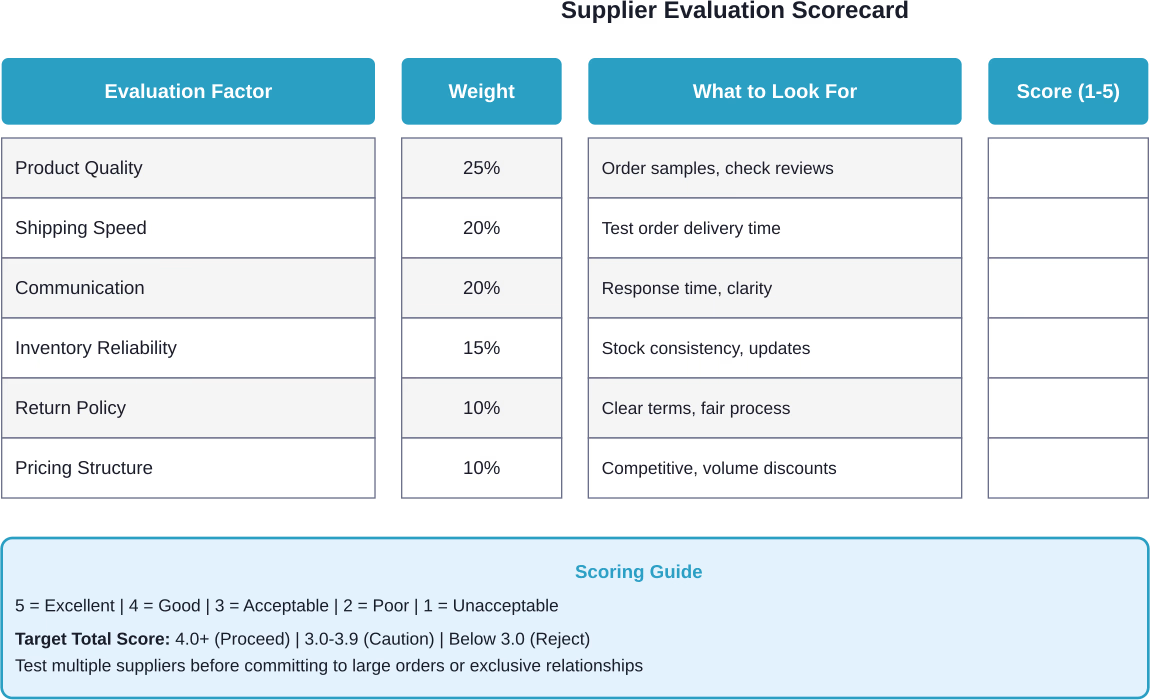
Supplier relationships make or break dropshipping businesses. Reliable partners ensure product quality, consistent inventory, and timely shipping. Poor suppliers create customer service nightmares and damage reputation.
Several platforms connect retailers with dropshipping suppliers:
Never commit to a supplier without thorough evaluation. Order sample products to assess quality firsthand. This reveals:
Test supplier communication by asking specific questions about inventory management, shipping methods, and quality control procedures. Slow or evasive responses indicate potential fulfillment problems.
Check business credentials when possible. Legitimate supliers maintain business licenses, have established company addresses, and operate transparently.
As order volume increases, negotiate better terms. Higher-volume accounts often secure:
Treat suppliers as partners rather than vendors. Clear communication, consistent order volume, and prompt payment build goodwill that pays dividends during stockouts or shipping disruptions.
The ecommerce platform chosen affects everything from startup costs to long-term scalability. Different platforms serve different business models and technical skill levels.
Here are the most common ones:
For beginners, Shopify typically offers the best balance of ease-of-use and dropshipping functionality. The learning curve is gentle, and the app ecosystem solves most operational needs without custom development.
Professional stores share common structural elements:
The checkout process deserves particular attention. Every additional step or required field increases cart abandonment. Offer guest checkout, display security assurances, and show total costs (including shipping) before payment information is entered.
Every ecommerce store needs legally compliant policy pages:
Generic templates provide starting points, but customize them for specific business practices. Overpromising in policies creates legal obligations that suppliers may not fulfill.
Operational excellence separates sustainable businesses from failures. Without inventory control, the order management process requires systematic procedures.
Establish a consistent daily routine:
Automation tools streamline this process. Oberlo, Spocket, and DSers automatically forward orders to suppliers and sync tracking numbers back to the store. This reduces manual work but still requires oversight for inventory issues.
The FTC's Mail Order Rule requires specific actions when delays occur. Notify customers promptly if shipment will exceed the original timeframe. Provide a revised delivery estimate and offer the option to cancel for a full refund.
Proactive communication prevents most disputes. A customer informed about a one-week delay usually stays satisfied. A customer kept in the dark for three weeks leaves negative reviews and files chargebacks.
When suppliers run out of stock after an order is placed, immediately notify customers and offer alternatives:
Never just wait hoping the supplier restocks soon. Silence damages trust more than honest communication about problems.
Dropshipping disadvantages include limited control over product quality and shipping. Customer service becomes the differentiator.
Respond to inquiries within 24 hours, ideally within a few hours during business days. Customers understand shipping delays better than communication delays.
Common customer service scenarios require prepared responses:
Absorbing occasional losses from customer service issues costs less than negative reviews and reputation damage. A generous return policy builds trust that increases overall conversion rates.
Building a store means nothing without traffic. Dropshipping requires effective marketing to overcome higher competition from low barriers to entry.
The testing phase identifies profitable campaigns before scaling. A successful ad might achieve 2-4x return on ad spend (ROAS), meaning every dollar spent generates $2-4 in revenue. Scaling happens after consistent profitability, not before.
Paid advertising drives immediate traffic but organic channels build sustainable growth:
Increasing traffic means nothing if visitors don't convert. Small improvements in conversion rate dramatically impact profitability:
Analytics platforms like Google Analytics and Hotjar reveal where customers drop off in the purchase funnel. Focus optimization efforts on the biggest leaks first.
Revenue doesn't equal profit. Many dropshipping stores generate six figures in sales while barely breaking even or operating at losses.
Every sale incurs multiple costs beyond the wholesale product price:
A $50 product with $20 wholesale cost doesn't yield $30 profit. After shipping ($5), payment processing ($1.75), platform fees ($1), and advertising ($15 customer acquisition), the actual profit might be $7.25—a 14.5% net margin.
Understanding unit economics before scaling prevents the common trap of growing revenue while losing money on every transaction.
Competitive pricing must still maintain profitability. Three common approaches:
Most successful stores use value-based pricing supported by strong branding, unique product positioning, and excellent customer service that justifies premium prices over generic competitors.
Dropshipping's pay-as-you-sell model creates positive cash flow cycles. Customers pay immediately while supplier invoices come later (often net-30 terms).
But advertising precedes sales. Testing new products or scaling campaigns requires capital to fund ads before sales revenue arrives. Maintain operating reserves covering 1-2 months of advertising spend.
Track key financial metrics weekly:
When CAC exceeds gross margin, every sale loses money. When LTV exceeds CAC by 3x or more, scaling becomes financially sustainable.
Learning from others' failures accelerates success. These mistakes appear repeatedly in failed dropshipping ventures:
Selling the same products as thousands of competitors based on "trending product" lists guarantees margin compression and advertising inefficiency. If dozens of stores advertise identical products on Facebook, customers click the cheapest option.
Find unique products or create unique positioning for common products. The product itself matters less than the story, branding, and value proposition surrounding it.
The Amazon Prime era conditioned customers to expect 2-day shipping. Advertising products that take 3-4 weeks to arrive without transparent disclosure generates complaints, refund requests, and negative reviews.
Either work with domestic suppliers offering faster shipping or set clear expectations upfront. Many customers accept longer delivery if they know before purchasing.
Viewing dropshipping as passive income leads to disaster. Customers need support, suppliers create issues, and problems require resolution. Unanswered emails and unresolved complaints destroy businesses faster than poor products.
Budget time daily for customer communication or hire virtual assistants to handle inquiries.
Increasing ad spend doesn't fix fundamentally unprofitable unit economics. If a product loses $5 per sale at $20/day ad spend, it loses $50 per sale at $200/day.
Test small, achieve profitability, then scale. Scaling magnifies whatever exists—profits or losses.
According to the FTC, several dropshipping operations have faced enforcement actions for deceptive practices. In August 2025, the FTC announced a case against Click Profit and its operators, which under a proposed settlement results in a permanent ban from the industry.
Operating without proper business licenses, misrepresenting shipping times, or failing to issue timely refunds creates legal liability. Compliance costs less than enforcement actions.
Once a profitable foundation exists, scaling accelerates growth. But scaling requires different skills than starting.
Adding complementary products increases average order value and customer lifetime value. A store selling phone cases might add screen protectors, charging cables, and phone stands.
Test new products with small inventory before full commitment. Run limited ad campaigns to gauge interest without extensive inventory or supplier contracts.
Most dropshippers start focusing on one country. Expanding to international markets multiplies addressable audiences.
Research import regulations, shipping costs, and local competition before entering new countries. Europe, Australia, and Canada represent natural expansion markets for US-based stores.
Currency conversion, international payment processors, and translated product descriptions require additional setup but open substantial growth opportunities.
Generic dropshipping stores face constant margin pressure. Building a recognized brand creates pricing power and customer loyalty.
Invest in custom packaging, branded inserts, and follow-up sequences that build relationships beyond transactions. Social proof through reviews, user-generated content, and influencer partnerships establishes credibility.
Consider transitioning successful products to private label manufacturing as volume increases. This provides quality control, better margins, and true differentiation from competitors.
Scaling beyond individual capacity requires delegation. Virtual assistants can handle customer service, order processing, and routine tasks at reasonable rates.
Marketing specialists, graphic designers, and video editors become necessary as advertising sophistication increases. Building a team transforms dropshipping from side hustle to legitimate business.
Automation tools reduce manual work: email sequences run automatically, chatbots handle common questions, inventory monitoring prevents stockouts, and analytics dashboards surface key metrics without manual calculation.
The dropshipping model removes traditional retail barriers—no inventory investment, no warehouse management, no upfront product commitments. But it replaces those barriers with different challenges: intense competition, supplier dependencies, and margin pressure.
Success comes from strategic differentiation. Finding underserved niches, building genuine supplier relationships, providing excellent customer service, and creating real value beyond just connecting buyers with products.
Start with thorough research rather than rushing to launch. Understand target customers, validate product demand, vet suppliers carefully, and ensure legal compliance from day one. The foundation built in early weeks determines long-term sustainability.
Treat dropshipping as a legitimate business requiring consistent effort, continuous learning, and strategic investment. Those who approach it seriously while learning from others' mistakes build profitable operations that scale beyond initial expectations.
The opportunity exists. The resources are available. The question isn't whether dropshipping works—it's whether you'll execute with the strategic discipline successful businesses require.
Ready to start? Begin with niche research, find three potential suppliers, and build a minimal viable store to test your first products. Action beats endless planning.


