OpenClaw Use Cases: 25 Ways to Automate Work in 2026
Discover 25 real OpenClaw use cases for productivity, DevOps, content automation, and smart workflows. Learn how this AI agent framework runs tasks locally.
Apr 8, 2026



The most profitable dropshipping niches for 2026 target passionate micro-audiences willing to pay premium prices, including pet wellness products, sustainable home goods, smart home accessories, and specialized hobby equipment. These niches combine low competition with consistent year-round demand and offer 3x markup margins between supplier costs and retail prices.
Dropshipping continues to grow as entrepreneurs search for business models with minimal upfront investment. But here's the thing—most dropshippers make the same fatal mistake. They copy what everyone else sells, leading to brutal price wars and margins so thin they barely cover advertising costs.
The winners in 2026 aren't chasing trending products from viral TikTok videos. They're building focused stores around niche-specific audiences that value expertise over rock-bottom prices. According to recent platform data, niche-specific stores consistently outperform general stores by 40-60% because they build customer loyalty and command premium pricing.
This guide breaks down the most profitable dropshipping niches for 2026, backed by market data and real performance metrics. No fluff, no outdated trend lists from 2024.
Generic dropshipping stores face a fundamental problem. When competing solely on price against hundreds of identical sellers, the only way to win is losing money on customer acquisition.
Niche-specific stores solve this by targeting micro-audiences with specific needs. A general pet store competes with Amazon and Chewy. A store focused exclusively on anxiety solutions for rescue dogs? That's a different conversation entirely.
The economics change dramatically. Instead of $5-10 profit margins getting eaten by Facebook ads, niche stores command premium prices from buyers actively searching for specialized solutions. The 3x markup rule remains the industry standard—if the supplier charges $10, retail pricing needs to hit $30 to maintain healthy unit economics after advertising and operational costs.
But there's more to it than markup percentages. The right niche combines several factors working together.
Profitable niches share specific characteristics that separate them from oversaturated markets. First, they target passionate buyers. Someone casually browsing for cheap phone cases won't pay premium prices. Someone building a smart home ecosystem or training for their first marathon? Different story.
Second, successful niches maintain consistent demand throughout the year. Seasonal products create feast-or-famine cash flow that kills businesses during slow months. Year-round demand means predictable revenue and the ability to scale advertising without seasonal cliff drops.
Third, the products themselves need to be compact and lightweight. Shipping costs destroy margins on heavy or bulky items. The key is finding compact items with high perceived value—think modular organization systems or specialized accessories, not furniture.
Real talk: competition matters, but not how most people think. Some competition validates demand. Zero competition often signals zero demand. The sweet spot is niches with enough search volume to support paid advertising but not so saturated that customer acquisition costs exceed profit margins.

Most “low competition” niches don’t fail because of demand – they fail because the angle doesn’t connect. You pick a product, launch ads, and only then realize the messaging is off. Extuitive is built to catch that earlier. It analyzes different product creatives using predictive models trained on consumer behavior, so you can see which directions are more likely to work before you run ads.
That shifts how you approach niche selection. Instead of relying only on trends or guesswork, you’re comparing options upfront and removing weak ideas before they cost you money. It doesn’t replace testing completely, but it makes it more focused and less wasteful. If you’re trying to find niches that actually hold up in 2026, it’s worth validating your direction first with Extuitive.
The National Retail Federation forecasts retail sales will grow 4.4% in 2026 to reach $5.6 trillion, with consumer spending remaining a pillar of economic support despite softening labor market conditions. For dropshippers, this means buyers continue purchasing but with increased scrutiny around value and quality.
Three major shifts are reshaping profitable niches this year. First, sustainability isn't a trend anymore—it's a baseline expectation for growing customer segments. Eco-friendly products and sustainable packaging have moved from nice-to-have to deal-breaker for environmentally conscious buyers.
Second, smart home integration has hit critical mass. Enough households now have smart speakers, hubs, and connected devices that accessories solving integration problems represent massive opportunity. The challenge isn't convincing people to start—it's helping them optimize systems they've already invested in.
Third, wellness continues expanding beyond basic fitness. Pet wellness, recovery tools, ergonomic solutions, and sleep optimization all fall under this umbrella. Buyers treat these purchases as investments in quality of life, not discretionary spending.
Gartner projects that by the end of 2026, 40% of enterprise applications will include task-specific AI agents. While this affects enterprise retail more than dropshipping directly, it signals the broader technology integration trend driving demand for smart accessories and connected products.
These niches combine low competition relative to demand, strong markup potential, and year-round purchasing patterns. They're ranked by overall profit potential considering margins, customer acquisition costs, and market size.
Pet products remain one of the most reliable dropshipping niches. The global pet care market was valued at $226.9 billion in 2023 and is projected to reach $340.7 billion by 2029, driven by owners investing more in comfort, wellness, and convenience for their pets.
Top pet supplies include anxiety-relief products, orthopedic beds for aging dogs, GPS tracking collars, and premium grooming tools. The magic here is targeting specific pet owner segments rather than trying to serve everyone. A store focused on solutions for senior dogs or anxiety products for rescue pets can charge premium prices because the products solve real pain points.
Markup potential sits comfortably in the 3-4x range. A $15 orthopedic pet bed from suppliers retails easily at $49-59 when marketed with proper positioning around joint health and comfort. Pet owners don't price-shop as aggressively when their animal's wellbeing is the focus.
Competition exists but fragments across hundreds of subspecialties. The broad "pet supplies" category is saturated. "Cooling mats for bulldogs with breathing issues" is wide open.
Eco-friendly living has evolved from niche to mainstream. Buyers actively seek plastic-free alternatives, sustainable materials, and products that reduce environmental impact without sacrificing functionality.
Strong performers include reusable food storage systems, bamboo kitchen accessories, compostable household items, and modular organization made from recycled materials. The key is products that solve immediate problems while delivering on sustainability promises.
Pricing power is significant here. Buyers pay premium prices for genuinely sustainable products, with typical markups running 3.5-4x supplier costs. A $12 set of reusable silicone food bags retails at $44-49 positioned as a long-term investment replacing hundreds of disposable bags.
The sustainability angle also builds brand loyalty. Customers who connect with eco-friendly values become repeat buyers and refer others, reducing customer acquisition costs over time.
Smart home adoption has reached the point where millions of households need accessories and integration tools, not starter kits. This creates opportunity in the gaps between major brands.
Profitable products include magnetic cable management systems, device mounting solutions, aesthetic covers for smart speakers, and integration accessories that connect different smart home ecosystems. Many of these items are compact, lightweight, and command strong margins because they solve specific frustrations.
Typical markup runs 3-3.5x with retail prices in the $25-65 range for most accessories. A $14 magnetic mount system for smart displays retails at $42-49 because it solves the specific problem of placing devices in kitchens or bathrooms where counter space is limited.
The search volume for smart home accessories grows as more households expand their systems. Unlike the initial smart speaker purchase which might be price-sensitive, accessories are often impulse buys from existing users who already invested in the ecosystem.
Fitness recovery has exploded beyond professional athletes to casual gym-goers and weekend warriors. Products that reduce soreness, improve flexibility, or speed recovery fill the gap between workouts and medical treatment.
Top sellers include massage guns, percussion therapy devices, resistance bands with guided systems, foam rolling alternatives, and posture correction tools. These products share high perceived value—buyers see them as investments in performance and injury prevention, not optional luxuries.
Margins typically hit 3-4x with retail prices from $35-120 depending on product category. A $22 trigger point massage tool retails at $69-79 when marketed with proper education around muscle recovery and injury prevention.
The recurring revenue opportunity is underrated here. Recovery tools naturally lead to complementary purchases—someone buying resistance bands often returns for massage tools or stretching aids within 60-90 days.
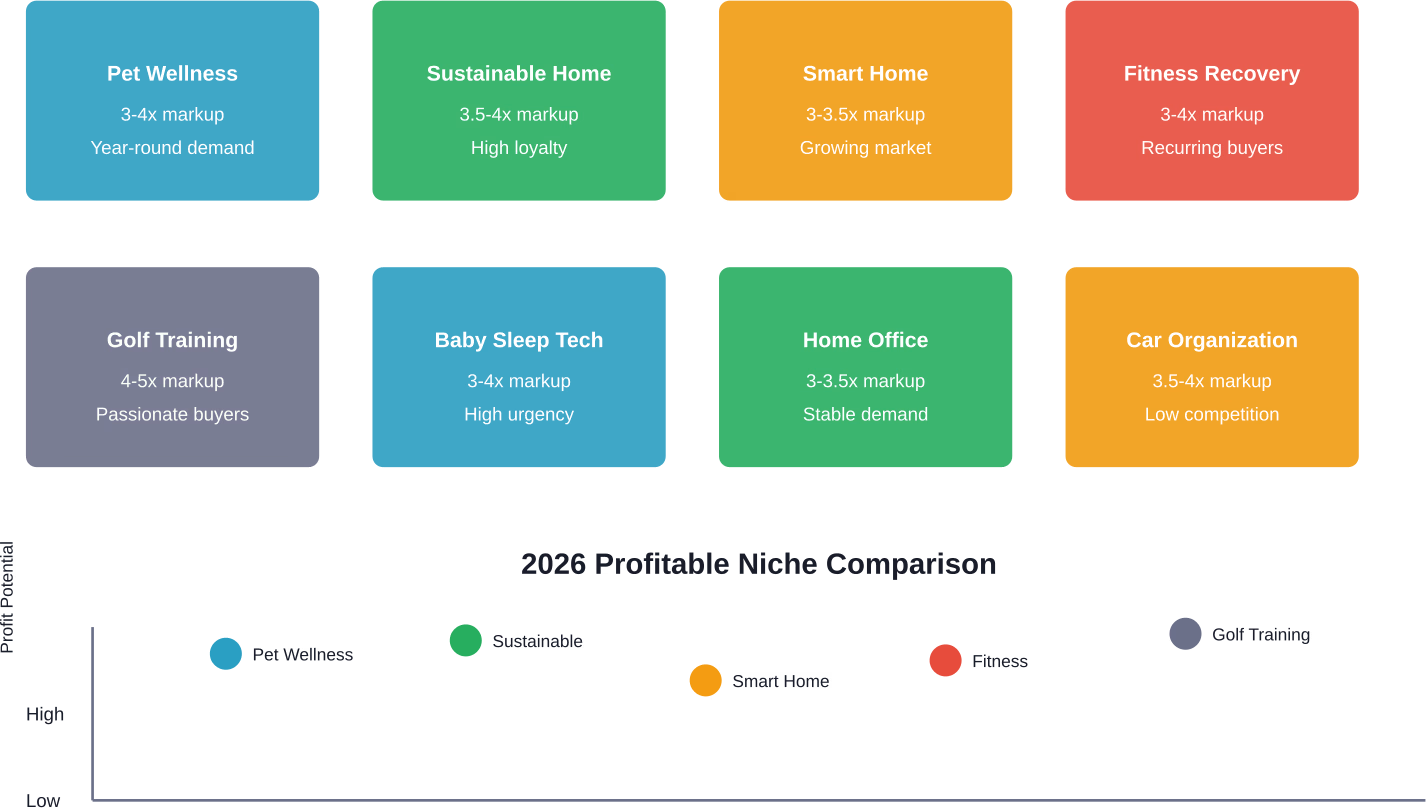
Golf represents the perfect storm for dropshipping. Passionate hobbyists willing to invest in improvement, compact training aids that ship easily, and enough fragmentation that small stores can compete effectively.
Profitable products include swing trainers, putting alignment tools, grip trainers, and practice accessories. These items aren't impulse purchases—golfers research solutions to specific problems in their game and pay accordingly.
Margins run higher here, often 4-5x supplier costs. A $16 alignment training aid retails at $69-79 because golfers view it as cheaper than lessons and essential for practice. The perceived value far exceeds the physical product cost.
The audience is also sticky. Golfers who find a store providing quality training aids often return for other products. The lifetime value of a golf customer significantly exceeds the initial transaction.
New parents represent one of the highest-urgency buyer segments in e-commerce. Sleep-deprived parents trying to get their infant sleeping through the night will pay premium prices for products that might help.
Top products include white noise machines with smart features, swaddles with temperature regulation, crib projectors, and sleep tracking monitors. The key is products positioned around solving the specific nightmare of infant sleep problems.
Typical markups run 3-4x with retail pricing from $35-90. A $20 smart white noise machine retails at $69-79 because exhausted parents care about results, not finding the absolute cheapest option.
The urgency factor is massive. Unlike hobbyists who might browse for weeks, new parents often buy within 24-48 hours of finding a product that promises relief. This dramatically improves conversion rates and reduces advertising costs.
Remote work has permanently expanded the home office market. Millions of people now work from home at least part-time, creating ongoing demand for ergonomic solutions that improve comfort and productivity.
Strong sellers include monitor arms, ergonomic keyboard trays, standing desk converters, cable management systems, and posture-support cushions. These aren't decorative—they solve real discomfort problems for people spending 40+ hours weekly at home workstations.
Margins typically hit 3-3.5x with pricing from $30-80 for most accessories. A $22 ergonomic laptop stand retails at $65-75 positioned around reducing neck strain and improving posture.
The market remains stable rather than explosive, but stability means predictable revenue. Home office products don't have dramatic seasonal swings, making cash flow management significantly easier.
Car accessories represent an underrated dropshipping opportunity. Vehicle owners consistently purchase organization and maintenance products, and the category has far less competition than obvious niches like fashion or electronics.
Profitable products include trunk organization systems, seat gap fillers, magnetic phone mounts, detailing tools, and interior cleaning accessories. The sweet spot is compact items that solve specific frustrations like lost items between seats or cluttered trunks.
Typical markups run 3.5-4x with retail prices from $25-60. A $12 set of trunk organizers retails at $44-49 because the value proposition is maintaining a clean, organized vehicle without permanent modifications.
Competition is surprisingly low relative to search volume. While car parts and major accessories are saturated, organization and detailing tools fly under the radar for most dropshippers chasing trendier niches.
Choosing a niche based purely on blog post recommendations is risky. Validation separates profitable niches from money pits. Start with search volume analysis using tools like Google Keyword Planner or similar platforms to verify people are actually searching for these products.
But search volume alone isn't enough. Check Facebook Ad Library to see who's advertising in the space. Active advertisers signal profitable demand—companies don't spend money on ads for products that don't convert. Look for ads running consistently for 60+ days, which indicates positive return on ad spend.
Next, analyze existing competition. Visit top stores in the niche and assess their positioning, pricing, and product selection. The goal isn't copying—it's understanding what's working and finding gaps. Maybe existing stores focus on budget options, creating opportunity for premium positioning. Or perhaps they're general stores with weak branding, opening the door for specialized expertise.
Test product margins early. Source 3-5 potential bestsellers from suppliers and calculate total landed costs including shipping, payment processing, and estimated return rates. If the numbers don't support the 3x markup rule minimum after all costs, the niche won't work at scale.
The 3x markup rule isn't arbitrary—it's the minimum needed to cover customer acquisition costs and operational expenses while maintaining profit. Here's how it breaks down.
If a supplier charges $10, the retail price needs to hit $30. From that $20 gross profit, roughly $8-12 goes to customer acquisition through paid ads. Another $2-3 covers payment processing fees, customer service, and refunds. That leaves $5-10 in actual profit per transaction.
Now scale this. A store selling 100 units monthly at $5 profit each generates $500. Not exciting. But 1,000 units monthly at $8 profit each? That's $8,000 in monthly profit—enough to build a real business.
The challenge is finding products where buyers accept 3x+ markups. This is why passionate niches outperform commodity products. Nobody pays $30 for a $10 phone cable when Amazon sells it for $12. But golfers absolutely pay $70 for a $16 training aid that might improve their game.
Some niches look promising on paper but fail in practice. Watch for these warning signs before investing time and money.
First, products with frequent returns destroy profitability. Apparel and sizing-dependent items typically see 20-30% return rates, which devastates margins. Stick to products where sizing isn't critical or where returns rarely happen due to quality issues.
Second, extremely heavy or fragile items create shipping nightmares. A $50 product with $30 shipping costs won't convert no matter how good the marketing. And fragile items that break during shipping generate refunds and negative reviews that kill the business.
Third, products requiring extensive customer education or support drain resources. Simple products that customers understand immediately scale far easier than complex items needing detailed setup instructions or ongoing support.
Fourth, products easily available at major retailers for comparable prices can't compete. If Amazon sells the identical item for $5 less with Prime shipping, customer acquisition becomes nearly impossible at profitable costs.
Once the niche is validated, store setup determines whether traffic converts into sales. Niche stores need focused branding that speaks directly to the target audience, not generic e-commerce templates that could sell anything.
Brand positioning starts with understanding buyer motivation. Pet wellness stores should emphasize care and expertise. Golf training stores need to convey performance improvement. Sustainable home stores must communicate environmental values authentically.
Product descriptions can't be generic supplier text copied and pasted. Effective descriptions address specific buyer concerns, explain benefits in outcome-focused language, and overcome objections before they form. A massage gun description focused on "percussion therapy technology" converts worse than one explaining "reduces post-workout soreness so you can train harder tomorrow."
Trust signals matter enormously. New stores lack the review volume and brand recognition of established retailers, so every trust indicator counts. Display security badges, include detailed shipping and return policies, and feature customer service contact information prominently.
Site speed affects conversion rates directly. Understanding consumer behavior is crucial for reducing business risks in market analysis. Slow-loading product pages kill conversions even with perfect products and positioning.
Paid advertising gets initial traction, but content marketing builds long-term authority and reduces customer acquisition costs. A blog answering common niche questions attracts organic search traffic from buyers actively researching solutions.
For pet wellness stores, content around anxiety triggers, training tips, or health concerns brings visitors who eventually convert into customers. Golf training stores benefit from swing tips, practice routines, and equipment guides. The content doesn't need to be revolutionary—it needs to be helpful and relevant.
Video content works exceptionally well for product demonstration. A 60-second video showing how a car organization system installs and functions converts significantly better than photos alone. These videos don't require professional production—smartphone quality works fine if the content is clear and useful.
Email marketing becomes powerful once the store has initial customers. A simple abandoned cart sequence recovers 10-15% of lost sales. Post-purchase sequences offering complementary products drive repeat purchases. Educational content delivered via email builds relationships that increase lifetime value.
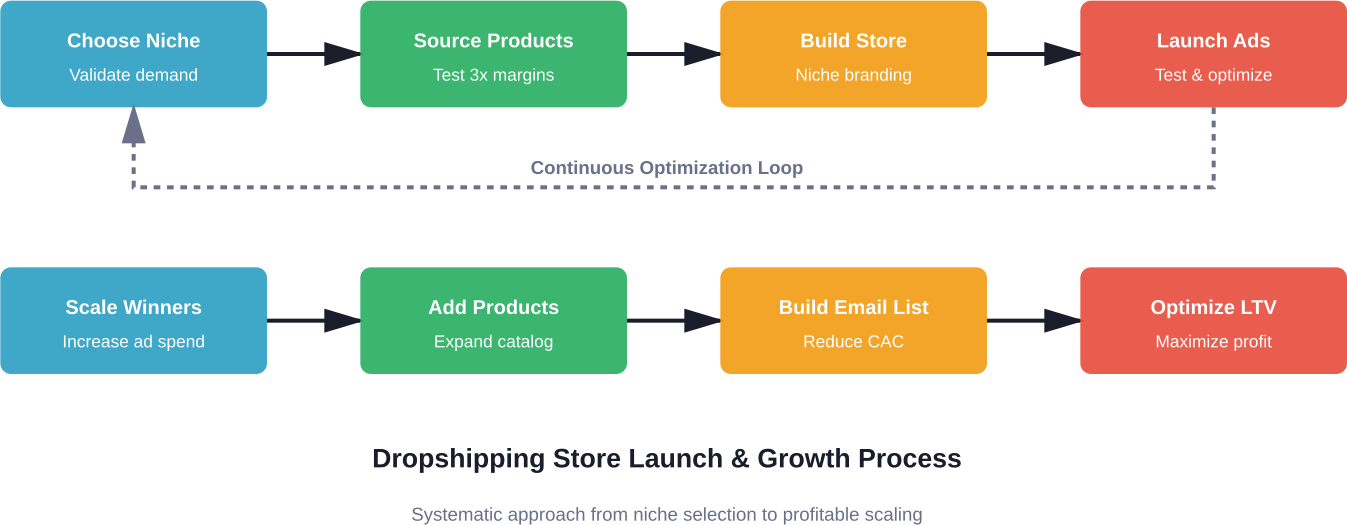
Getting to the first $1,000 in revenue validates the concept. Scaling to $10,000+ monthly requires different strategies focused on efficiency and expansion rather than pure testing.
The first scaling lever is increasing advertising spend on proven winners. Once products demonstrate consistent profitability at small budgets, gradually increase daily ad spend while monitoring return on ad spend closely. A product generating 3x ROAS at $20 daily often maintains similar performance at $100 daily.
Second, expand the product catalog strategically. Add complementary products that existing customers naturally purchase together. A store selling golf alignment aids should add putting trainers and grip tools, not random golf items. The goal is increasing average order value and purchase frequency.
Third, implement email sequences that maximize lifetime value. Welcome sequences for new subscribers, abandoned cart recovery, post-purchase cross-sells, and re-engagement campaigns for past buyers all contribute to extracting more value from existing traffic rather than constantly needing new customers.
Fourth, explore additional traffic sources beyond the initial platform. A store finding success with Facebook ads should test Google Shopping, Pinterest ads, or TikTok depending on the niche and audience. Diversifying traffic sources reduces platform dependency and often uncovers cheaper customer acquisition channels.
Not every niche selection succeeds despite proper validation. Knowing when to pivot versus pushing through rough patches separates successful dropshippers from those who waste months on dying stores.
Consider pivoting if customer acquisition costs remain above 50% of average order value after 60 days of optimization. This indicates fundamental product-market fit problems that won't resolve with minor tweaks. The math simply doesn't work at scale.
Also pivot if return rates exceed 15% consistently. High returns signal product quality issues, misleading marketing, or fundamental mismatches between product and buyer expectations. These problems compound as the store scales.
Push through if the metrics are close but not quite profitable yet. A store with 45% customer acquisition costs and strong repeat purchase signals just needs optimization, not abandonment. Similarly, stores with good margins but low traffic need marketing improvements, not different products.
Time matters too. Most niches need 90-120 days of consistent effort before drawing conclusions. Early struggles often reflect learning curves in advertising and conversion optimization rather than niche problems. But struggling identically at month six as month one signals deeper issues requiring pivots.
Several mistakes kill dropshipping stores before they reach profitability. First, choosing suppliers based purely on price creates quality problems that generate negative reviews and returns. Slightly higher supplier costs mean nothing if products arrive damaged or significantly miss buyer expectations.
Second, neglecting customer service tanks stores fast. Dropshipping delays response to customer inquiries, but buyers don't care about the business model—they want answers. Implementing chat support or quick email response times dramatically improves conversion rates and reduces refund requests.
Third, running identical product descriptions from suppliers hurts both conversion and SEO. These descriptions get duplicated across hundreds of stores, creating zero differentiation and poor search visibility. Unique descriptions addressing specific buyer concerns convert significantly better.
Fourth, launching with insufficient testing budget leads to premature conclusions. A $100 ad test doesn't provide enough data to determine if products or audiences work. Plan for $500-1000 in testing budget to properly evaluate niche viability.
Sustainable dropshipping businesses evolve beyond pure arbitrage. The most successful stores gradually build brand equity, develop supplier relationships that create competitive advantages, and expand into related product categories that increase customer lifetime value.
Brand building starts from day one with consistent visual identity, voice, and customer experience. A store that's just a collection of random products never builds loyalty. But a store positioning itself as the trusted expert in pet anxiety solutions or golf performance improvement creates defensible value.
Supplier relationships improve over time for stores placing consistent orders. Volume creates negotiating power for better pricing, custom packaging, or exclusive products unavailable to competitors. These advantages compound as the business grows.
Some successful dropshippers eventually transition to holding inventory for bestselling products, dramatically improving margins and shipping times. This hybrid model keeps the low-risk benefits of dropshipping for testing new products while capturing the margin benefits of inventory for proven winners.
Others expand into related business models like affiliate marketing, digital products, or even private label once they've built an audience and expertise in the niche. The dropshipping store becomes the foundation for a broader e-commerce ecosystem.
The most profitable dropshipping niches for 2026 share specific characteristics: passionate micro-audiences, year-round demand, products supporting 3x+ markups, and manageable competition. Pet wellness, sustainable home products, smart home accessories, and specialized hobby equipment all fit these criteria.
But success depends less on choosing the "perfect" niche than on proper validation, systematic testing, and relentless optimization. The National Retail Federation projects retail sales growth of 4.4% in 2026, indicating consumer spending remains strong despite economic headwinds. This creates opportunity for focused niche stores delivering real value to specific audiences.
The dropshippers winning in 2026 aren't chasing viral products or copying competitors. They're building branded stores around specific customer problems, testing systematically, and optimizing ruthlessly based on data rather than hunches.
Start by validating one niche thoroughly rather than dabbling in several. Source quality products, build trust through professional branding, and allocate sufficient testing budget to properly evaluate performance. The path to sustainable dropshipping income runs through focused niche expertise, not broad product catalogs competing on price.
Ready to launch? Choose one niche from this list, validate demand through keyword research and competitor analysis, source samples from reliable suppliers, and commit to 90 days of consistent testing and optimization. The stores reaching $10,000+ monthly revenue all started exactly where you are now.


