Best Tools for Facebook Dynamic Ads Management
Top tools for Facebook dynamic ads management to automate product ads, improve targeting, and scale campaigns with better control.
Jan 26, 2026



Opting out of AI resume screening can reduce your chances of getting noticed, as most Fortune 500 companies now use automated systems to filter candidates. While opting out may trigger manual review in some cases, it often results in your application receiving a 'Not Available' score—the same designation given to poorly formatted resumes. For most applicants, staying opted-in and optimizing your resume for AI systems offers better odds than opting out.
The checkbox appears at the bottom of the application form: "Opt out of AI resume review." And suddenly, a simple job application becomes a philosophical dilemma.
Do you trust the algorithm to evaluate your experience fairly? Or do you opt out and hope a human actually sees your resume?
Here's the reality: as many as 98.4% of Fortune 500 companies now leverage AI in their hiring processes. Between 35% and 45% of all companies have adopted some form of automated tool to screen candidates. This isn't a distant future scenario—it's happening right now, and that opt-out checkbox forces job seekers to make a strategic decision with limited information.
The answer isn't simple. But it's also not random.
Before deciding whether to opt out, understanding what happens when AI screens resumes matters.
AI resume screening uses automated software to score and rank applications before any human sees them. These systems parse resumes for specific keywords, skills, education credentials, and experience levels that match the job description. But modern systems go further than simple keyword matching.
Large language models now make inferences about cultural fit, communication style, and even personality traits based on word choice and phrasing. One of the largest Applicant Tracking Systems (ATS) in the world, ADP Workforce Now, assigns "Candidate Relevancy Scores" to applications based on AI analysis of education, skills, and experience.
The process typically flows like this:
The efficiency gains are substantial. According to SHRM research, AI recruitment can reduce cost-per-hire by as much as 30%. Companies report saving significant time—one company saved over a million dollars in a single year by incorporating AI into its interview process.
But here's where it gets messy: Some platforms enable hiring teams to save up to 70% of time on hiring processes, which means recruiters spend far less time reviewing individual applications. When hundreds of candidates apply for a single role, AI screening becomes the gatekeeper that determines who gets human attention.
So what actually occurs when that checkbox gets clicked?
The consequences vary by company and ATS platform. But patterns have emerged from community discussions and industry reports.
When applicants opt out of ADP's AI review system, their application receives a score of "Not Available"—the same designation assigned to applications with poor formatting or technical errors. For roles attracting hundreds of candidates, and recruiters managing impossible workloads, this scoring can be a death sentence.
Think about it from the recruiter's perspective. They're sorting through 300 applications for a single position. The ATS shows 50 candidates with relevancy scores of 85-95, another 100 with scores of 60-80, and 20 applications marked "Not Available." Which group gets reviewed first?
The high scorers. Always.
But wait—doesn't opting out guarantee human review? Not necessarily. Some companies do flag opt-out applications for manual screening. Others simply place them in a lower-priority queue. And some treat "Not Available" scores the same as low scores, effectively filtering them out.
According to 2025 Pew Research Center data, 68% of job seekers now prefer AI initial screening for its perceived neutrality, compared to 2023 when the majority expressed concern. Significant majorities opposed allowing AI to make final hiring decisions, with substantial portions opposing AI use in application review.
Yet opting out doesn't remove AI from the equation—it just changes how AI categorizes the application.
Despite the risks, opting out isn't always the wrong move.
Certain scenarios tilt the calculation in favor of human review:
Career changers, self-taught professionals, and candidates with unconventional backgrounds often confuse AI systems. If experience doesn't map neatly to traditional job titles and credentials, AI algorithms may miss transferable skills that a human recruiter would recognize immediately.
Positions requiring subjective judgment—design portfolios, creative writing samples, strategic thinking—don't always translate well to algorithmic scoring. For roles where qualitative assessment matters more than keyword matching, human evaluation provides better outcomes.
Organizations receiving 20-50 applications per role (rather than 200-500) have more capacity for manual review. If the company is small enough that a real person will likely read every application anyway, opting out carries less downside.
When someone inside the company has already advocated for a candidate, opting out can signal confidence that the application will receive direct attention. The internal champion becomes the screening mechanism, not the AI.
Research from the University of Washington found significant racial, gender, and intersectional bias in how three state-of-the-art large language models ranked resumes. The systems preferred white-associated names 85% of the time versus Black-associated names 9% of the time, and male-associated names 52% of the time versus female-associated names 11% of the time.
For candidates who suspect AI bias may work against them based on documented patterns—opting out becomes a calculated risk worth considering.
Real talk: for most applicants, staying opted-in offers better odds.
The math is straightforward. AI screening has become the default filtering mechanism at the vast majority of large employers. By some estimates, as many as 83% of employers and up to 99% of Fortune 500 companies now use some form of automated tool to manage candidate flow.
Opting out doesn't guarantee human review—it guarantees a "Not Available" score. And "Not Available" sits at the bottom of the priority queue.
But there's another angle. AI systems, while imperfect, do offer consistency. They apply the same criteria to every application. A human recruiter having a bad day might skim a resume in 10 seconds and miss key qualifications. An AI system won't have a bad day—it will parse every line with the same mechanical attention.
The efficiency argument cuts both ways. Industry research indicates employers believe significant numbers of qualified candidates are filtered out due to ATS-unfriendly resume formatting. Research indicates AI screening can be reductive, potentially filtering out candidates who would excel in roles but didn't phrase their experience in system-friendly language.
That's a fixable problem. Resume optimization is learnable. Opting out and hoping for the best is just hope.
What legal protections exist for candidates facing AI screening?
The regulatory landscape has evolved, but enforcement remains inconsistent. The U.S. Equal Employment Opportunity Commission (EEOC) has held public meetings on navigating employment discrimination in AI and automated systems, calling it a "new civil rights frontier."
According to EEOC testimony, increasingly automated systems are used in all aspects of employment—from recruiting and interviewing to hiring, evaluations, and promotions. By some estimates, as many as 83% of employers now use some form of automated tool to screen candidates.
The legal framework centers on existing anti-discrimination laws. If AI systems produce discriminatory outcomes—even unintentionally—employers can face liability under Title VII of the Civil Rights Act, the Americans with Disabilities Act, and other employment laws.
Key protections include:
But here's the gap: few laws require companies to treat opt-out applications any particular way. The right to opt out exists in many systems. The right to equivalent treatment after opting out? That's murkier.
According to SHRM research, nearly one in four organizations reported using automation or artificial intelligence to support HR-related activities. Yet regulatory frameworks haven't kept pace with adoption rates. Candidates have limited recourse if opting out leads to disadvantageous treatment, unless they can prove intentional discrimination.
If staying opted-in is the strategic choice for most candidates, making resumes AI-friendly becomes critical.
These tactics improve AI scoring without sacrificing human readability:
AI systems compare resume content against job postings. Use the exact terminology from the job description. If the posting says "project management," use "project management" rather than "managed initiatives." If it specifies "Python," list "Python" explicitly rather than burying it in a project description.
Creative headings like "Where I've Made My Mark" confuse parsing algorithms. Stick with conventional labels: Work Experience, Education, Skills, Certifications. ATS platforms are trained to recognize standard formats.
A dedicated Skills section packed with relevant technical competencies, tools, and methodologies gives AI systems clear matching points. List both acronyms and full terms: "SEO (Search Engine Optimization)" rather than just one or the other.
Tables, text boxes, headers, footers, and graphics often break ATS parsing. Use simple formatting: standard fonts, clear bullet points, consistent spacing. Save the designer resume for PDF portfolios, not ATS submissions.
AI systems recognize numbers and metrics as achievement indicators. "Increased sales by 32%" scores better than "significantly improved sales performance." Specific percentages, dollar amounts, and scale indicators boost relevance scores.
Different companies use different terminology for the same skills. Include variations: "customer service" and "client relations," "agile methodology" and "scrum framework." This broadens matching opportunities without keyword stuffing.
Job seekers have developed creative workarounds to game AI systems. But do these tactics deliver results?
The theory: add keywords in white font so AI sees them but humans don't. The reality: modern ATS platforms detect this technique and flag applications for potential fraud. Some systems automatically reject applications with hidden text. Not worth the risk.
Similar concept—paste the full job posting into the resume in white or tiny font. Same problem: sophisticated systems catch this. And if a human does review it (many systems convert to plain text for review), it looks terrible.
Submitting both a keyword-optimized version and a visually appealing version. Some platforms allow multiple attachments, but this can backfire if only the first document gets parsed. Consistency across all submitted materials works better.
This one actually has merit. A comprehensive skills section with relevant technologies, methodologies, and competencies gives AI systems legitimate matching points. As long as the skills are genuine and defensible in an interview, this approach improves scoring without deception.
The most effective strategy? Bypass automated systems altogether.
These approaches circumvent AI screening without relying on that opt-out checkbox:
Employee referrals typically skip initial AI screening or receive preferential scoring. Building relationships with people inside target companies creates pathways that don't depend on algorithmic approval. Referrals are widely recognized as producing high-quality candidates.
Reaching out directly to hiring managers or recruiters on LinkedIn before applying creates human connection before AI evaluation. When a recruiter recognizes a name in the system, that application gets attention regardless of AI scoring.
Job fairs, networking events, and company-hosted recruiting sessions provide face-to-face interaction. Candidates who make positive impressions at these events often have their applications flagged for review, effectively overriding AI filters.
For creative, technical, or strategic roles, leading with work samples rather than resumes shifts evaluation criteria. Sharing a portfolio, writing sample, or project demo establishes credibility before any AI system evaluates credentials.
Organizations with less sophisticated ATS implementations or lower application volumes rely more on human review. Targeting companies with 50-500 employees rather than Fortune 500 corporations reduces AI screening intensity.
Is any of this actually fair?
Research from the University of Washington and Brookings Institution examined gender, race, and intersectional bias in AI resume screening via large language models. The findings were stark. Systems demonstrated clear preference patterns along demographic lines, even when resumes contained identical qualifications.
According to testimony before the EEOC, cost-effectiveness drives AI adoption. Some platforms enable businesses to source, screen, and onboard workers faster, with some companies claiming up to 70% time savings on hiring. More than 24,000 businesses use automated screening platforms, with some reporting up to 70% time savings on hiring processes.
But as one EEOC witness noted, cost-effectiveness cannot drive employment decision-making if it results in discrimination. The legal standard is clear even if enforcement mechanisms lag behind technological adoption.
The ethical tension is real. AI screening offers speed and scale. It also perpetuates historical biases embedded in training data. Nearly one in four organizations now report using AI in HR activities, yet algorithmic auditing and bias testing remain inconsistent.
From the candidate perspective, the fairness question has no satisfying answer. Opting out might avoid algorithmic bias, but it trades one form of disadvantage for another—deprioritization in overwhelmed recruiting queues.
The system isn't fair. But understanding how it works provides more agency than refusing to engage with it.
So should you click that opt-out checkbox?
For most candidates applying to large employers with high application volumes, staying opted-in and optimizing for AI screening maximizes chances of advancing. The risks of receiving a "Not Available" score outweigh the potential benefits of human review—especially when human review isn't guaranteed.
Opt out when:
Stay opted-in when:
The decision isn't about what's fair or what should work. It's about what actually works given current hiring infrastructure. AI screening has become the default gatekeeper at most large organizations. Fighting that reality by opting out doesn't change the system—it just changes how the system categorizes individual applications.
Optimize for AI. Build networks to bypass AI. But don't rely on opt-out checkboxes to guarantee better treatment.
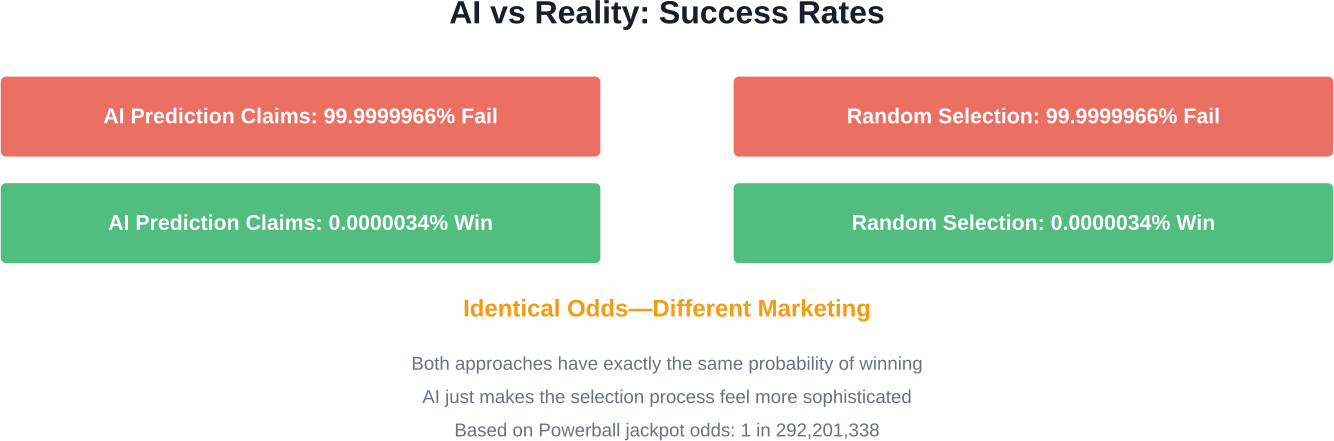
AI resume screening isn't going away. As many as 98.4% of Fortune 500 companies now use automated systems in their hiring processes, and adoption continues growing across companies of all sizes.
The opt-out checkbox offers an illusion of control. But opting out doesn't guarantee human review—it typically results in a "Not Available" score that places applications in lower-priority queues. For most candidates at most companies, staying opted-in and optimizing resumes for AI systems provides better odds of advancing.
The more effective strategy focuses on bypassing AI screening entirely through network referrals, direct recruiter contact, and portfolio-first approaches. Building human connections creates pathways that don't depend on algorithmic approval.
When AI screening is unavoidable, optimization matters. Use job description keywords verbatim. Stick with standard formatting and section headings. Quantify achievements with specific metrics. Include comprehensive skills sections with relevant technologies and methodologies.
The system has problems. Bias exists. Discrimination happens. Qualified candidates get filtered out. But understanding how AI screening actually works—and making strategic decisions based on that reality—gives job seekers more agency than passive hope that opting out will fix broken processes.
The fairness question remains unresolved. The strategic question has clearer answers: optimize for the systems that exist while building relationships that transcend them.
Ready to optimize your resume for AI screening? Start by analyzing job descriptions for keyword patterns, reformatting for ATS compatibility, and reaching out to connections at target companies. The opt-out checkbox is a distraction. The real work is making yourself visible—whether algorithms are watching or not.


