Best Meta Ads Agencies in New York: How to Choose the Right One
Looking for the best Meta ads agency in New York? Learn what actually separates high-performing agencies from expensive guesswork.
Mar 24, 2026



If you search for how many merchants Shopify has, you will see a lot of numbers. Millions of stores. Millions of users. Millions of websites. The problem is that these figures are often talking about different things, even when they sound similar.
Some sources count every store ever created. Others focus only on active merchants who are actually using the platform. A few mix both without explaining the difference. That is how confusion starts.
In this article, we break down what Shopify actually means by “merchant,” how many merchants the platform supports today, and why the real number depends on how you look at activity, not just scale.
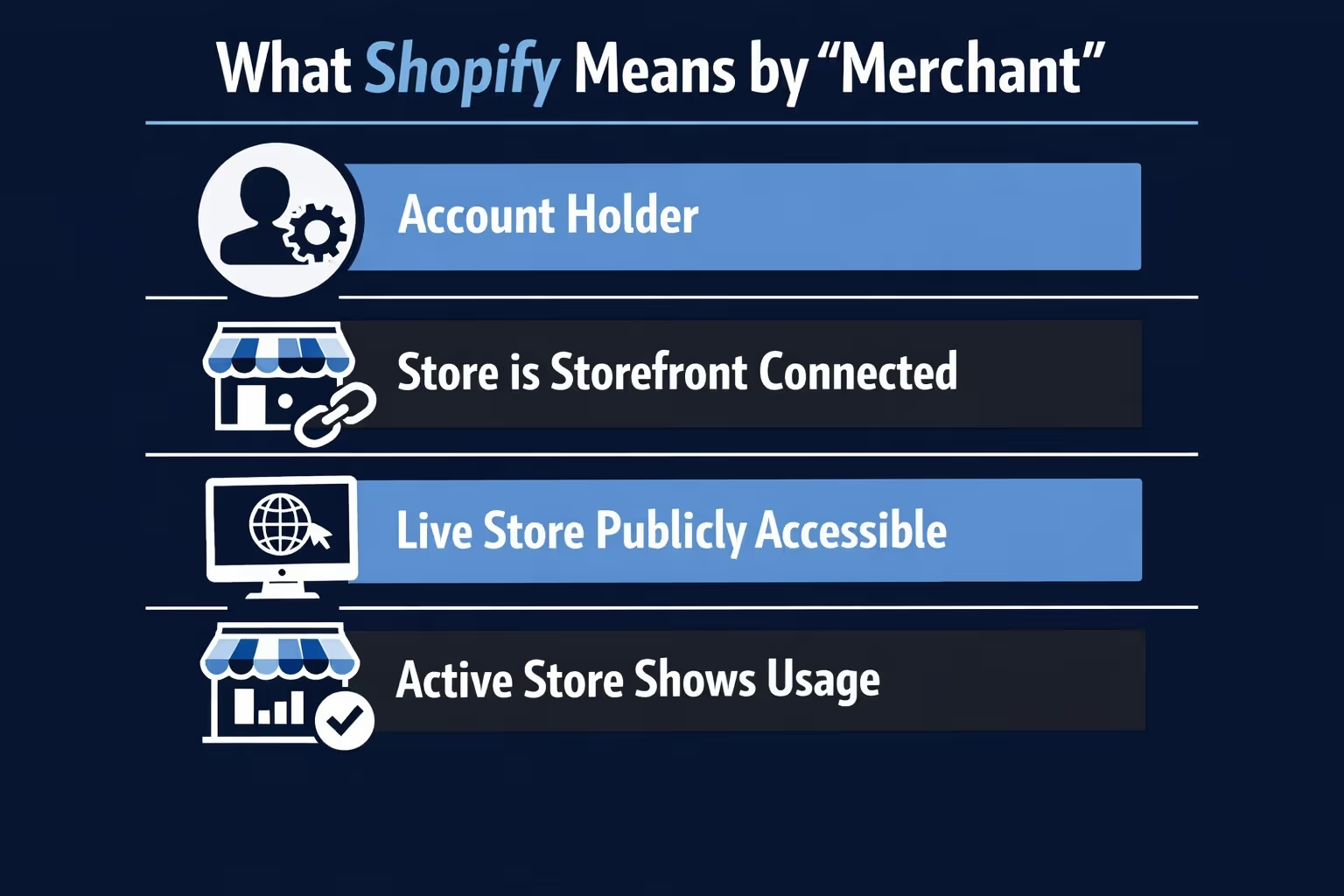
Before touching any numbers, it is important to understand how Shopify uses the word merchant.
In Shopify’s own language, a merchant is an individual or business that pays for and operates a Shopify account. That account may run one store or several. It may be live, paused, private, or used only internally. The merchant exists as long as the account exists and shows activity of some kind.
This creates a key distinction:
Many articles blur these definitions. That is where confusion begins.
Based on the most recent aggregated data from Shopify disclosures, platform analysis tools, and market research sources used in the articles you shared, Shopify’s ecosystem in 2025 to early 2026 looks roughly like this:
Each of these numbers answers a different question. None of them are wrong on their own. They simply describe different slices of the same system.

As Shopify continues to grow, competition for attention and ad spend gets tougher. Guessing what will work is expensive. That is the gap we built Extuitive to close.
We help Shopify brands predict how their ads will perform before launch. Using AI models trained on real campaign outcomes, our platform forecasts performance in advance, so teams can stop testing losing ideas and focus on what is most likely to win. Instead of relying on generic benchmarks, predictions are measured against each brand’s own historical averages and top performers.
We also support smarter audience targeting. By combining creative performance forecasts with audience insights, brands can reach shoppers who are more likely to convert, improving CTR and ROAS without increasing spend. For teams running ads at scale, this means faster decisions, fewer failed launches, and better use of budget.
In a crowded Shopify ecosystem, we replace guesswork with clarity.
One of the most common misconceptions is assuming that every Shopify merchant equals one live store. That has never been how the platform works.
Many merchants operate multiple storefronts under a single account. Some run separate stores for different regions or brands. Others keep development or staging stores that are never meant to be public. There are also merchants who pause sales seasonally, temporarily take a store offline, or shut down a storefront while keeping the account open for future use or internal access.
Because of this, Shopify often reports more merchants than publicly visible stores. A merchant represents a person or business with an active account, while a store represents a storefront connected to that account. Not all storefronts are meant to be public, and not all merchants are actively selling at all times.
This structural difference explains why some datasets show millions of merchants while others report only a few million live stores.
Shopify’s merchant base did not grow in a straight line.
Early growth between 2014 and 2018 was steady but modest. The platform appealed mainly to small businesses and early DTC brands. By 2019, Shopify supported just over 1 million merchants.
Then came a sharp acceleration.
Between 2020 and 2022, merchant growth surged. Lockdowns pushed businesses online, side projects turned into stores, and Shopify’s low barrier to entry made it an obvious choice. Merchant counts more than doubled in a short period.
After 2022, the picture changed again.
Store creation remained high, but churn increased. Many short-lived stores shut down. Shopify began cleaning up inactive or abandoned storefronts from public datasets. As a result, some tracking tools showed sudden drops in live store counts, even though merchant accounts remained active.
This explains why some articles describe massive growth, while others talk about decline. They are often measuring different layers of the same ecosystem.
This distinction matters more than it seems, especially when merchant numbers are used to judge Shopify’s real scale.
A live store is easy to spot. Crawlers can detect it, and tracking tools can count it. But a visible storefront does not automatically mean there is a serious or sustainable business behind it. Many live stores never move beyond testing, soft launches, or short-lived experiments.
An active merchant is harder to see from the outside, but usually shows clear signs of real usage inside the platform. This can include regular logins to the Shopify admin, ongoing app usage or billing activity, completed transactions or test orders, and frequent changes to store settings, products, or configurations.
These signals indicate that a business is actually working with the platform, even if the storefront itself is not always public.
Shopify tends to focus more on active merchants than on live storefronts when evaluating its own business health. Active merchants are the ones who pay subscription fees, use merchant services like payments and shipping, and remain engaged over time. They are also far more likely to upgrade plans, adopt new features, and contribute to long-term revenue.
From this perspective, the most realistic current estimate places Shopify’s active merchant base at just under 5 million worldwide.
Shopify merchants operate in more than 175 countries, but the distribution is not even.
North America remains the largest region by far. Over half of all Shopify merchants are based in the United States and Canada combined. The US alone still accounts for the single largest share, even after recent cleanups in store tracking data.
Europe, the Middle East, and Africa make up the second-largest group. Growth here has been steady rather than explosive, with strong adoption in the UK, France, Germany, the Netherlands, and parts of Eastern Europe.
Asia-Pacific has become one of the fastest-growing regions. India stands out in particular, showing consistent increases in merchant counts year over year. This growth is driven by digital-first businesses, improved local payment support, and Shopify’s expansion into cross-border selling tools.
Latin America remains smaller by comparison but shows signs of gradual adoption, especially in Brazil and Mexico.
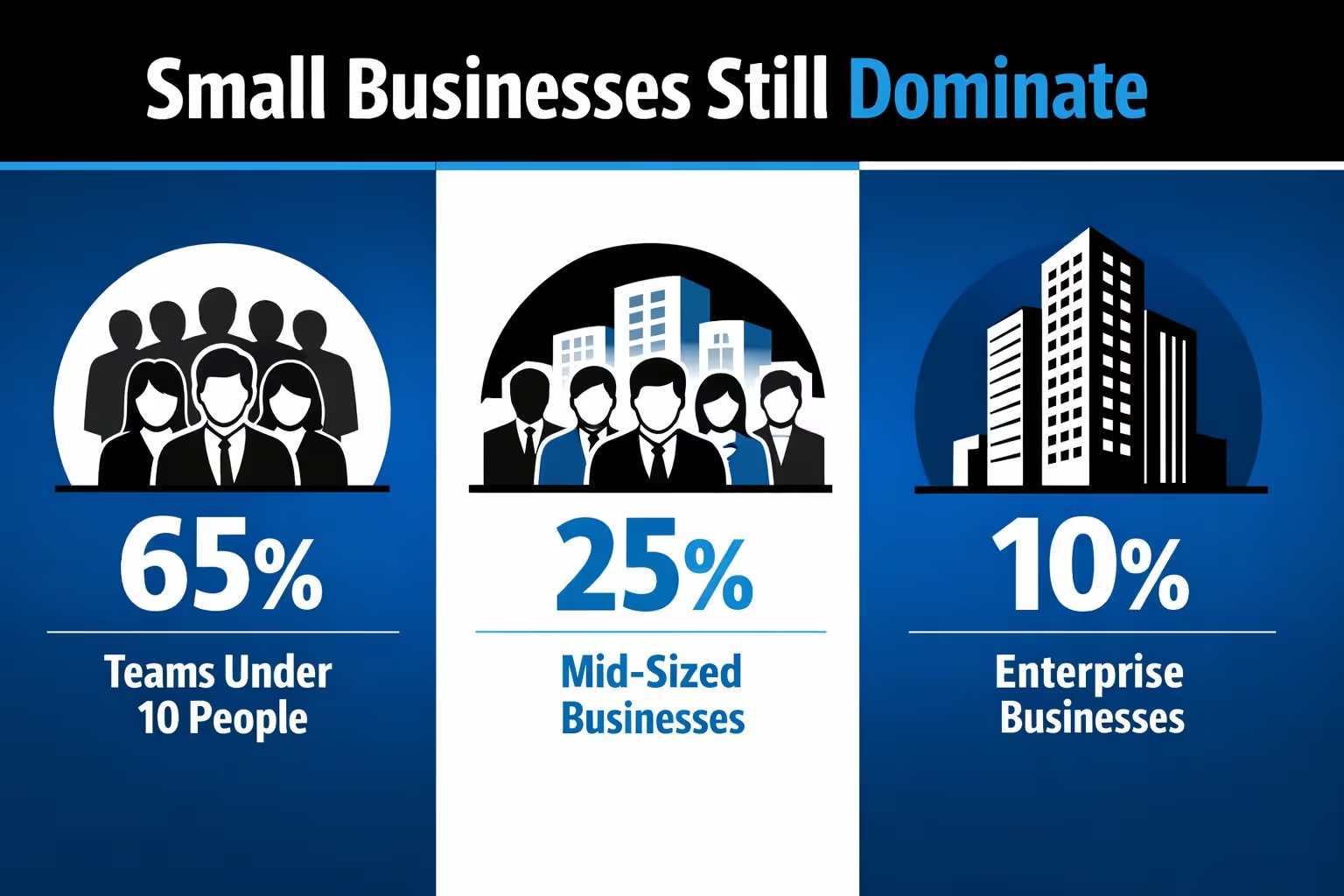
Despite Shopify Plus and enterprise features getting more attention, most Shopify merchants are still small operators.
Roughly:
This has not changed dramatically over time. What has changed is how many of those small merchants stay active long term.
The barrier to starting a Shopify store is low. The barrier to sustaining one is much higher. That gap explains why merchant counts continue to rise even as live store counts fluctuate.
Shopify Plus merchants deserve special mention because they often distort how people perceive the platform’s overall scale.
In purely numerical terms, Plus merchants make up a very small share of Shopify’s total merchant base. Even at around 50,000 users, they represent roughly 1 percent of all merchants on the platform. From a distance, that can make Plus seem insignificant.
Economically, the opposite is true. Shopify Plus accounts for a disproportionate share of total gross merchandise volume. These merchants tend to operate high-volume direct-to-consumer brands, manage multi-region storefronts, and run complex B2B or wholesale operations that require advanced customization. Many rely on custom integrations, automation, and tailored workflows to support their scale.
When Shopify discusses enterprise adoption, growth in merchant services revenue, or partnerships with large brands, Plus merchants are usually the point of reference. That said, they are not representative of the typical Shopify merchant, who is far more likely to be a small or mid-sized business.
Merchant growth and revenue growth are related, but not directly proportional.
Shopify generates revenue through two main streams:
A large number of small merchants can drive subscription revenue but contribute relatively little to GMV. A smaller number of large merchants can generate significant transaction volume and services revenue.
This is why Shopify can continue growing revenue even during periods when live store counts appear flat or declining. The platform is retaining higher-quality merchants, not just more merchants.
This is the hardest question to answer precisely.
Not every active merchant is currently selling products. Some are preparing a launch. Others operate seasonally. Some run internal or private stores.
Based on available data and patterns across multiple studies, a realistic estimate is that:
This aligns with the observed gap between active merchant counts and live store counts.
One uncomfortable truth about Shopify is that most merchants do not succeed long term.
Multiple datasets suggest that only 5 to 10 percent of Shopify merchants reach sustained profitability. Many close within the first year. Others operate intermittently.
This is not unique to Shopify. It reflects the broader reality of ecommerce.
What Shopify provides is access. What merchants bring is execution. The platform’s merchant count includes both.
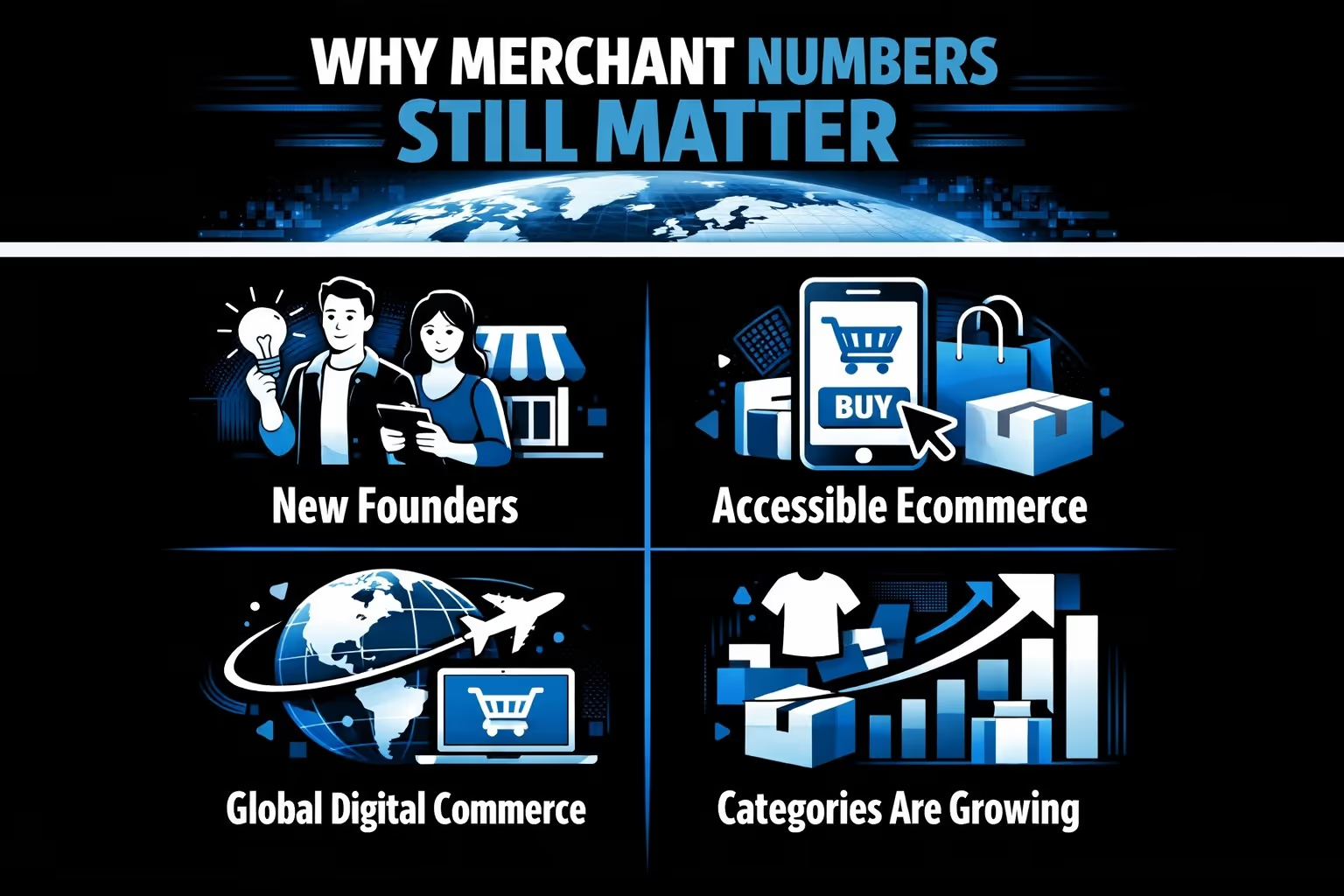
Even with high churn and a large share of short-lived stores, Shopify’s merchant count remains a meaningful signal when interpreted correctly. On its own, the number does not tell the full story, but it does point to important shifts in how online commerce is evolving.
It helps explain several broader trends:
Used carefully, merchant data helps reveal long-term patterns and emerging opportunities. Used carelessly, without context or clear definitions, it creates noise and misleading conclusions.
So how many merchants does Shopify have?
The most honest answer is that it depends on what you mean by merchant.
If you mean accounts that exist and show activity, the number is close to 5 million. If you mean stores that are live and selling today, the number is much smaller. If you mean businesses generating meaningful revenue, the number is smaller still.
Shopify’s scale is real, but it is layered. Once you understand those layers, the numbers stop being confusing and start being useful.
And that is the difference between reading statistics and actually understanding them.


