Best Enterprise Facebook Ads Reporting Tools for Serious Teams
An expert looks at the best enterprise Facebook ads reporting tools for teams that need accurate data, scale, and real attribution.
Jan 26, 2026



Modern AI can read cursive handwriting with high accuracy using deep learning and specialized OCR models. Tools like Transkribus and advanced vision-language models achieve character error rates as low as 1.4% on cursive text. While cursive poses unique challenges compared to printed text, the claim that AI cannot read cursive is false.
The internet loves a good conspiracy theory. One that's been making the rounds claims schools stopped teaching cursive specifically because AI can't read it. The implication? Writing in cursive somehow protects your privacy from digital surveillance.
Sounds compelling. But here's the thing—it's demonstrably false.
AI can absolutely read cursive handwriting. And it's getting better at it every year.
According to research published on arXiv, deep learning models leveraging multi-head attention mechanisms achieved a character error rate (CER) of 1.4% on medicine extraction from handwritten prescriptions. That's a 98.6% accuracy rate on messy, connected handwriting that even humans struggle to decipher.
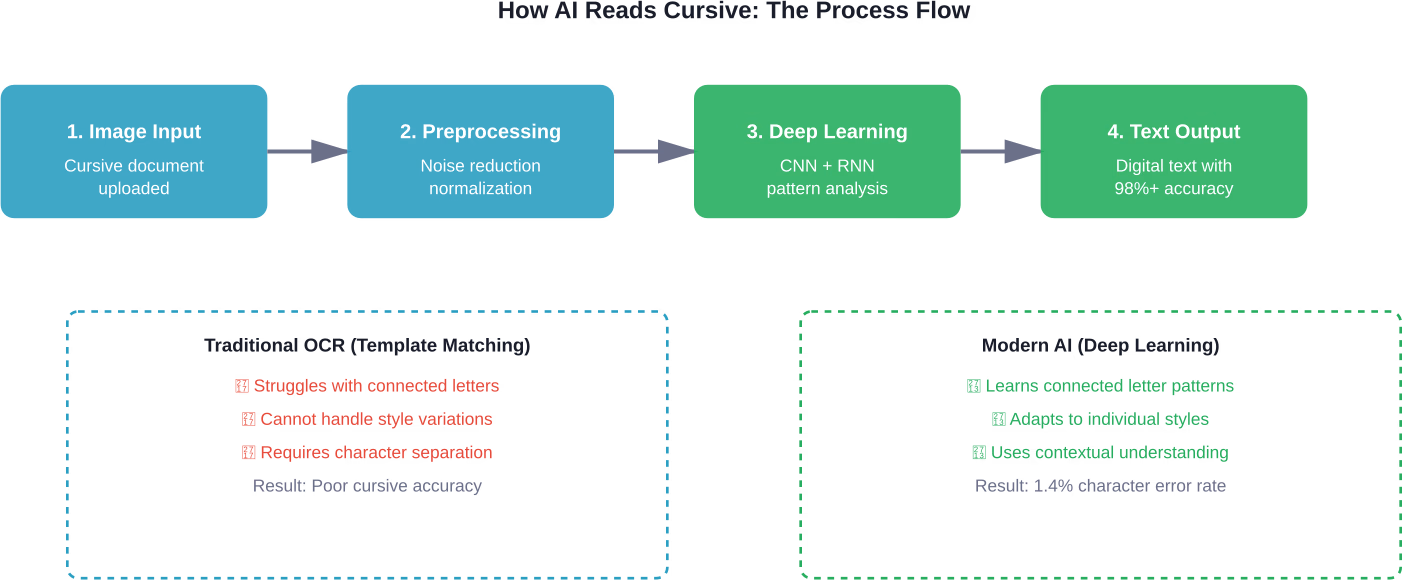
The claim isn't entirely baseless. Traditional optical character recognition (OCR) systems—the kind that power basic document scanners—do struggle with cursive.
These older systems relied on template matching. They worked by comparing each character against a database of known letter shapes. Printed text? Perfect. But cursive, where letters connect and flow together, broke this approach completely.
So for decades, cursive was harder for computers to read than print.
That changed with deep learning.
Modern handwriting recognition doesn't try to match individual letters. Instead, it learns patterns.
Deep learning models—specifically convolutional neural networks (CNNs) and recurrent neural networks (RNNs)—analyze entire words or phrases. They recognize the flowing, connected nature of cursive as a feature, not a bug.
Here's how the process works:
Research documented in handwritten text recognition surveys shows these models don't just match letters—they learn handwriting. They understand that a cursive 'a' connected to an 'n' looks different from a standalone 'a'.
And they adapt to individual writing styles.
Several platforms now offer cursive handwriting recognition as a standard feature.
Transkribus is arguably the most specialized cursive converter available. It was designed specifically for historical documents—letters, manuscripts, and archives written in cursive scripts that even native speakers struggle to read.
The platform offers 300+ public AI models trained on different cursive styles, including historical scripts like Kurrent and Sütterlin. Users can upload photos of cursive handwriting, and the AI converts it to digital text in seconds.
What sets Transkribus apart is customization. Organizations can train the AI on their specific cursive handwriting, improving accuracy for unique writing styles. The platform supports 100+ languages.
According to documentation from Hugging Face, the latest generation of vision-language models excel at OCR tasks, including cursive recognition.
Models like PP-OCRv5 and specialized handwriting recognition systems use multi-head attention mechanisms to process cursive text. These aren't general-purpose tools—they're designed specifically for document analysis.
Research comparing models like Aya-Vision-8B and Qwen2VL-OCR-2B shows that even smaller 2B-parameter models can handle messy handwriting effectively. The technology has become accessible enough that developers can integrate cursive recognition into applications without massive computational resources.
That said, cursive isn't a solved problem.
AI handwriting recognition works remarkably well on consistent handwriting. But extremely messy or idiosyncratic cursive can still trip up even advanced models.
Here are the remaining challenges:
According to academic research on handwritten text recognition, personalized adaptation remains an active area of development. The MetaWriter approach uses meta-learning and prompt tuning to adapt models to individual handwriting styles using less than 1% of model parameters—but this still requires test-time examples.
So if AI can read cursive, why does the myth persist?
A few reasons:
Beyond debunking myths, cursive recognition technology has real-world applications that matter.
The short answer? Not really.
If your concern is avoiding automated surveillance or data harvesting, cursive handwriting won't protect you. Any organization with the resources to conduct mass surveillance also has access to handwriting recognition technology.
That said, cursive does offer some practical obscurity:
But this is security through obsolescence, not design. It's like hiding valuables in a VCR—sure, a burglar might not recognize it, but that doesn't make it a safe.
AI can absolutely read cursive handwriting. Not just theoretically—practically, accurately, and at scale.
The technology isn't perfect. Extremely messy handwriting, rare historical scripts, or inconsistent writing styles can still pose challenges. But modern deep learning models achieve character error rates as low as 1.4% on cursive text benchmarks.
The claim that schools eliminated cursive to help AI surveillance doesn't hold up to scrutiny. Cursive instruction declined for educational policy reasons unrelated to technology. And even if it were true, the premise is backwards—AI cursive recognition has improved despite cursive becoming less common, not because of it.
So what does this mean practically?
If you're digitizing historical documents, personal letters, or archival materials, specialized tools like Transkribus can convert cursive to searchable text efficiently. If you're worried about privacy, cursive won't protect you from determined surveillance—but it might stop casual automated scanning.
And if you see someone claiming cursive is an "AI-proof" communication method? You can confidently tell them the technology has already solved that problem.
The real story here isn't about what AI can't do. It's about how quickly machine learning surpassed human assumptions about what's possible. Template-matching OCR couldn't read cursive. Deep learning models can. That gap between old and new technology created the myth.
But the myth is exactly that—a myth. Modern AI reads cursive just fine.


