How to Speed Up Your Shopify Website the Right Way
Learn how to speed up your Shopify website with practical fixes that improve load time, user experience, and conversions.
Jan 27, 2026



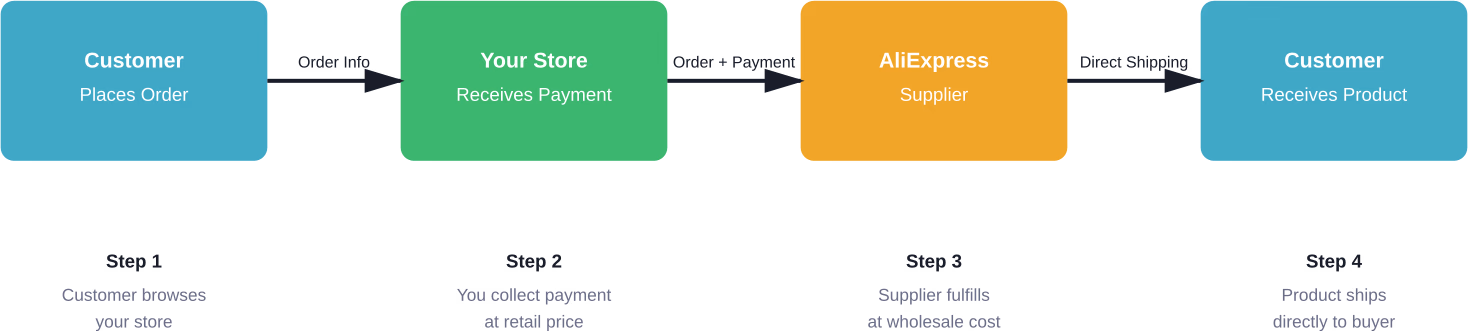
AliExpress dropshipping is a business model where sellers list products from AliExpress suppliers on their online store without holding inventory. When a customer makes a purchase, the supplier ships directly to the buyer. Tools like DSers automate order processing, allowing sellers to place bulk orders in seconds and manage multiple stores from one account.
The dropshipping model has transformed how people start online businesses. No warehouses. No inventory headaches. Just you, a laptop, and access to millions of products ready to ship worldwide.
AliExpress has become the go-to marketplace for dropshippers, connecting sellers with over 300,000 suppliers and more than 100 million items. But here's the thing—success isn't just about listing random products and waiting for money to roll in.
The landscape has matured significantly. What worked in 2020 won't necessarily work now. Competition has intensified, customer expectations have risen, and the tools available have become far more sophisticated.
AliExpress dropshipping is a retail fulfillment method where store owners sell products without keeping them in stock. Instead, when a customer places an order, the seller purchases the item from a third-party supplier on AliExpress who then ships it directly to the customer.
The profit comes from the markup. A product costs $5 from the supplier, sells for $25 in your store, and the $20 difference minus platform fees equals your margin.
According to research from academic institutions, dropshipping allows entrepreneurs to run successful businesses without the hassle of managing inventory, warehousing, or shipping. The supplier handles manufacturing, packaging, and fulfillment while the seller focuses on marketing and customer service.
Real talk: This model isn't passive income. It requires active management, smart product selection, and excellent customer communication.
The workflow is straightforward but requires coordination between multiple platforms. First, sellers create an online store using platforms like Shopify or WooCommerce. Then they import products from AliExpress using automation tools.
When an order comes through, the seller places the same order with the AliExpress supplier, entering the customer's shipping information. The supplier packages and ships the product directly to the end customer.
The seller never touches the physical product. This eliminates storage costs and reduces startup capital requirements significantly.

AliExpress gives you access to thousands of products, but it doesn’t tell you which ones will actually sell. A product can look great on the supplier page and still fail once you start driving traffic. Most of the time, you only see that after spending on ads.
Extuitive focuses on that exact moment. It analyzes different ad creatives and product angles to estimate how people are likely to respond before you launch campaigns. That makes it easier to spot weak ideas early and avoid putting money behind something that won’t convert. If you’re sourcing from AliExpress, don’t wait for ad results to figure things out. Check your creative ideas with Extuitive first and move forward with the ones that show real potential.
Running a dropshipping business manually would be chaos. Imagine copying product details one by one, then logging into AliExpress for every single order. That's where automation tools become critical.
DSers is the whitelisted, official e-commerce solution for AliExpress dropshipping. It integrates directly with Shopify and WooCommerce, allowing sellers to manage their entire operation from one dashboard.
The platform can process bulk orders to AliExpress and make payments in batches. Instead of placing orders individually, DSers place 100s of orders with one click in seconds. This becomes essential when scaling beyond a few sales per day.
Over 4.5 million dropshipping users have leveraged DSers to start and scale ecommerce stores. The tool finds multiple AliExpress supplier options for a single product in one click, giving sellers flexibility to choose based on price, shipping time, and supplier ratings.
Key features include automatic stock and price updates, bulk order placement, automation for tracking order and package status, and the ability to manage multiple Shopify stores from one account.
DSers offers a free plan, making it accessible for beginners testing the waters. According to the Shopify App Store, DSers maintains a 4.9 rating with 5,391 reviews, and 98% of those ratings are 5 stars.
AliDropship positions itself as a turnkey solution, offering ready-to-sell stores that can launch in minutes. The platform emphasizes that no technical skills are needed and provides a free trial for testing.
CG Dropshipping, mentioned in academic research from An-Najah University, offers a wide range of products from countless categories and cooperates with hundreds of factories and suppliers. It allows brand customization, giving businesses a unique advantage in a crowded market.
Product selection makes or breaks a dropshipping business. Selling low-margin commodities results in razor-thin profits that evaporate with advertising costs. The goal is finding products with healthy margins in growing niches.
AliExpress's official channel connects sellers to more than 100 million items and 300,000 suppliers. But that massive selection becomes overwhelming without a systematic approach.
According to AliExpress's official business resources, certain niches consistently deliver higher profit margins. These typically involve products where perceived value exceeds manufacturing cost, or where customers prioritize quality and convenience over rock-bottom prices.
Generally speaking, successful dropshippers focus on specific niches rather than trying to be a general store competing with Amazon. Specialization builds brand authority and attracts targeted audiences more likely to convert.
According to discussions found in search results, experienced dropshippers prioritize supplier reliability over absolute lowest cost. A supplier who consistently ships on time and maintains quality standards is worth paying slightly more for.
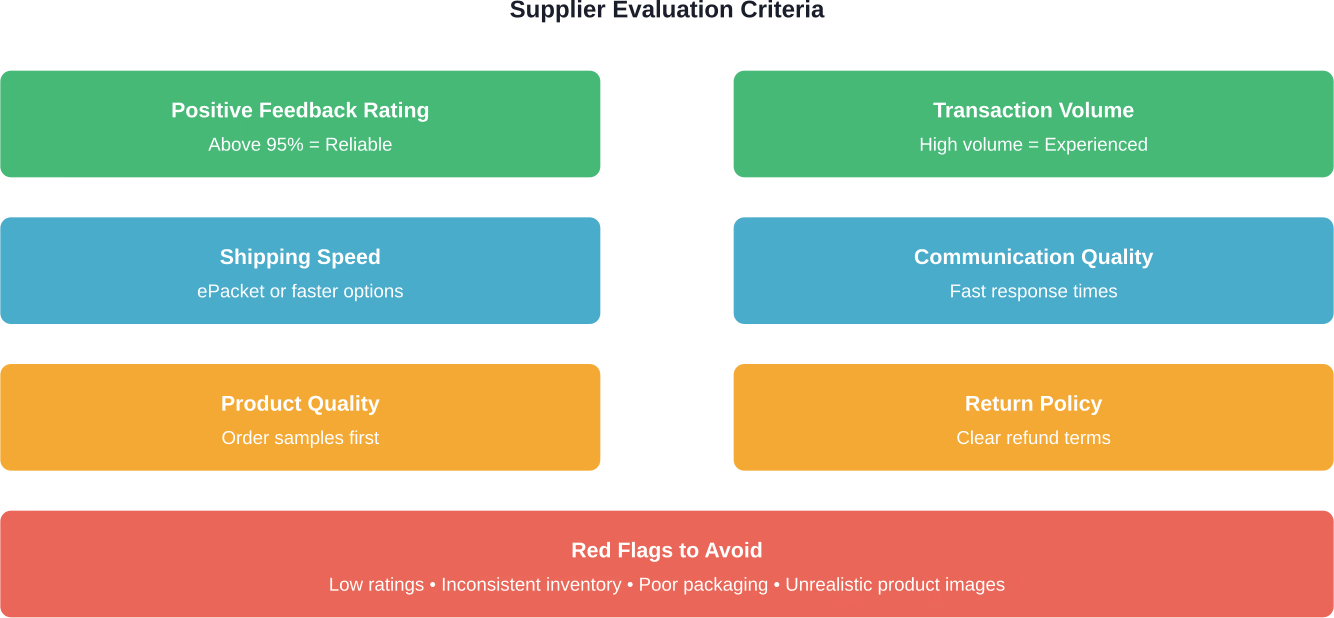
Not all AliExpress suppliers are created equal. Some ship promptly with excellent packaging, while others cause headaches with delays and poor product quality.
Look for suppliers with high transaction volumes, positive feedback ratings above 95%, and good communication scores. Many dropshippers order sample products before committing to a supplier, testing shipping times and product quality firsthand.
DSers simplify this process by finding multiple supplier options for the same product. Sellers can compare prices, shipping methods, and ratings side by side before deciding which supplier to use.
The legal landscape for online marketplaces has evolved. Regulations now exist to protect consumers and ensure transparency in e-commerce transactions.
According to the Federal Trade Commission, the Integrity, Notification, and Fairness in Online Retail Marketplaces for Consumers Act became effective June 27, 2023. The law requires online marketplaces to obtain information from certain high-volume third party sellers and ensure that information is clearly disclosed.
A 'high-volume third party seller' is defined as a seller who, in any continuous 12-month period during the previous 24 months, has entered into 200 or more discrete sales or transactions of new or unused consumer products and an aggregate total of $5,000 or more in gross receipts. Sellers meeting these thresholds must provide verification information to the marketplace, including bank account details, contact information, and tax identification.
Online marketplaces that violate the law could face steep financial penalties. The FTC has authority to enforce the statute alongside state authorities.
This matters for dropshippers because platforms like Shopify, WooCommerce, and others may request additional verification once sellers reach these volume thresholds. Being prepared with proper business documentation prevents disruptions.
The FTC issued a warning on October 28, 2024, about taking action to stop online business opportunity scams that have cost consumers millions. A federal court temporarily shut down schemes that operated for years under various names, promising easy income through dropshipping and similar models.
The short answer? Legitimate dropshipping requires real work. Any program promising passive income or guaranteed profits without effort is a scam. Research from Keiser University emphasizes that dropshipping is a legitimate business model, but success depends on proper execution, not get-rich-quick schemes.
The technical setup is more accessible than ever. Multiple platforms cater specifically to dropshippers, with integrations that handle most of the heavy lifting.
Shopify dominates the dropshipping space. The platform offers one-click app installations for DSers and other dropshipping tools, built-in payment processing, and themes optimized for e-commerce conversions.
WooCommerce provides an alternative for those comfortable with WordPress. It offers more customization flexibility but requires more technical knowledge to configure properly.
Both platforms support the essential features: product imports, automated inventory updates, order processing, and customer management.
After selecting a platform, install a dropshipping app like DSers. Connect it to your AliExpress account to enable product imports and order automation.
Import products strategically rather than flooding the store with thousands of items. Start with 20-50 carefully selected products in a focused niche. Write unique product descriptions—don't copy-paste from AliExpress. Customers can find those generic descriptions anywhere.
Set competitive pricing that accounts for product cost, shipping, platform fees, payment processing fees, and advertising costs while maintaining healthy profit margins. A common mistake is underpricing products and discovering margins evaporate after accounting for all expenses.
Configure shipping settings to match supplier capabilities. Be transparent about shipping times—customers appreciate honesty more than unrealistic promises.
Here's where many dropshippers struggle. Building the store is the easy part. Driving qualified traffic that converts requires strategic marketing.
Facebook and Instagram ads remain popular for dropshippers, offering sophisticated targeting to reach specific demographics and interests. The learning curve is steep, and ad costs have increased substantially over recent years.
Google Shopping ads capture high-intent buyers actively searching for products. These tend to convert better than social media ads but require proper product feed optimization.
TikTok has emerged as a powerful channel, especially for products that demonstrate well in short videos. The platform's algorithm can give new advertisers significant reach at lower costs than more established channels.
Search engine optimization requires long-term thinking but builds sustainable traffic. Creating content around product uses, comparisons, and buyer guides helps stores rank for relevant searches.
According to research from An-Najah University, successful dropshippers use multiple tools to determine effective marketing platforms and methods for their target country. Search engines play a pivotal role, making keyword research and SEO essential components.
Social media presence builds brand credibility. Regular posts showcasing products, customer testimonials, and behind-the-scenes content help establish trust with potential customers.
Email marketing remains one of the highest-ROI channels. Building an email list through lead magnets and converting subscribers with targeted campaigns generates repeat purchases.
Customer experience determines long-term success. Bad reviews and chargebacks can sink a business faster than anything else.
According to AliExpress official business resources, handling returns and refunds is a comprehensive process that requires clear policies and prompt communication.
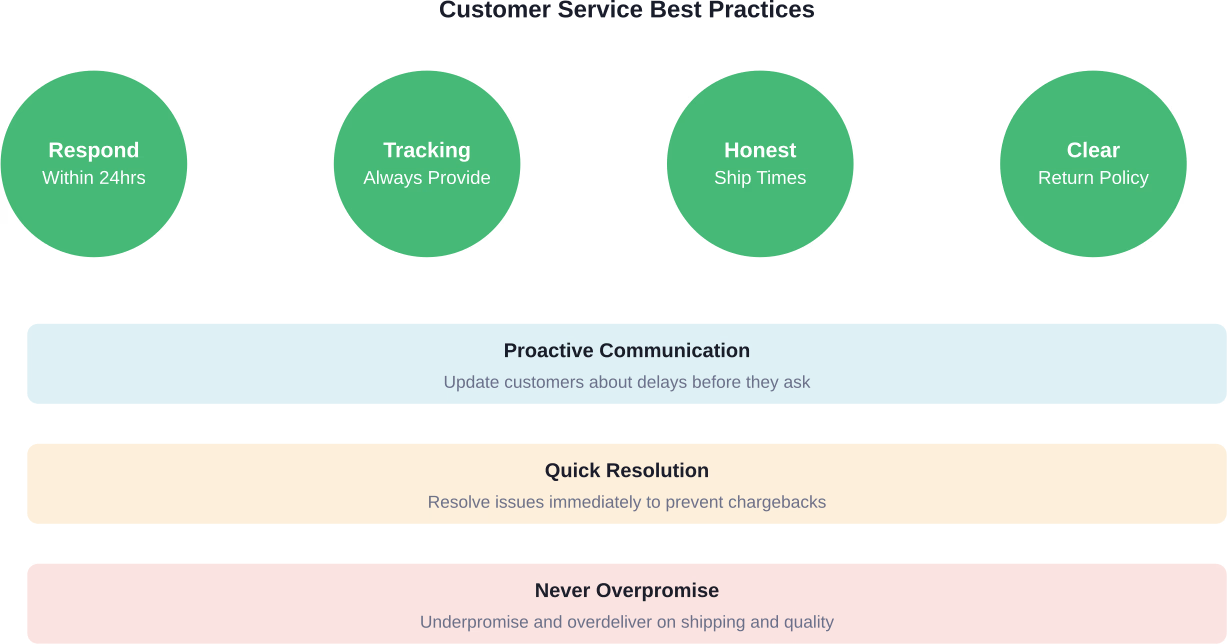
Establish a clear return policy before launching. Specify timeframes for returns, who pays return shipping, and under what conditions refunds are issued. Being upfront prevents disputes later.
When customers request returns, respond quickly. Delayed responses escalate frustration and increase chargeback risk. Work with suppliers to process returns when necessary, though many issues can be resolved with partial refunds for minor defects.
DSers helps manage this by automatically tracking order and package status. Sellers can proactively reach out to customers about shipping delays rather than waiting for angry emails.
Transparency builds trust. Don't hide shipping times in fine print—display them prominently on product pages. If a supplier ships from China with 15-25 day delivery, say so clearly.
Provide tracking numbers promptly. DSers automatically sends order tracking numbers to stores and helps notify customers of shipment status updates.
Respond to customer inquiries within 24 hours. Fast communication reassures customers and prevents issues from escalating into problems.
Once the fundamentals work, scaling becomes the focus. Moving from 5 orders per day to 50 requires systems and automation.
DSers becomes essential at this stage. The ability to place 100s of orders in seconds prevents order fulfillment from becoming a full-time job. Multiple store management features allow sellers to expand into additional niches or markets without multiplying workload proportionally.
Many experts suggest hiring virtual assistants to handle customer service inquiries once volume justifies the expense. This frees up time to focus on marketing and business development.
Diversifying supplier relationships reduces risk. Relying on a single supplier for bestselling products creates vulnerability if they run out of stock or change terms. Having backup suppliers identified prevents scrambling during disruptions.
As of 2024-2025, mobile commerce (m-commerce) accounts for nearly 60% of all e-commerce sales globally, and approximately 80% of millennials shop online. Optimizing stores for mobile conversion remains critical as this demographic represents substantial purchasing power.
Every business model has obstacles. Knowing what to expect helps prepare appropriate responses.
According to community discussions, many dropshippers struggle initially with supplier communication and product quality consistency. Starting with small test orders before committing to large-scale promotion helps identify problems before they affect many customers.
But wait. The biggest challenge isn't technical—it's persistence. Most dropshipping businesses fail within the first three months because owners give up before finding winning products and dialing in their marketing.
The dropshipping model has matured from the Wild West days of 2015-2018. What remains is a legitimate business opportunity for those willing to treat it professionally.
Success requires selecting the right niche, finding reliable suppliers, using proper automation tools, marketing effectively, and delivering excellent customer service. None of these components are optional.
Start with thorough research before spending money on ads. Test products in small batches. Use DSers to streamline operations from day one. Build systems that scale rather than relying on manual processes that break under volume.
The entrepreneurs succeeding with AliExpress dropshipping in 2026 aren't looking for shortcuts. They're building real brands, cultivating supplier relationships, and focusing on long-term customer value rather than one-time transactions.
Ready to start? Create a free Shopify trial, install DSers, and spend the next week researching niches and suppliers before importing a single product. That preparation makes the difference between businesses that fail in 90 days and those still growing three years later.


