AI Tools to Create Ads Without Guesswork
A practical look at AI tools for creating ads. What they do well, where they help most, and how teams actually use them today.
Jan 8, 2026



Meta ads optimization isn’t about finding clever tricks inside Ads Manager. Most of the time, performance problems come from simpler things: unclear objectives, weak signals, and decisions made too late, after the budget is already spent.
The platform has changed. Costs are higher, algorithms are less transparent, and testing everything no longer scales the way it used to. Optimizing Meta ads today means understanding how the system makes decisions and feeding it the right signals at the right time.
This article breaks down what actually matters in Meta ads optimization, without shortcuts, buzzwords, or recycled advice.
At Extuitive, we built our prediction engine around a simple observation: most Meta ads optimization happens too late. Teams launch creatives, spend to learn, wait for results, and then adjust. That loop used to work. Today, it burns budget fast and leaves very little reusable insight behind.
Meta ads have become more automated and less transparent. When performance drops, it is harder to tell whether the issue is creative, audience, timing, or signal quality. By the time answers appear, the spend is already locked in.
Our goal is to shift optimization earlier in the process, before ads ever enter the auction.
Instead of treating every launch like a fresh experiment, we use prediction to guide decisions upfront. We learn from your brand’s historical performance, analyze what has actually driven engagement and conversion, and apply that intelligence to new creative before it goes live.
Two brands can submit the same creative and get different predictions because performance is contextual. What works for one audience does not automatically work for another. Our system is designed around that reality.
For Meta ads optimization, this means:
Predictive ad performance turns optimization into a decision system instead of a reaction loop. Creative teams gain confidence in which directions are worth exploring. Growth teams reduce the learning tax that comes with constant testing. Leadership teams get more predictable performance without increasing spend.
Over time, Extuitive becomes a memory layer for your advertising. What works is captured. What fails is understood. Learning compounds instead of resetting every time creative refreshes.
That is how we help teams move from guessing inside Meta Ads Manager to launching with intent.
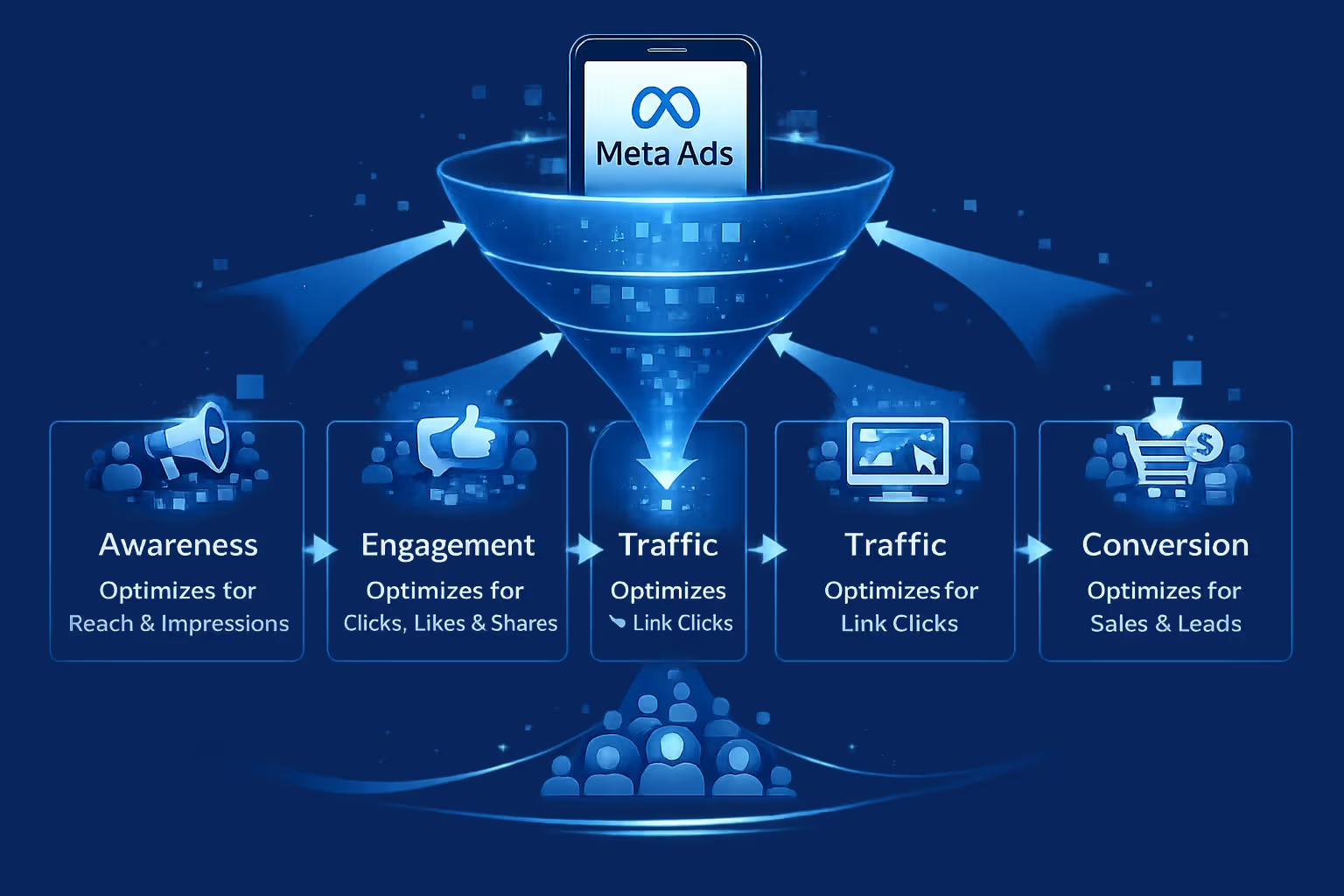
Every Meta campaign is built around an optimization objective. Awareness, engagement, traffic, conversions. This choice is not a formality. It defines how the algorithm allocates spend and what type of users it actively looks for.
The most common mistake teams make is treating objectives as interchangeable steps in a funnel, rather than as distinct systems with different rules.
Each objective trains Meta to prioritize a different kind of behavior:
As the required action becomes more demanding, the audience Meta looks for becomes smaller and more expensive to reach. This is not a flaw in the system. It is how the system is designed to work.
Optimization improves when the objective matches both the real business goal and the quality of data available. Optimizing for conversions without enough high-quality conversion events leaves the algorithm guessing. Optimizing for traffic when the goal is revenue produces cheap clicks that teach Meta very little about who actually buys.
Before touching creative or targeting, clarify one thing: what behavior are you actually training Meta to find?
In 2026, Meta's 'Multi-Event Optimization' allows campaigns to optimize for both primary conversions and secondary micro-conversions simultaneously, reducing the need to manually move up the funnel when volume is low.
But it is not magic. It is pattern recognition driven by data.
Meta builds a user graph based on people who convert. Demographics, behaviors, contextual signals, and engagement patterns all feed into that model. Over time, the system looks for users who resemble past converters.
This only works when the conversion signal reflects real value.
If you feed the system low-quality data, it will optimize perfectly for the wrong outcome.
One of the most repeated rules in Meta advertising is that campaigns need a certain number of conversion events per week to optimize properly. Volume does matter, but it is often overemphasized. In practice, the quality of those events has a bigger impact on long-term performance.
Meta does not evaluate conversions in isolation. It looks for patterns across the people who convert. If those patterns are weak or misleading, more data simply reinforces the wrong behavior.
Lead generation campaigns are a common example. When every form submission is counted as a conversion, the system cannot tell the difference between a serious prospect and someone clicking out of curiosity.
Over time, Meta learns to find more users who behave like low-intent submitters. Performance declines, not because the algorithm is broken, but because it is doing exactly what it was trained to do.
Improving performance often starts with making conversion signals more meaningful. This usually involves narrowing what is sent back to the platform:
Fewer, higher-quality conversions almost always outperform larger volumes of weak signals. The algorithm becomes more selective, learning improves, and optimization stabilizes over time.

Some businesses sell expensive products or services. In these cases, weekly conversion volume may be too low to train the system effectively.
Some businesses sell high-ticket products or services, which naturally limits how many conversions happen each week. When volume is low, it can feel like conversion optimization is not working. In reality, the system often just does not have enough signal yet.
Low volume alone is not a reason to switch objectives entirely. Dropping conversion optimization too quickly usually creates more problems than it solves.
When primary conversion volume is limited, the better approach is to support it rather than replace it. Introducing a secondary campaign optimized for a higher-funnel action gives Meta more behavioral data to work with.
This might include optimizing for add-to-cart events, key page views, or meaningful content engagement. These actions happen more frequently and help expand reach without changing the core goal of the account.
The primary conversion campaign should remain focused on purchases or qualified leads. The supporting campaign exists to feed learning into the system, not to compete for results.
When structured correctly, this approach gives Meta more data while preserving focus on outcomes that actually matter to the business.
The key is to treat funnel stages as complementary, not competing.
One of the most meaningful shifts in Meta Ads optimization is the move from revenue-based signals to profit-based signals.
Traditional value optimization focuses on purchase value. The algorithm prioritizes higher order amounts, regardless of margin, returns, or downstream costs.
This works well for some businesses, but poorly for others.
When profit data is available, optimization improves dramatically. Instead of chasing revenue, the system learns which products, users, and behaviors actually contribute to profit.
This is especially valuable for:
While profit-based optimization is still limited in availability, the direction is clear. Better signals lead to better decisions earlier in the process.
Meta’s targeting capabilities are often both overestimated and misunderstood. Detailed interest targeting once played a central role in campaign performance. Today, that approach frequently limits learning rather than improving results.
The platform already has access to more behavioral data than advertisers can manually define. When audiences are over-constrained, Meta has fewer opportunities to observe patterns, test delivery, and refine predictions.
In many cases, the most effective audience setup is intentionally simple. Rather than trying to predict intent upfront, advertisers allow the algorithm to identify it through behavior.
Geographic and demographic boundaries still matter. They provide the basic context Meta needs to deliver ads in relevant markets without restricting the system’s ability to explore.
Heavy interest layering often reduces reach without improving intent. Keeping interest targeting light or removing it entirely allows Meta to learn from conversion signals instead of assumptions.
Exclusions remain one of the most important targeting tools. Removing recent site visitors, converters, or frequent ad engagers prevents the algorithm from over-relying on the same users and helps maintain reach and learning over time.
While broad targeting works well, exclusions matter more than ever. Conversion-focused campaigns naturally drift toward people who have already visited the site or interacted with ads. Those users are more likely to click, which can make performance look strong on the surface.
The downside is that reach and learning slowly collapse. Click-through rates improve, but the audience stops expanding. The algorithm keeps cycling through familiar users instead of identifying new ones.
When growth and scale are real goals, exclusions become essential. Removing recent site visitors, past converters, and frequent ad engagers forces Meta to search for new users instead of leaning on easy wins. This shift often reveals whether an account is truly acquiring demand or simply retargeting it.
When exclusions are applied correctly, many advertisers see a noticeable increase in new user volume. More importantly, the system begins learning from a wider pool of behavior, which supports long-term performance rather than short-term metrics.
As targeting becomes more automated, creative carries more weight in Meta ads optimization. Audience definitions no longer do most of the filtering. Creative now plays a central role in determining how delivery expands and who the algorithm prioritizes.
Creative does not just persuade users. It actively teaches Meta who to show ads to.
How creative influences optimization:
This dynamic creates a feedback loop. Creative that earns early engagement is shown to more new users, which feeds stronger learning. Creative that plays it safe is shown to fewer people, which limits discovery.
Optimization improves when creative is treated as an input signal, not just a branding exercise. When ads clearly communicate intent, both users and the algorithm respond more predictably.
One of the most common mistakes is running bottom-funnel messaging in top-funnel campaigns.
Conversion optimization does not mean every ad should push for a sale. It means every ad should align with the action being optimized.
Early-stage creative should focus on relevance and clarity. Mid-stage creative should build trust and understanding. Late-stage creative can push urgency or offers.
When messaging and optimization goals are misaligned, performance suffers even if targeting and budgets are correct.

The best-performing Meta Ads accounts are rarely the ones with the most settings adjusted. They are the ones that learn the fastest. Performance improves when the system receives clear, consistent signals and has time to recognize patterns.
Fast learning comes from short, clean feedback loops.
When objectives are well defined and stable, Meta knows exactly which behavior to prioritize. Constantly switching goals resets learning and makes performance unpredictable.
Optimization depends on signals that reflect real value. When conversion events are clean and meaningful, the algorithm can learn quickly and apply that insight across campaigns.
Creative works best when it follows a recognizable structure. Consistency allows Meta to understand what elements drive engagement and what changes actually impact performance.
Testing is most effective when variables are isolated and intentional. Making too many changes at once creates noise and breaks the feedback loop.
When campaigns are constantly reset, learning is lost. When structure stays stable and variables change deliberately, insight compounds over time.
Optimization is not about reacting faster. It is about designing systems that require less reaction.
Testing is still important, but blind experimentation is expensive.
The old model of launching dozens of creatives and letting the algorithm figure it out assumes cheap attention and fast feedback. Neither is guaranteed anymore.
Smarter optimization prioritizes prediction over experimentation. Using past performance, qualitative insights, and consumer understanding to narrow options before spend is deployed.
This shift reduces wasted budget and shortens the distance between idea and outcome.
Meta Ads optimization today is less about clever adjustments and more about clarity. The platform has changed, and the way performance improves has changed with it. Algorithms are more automated, signals matter more than settings, and learning is harder to preserve once it is lost.
Accounts that perform well over time are built around a few fundamentals. Clear objectives that match real business goals. Conversion signals that reflect actual value. Creative that teaches the algorithm who to look for. Structures that allow learning to compound instead of resetting every few weeks.
There is no shortcut around this. Optimization is no longer about reacting faster inside Ads Manager. It is about designing systems that make better decisions earlier and waste less budget discovering what does not work.
Teams that accept this shift stop chasing tactics. They focus on inputs, feedback loops, and signal quality. That is where predictable performance comes from now.


