How to Speed Up Your Shopify Website the Right Way
Learn how to speed up your Shopify website with practical fixes that improve load time, user experience, and conversions.
Jan 27, 2026



Instagram ads rarely fail because of one obvious mistake. More often, performance slips quietly. Audiences get too broad, creatives stop resonating, budgets drift, and teams keep testing without learning much from it. Optimization then turns into constant tweaking instead of real progress.
Good Instagram ads optimization is not about tricks or endless experiments. It’s about understanding where signal comes from, spotting waste early, and making decisions that compound over time. This article breaks down how to approach optimization in a way that feels grounded, repeatable, and tied to actual results rather than surface-level metrics.
Most Instagram ads optimization begins after money has already been spent. Creatives are launched, campaigns collect data, and only then do teams try to understand what worked and what failed. By that stage, a significant portion of the budget is already gone.
We designed Extuitive to reverse that sequence. Instead of relying on post-launch performance, the platform predicts which creatives are most likely to drive higher click-through rates and stronger return on ad spend before they enter the auction. This removes one of the largest sources of waste in Instagram advertising.
Extuitive evaluates creatives in context rather than isolation. The system combines brand-level performance history with large-scale consumer intelligence to assess visual structure, messaging angles, and creative composition. Because performance is contextual, two brands can submit the same creative and receive different predictions.
Using Extuitive in Instagram ads optimization helps teams:
When prediction comes first, optimization becomes proactive instead of corrective. Campaigns launch with clearer intent, learning compounds over time, and performance becomes more predictable without increasing budget.
This is the role Extuitive plays in modern Instagram ads optimization - turning experimentation into a decision system.
Instagram is a visual platform, but creative alone does not carry performance. Real optimization happens when creative quality, placement context, and budget control work together instead of competing with each other.
The biggest gains rarely come from tiny targeting tweaks or constant budget increases. They come from deciding what deserves attention, where it should appear, and how much spend it earns. When those decisions are clear, optimization stops feeling reactive and starts producing measurable improvement without increasing budget.
This section breaks down the levers that consistently move Instagram ads performance when used together, not in isolation.
High-performing Instagram ads do not ask for patience. They communicate the core idea almost immediately.
Strong creatives tend to share a few traits:
When creatives fail, it is often because they try to say too much or hide the point behind visuals. Clarity beats cleverness more often than teams expect.
One of the most common optimization traps is endless variation without substance. Changing colors, headlines, or formats while keeping the same idea rarely moves performance in a meaningful way.
Creative optimization works best when testing different angles instead:
One strong concept will outperform five polished versions of a weak one. Optimization should reduce noise, not multiply it.
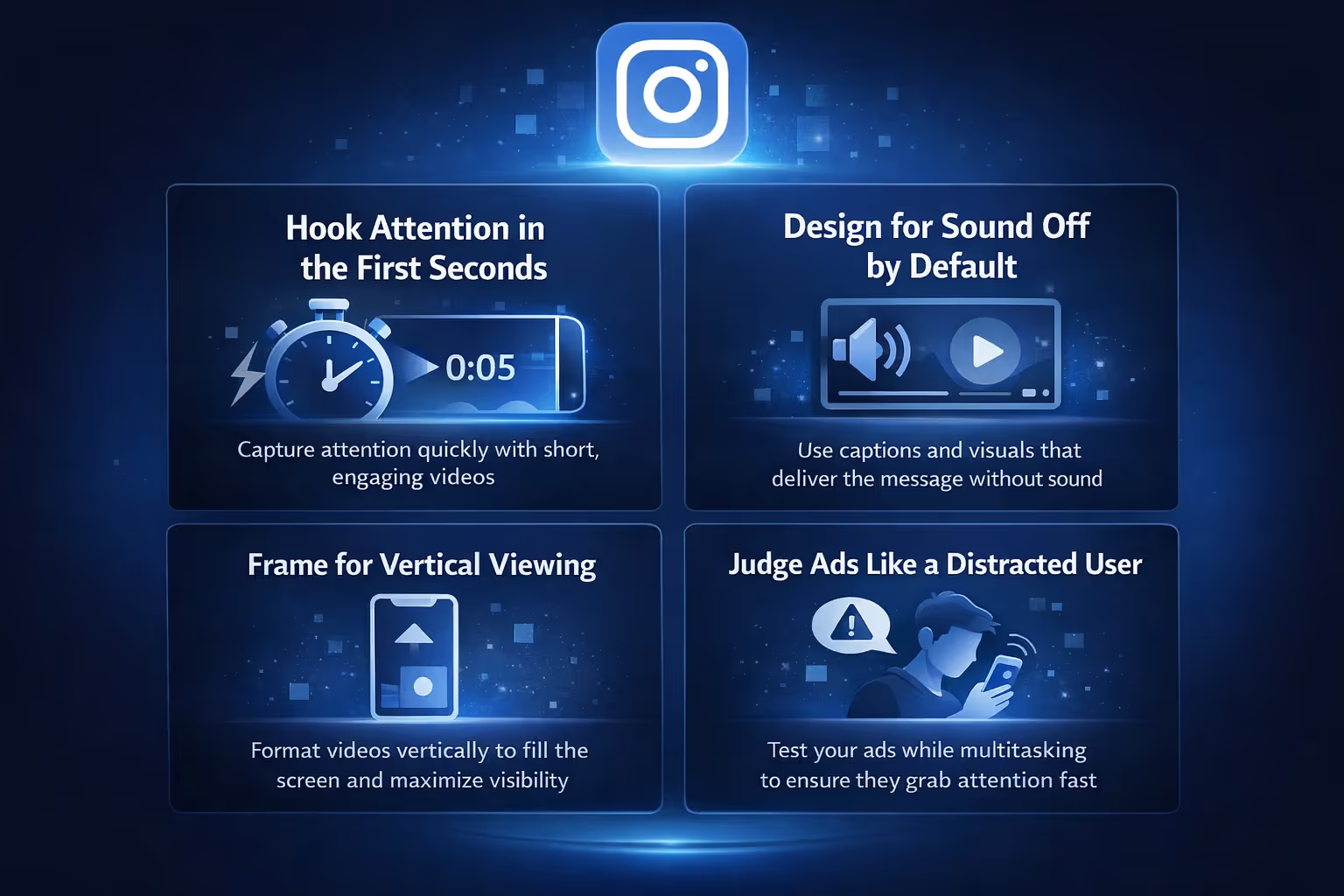
Video dominates Instagram consumption, but many advertisers overcomplicate it. Effective video optimization does not require cinematic production or long edits. It requires focus.
Short videos that earn attention quickly tend to outperform longer, more polished pieces. The opening moments matter more than the ending. If the core idea is not clear early, most users will never see the rest.
Many users scroll with sound muted. Subtitles are not optional. Visual cues should carry the message even without audio, while sound adds depth for those who choose to turn it on.
Instagram is consumed vertically. Videos that rely on horizontal framing or small on-screen elements often lose impact. Clear visuals that fill the screen perform more consistently across placements.
If a video only makes sense with sound on, or after ten seconds, performance will suffer. A simple rule applies here: watch the ad as a distracted user. If it does not earn attention quickly, others will scroll past it too.
Automatic placements often look efficient in reports, but they hide important performance differences. Feed, Stories, Reels, and Explore are not interchangeable environments.
Users consume content differently in each placement. A creative that performs well in Feed may fall flat in Stories. A Reel-style video may struggle in static placements.
Optimization means reviewing performance by placement and reallocating budget intentionally. This does not mean disabling placements blindly. It means identifying where ads earn attention versus where they only accumulate impressions.
Many accounts unlock cost savings simply by excluding placements that spend consistently without contributing downstream value.
Budget optimization is often misunderstood as increasing or decreasing spend. In reality, it is about distribution.
When budgets are spread evenly across uneven performers, waste follows. Strong ads should earn more budget quickly. Weak ads should lose it just as fast.
Effective budget control requires clear rules:
Optimization works best when budgets move based on evidence, not emotion. Consistency here often matters more than aggressiveness.
Testing is necessary. Excessive testing is expensive.
One of the most common Instagram ads optimization mistakes is changing too many variables at once. When concepts, visuals, audiences, and budgets all shift together, the result is noise rather than insight. Performance moves, but the reason remains unclear.
Effective testing follows a sequence. Concepts should be validated first, before worrying about execution details. Once a concept proves it can earn attention, execution can be refined through visuals, copy, and format. Only after that does it make sense to test scale. Each stage answers a different question, and skipping steps almost always leads to wasted spend.
What matters just as much as running a test is closing it properly. When a test ends, the outcome should be documented. What worked, what failed, and why it likely happened. That record becomes part of an optimization system that compounds over time. Without documentation, every new campaign quietly starts from zero.

Optimization often fails not because teams lack data, but because they focus on the wrong numbers. Metrics that look good in isolation can quietly hide weak intent and wasted spend.
Clicks without intent inflate confidence. Low CPMs can mask poor conversion quality. Even CTR becomes misleading when creatives attract curiosity without relevance. Metrics only make sense when they are tied to the stage of the campaign.
At the top of the funnel, the goal is earning attention. Metrics here are signals, not outcomes. Reach, impressions, and video views help indicate whether a creative is breaking through the feed and earning initial interest. If an ad cannot win attention, nothing downstream will improve it.
Once attention is established, engagement quality becomes more important. Landing page views, time spent on site, and meaningful interactions provide insight into whether interest is real. This stage helps separate surface-level curiosity from actual consideration.
At the conversion stage, optimization must be tied to outcomes. Cost per lead, cost per purchase, and return on ad spend matter more than volume metrics. This is where wasted traffic becomes visible and budget decisions should be most disciplined.
Optimizing everything to a single number creates blind spots. Each metric answers a different question depending on campaign intent. Context matters, and optimization improves when metrics are chosen deliberately rather than out of habit.
Some mistakes show up again and again, regardless of account size or industry. They are rarely dramatic, but over time they quietly drain performance and budget.
Avoiding these errors alone often leads to noticeable improvement, even without advanced tools or complex tactics.
The biggest difference between average and strong advertisers is not tactics. It is the presence of a system. Strong teams do not rely on instinct alone or chase short-term fixes when performance dips. They build processes that capture learnings, standardize decisions, and reduce dependence on guesswork. Optimization becomes something that happens continuously, not only when results start to slide.
Over time, this approach changes how campaigns perform. New ads launch with clearer intent. Weak ideas are filtered out earlier. Budget flows more naturally toward what works, and waste shrinks without aggressive cuts. Performance becomes more predictable because learning compounds instead of resetting. That is how better results emerge from the same budget, without relying on constant experimentation or higher spend.
Instagram ads optimization is not about chasing trends or copying tactics from other accounts. It is about understanding your own data, your own audience, and your own creative signals.
When you focus on reducing waste, learning deliberately, and aligning ads with real user behavior, performance usually improves without spending more.
Optimization is not magic. It is attention to detail, applied consistently.
And that, more than any hack, is what moves results.


