Top Free AI Agents: Tools, Platforms, and What’s Available
A curated list of free AI agent tools and platforms, plus context to help you understand what’s out there and where they fit.
Apr 10, 2026



Split testing Facebook ads for divorce lawyers involves systematically comparing different ad variations (headlines, images, audiences, or copy) to identify which combinations generate the highest-quality leads at the lowest cost. By testing one element at a time and measuring performance against clear metrics like cost per lead and consultation booking rates, divorce attorneys can optimize their ad spend and improve campaign ROI while staying compliant with advertising regulations.
Facebook advertising continues to challenge divorce lawyers in 2026. Some community discussions in r/LawFirm suggest mixed results with Facebook ads, with some practitioners noting difficulties obtaining quality leads compared to Google PPC.
The difference? Split testing.
According to Harvard Business School Online, A/B testing provides a cost-effective way for businesses to identify and test value-creating elements in their marketing. For divorce attorneys competing in crowded local markets, this methodology transforms guesswork into data-driven decisions.
But here's the thing—split testing isn't about randomly trying different ad variations and hoping something works. It requires a structured approach that respects both the sensitive nature of family law and the compliance requirements governing attorney advertising.
Split testing (also called A/B testing) works by dividing your audience into groups and showing each group a different version of your ad. According to Iowa State University's CALS/LAS Web Team research on A/B testing, one group sees version A (the control), while another sees version B (the variant). Analytics systems track visitor actions, revealing which version performs better over time.
The Federal Trade Commission mandates that all advertising must be truthful and non-deceptive, and advertisers must have evidence to back up their claims. This applies directly to divorce lawyer Facebook ads—every claim about results, experience, or services requires substantiation.
For divorce attorneys, split testing serves three critical functions:
Penn State Extension notes that the effectiveness of online marketing can be achieved by testing the impact of small changes. This principle matters enormously in legal advertising, where minor adjustments to ad copy or targeting can mean the difference between attracting serious prospects or tire-kickers.
Divorce-related advertising operates under unique constraints. People searching for divorce attorneys are often in emotional distress, making them vulnerable to misleading claims. State bar associations scrutinize family law advertising closely.
Real talk: the stakes are higher than most practice areas.
Testing must account for:
Marketing case studies demonstrate how combining expert advertising strategies with deep legal experience produces measurable results, such as firms that executed comprehensive rebranding and implemented SEO and content strategy, transforming stagnant online presence into lead-generating systems.

For a niche campaign like divorce lawyer ads, weak variants can still waste budget fast. Extuitive helps teams compare ad creatives before launch by predicting likely ad performance. The platform uses AI models validated against live campaign results, so advertisers can review variants before putting spend behind the split test.
Use Extuitive to:
👉 Book a demo with Extuitive to see how it predicts ad performance before launch.
Before launching any split test, divorce lawyers need a structured framework. Random testing wastes budget and produces inconclusive results.
Start with these foundational elements:
Click-through rate doesn't matter if those clicks come from unqualified leads. For divorce attorneys, meaningful metrics include:
Track these metrics for each ad variation. Over time, patterns emerge showing which approaches attract serious clients rather than information-seekers.
Small sample sizes produce misleading results. According to academic research on A/B testing methodology from Harvard Business School and others, tests need adequate volume to reach statistical validity.
For Facebook ad split tests, this typically means:
Many attorneys make the mistake of declaring a winner after three days or twenty leads. That's not testing—it's gambling.
Advanced conversion tracking separates successful campaigns from disappointing ones. Without proper tracking, attorneys can't distinguish between ads that generate consultations and ads that attract tire-kickers.
The tracking setup should capture:
This infrastructure enables testing based on business outcomes, not vanity metrics like impressions or reach.
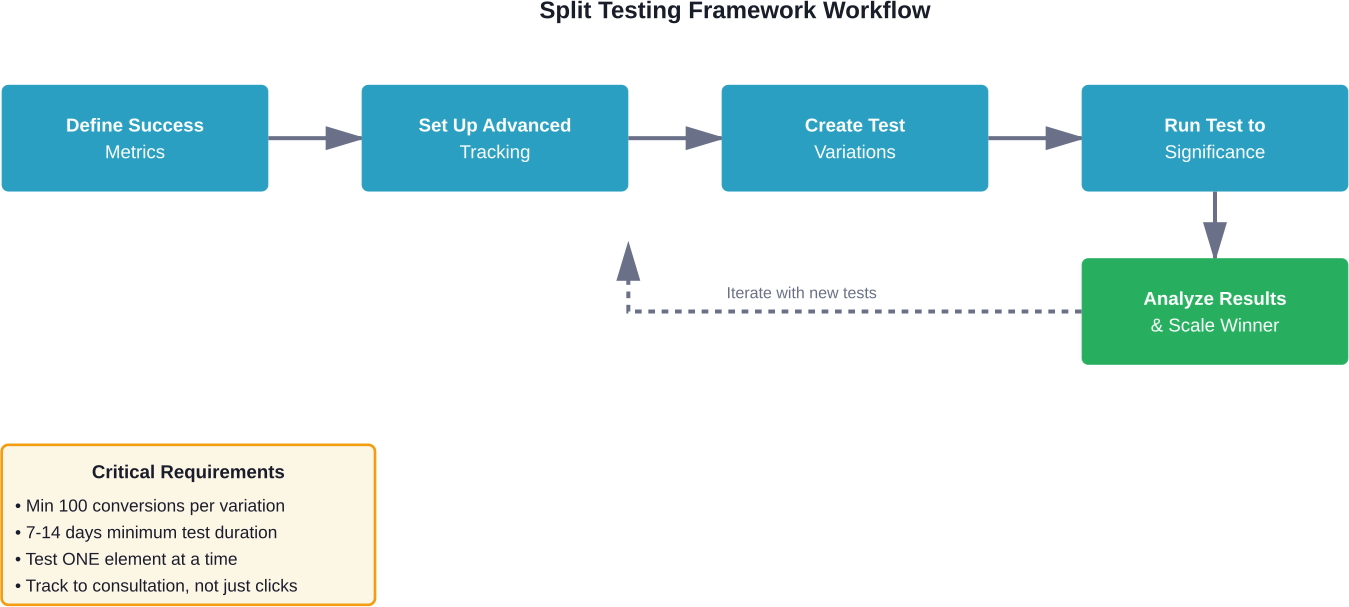
Not all ad elements deserve equal testing priority. Some variables dramatically impact performance, while others produce marginal differences.
Based on documented law firm marketing results, comprehensive strategies combining multiple optimization elements have produced significant performance improvements:
Audience selection often determines campaign success more than any other factor. Facebook offers sophisticated targeting options, but for divorce attorneys, broader isn't always better.
Test these audience configurations:
Here's the thing though—relationship status targeting feels obvious but often underperforms. People don't always keep their Facebook status current, and many haven't updated it in years. Geographic and demographic targeting sometimes produces better results.
Visual elements capture attention in crowded Facebook feeds. For divorce lawyers, the creative presents unique challenges—the imagery must convey professionalism and empathy without exploiting emotional vulnerability.
Testing priorities for creative elements:
Video content often generates higher engagement, but that doesn't automatically translate to better leads. Some divorce prospects prefer the discretion of static image ads that don't autoplay.
Test both formats against your specific metrics.
Headlines make or break ad performance. For divorce attorneys, the headline must acknowledge the prospect's situation without sensationalizing it.
Effective headline testing approaches:
According to the FTC's guidance on advertising, claims about outcomes or expertise must be substantiated. Headlines promising specific results ("Win Your Custody Case") create compliance risks. Focus testing on differentiation and relevance rather than outcome guarantees.
What happens when someone clicks the ad? The offer determines whether prospects convert or bounce.
Test these offer structures:
Community discussions in r/LawFirm reveal mixed experiences with Facebook ads generally, with some reporting quality issues with leads. Some attorneys report quality concerns with certain offer structures, while others find free consultations essential for converting Facebook leads. The only way to know what works for a specific market? Test it.
Should divorce lawyer Facebook ads use long, detailed copy or short, punchy messaging? Both approaches have advocates, which means both deserve testing.
Test variations in:
Longer copy often performs better for high-consideration decisions like hiring a divorce attorney. But that's a generalization—the data from actual tests determines what works for a specific practice.
The ad gets prospects to click. The landing page converts them into leads. Testing stops being effective when landing pages undermine ad performance.
According to Penn State Extension research on A/B testing for online marketing, landing page optimization can improve conversion rates. According to Iowa State University's A/B testing case study, a variation achieved a 10% conversion rate versus the original's 3% rate through testing button text changes—demonstrating how minor elements create major impact.
Custom landing pages outperform generic website homepage traffic for Facebook ads. Each ad variation should direct to a landing page that maintains message consistency.
Critical landing page test elements:
For divorce-related landing pages, privacy concerns loom large. Many prospects worry about confidentiality. Testing different approaches to addressing these concerns—explicit privacy statements, secure form badges, confidentiality assurances—can significantly impact conversion rates.
When an ad promises a "free custody strategy consultation" but the landing page offers a "general divorce consultation," conversion rates plummet. Message match matters.
Test the degree of message alignment:
Tighter message match typically converts better, but some attorneys worry about appearing too narrow. Testing resolves the debate with actual data.
Lead forms present a constant tension: longer forms filter out low-quality leads but reduce overall conversion volume. Shorter forms maximize conversions but may attract less serious prospects.
The optimal approach depends on practice capacity and lead quality requirements. Test systematically:
Multi-step forms (breaking questions across multiple screens) sometimes achieve the best of both worlds—higher completion rates than long single-page forms while still gathering detailed qualification information.
But does that actually work for divorce leads? Test it.
Split testing requires creating multiple ad and landing page variations. Each variation must comply with applicable advertising rules.
The FTC mandates that advertising must be truthful and non-deceptive, and every state has consumer protection laws governing advertisements. For attorneys, additional layers of regulation apply through state bar associations.
The FTC pays closest attention to ads making claims about outcomes or guarantees. For divorce lawyers, this affects common marketing messages.
Problematic claims that require careful handling:
According to FTC guidance, offering a money-back guarantee doesn't substitute for substantiation. Attorneys still need proof supporting claims, even when guarantees are offered.
State bar rules vary, but most restrict:
When testing different messaging approaches, establish a compliance review process. Have each variation reviewed before launch, even minor changes to headlines or copy.
Better to test five compliant variations than ten variations that risk bar complaints.
Facebook's targeting capabilities create ethical considerations for divorce lawyers. Targeting people based on relationship status or recent life events feels intrusive to many prospects.
Test targeting approaches, but consider the ethical implications:
Broader demographic targeting often performs adequately while avoiding the ethical concerns of hyper-specific relationship-based targeting.
Theory matters less than execution. Here's how to structure an actual split test for divorce lawyer Facebook ads.
The biggest mistake in split testing? Changing multiple elements simultaneously. When the test results come in, which change drove the difference? Impossible to know.
For a first test, focus on one high-impact element. Headline testing provides an excellent starting point—relatively easy to implement, significant impact potential.
Create two ad variations:
Everything else—image, audience, offer, landing page—remains identical.
Facebook's split testing feature automatically distributes budget evenly between variations. For manual testing (running separate ad sets), allocate equal budgets.
Minimum effective test budgets for divorce lawyer Facebook ads:
These budgets assume reaching the 100-conversion minimum for statistical significance. Adjust based on typical cost-per-lead in a specific market.
Run tests for at least seven days to capture full-week patterns. Divorce-related searches often show day-of-week variations—weeknight and weekend traffic differs from weekday patterns.
Fourteen days provides better data, capturing two full weekly cycles. This matters more in smaller markets where daily lead volume stays low.
Resist the temptation to call winners early. Three days and fifteen leads doesn't constitute valid data, regardless of how promising the results look.
While tests run, monitor for:
Don't make optimization changes mid-test. If serious problems emerge, pause the test, fix the issue, and restart with fresh data.
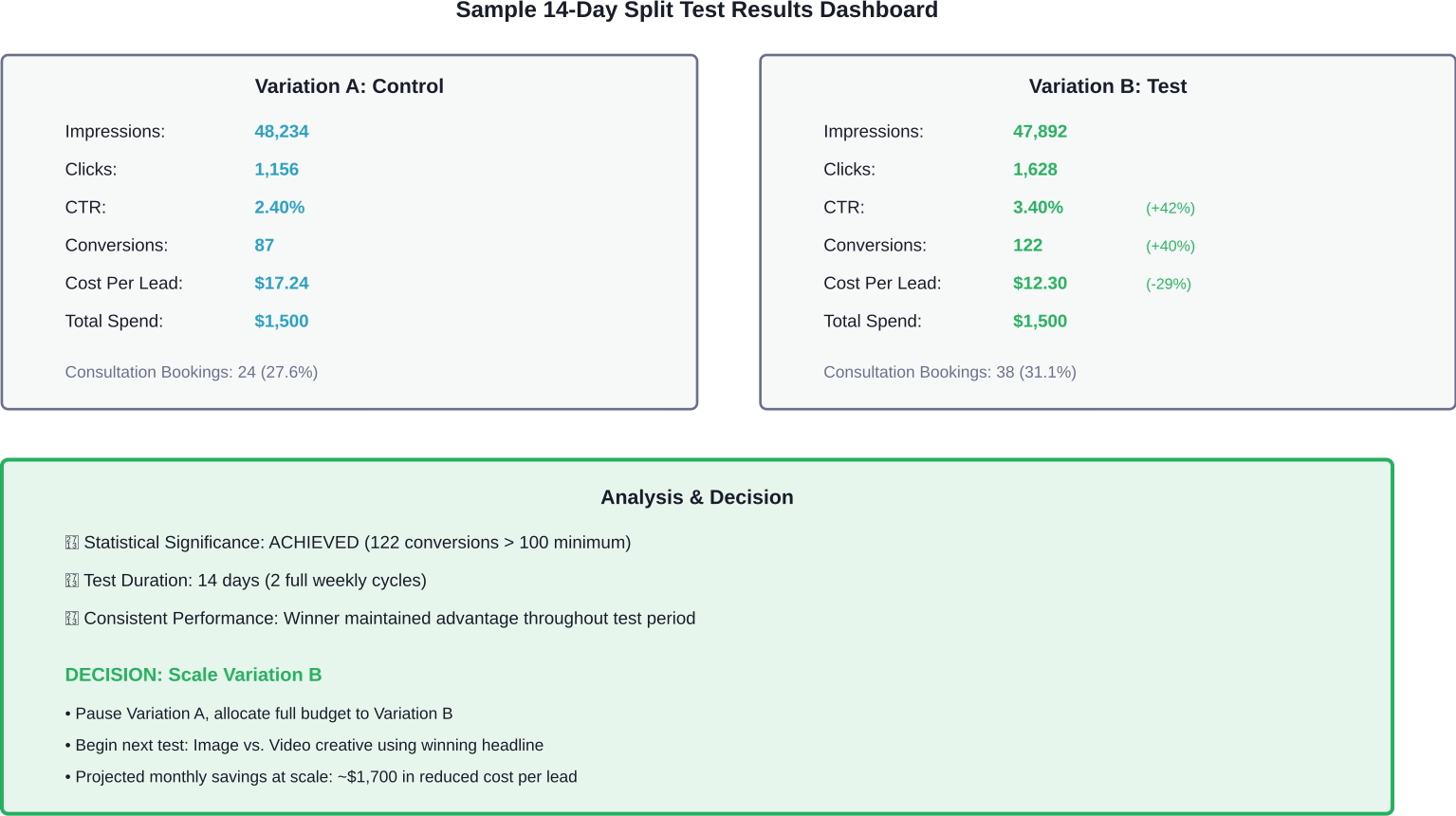
Example split test results comparing control vs. test variation, showing clear winner with 29% lower cost per lead and higher consultation booking rate.
Data without analysis produces no value. When tests reach statistical significance, proper analysis determines next steps.
Click-through rate and cost-per-click matter, but they don't determine success for divorce attorneys. A variation generating twice the clicks means nothing if those clicks don't convert to consultations.
Analyze the full funnel:
Sometimes a variation with lower click-through rates produces better qualified leads that convert at higher rates. The math matters more than individual metrics.
Not every test produces a decisive winner. Sometimes variations perform nearly identically.
When results show less than 15% difference and metrics remain within the margin of error:
Inconclusive tests provide valuable information—they reveal what doesn't matter, allowing focus on elements that do.
When a clear winner emerges, the scaling process begins:
The last point matters critically. One successful test doesn't mean optimization is complete. Each winning variation becomes the new control for subsequent tests.
Systematic testing requires planning multiple iterations:
Each test builds on previous learnings. By iteration five, the campaign operates at dramatically higher efficiency than the original version.
Even experienced marketers make costly testing errors. For divorce lawyers new to Facebook advertising, certain mistakes appear repeatedly.
The temptation to test everything at once is strong. Different headline, different image, different audience, different landing page—all in one test.
When results come in, which change created the difference? Impossible to determine.
Single-variable testing requires patience but produces actionable insights. Multi-variable testing produces ambiguity.
Declaring winners based on 30 leads or three days of data leads to false conclusions. Small samples produce random variation that doesn't predict long-term performance.
According to academic research on A/B testing methodology, adequate sample sizes are essential for statistical validity. For Facebook ad testing, this means minimum 100 conversions per variation and 7-14 days duration.
Patience pays. Premature optimization wastes more money than waiting for valid data.
Divorce-related searches show seasonal patterns. January sees spikes (post-holiday effect). Summer shows different patterns than winter.
Testing during unusual periods produces skewed results. Running a test during a local news story about a high-profile divorce case may temporarily boost all divorce-related ad performance.
Consider external factors when analyzing results. Unusual spikes or drops may reflect timing rather than ad performance.
After running five or six tests over several months, details blur. Which headline was tested in February? What were the exact results from the audience targeting test?
Maintain a testing log documenting:
This documentation prevents repeating failed tests and provides historical context for performance trends.
Facebook's native conversion tracking captures some data, but divorce lawyers need deeper tracking to measure true campaign value.
Without tracking consultation bookings, show rates, and retention outcomes, testing optimizes for the wrong metrics. An ad variation might generate more leads while producing fewer paying clients.
Set up comprehensive tracking before starting tests, not after.
Once basic split testing produces consistent improvements, advanced strategies amplify results.
Each successful test improvement compounds with previous wins. A 25% improvement in headline performance, followed by 20% improvement from creative optimization, followed by 15% improvement from landing page changes produces cumulative improvement far exceeding any single test.
The math: Starting cost per lead of $20, reduced by 25% to $15, then by 20% to $12, then by 15% to $10.20—a total 49% improvement through three sequential tests.
This compound improvement explains why consistent testing produces dramatically better results over time.
Not all divorce prospects respond identically to the same messaging. Different demographics may require different approaches.
Test variations across segments:
A headline performing well with 35-44 year-olds might underperform with 55-65 year-olds. Segmented testing reveals these nuances.
Divorce-related searches spike around certain times:
Test seasonal messaging variations that acknowledge these patterns without exploiting them. "New Year, New Start" messaging might perform well in January but feel tone-deaf in July.
Lessons from Facebook split testing often apply to other channels. A headline performing well in Facebook ads might also improve Google Ads performance. Landing page optimizations developed through Facebook testing typically benefit all traffic sources.
Look for cross-channel applications of testing insights to multiply their value.
Split testing requires dedicated budget. How much should divorce lawyers allocate to testing versus proven campaigns?
A commonly recommended approach: allocate 80% of budget to proven winners and 20% to active testing.
For a divorce lawyer spending $5,000 monthly on Facebook ads:
This balances current lead generation needs with ongoing optimization. Testing budget pays for itself through compound improvements over time.
Smaller practices with limited intake capacity might reduce testing budget during busy periods. Larger practices with scalable operations can afford more aggressive testing.
The key question: can the practice handle increased lead volume if tests produce dramatic improvements? If not, throttle testing budget until capacity expands.
Split testing rarely produces immediate ROI. The first test might run for two weeks with inconclusive results. The second test might show 15% improvement. The third might reveal 30% improvement.
Generally speaking, practices should evaluate testing ROI over 6-12 month periods, not monthly. The compound improvements accumulate, but they require time to materialize.
Beyond individual test results, tracking overall campaign improvement over time reveals testing program effectiveness.
Establish baseline measurements before systematic testing begins:
Track these monthly. As testing progresses, improvements should become evident across most metrics.
Testing ROI calculation requires comparing current performance to baseline performance, accounting for testing costs.
Example calculation:
Baseline: $25 cost per lead, 20% booking rate, $5,000 monthly budget = 200 leads, 40 consultations
After 6 months testing: $16 cost per lead, 28% booking rate, $5,000 monthly budget = 312 leads, 87 consultations
Improvement: 117% increase in monthly consultations from same budget. Testing investment (approximately $6,000 over six months) produced permanent improvement worth thousands monthly.
Knowledge without implementation produces no results. Here's how to start split testing for divorce lawyer Facebook ads this week.
Begin with current performance documentation. Record baseline metrics—cost per lead, conversion rates, consultation booking rates—before making any changes. These baselines provide the comparison point for measuring improvement.
Set up proper tracking infrastructure. Ensure Facebook pixel implementation captures form submissions, consultation bookings, and phone calls. Without accurate tracking, testing optimizes for the wrong outcomes.
Identify the first test. For most divorce attorneys, headline testing provides the best starting point—high impact potential with straightforward implementation. Create two headline variations that maintain compliance while testing different messaging approaches.
Allocate appropriate budget. Don't try running meaningful tests on $200. Commit sufficient budget to reach statistical significance, typically $1,000-3,000 depending on market size.
Schedule the test launch. Pick a normal week—not during holidays, major local events, or unusually busy periods that might skew results.
Plan for patience. Resist checking results daily and making premature optimizations. Let tests run their full duration before analyzing performance.
Document everything. Start a testing log capturing what was tested, when, budget allocated, and results achieved. This documentation becomes invaluable as testing programs mature.
The divorce lawyers seeing consistent Facebook ad success aren't lucky—they're systematic. They test, measure, analyze, and optimize continuously. That systematic approach separates practices generating quality leads at sustainable costs from those burning budget on underperforming campaigns.
Split testing isn't glamorous. It requires patience, discipline, and tolerance for occasional failures. But the compound improvements over time transform advertising economics. A 49% reduction in cost per lead over six months of systematic testing means the same budget generates nearly double the consultations.
For divorce lawyers competing in crowded markets, that advantage can define practice growth trajectories.
Start testing today. Document baselines, set up proper tracking, create your first test variation, and commit to the process. Six months from now, advertising performance will look dramatically different—if the testing discipline holds.


