How to Set Up Pre-Orders on Shopify Without the Confusion
Learn how to set up pre-orders on Shopify with or without an app, plus tips for managing payments, inventory, and customer expectations.
Mar 25, 2026



Quick Summary: An AI marketing agency is a specialized firm that integrates artificial intelligence technologies—including generative AI, predictive analytics, and autonomous AI agents—into marketing services to automate tasks, personalize campaigns, and optimize performance. According to the American Marketing Association's September 2024 survey, nearly 90% of marketers have used gen AI tools at work, with agencies leveraging these technologies for content creation, audience targeting, customer support, and predictive analytics. Unlike traditional agencies, AI marketing agencies combine human strategic expertise with AI-powered automation to deliver faster, more data-driven results.
Marketing just hit another inflection point. And no, this isn't another automation wave or a slightly better analytics platform.
AI marketing agencies represent a fundamental shift in how marketing services get delivered. Research from the Interactive Advertising Bureau shows that more than half of marketers already use generative AI for creative content and audience targeting, with nearly all planning to expand AI use next year.
But what actually separates an AI marketing agency from a traditional firm that just happens to use some AI tools?
The distinction matters more than most businesses realize.
An AI marketing agency builds its entire service model around artificial intelligence technologies. These aren't traditional agencies that added ChatGPT to their workflow last year—they architect solutions where AI handles autonomous decision-making, execution, and optimization.
The core difference? Traditional agencies use AI as an assistant. AI marketing agencies deploy AI as an operator.
According to the American Marketing Association's September 2024 survey, 62% of marketers use chatbots like ChatGPT for content generation at work, while 58% rely on AI-powered tools like Grammarly. AI marketing agencies take this several steps further, implementing specialized AI agents that assess situations, reason through decisions, and take appropriate action with minimal human intervention.
These agencies operate across three primary technology layers:
The business model centers on leveraging these technologies to deliver outcomes that would require significantly larger teams in traditional agency structures.
Here's where it gets interesting. The economics of AI marketing agencies work differently than conventional service firms.
Traditional agencies scale revenue by adding headcount. AI agencies scale by expanding AI system capabilities and training specialized agents for new use cases.
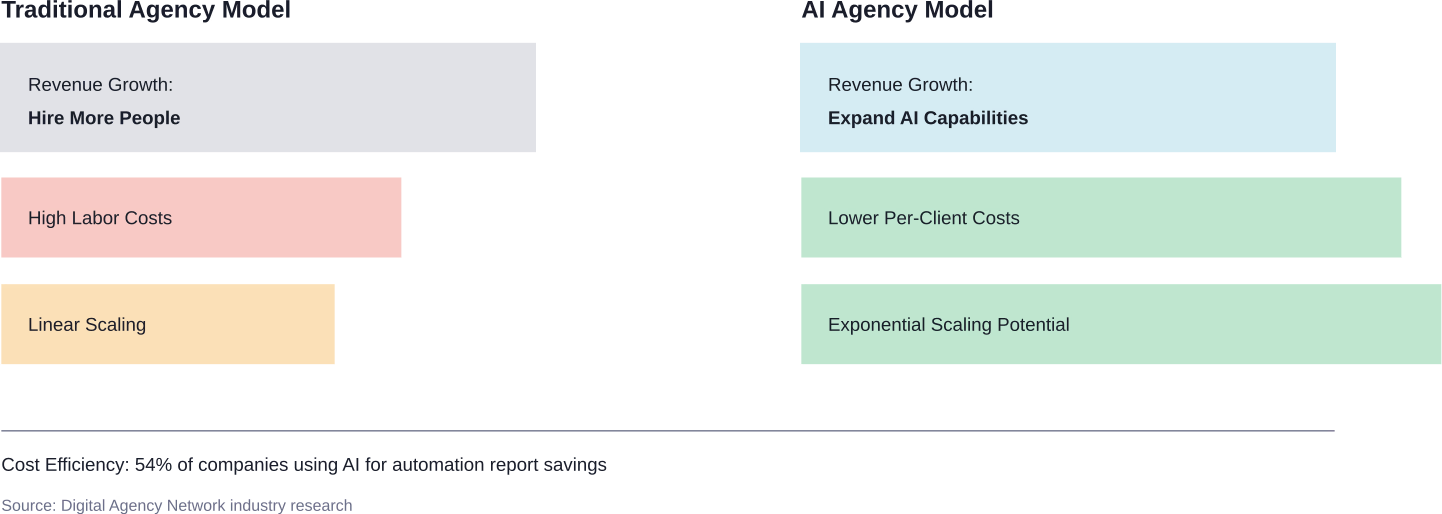
According to industry research, 54% of companies using AI for automation have reported savings and increased efficiency. AI agencies capitalize on this by building reusable AI systems that serve multiple clients simultaneously.
The revenue model typically includes:
MIT CISR research predicts that rapid advancements in AI will drive business model evolution, with business models in the AI era becoming increasingly outcome-oriented and enabled by autonomous AI. AI marketing agencies are already operating in this paradigm.
What do these agencies actually deliver? The service portfolio centers on areas where AI demonstrates clear advantages over manual execution.
Generative AI has transformed content production economics. According to the IAB research, over half of marketers use AI for creative content development.
AI marketing agencies deploy these capabilities at scale:
The key advantage? Speed and volume. What used to require days of copywriting and design work can now happen in minutes.
More than half of marketers already use AI for audience targeting, according to IAB data. AI agencies take this beyond basic segmentation.
Advanced capabilities include:
These systems analyze patterns across millions of data points that human analysts would never catch.
Most predictive systems in marketing focus on audiences and behavior. But creative performance is just as important, and harder to evaluate before launch.
AI marketing agencies are starting to apply predictive models to ad creatives themselves, using historical data and simulations to estimate how different concepts might perform. This shifts part of the testing process earlier, before any budget is spent.
Advanced capabilities include:
Platforms like Extuitive reflect this shift toward pre-launch evaluation. Instead of relying entirely on live A/B testing, teams can assess which ideas are likely to work in advance, reducing unnecessary spend and shortening feedback loops.
This is where AI marketing agencies diverge most sharply from traditional firms. Autonomous AI agents don't just analyze data—they take action.
As the Salesforce guide explains, AI agents are specialized software systems that assess situations, reason through decisions, and take appropriate action on behalf of marketers, particularly when managing time-consuming and complex tasks.
Agentic AI represents the next evolution. These agents can manage entire workflows—from identifying opportunity to execution to measurement—with minimal human oversight.
Nearly half of marketers use AI for customer support, according to the American Marketing Association survey. AI agencies build sophisticated chatbots and virtual assistants that handle complex customer interactions.
Modern AI customer support systems can:
The value proposition goes beyond just "AI is faster." Several specific advantages drive adoption.
Building in-house AI marketing capabilities requires significant investment. AI agencies provide immediate access to advanced systems without the infrastructure overhead.
Economics works especially well for mid-market companies. They get enterprise-grade AI capabilities at agency pricing rather than building data science teams, buying AI platforms, and managing complex integrations.
According to available research, customers increasingly expect personalized experiences. AI agencies deliver this through systems that tailor content, offers, and messaging to individual users in real-time.
Human teams can segment audiences into dozens of groups. AI systems can personalize millions of individuals simultaneously.
Market conditions change faster than quarterly planning cycles. AI marketing agencies deploy systems that adapt in real-time.
Campaign optimization that used to happen weekly now happens every hour. Content testing that requires months can be completed in days.
Effective AI marketing requires understanding both marketing strategy and AI technology. That combination is rare and expensive to hire.
AI agencies aggregate this expertise across their team, giving clients access to specialists they couldn't afford to employ directly.
Here's what gets lost in the AI hype: the best AI marketing agencies aren't trying to eliminate human marketers.
Real talk—AI excels at pattern recognition, rapid execution, and processing massive datasets. It's terrible at understanding brand nuance, reading cultural context, and making judgment calls on sensitive issues.
According to IAB research, over 70% of marketers have encountered an AI-related incident in their advertising efforts, yet less than 35% plan to increase investment in AI governance or brand integrity oversight. This creates real risks around brand safety, data privacy, and ethical AI use.
Effective AI marketing agencies build hybrid models where:
The question isn't whether AI will replace marketing agencies. It's which agencies will successfully integrate AI while maintaining the human expertise that clients actually value.
Not everything is sunshine and exponential growth curves. AI marketing agencies face significant operational challenges.
The Federal Trade Commission has been cracking down on deceptive AI claims. In September 2024, the FTC announced Operation AI Comply, bringing five law enforcement actions against operations that use AI hype or sell AI technology that can be used in deceptive and unfair ways.
In March 2026, Air AI and its owners were banned from marketing business opportunities to settle FTC charges that the company misled many entrepreneurs and small businesses.
AI marketing agencies must navigate evolving regulations around data privacy, algorithmic transparency, and AI disclosure requirements.
AI systems are only as good as their training data. Agencies working with clients who have limited data, siloed systems, or poor data quality face significant limitations.
The challenge compounds when clients need results quickly but haven't invested in data infrastructure.
Most businesses run on fragmented marketing technology stacks. Integrating AI agents across CRM systems, marketing automation platforms, analytics tools, and content management systems creates technical debt.
AI agencies spend substantial resources on integration work that doesn't directly generate revenue.
Many businesses don't understand what AI can and cannot do. Managing client expectations—especially when AI hype creates unrealistic assumptions—requires constant education.
The gap between "AI that writes email subject lines" and "AI that runs our entire marketing strategy" is massive. But clients don't always recognize this distinction.
One emerging challenge that AI marketing agencies must address: AI-powered search is fundamentally changing how buyers discover solutions.
According to Forrester research published in October 2025, AI-powered search is rapidly reshaping how B2B buyers discover, evaluate, and engage with providers, reaching well beyond inbound tactics to impact the entire B2B growth engine. Modern buyers ask questions that require more than simple keyword matches—they expect AI-based answer engines to understand intent and deliver responses contextually.
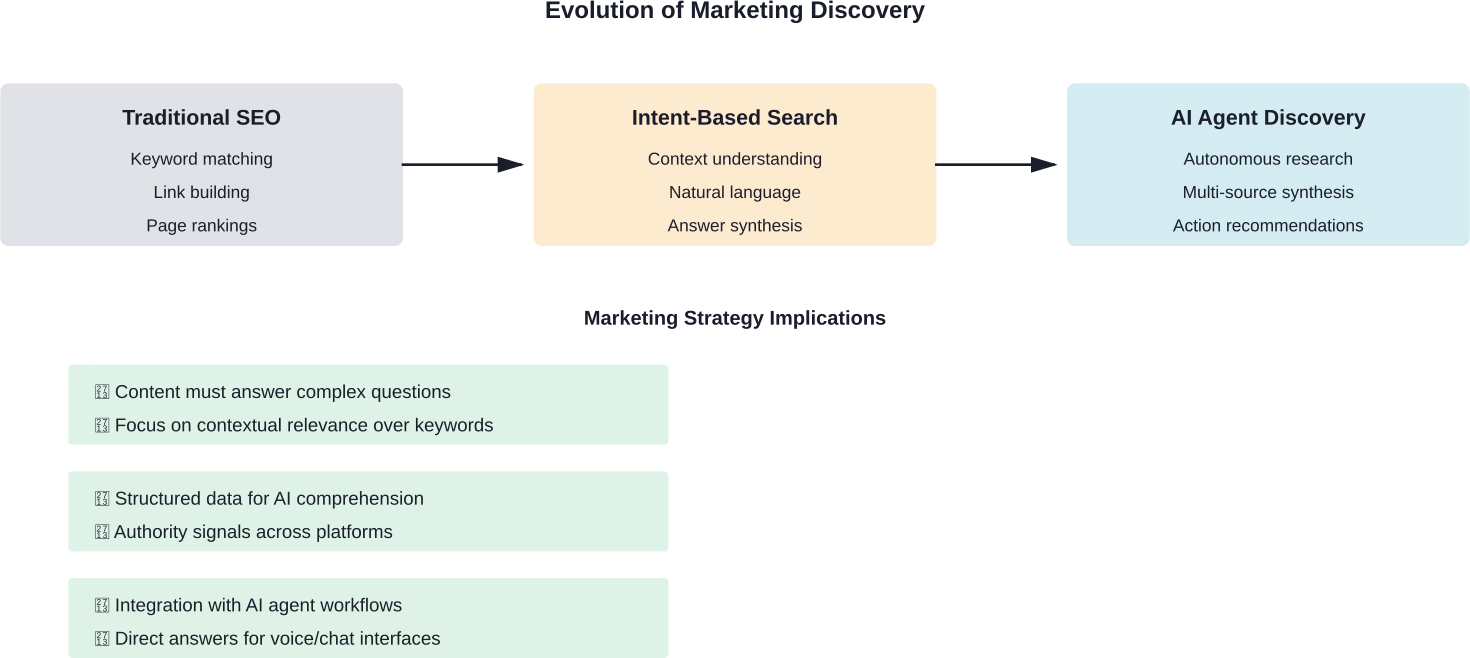
AI marketing agencies need to optimize for AI-powered search engines, not just traditional Google rankings. This means creating content that AI systems can parse, understand, and synthesize into coherent answers.
So how do businesses evaluate AI marketing agencies? Not all agencies claiming "AI-powered" services actually deliver sophisticated AI implementations.
Key evaluation criteria include:
The Federal Trade Commission's enforcement actions demonstrate the importance of verifying AI claims. Agencies that can't articulate specific AI implementations should raise red flags.
Where is this heading? MIT CISR research predicts that rapid advancements in AI will drive business model evolution, with business models in the AI era becoming increasingly outcome-oriented and enabled by autonomous AI.
For marketing agencies, this likely means:
The agencies that thrive won't be those with the most AI—they'll be those that best combine AI capabilities with irreplaceable human expertise.
AI marketing agencies represent a legitimate evolution in how marketing services get delivered. The data shows clear adoption momentum—nearly 90% of marketers have used gen AI tools, and usage continues expanding.
But adoption for its own sake misses the point.
The value of AI marketing agencies comes from combining advanced technology with strategic marketing expertise to deliver outcomes that neither humans nor AI could achieve independently. The best agencies understand that AI handles execution while humans provide judgment, creativity, and strategic direction.
For businesses evaluating whether to work with an AI marketing agency, the question isn't "should we use AI?" It's "what specific marketing challenges can AI help us solve more effectively?"
Start there. Then find an agency that can demonstrate specific AI capabilities matched to those challenges, with proven results and proper safeguards.
The AI marketing revolution is real. But like any revolution, success goes to those who implement thoughtfully, not just quickly.


