Meta Ads Optimization Strategies for Stable Performance and Scale
A practical look at Meta ads optimization strategies that actually hold up in 2026. What to focus on, what to stop doing, and how to adapt.
Feb 10, 2026



Quick Summary: AI transforms marketing through automation, personalization, and data-driven insights. According to the American Marketing Association, nearly 90% of marketers now use generative AI tools like ChatGPT (62%) and Grammarly (58%) to boost productivity. AI enhances customer experiences, automates repetitive tasks, and enables real-time campaign optimization while requiring human oversight for strategy and creativity.
Artificial intelligence has moved from marketing buzzword to essential toolkit component. But here's the thing: most marketers still grapple with understanding where AI fits into their daily workflows.
According to research from the American Marketing Association and Kantar surveying 184 marketers, although professionals are optimistic about AI's implications, understanding of AI capabilities remains limited and usage is still relatively modest. The gap between hype and practical application is real.
That changes now. This guide cuts through the noise to show exactly how marketing teams are deploying AI tools to accomplish real tasks, backed by data from organizations actually using these technologies.
AI in marketing refers to computer-based systems capable of performing and integrating multiple tasks that otherwise require human intelligence. The American Marketing Association notes that AI technologies currently serve as customer-facing agents of firms, as core attributes of interactive products, and are integral in newer marketing applications.
But what does that mean in practice?
McKinsey estimates that AI adoption across the global business landscape increased to 72% as of 2024. Generative AI alone might add as much as USD 4.4 trillion to the global economy annually. These aren't trivial numbers.
Here's what matters: AI isn't replacing marketers. Marketers who effectively use AI are gaining competitive advantages over those who don't. Analysis from Anthropic shows that 57% of AI usage focuses on augmentation—AI assisting workers rather than making them obsolete. The technology handles repetitive tasks while humans focus on strategy and creative direction.
According to the American Marketing Association's September 2024 survey in collaboration with Lightricks, the tools marketers actually use are remarkably diverse:
The diversity reflects how many marketing tasks can benefit from AI assistance. From content creation to customer service, AI tools have infiltrated nearly every marketing function.
Theory is nice. Practice matters more. Here are the proven applications where AI delivers measurable marketing value.
Generative AI has seen widespread adoption for content tasks. According to the American Marketing Association's September 2024 survey in collaboration with Lightricks, nearly 90% of marketers have used generative AI tools at work. The study found that 71% of respondents use gen AI weekly or more.
Content creation AI handles:
But there's a catch. AI gets teams to roughly 80% completion. That final 20%—adding brand voice, strategic insights, and human judgment—makes all the difference. Personalization matters.
Companies are tapping into AI more than ever to interact with consumers in various ways. The American Marketing Association emphasizes that AI technologies serve as customer-facing agents, fundamentally changing how brands engage with audiences.
Practical applications include:
The American Marketing Association notes that behavioral triggers—such as price-drop alerts and re-engagement campaigns—encourage action when users are most likely to convert. Timing becomes precision-focused rather than guesswork.
.avif)
Machine learning excels at pattern recognition in massive datasets. Marketing teams leverage this for:
The advantage? AI processes data volumes impossible for human analysis. Real-time adjustments become feasible rather than aspirational.

A newer but increasingly practical application is predicting ad performance before campaigns go live. Instead of relying only on live A/B testing, teams are starting to evaluate creatives earlier using models trained on historical data. Platforms like Extuitive take this approach by simulating how different concepts might perform based on patterns from past campaigns.
Practical applications include:
This doesn’t eliminate testing entirely. It shifts part of the process earlier, where mistakes are cheaper and easier to adjust.
Automation frees marketers from repetitive tasks. AI-powered tools handle:
The Federal Trade Commission filed suit in June 2024 against FBA Machine and Bratislav Rozenfeld, alleging that in a business opportunity scheme, they falsely guaranteed that consumers could make money operating online storefronts using AI-powered software. The lesson? Automation works, but unrealistic promises about AI capabilities persist. Maintain realistic expectations.
Knowing what AI can do matters less than knowing how to integrate it into existing workflows. Here's a practical framework.
Start with tasks that are:
Good first candidates include social media caption drafts, email subject line variations, basic customer inquiry responses, and initial data analysis reports. Bad first candidates include strategic planning, brand positioning, and high-stakes customer communications.
Don't chase features. Match tools to specific problems.
For content creation, chatbots like ChatGPT lead adoption at 62% usage. For writing quality, Grammarly claims 58% of the market according to the American Marketing Association data. For analytics, specialized platforms dominate.
Test tools with limited scope before enterprise-wide deployment. Many platforms offer free tiers—use them.
AI quality depends entirely on input quality. Poor prompts generate poor outputs.
Effective prompts include:
Compare these prompts:
Weak: "Write a blog post about our product."
Strong: "Write a 500-word blog post introducing our project management software to small business owners with 5-15 employees. Focus on time-saving benefits. Use a conversational but professional tone similar to this example: [paste example]. Include a call-to-action for a free trial."
The difference in output quality is dramatic.
AI generates drafts, not finals. Establish workflows where:
The Federal Trade Commission has emphasized privacy and confidentiality commitments for AI companies. Data at the heart of AI development must be handled responsibly. Ensure AI tools comply with privacy regulations and company policies.
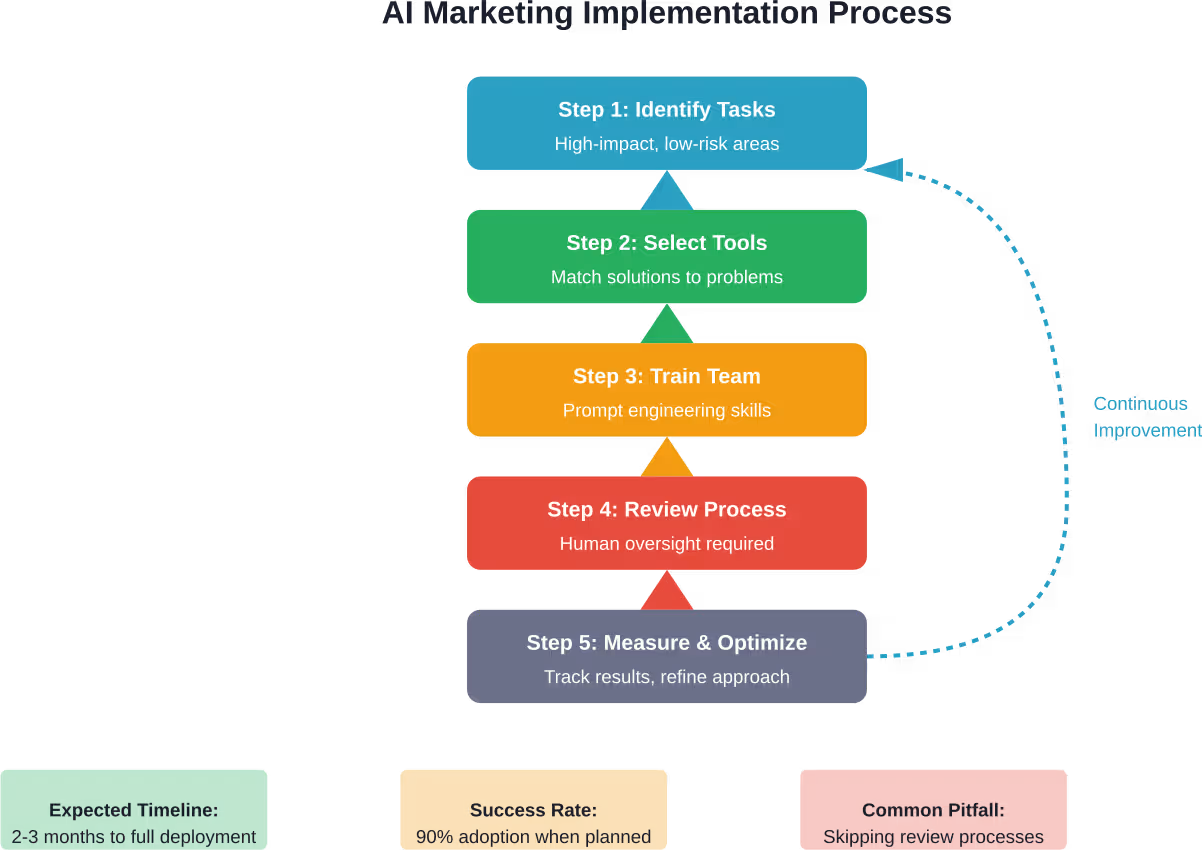
Track metrics that matter:
Adjust based on data, not assumptions. What works for one team might not work for another.
The Federal Trade Commission launched Operation AI Comply in September 2024, announcing five law enforcement actions against operations using AI hype or selling AI technology that can be used in deceptive and unfair ways. Regulatory scrutiny is increasing.
The National Institute of Standards and Technology (NIST) developed an AI Risk Management Framework to cultivate trust in AI technologies and promote AI innovation while mitigating risk.
Marketing teams should:
The FTC has been clear: AI companies must uphold privacy and confidentiality commitments. Marketing departments using these tools inherit those responsibilities.
Based on community discussions and user experiences, these mistakes appear frequently:
AI isn't appropriate for every marketing task. Avoid using AI for:
Knowing when not to use AI demonstrates strategic thinking, not technophobia.
What separates successful AI adoption from failed experiments? Patterns emerge from organizations that have implemented AI effectively.
Organizations that succeed typically begin with pilot programs in single departments or for specific tasks. They measure results rigorously before expanding.
The American Marketing Association research shows that while 90% of marketers have used generative AI, understanding remains limited. Organizations bridging that gap through focused training and gradual expansion see better outcomes.
The most effective applications pair AI efficiency with human judgment. AI handles data processing, content drafts, and pattern recognition. Humans provide strategic direction, quality control, and creative refinement.
This hybrid approach leverages the strengths of both while compensating for the weaknesses of each.
AI should improve customer experiences, not just internal efficiency. The American Marketing Association emphasizes that companies use AI to interact with consumers in various ways—from chatbots to personalized product recommendations.
The question isn't "Can we use AI here?" but rather "Does AI help us serve customers better here?"
AI marketing capabilities are evolving rapidly. Harvard reports that AI presents marketers with a variety of opportunities to personalize customer experiences and build technological skills.
Several developments are reshaping what's possible:
The American Marketing Association notes that generative AI has fostered high confidence among users while raising lingering concerns. Balancing enthusiasm with caution remains critical.
As AI handles more tactical execution, human marketers need to develop:
The marketing tech landscape is changing fast. Continuous learning isn't optional anymore.
.avif)
AI in marketing has moved beyond the experimental phase. With 90% of marketers already using generative AI tools, the question isn't whether to adopt AI but how to do it effectively.
Start with these concrete actions:
Audit current marketing tasks to identify time-consuming, repetitive work suitable for AI assistance. Focus on low-risk areas where errors are easily caught and corrected.
Select one AI tool that addresses a specific pain point rather than trying to implement comprehensive solutions immediately. Test with free or trial versions before committing budgets.
Develop prompt engineering skills through practice and experimentation. The quality of AI outputs depends entirely on input quality—invest time learning effective prompting techniques.
Establish review workflows ensuring human oversight of all AI-generated content before publication. This protects brand integrity while allowing AI efficiency gains.
Measure results rigorously against baseline performance metrics. Data-driven decisions beat assumptions every time.
The American Marketing Association's research shows that although marketers are optimistic about AI's future, understanding of capabilities remains limited. Close that gap through continuous learning and thoughtful implementation.
AI won't replace marketers. Marketers who effectively use AI are gaining competitive advantages over those who don't. The technology exists. The adoption patterns are clear. The competitive advantage goes to teams that master AI integration while maintaining strategic human oversight.
Ready to transform marketing workflows? Start small, measure everything, and scale what works. The future of marketing isn't purely human or purely AI—it's the strategic combination of both.


