Smart Ads for Your Shopify Store That Doesn’t Burn Cash
Learn how to run effective Shopify ads without wasting your budget. Get real strategies, tools, and insights that drive actual results.
Jan 6, 2026



AI will not fully replace marketing professionals but will fundamentally transform the field by automating repetitive tasks while human creativity, strategic thinking, and emotional intelligence remain irreplaceable. According to the American Marketing Association's 2026 Future Trends report, while AI will automate much of transactional marketing, human creativity, cultural fluency, and authentic storytelling will become the primary differentiators for brands.
The question keeps marketers up at night: will artificial intelligence replace their jobs entirely?
It's a legitimate concern. When OpenAI CEO Sam Altman claims that AGI will handle 95% of tasks currently performed by marketing agencies, strategists and creative professionals, alarm bells ring across the industry. But here's the thing—predictions about technology replacing entire professions have a complicated history.
Marketing as a profession isn't disappearing. It's evolving faster than most anticipated.
The Bureau of Labor Statistics projects total employment will grow from 170.0 million in 2024 to 175.2 million in 2034, an increase of 3.1 percent. While this growth is slower than the previous decade, AI's impact varies dramatically across different occupations and sectors. Some marketing roles face significant disruption while others are experiencing unprecedented demand.
Real talk: AI is already embedded in marketing workflows. Nearly 90% of marketers have used generative AI tools according to a September 2024 survey conducted by the American Marketing Association in collaboration with Lightricks. That's not a future trend—it's the current reality.
The more pressing question isn't whether AI will replace marketing entirely. It's which aspects of marketing will be automated, which will be augmented, and what new skills professionals need to remain competitive.
AI isn't coming for marketing jobs uniformly. Certain tasks and roles face more disruption than others.
The Bureau of Labor Statistics identifies that AI primarily affects occupations whose core tasks can be most easily replicated by generative AI in its current form. For marketing, this means repetitive, structured work gets automated first.
Content generation tools have fundamentally changed how marketers produce written material. Chatbots like ChatGPT are the most popular tool for content generation, with 62% of marketers using them at work, according to an American Marketing Association survey conducted with Lightricks in September 2024. Close behind are AI-powered tools like Grammarly at 58% adoption.
But it goes deeper than writing assistance.
AI handles data analysis that previously required dedicated analysts. Predictive analytics platforms process customer behavior patterns, forecast campaign performance, and identify trends without human intervention. Tasks that once consumed hours of manual work—segmenting audiences, A/B testing variations, optimizing ad spend—now happen automatically.
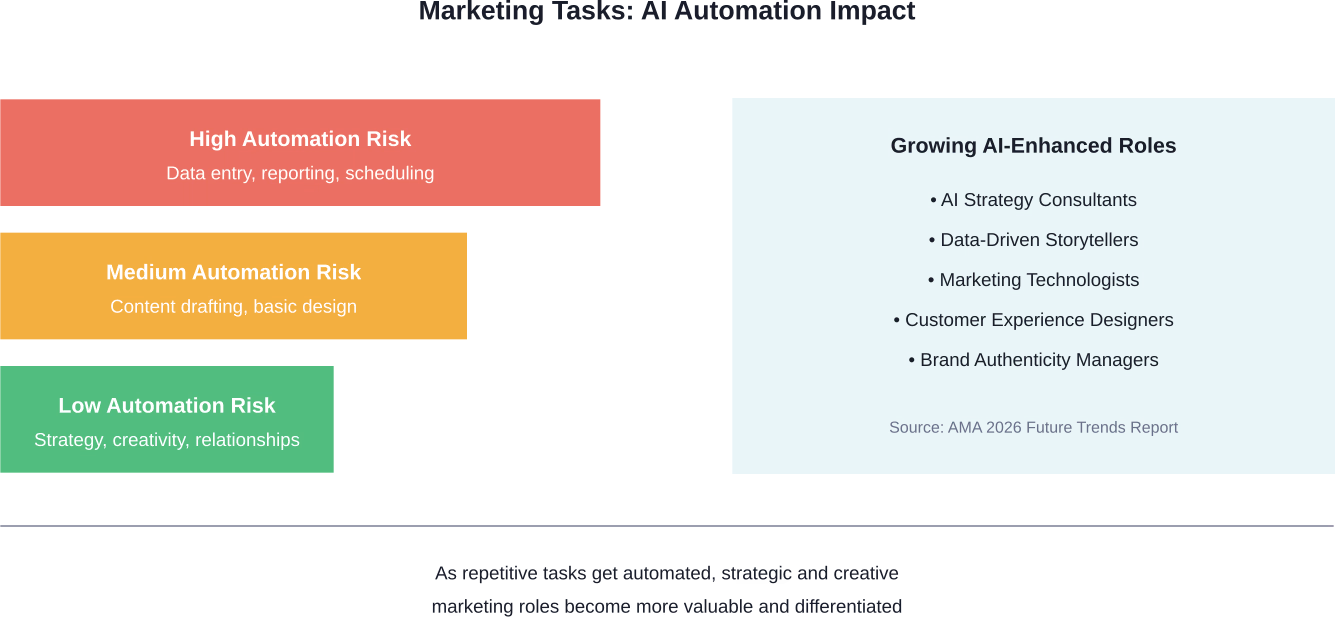
Social media scheduling, basic graphic design, email campaign optimization, and performance reporting have all been substantially automated. These weren't particularly creative tasks to begin with. They were necessary but repetitive.
Here's where things get uncomfortable for early-career professionals.
A Harvard University study tracking 62 million workers across 285,000 US firms found junior positions "shrinking at companies integrating AI" since 2023. The researchers warn that AI is "eroding the 'bottom rungs' of career ladders" by automating many "intellectually mundane tasks" that junior employees traditionally handled.
Entry-level marketing coordinators who primarily managed spreadsheets, compiled reports, and executed predefined social media calendars face the most immediate pressure. These roles served as training grounds where professionals learned the fundamentals while contributing operational value.
Now those training grounds are shrinking.
Research by Suraj Srinivasan at Harvard Business School finds that employers are seeking more AI-related skills in certain fields while demand for structured and repetitive tasks is waning. The largest reductions were observed in the finance and technology sectors.
Now for the good news.
AI has glaring limitations that create permanent space for human marketing professionals. These aren't temporary gaps that will close with better algorithms—they're fundamental constraints tied to what marketing actually accomplishes.
AI processes data. Marketers understand business context.
An AI can analyze which email subject lines generated higher open rates, but it can't determine whether a campaign aligns with long-term brand positioning or might alienate a key customer segment six months from now. It doesn't grasp organizational politics, competitive dynamics, or market timing in ways that require genuine business judgment.
Strategy involves making bets with incomplete information. It requires understanding not just what the data shows, but what the data might be missing. AI optimizes within defined parameters—humans set those parameters in the first place.
The American Marketing Association's 2026 Future Trends report emphasizes that human creativity, cultural fluency, and authentic storytelling will become the primary differentiators for brands as AI handles transactional marketing.
AI-generated content can be grammatically perfect and statistically optimized while being utterly forgettable. It lacks genuine voice, cultural nuance, and the ability to take creative risks that define breakthrough campaigns.
Real creativity isn't recombining existing patterns—it's recognizing which conventions to break and when. It's understanding cultural moments, reading emotional undercurrents, and crafting messages that resonate on human levels AI fundamentally cannot access.
Can AI write a punchy headline? Absolutely. Can it conceive a campaign that becomes part of cultural conversation? That's a different question entirely.
Marketing isn't just broadcasting messages. It's building relationships.
Client services, stakeholder management, partnership negotiations, and customer relationship development all require emotional intelligence, trust-building, and interpersonal skills that AI cannot replicate. A chatbot can handle basic customer service inquiries, but it can't navigate a complex B2B sales process or repair a damaged client relationship.
According to academic research, up to 4 in 5 employers now prioritize hiring AI-skilled talent, but 75% of those employers struggle to find workers with the necessary creative and strategic capabilities alongside technical skills. The gap isn't in AI literacy—it's in combining AI competence with distinctly human capabilities.
AI tools have repeatedly demonstrated ethical blind spots. They perpetuate biases present in training data, generate content that misrepresents facts, and lack judgment about appropriate messaging for sensitive contexts.
Marketers must make ethical decisions about data usage, message framing, and customer manipulation. These decisions carry legal, reputational, and moral weight that requires human accountability. When an AI-generated campaign crosses ethical lines, a human marketing professional answers for it.
Brand stewardship—protecting and evolving brand identity across changing cultural landscapes—requires judgment that AI doesn't possess.
Marketing jobs aren't disappearing. They're being redefined.
The shift resembles what happened when digital cameras replaced film. The Bureau of Labor Statistics notes that despite the absence of historical data showing employment declines for photographic process workers initially, the agency projected employment declines based on the speed and maturation of technological change. They were right—but photography as a field didn't disappear. It transformed.
Marketing is experiencing a similar transformation, just much faster.
New marketing positions combine technical AI literacy with traditional marketing expertise. These roles didn't exist five years ago and are now among the fastest-growing positions:
These positions command premium salaries precisely because they bridge technical and creative domains. The Bureau of Labor Statistics notes that AI may support demand for computer occupations, as software developers are needed to develop AI-based business solutions and maintain AI systems.
The same pattern applies in marketing—professionals who can both leverage AI tools and apply marketing expertise become increasingly valuable.
Even established marketing positions are being redefined by AI capabilities.
Content marketers now spend less time writing first drafts and more time refining AI-generated content, adding strategic framing, and ensuring brand voice consistency. Social media managers use AI for scheduling and basic engagement while focusing their energy on community building and crisis management. Marketing managers increasingly function as orchestrators of AI tools rather than executors of manual tasks.
The work hasn't disappeared—it's shifted up the value chain.
Waiting isn't a strategy. The marketing professionals adapting successfully aren't passive observers—they're actively reshaping their skills and positioning.
Understanding AI doesn't require becoming a data scientist. It requires hands-on experience with tools that are reshaping marketing work.
Start using generative AI tools daily. ChatGPT, Claude, and similar platforms should become as familiar as email clients. Experiment with AI-powered design tools, analytics platforms, and automation software. The goal isn't mastery of every tool—it's developing intuition for what AI handles well and where it falls short.
Digital literacy and AI skills are fast becoming non-negotiables for marketers. Understanding prompt engineering, recognizing AI limitations, and knowing when to override AI recommendations separates competent practitioners from those being left behind.

Marketing work is also shifting in when decisions get made, not just how. Instead of relying entirely on post-launch results, more teams are starting to evaluate ideas earlier in the process using predictive modeling.
Tools like Extuitive take historical campaign data and simulate how new creatives or concepts might perform before any budget is spent. Rather than running dozens of variations in the real world, teams can now filter out weaker ideas upfront and focus their budget and effort on concepts that already show stronger predicted performance.
This doesn’t eliminate real-world testing, but it significantly reduces wasted spend and speeds up the iteration cycle. For marketers, this means shifting part of their role from reacting to results toward making more informed, data-backed decisions at the strategy stage.
As AI commoditizes technical execution, human skills become differentiators.
Invest in strategic thinking capabilities. Learn frameworks for business strategy, competitive analysis, and market positioning. Develop storytelling skills that go beyond formulaic content—study narrative structure, cultural analysis, and persuasion psychology.
Cultivate emotional intelligence and relationship management abilities. These soft skills matter more as technical skills become table stakes. The ability to understand unspoken client needs, navigate organizational dynamics, and build authentic customer connections becomes increasingly valuable.
Work on creative risk-taking. AI optimizes for statistical likelihood—breakthrough marketing often requires going against what data suggests. Developing confidence to make unconventional creative choices becomes a rare and valuable capability.
Marketing professionals need to articulate value beyond task execution.
Instead of positioning as someone who "manages social media," reframe as someone who "develops brand communities that drive customer loyalty." Rather than "creating email campaigns," focus on "designing customer journey strategies that improve lifetime value."
The shift is from tactical execution to strategic outcomes. AI can handle tactics—strategic judgment and business impact remain human domains.
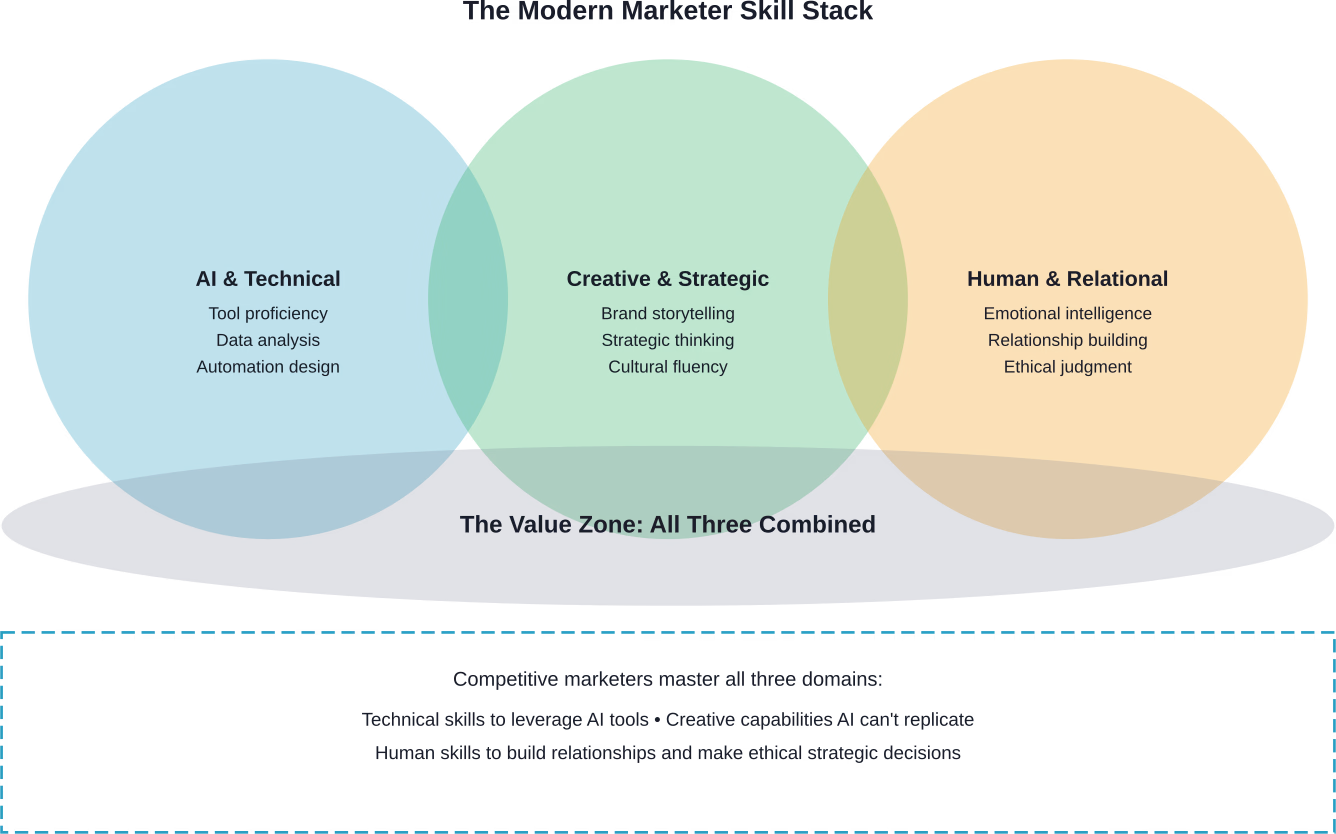
Successful marketing professionals in the AI era combine technical proficiency, creative strategy, and human relationship skills.
Historical perspective helps here.
When marketing automation platforms first emerged, some predicted the death of email marketing roles. Instead, email marketing became more sophisticated, more personalized, and more effective. The role evolved rather than disappeared.
When social media exploded, traditional marketers worried their skills were obsolete. Instead, principles of brand building, audience understanding, and strategic communication became more important—just applied in new channels.
AI represents a more significant shift than those transitions. But the pattern holds: technology changes how marketing work gets done without eliminating the need for marketing judgment.
Look beyond the alarming headlines about AI replacement.
The Bureau of Labor Statistics employment projections show nuanced impacts. While certain occupations face pressure, others are growing. The global digital marketing spending is projected to reach $786.2 billion by 2026 according to industry analysis. That's not a shrinking field—it's expanding rapidly even as AI transforms workflows.
The American Marketing Association survey data reveals that while nearly 90% of marketers use generative AI, confidence in the technology remains qualified. Marketers recognize both the productivity gains and the limitations. Most see AI as augmentation rather than replacement.
Employment isn't disappearing—it's being redistributed. Junior tactical roles shrink while strategic and specialized positions grow. The total number of marketing jobs may remain relatively stable even as the nature of those jobs changes substantially.
We're not in an AI replacement phase. We're in an integration and experimentation phase.
Organizations are figuring out which AI tools actually deliver value versus which are overhyped. Marketing teams are learning through trial and error where AI enhances work and where it creates more problems than it solves. The technology is being incorporated into workflows rather than replacing those workflows entirely.
This phase creates opportunity for professionals who engage actively rather than defensively. The marketers defining best practices, identifying effective use cases, and developing hybrid skills are positioning themselves as valuable guides during an uncertain transition.
AI's effect on marketing varies substantially across industries and marketing specializations.
B2B marketing faces significant AI disruption in lead scoring, account-based marketing automation, and content personalization. AI platforms can analyze buyer behavior patterns, predict purchase likelihood, and automate outreach sequences with minimal human intervention.
But the consultative, relationship-driven aspects of B2B marketing remain deeply human. Complex enterprise sales cycles involving multiple stakeholders, customized solutions, and long-term partnership development resist automation. The B2B marketers thriving in this environment combine AI-powered analytics with relationship management expertise.
Consumer-facing marketing sees perhaps the most extensive AI adoption. Product recommendations, dynamic pricing, programmatic advertising, and personalized email campaigns are increasingly automated.
Yet brand differentiation becomes harder in this AI-optimized environment. When every competitor uses similar AI tools optimizing for similar metrics, authentic brand voice and creative differentiation matter more. The e-commerce brands winning aren't just those with the best AI implementation—they're those combining AI efficiency with compelling brand stories.
Sam Altman's claim that AI will handle 95% of agency work targets this sector specifically. Creative agencies face real pressure as AI tools generate design variations, write copy, and produce video content at unprecedented speed and minimal cost.
However, the 95% figure conflates task automation with value delivery. An agency's value isn't in producing deliverables—it's in strategic insight, creative direction, and brand stewardship. The agencies adapting successfully are repositioning around strategic consulting and creative leadership while using AI to enhance execution efficiency.
Marketing isn't being replaced by AI. It's being redefined.
The distinction matters because it changes how professionals should respond. Panic and resistance accomplish nothing. Active adaptation and strategic skill development create opportunity.
The marketing professionals who thrive over the next decade won't be those who resist AI or those who blindly embrace it. They'll be those who develop a clear-eyed understanding of where AI adds value and where human judgment remains essential. They'll combine technical proficiency with creative capabilities and strategic thinking that AI fundamentally cannot replicate.
This transition creates genuine challenges, particularly for early-career professionals entering a field where traditional entry points are shrinking. But it also creates space for those willing to develop hybrid skills that few possess—the combination of AI literacy, marketing expertise, and distinctly human capabilities.
The question isn't whether marketing will be replaced by AI. It's whether individual marketing professionals will adapt fast enough to remain valuable in a rapidly evolving field.
Those who act now—building AI skills, deepening strategic capabilities, and repositioning around irreplaceable human value—will find themselves increasingly in demand. Those who wait will find the gap harder to close with each passing month.
The transformation is already underway. The only remaining question is which side of it professionals choose to be on.


