Local Instagram Marketing Agency: Finding the Right Partner
Looking for a local Instagram marketing agency? This guide explains what they do, how they help businesses grow, and which agencies to consider.
Mar 20, 2026



AI is fundamentally transforming marketing through advanced personalization, predictive analytics, automated content creation, and data-driven customer engagement. According to academic research from institutions like Harvard and Missouri State University, AI enables marketers to offer more customized experiences while improving efficiency. However, as highlighted by the FTC's enforcement actions and consumer research showing 45% prioritize data control, ethical implementation and transparency remain critical for success.
Marketing stands at a transformative inflection point. Artificial intelligence isn't just another technology trend—it's reshaping how businesses understand customers, create content, and drive growth.
According to consultancy McKinsey, as of 2024, AI adoption across the global business landscape increased to 72%. And the impact? Potentially massive. Generative AI might add as much as USD 4.4 trillion to the global economy annually, according to McKinsey estimates.
But here's the thing: that headline number doesn't tell the full story. The real question isn't whether AI will impact marketing—it's how marketers can harness these capabilities while navigating ethical considerations and consumer expectations.
AI has moved well beyond pilot programs and experimental phases. Marketing teams are deploying AI technologies across multiple functions, from customer service chatbots to sophisticated predictive models.
Dr. Ismet Anitsal, head of the marketing department at Missouri State University, notes that "AI is fundamentally reshaping marketing, offering more efficient, personalized and data-driven approaches to customer engagement."
The technologies driving this transformation include machine learning algorithms, natural language processing, computer vision, and increasingly, generative AI systems. These tools analyze consumer behavior patterns, automate routine tasks, and generate content at scales impossible for human teams alone.
Real talk: the acceleration has been stunning. What took years of development in traditional marketing technologies has condensed into months with AI advancement.
Perhaps no area demonstrates AI's marketing impact more clearly than personalization. Customers increasingly expect brands to understand their preferences, anticipate needs, and deliver relevant experiences.
AI makes this possible at an unprecedented scale. Machine learning algorithms process vast datasets—purchase history, browsing behavior, demographic information, engagement patterns—to create detailed customer profiles and predict future actions.
Harvard research emphasizes that "AI presents marketers with a variety of opportunities to personalize customer experiences." This goes beyond simply inserting a customer's name in an email. AI enables dynamic content recommendations, personalized pricing strategies, customized product suggestions, and tailored messaging across channels.
Consider how streaming platforms curate individual playlists or how e-commerce sites adjust homepage displays based on browsing history. These aren't manual processes—they're AI systems making millions of micro-decisions daily.
The shift from broad demographic targeting to individual-level personalization represents a fundamental change in marketing strategy. And AI provides the computational power to make it operational.
Understanding what customers might do next has always been marketing's holy grail. AI-powered predictive analytics brings that goal closer to reality.
These systems analyze historical data to forecast future behaviors: which customers are likely to churn, which prospects have the highest conversion probability, what products a customer might purchase next, when engagement is most likely to occur.
According to research published in the Journal of Applied Business Research, AI enables "more efficient, personalized and data-driven approaches" by processing patterns humans might miss. The algorithms identify subtle correlations across massive datasets that reveal behavioral triggers and decision patterns.
This capability transforms marketing from reactive to proactive. Instead of responding to customer actions, marketers can anticipate needs and intervene at optimal moments.
The applications span industries. Financial services firms predict which customers need specific products. Retailers forecast inventory needs based on emerging trends. B2B companies identify accounts showing buying signals.
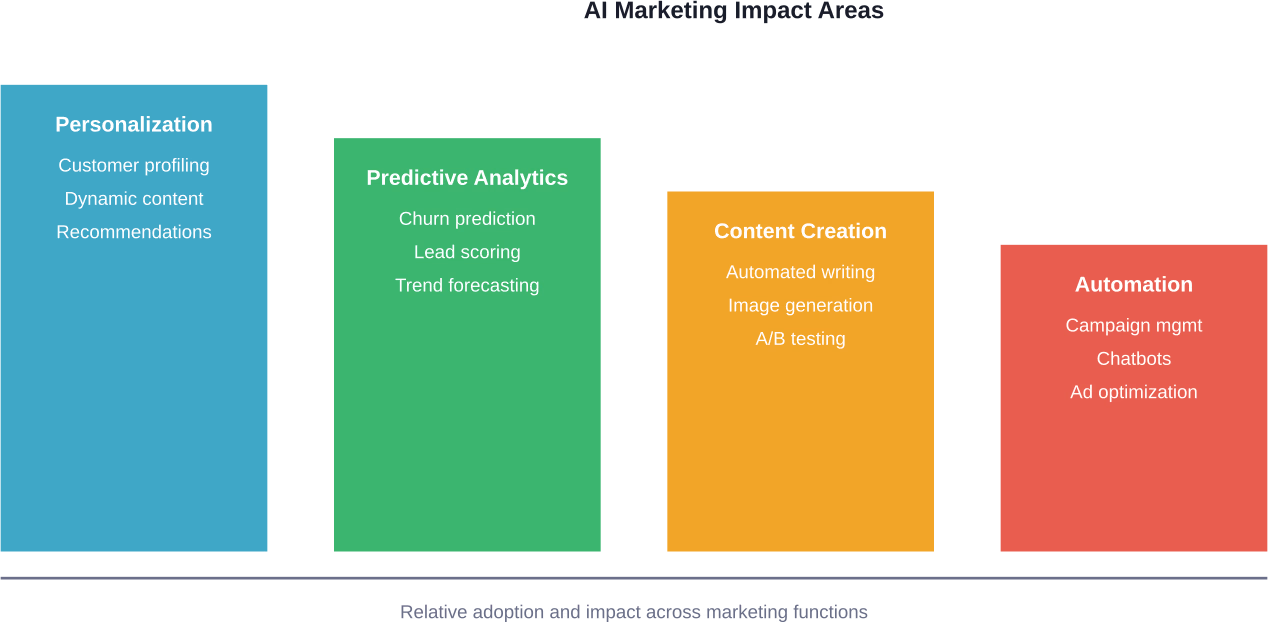
Generative AI has dramatically altered content production workflows. Large language models can draft blog posts, social media updates, email campaigns, product descriptions, and ad copy in seconds.
This doesn't mean AI replaces human creativity. Rather, it handles routine content tasks, generates initial drafts, creates variations for testing, and scales production beyond human capacity.
The efficiency gains are substantial. Marketing teams can test dozens of headline variations, personalize email content for different segments, and maintain consistent publishing schedules without proportional increases in headcount.
But quality control remains essential. AI-generated content requires human oversight to ensure accuracy, brand voice alignment, and strategic coherence. The most effective approach combines AI's generative capacity with human editorial judgment.
Beyond text, AI tools now generate images, videos, and audio content. These capabilities are expanding creative possibilities while reducing production costs and timelines.
Chatbots and virtual assistants have evolved from frustrating automated systems to sophisticated conversational interfaces. Modern AI-powered customer service tools understand context, handle complex queries, and escalate appropriately to human agents.
These systems provide 24/7 availability, instant responses, and consistent service quality. They handle routine inquiries—order tracking, basic troubleshooting, FAQ responses—freeing human agents for complex issues requiring empathy and judgment.
The FTC has taken notice of the proliferation of AI chatbots. In September 2025, the agency launched an inquiry into AI chatbots acting as companions, issuing orders to seven companies seeking information on how these firms measure, test, and monitor potentially negative effects.
This regulatory attention highlights both AI's growing role in customer interaction and the need for responsible deployment. Conversational AI must balance efficiency with transparency about its automated nature.
AI excels at processing enormous datasets to extract actionable insights. Marketing analytics platforms now incorporate machine learning to identify trends, attribute conversions, optimize spending, and recommend strategic adjustments.
These systems analyze performance across channels, time periods, and customer segments with granularity impossible through manual analysis. They detect patterns indicating which tactics drive results and which waste resources.
The shift toward data-driven marketing isn't new, but AI dramatically enhances analytical capabilities. Marketers can move beyond reporting what happened to understanding why it happened and what to do next.
That said, data quality remains foundational. AI systems trained on flawed, biased, or incomplete data produce unreliable outputs. Garbage in, garbage out still applies—perhaps more critically with AI's automated decision-making.

One area that’s starting to shift quietly is how teams approach testing. Traditionally, marketers rely on A/B testing after campaigns go live, using real performance data to decide what works. That process still matters, but it’s also slow and often expensive.
Some teams are beginning to move part of that decision-making earlier. Platforms like Extuitive use predictive models trained on historical campaign data to estimate how different creatives might perform before they’re launched. Instead of treating every variation as an experiment that needs a budget behind it, marketers can narrow down options in advance.
This doesn’t eliminate testing, but it changes its role. Instead of testing everything, teams focus on validating stronger candidates. The result is a more controlled workflow, where fewer decisions depend entirely on trial and error, especially in environments where creative volume is high and iteration cycles are short.
According to the Adobe 2025 AI and Digital Trends report, 45% of consumers say visibility and control over their data is a top priority when engaging with brands—a clear mandate for transparency. This creates a clear mandate for transparency in AI deployment.
Research from Washington State University's Carson College of Business found that 75% of Americans believe businesses committed to ethical marketing practices are more likely to succeed long-term. However, the research shows more than half (69%) of the 1,000 American adults surveyed think businesses aren't really improving in the area of ethical marketing.
The Federal Trade Commission has actively enforced against deceptive AI claims. In March 2026, Air AI and its owners were banned from marketing business opportunities after allegedly misleading entrepreneurs about AI-powered business growth and earnings potential.
These enforcement actions signal that regulatory scrutiny will intensify. Marketers must ensure AI claims are substantiated, customer data is protected, and automated systems don't discriminate or deceive.
Building consumer trust requires transparency about AI use, clear privacy policies, opt-out mechanisms, and demonstrable data security. The technical capabilities matter less if customers don't trust how they're deployed.
According to BCG, nearly three-quarters of CEOs say that they are their organization's main decision maker on AI, twice the share as last year. This executive attention reflects AI's strategic importance beyond tactical applications.
For marketing leaders, AI represents an opportunity to reinvent operating models entirely. BCG research emphasizes that "Marketing leaders who focus on isolated tools or pure efficiency gains are missing the bigger picture."
The strategic shift involves moving from campaign-focused tactics to integrated AI-powered customer engagement systems. This requires new capabilities, organizational structures, technology infrastructure, and performance metrics.
CMOs must balance multiple priorities: driving immediate results through AI tools, building long-term AI capabilities, managing ethical risks, and developing team skills.
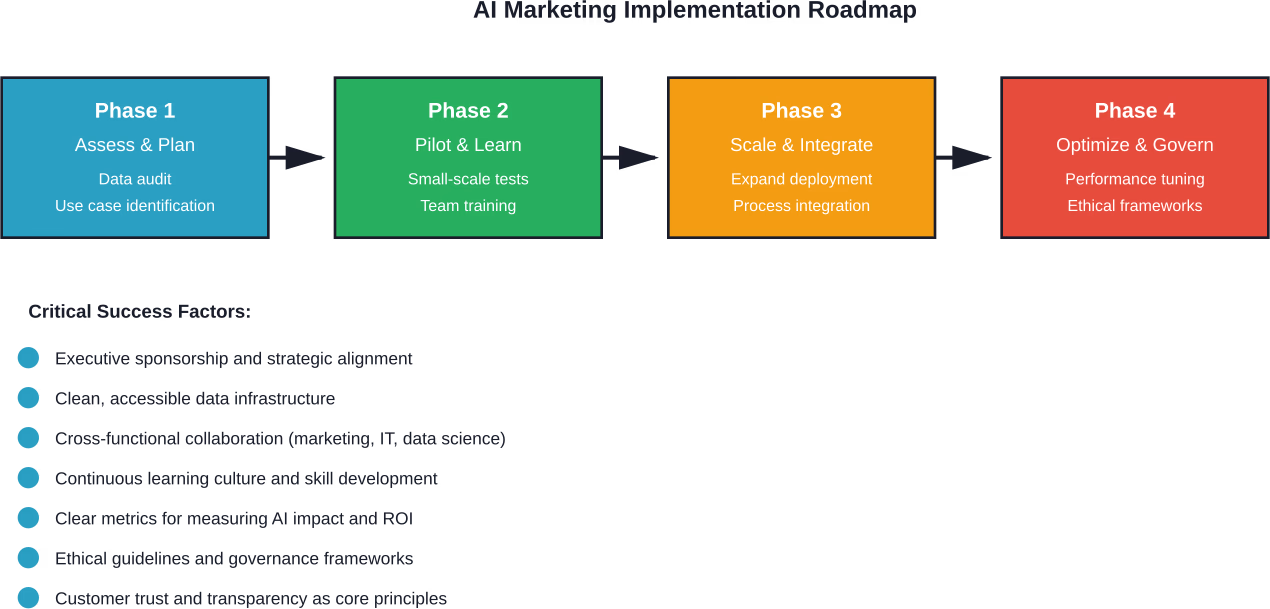
Successful AI adoption requires more than technology procurement. Organizations need data infrastructure, technical expertise, process redesign, and cultural adaptation.
Harvard research notes that AI "presents marketers with opportunities to build their technological skills." This learning imperative extends across marketing teams, not just technical specialists.
Marketers need to understand AI capabilities and limitations, interpret algorithmic outputs, design effective human-AI workflows, and make strategic decisions about AI deployment.
Many organizations face a capability gap. According to BCG's 2025 survey of finance executives, only 45% of executives can quantify ROI from their AI initiatives.
The solution involves structured learning programs, hands-on experimentation, cross-functional collaboration with data science teams, and realistic expectations about implementation timelines.
Looking ahead, AI capabilities will continue advancing rapidly. Agentic AI—systems that can act autonomously on behalf of users—represents the next frontier.
According to the American Marketing Association, agentic AI is "a new kind of collaborator" that's "redefining how we think about customer experiences, creativity, and scale."
This evolution extends beyond tools that assist marketers to systems that independently execute tasks, make decisions within defined parameters, and interact directly with customers and other AI agents.
Harvard Business Review research highlights that AI is driving two concurrent revolutions: conversational AI displacing traditional search as how people discover products, and AI agents beginning to act as buyers, making purchasing decisions on behalf of humans.
This shift from search engine optimization to what researchers call "generative engine optimization" favors brands whose information is structured, trusted, and easy for AI systems to synthesize.
Marketing must adapt to a world where customers may be machines with their own decision logic, requiring entirely new content strategies, infrastructure designs, and engagement approaches.
AI's impact on marketing extends far beyond automation and efficiency gains. The technology is fundamentally reshaping customer engagement, content creation, data analysis, and strategic decision-making.
The opportunities are substantial: hyper-personalized experiences at scale, predictive insights that anticipate customer needs, content production capabilities that dramatically expand creative capacity, and analytical power that drives more effective resource allocation.
But realizing these benefits requires thoughtful implementation. Data infrastructure must be solid. Teams need new skills. Ethical frameworks must guide deployment. And customer trust must remain central to every AI application.
Organizations that treat AI as merely a cost-cutting tool miss its transformative potential. Those that combine AI's computational power with human creativity, strategic thinking, and ethical judgment will gain competitive advantages in an increasingly AI-powered marketplace.
The question isn't whether AI will impact marketing—that's already happening. The question is whether marketing leaders will proactively shape that impact or reactively respond to it. Now is the time to build capabilities, establish governance, and position organizations for the AI-transformed marketing landscape ahead.


