Top Shopify Marketing Agencies in Phoenix: How to Choose the Right Partner
A practical roundup of top Shopify marketing agencies in Phoenix, plus what to look for in SEO, ads, CRO, and Shopify-specific growth support.
Feb 11, 2026



AI marketing uses artificial intelligence technologies like machine learning, natural language processing, and predictive analytics to automate decisions, personalize customer experiences, and optimize marketing campaigns. It enables marketers to analyze vast amounts of data, predict customer behavior, create targeted content, and improve ROI through intelligent automation and data-driven insights.
Artificial intelligence has moved from science fiction to marketing departments worldwide. And it happened fast.
According to the American Marketing Association's September 2024 survey, nearly 90% of marketers have used generative AI tools at work. That's not a future trend. That's the current reality.
But what exactly is AI marketing? It's more than chatbots and automated emails. It's a fundamental shift in how marketing teams make decisions, understand customers, and deliver experiences at scale.
This guide breaks down AI marketing from the ground up—what it is, how it works, and why it matters for modern marketing teams.
AI marketing refers to the use of artificial intelligence technologies to make automated decisions based on data collection, data analysis, and additional observations of audience or economic trends.
Here's the thing though—it's not about replacing human marketers. It's about augmenting their capabilities with machine intelligence that can process information at scales humans simply can't match.
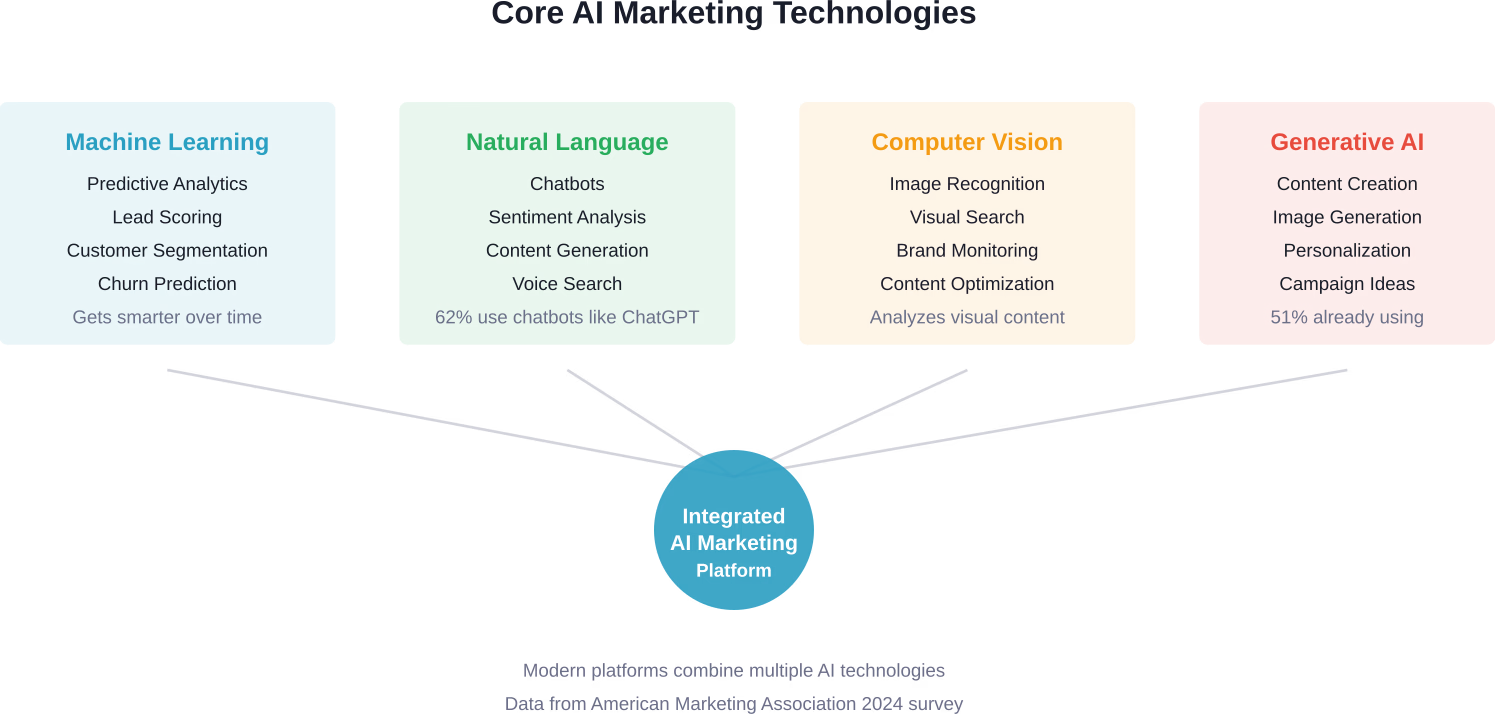
At its core, AI marketing combines several technologies: machine learning algorithms that improve through experience, natural language processing that understands human language, predictive analytics that forecast future behaviors, and computer vision that interprets visual content.
These technologies work together to analyze customer data, identify patterns, predict outcomes, and execute marketing tasks with minimal human intervention.
Traditional marketing relies heavily on human analysis, intuition, and manual execution. Marketers segment audiences based on broad demographics. They test campaigns through trial and error. They analyze results after the fact.
AI marketing flips this approach. It processes millions of data points in real time. It identifies micro-segments based on behavior patterns. It optimizes campaigns while they're running. It predicts which customers will convert before they even visit a website.
The speed and scale are fundamentally different. What took weeks now happens in minutes.
Several distinct AI technologies power modern marketing platforms. Understanding these helps clarify what AI marketing can actually do.
Machine learning algorithms learn from historical data to make predictions about future outcomes. In marketing, this means predicting which leads will convert, which customers will churn, which products a customer will buy next, or which email subject lines will drive opens.
These systems get smarter over time. Each campaign provides new data. Each customer interaction refines the model. The predictions become more accurate with use.
Natural language processing (NLP) enables machines to understand, interpret, and generate human language. This powers chatbots that handle customer service, sentiment analysis tools that gauge brand perception, content generation systems, and voice search optimization.
According to the American Marketing Association's survey, 62% of marketers use chatbots like ChatGPT for content generation at work. AI-powered tools like Grammarly, which 58% of marketers use, employ NLP to improve writing quality.
Computer vision allows AI to interpret visual content—images, videos, and graphics. Marketing applications include analyzing social media images for brand mentions, optimizing visual content for engagement, automated image tagging, and visual search capabilities.
Generative AI represents the newest wave of AI marketing technology. These systems create new content—text, images, video, or audio—based on patterns learned from training data.
The technology has seen explosive adoption. According to Salesforce's 'State of Marketing' report (9th Edition, 2024), 32% of marketers are fully implementing generative AI, while an additional 43% are experimenting with it, totaling 75% engagement. In 2023, the number of marketers already utilizing generative AI or engaging in experimentation with it was 51%.
The rapid adoption of AI marketing isn't happening because it's trendy. It's happening because it delivers measurable advantages.
Personalization used to mean inserting a first name into an email. AI marketing enables true personalization—tailored product recommendations, individualized content, custom timing for outreach, and dynamic pricing.
And it scales. AI can personalize experiences for millions of customers simultaneously. Each customer gets treated as a segment of one.
Marketing teams drown in data. Website analytics, CRM records, social media metrics, ad performance, customer service logs—the volume is overwhelming.
AI excels at finding patterns in massive datasets. It identifies which marketing channels drive the most valuable customers. It spots trends before they become obvious. It reveals correlations humans would miss.
According to McKinsey's 'The state of AI in early 2024' report, 65% of organizations are regularly using generative AI, while overall AI adoption stands at 72% only in specific high-tech or leading sectors, with a global cross-industry average being slightly lower or specifically focused on GenAI uptake. This widespread adoption reflects AI's proven value in turning data into actionable insights.
AI automates repetitive tasks that consume marketing hours: scheduling social posts, sending follow-up emails, updating customer records, generating reports, and optimizing ad bids.
This frees marketers for strategic work—developing positioning, crafting messaging, building relationships, and creating innovative campaigns.
Customers expect instant responses, relevant recommendations, and seamless experiences across channels. AI makes this possible through 24/7 chatbot support, predictive customer service, personalized content delivery, and consistent omnichannel experiences.
But here's the catch. With 68% of customers saying advances in AI make it more important for companies to be trustworthy, the quality of AI implementation matters as much as the technology itself.
AI helps allocate budgets more effectively by predicting campaign performance, identifying high-value audience segments, optimizing bid strategies in real time, and eliminating waste on low-performing channels.
The result is better ROI. Marketing dollars go to the tactics that actually drive results.
AI marketing spans a wide range of applications. These are the most impactful use cases marketing teams are implementing today.
Generative AI tools create draft blog posts, social media captions, email copy, product descriptions, and ad variations. They don't replace writers—they accelerate the content production process.
AI also optimizes existing content. It suggests headlines that drive clicks, rewrites copy for different audiences, adapts tone and style, and identifies content gaps.
AI-powered email platforms go beyond basic automation. They determine optimal send times for each recipient, predict which subject lines will drive opens, personalize content based on behavior, and automatically segment lists based on engagement patterns.
The systems learn from every letter sent. Open rates, click rates, and conversion data refine future campaigns.
Traditional segmentation uses fixed criteria—demographics, location, purchase history. AI segmentation is dynamic and behavioral.
Machine learning identifies micro-segments based on browsing patterns, engagement history, predicted lifetime value, and likelihood to convert. These segments update in real time as customer behavior changes.
AI-powered chatbots handle customer inquiries, qualify leads, schedule appointments, provide product recommendations, and process simple transactions—all without human intervention.
Modern chatbots use NLP to understand intent and context. The conversations feel increasingly natural.
Not all leads are equal. AI analyzes historical data to predict which leads will convert, assign scores based on conversion probability, prioritize sales outreach, and identify ideal customer profiles.
Sales teams focus on the leads most likely to close. Conversion rates improve.

Most AI advertising tools optimize campaigns after they go live. A newer approach focuses on evaluating performance before any budget is spent. Instead of relying entirely on A/B testing in live environments, some platforms use predictive models to estimate how creatives are likely to perform in advance.
Tools like Extuitive take this approach further by analyzing historical campaign data and testing new ad concepts against simulated scenarios. The goal isn’t to replace experimentation entirely, but to reduce the number of low-performing variations that make it into production. This helps teams focus on stronger concepts earlier and avoid unnecessary spend on ideas that are unlikely to work.
Programmatic advertising uses AI to automate ad buying and placement. The systems bid on ad inventory in real time, target specific audience segments, optimize creative elements, and adjust budgets based on performance.
Campaigns run more efficiently. Cost per acquisition drops.
AI tools monitor brand mentions across social platforms, analyze sentiment (positive, negative, neutral), identify trending topics, and detect potential PR issues early.
Marketing teams respond faster and more strategically to social conversations.
Implementing AI marketing requires strategy. Throwing AI tools at problems won't work. Here's a practical framework.
Don't start with "we need AI." Start with business problems. Where do bottlenecks exist? What tasks consume excessive time? Where could better data improve decisions?
Map AI capabilities to specific challenges. Be concrete. "Improve email performance" is vague. "Increase email open rates by optimizing send times" is actionable.
AI runs on data. The quality and accessibility of data determine AI effectiveness.
Assess current data: Is it centralized or siloed? Is it clean or messy? Is it comprehensive or incomplete? Is it accessible or locked in legacy systems?
Fix data problems before implementing AI. Garbage data produces garbage insights.
Resist the urge to overhaul everything at once. Start with one or two high-impact, low-complexity use cases.
Good starter projects include automated email segmentation, chatbot for FAQs, content optimization tools, or social media scheduling.
Learn from these pilots. Build expertise. Then scale.
The AI marketing tool landscape is crowded. Evaluate tools based on integration with existing systems, ease of use, specific capabilities needed, pricing structure, and vendor support.
Some platforms offer all-in-one solutions. Others specialize in specific functions. The best choice depends on current tech stack and specific needs.
AI tools require human expertise to use effectively. Invest in training for marketing teams, hire specialized talent where needed, and establish clear processes for AI-assisted workflows.
The goal isn't to replace marketers with AI. It's to create AI-augmented marketing teams.
AI raises important questions about data privacy, algorithmic bias, content authenticity, and customer trust.
Stanford's guidelines for AI in marketing emphasize responsible, legal, and ethical implementation. Establish clear policies around data usage, transparency with customers about AI use, content disclosure, and bias monitoring.
According to the Adobe 2025 AI and Digital Trends report, 45% of consumers say visibility and control over their data is a top priority when engaging with brands. Transparency builds trust.
Define success metrics before implementation. Track performance against baselines. Measure ROI on AI investments.
AI systems improve through feedback loops. Continuous monitoring and adjustment are essential.
AI marketing isn't without obstacles. Understanding these challenges helps teams prepare and mitigate risks.
AI systems require extensive customer data. This creates privacy risks and regulatory obligations.
The FTC has taken action against companies making false earnings guarantees related to AI-powered business opportunities. Organizations must comply with privacy regulations, obtain proper consent for data use, implement strong security measures, and provide transparency about data collection.
AI systems learn from historical data. If that data contains biases, the AI perpetuates them.
Marketing AI can inadvertently exclude demographic groups, reinforce stereotypes, or create unfair customer experiences. Regular audits and diverse training data help mitigate this risk.
Most marketing teams use multiple platforms—CRM, email, analytics, ad platforms, content management. Getting these systems to work together with AI tools can be technically challenging.
APIs and integration platforms help, but expect some technical heavy lifting.
Marketing teams traditionally focus on creativity and communication. AI requires technical skills many marketers don't have.
Bridging this gap requires training, hiring, or partnerships with technical specialists.
AI excels at pattern recognition and data processing. It struggles with creativity, empathy, and strategic judgment.
The most effective approach combines AI efficiency with human insight. AI handles data-heavy tasks. Humans provide context, creativity, and strategic direction.
AI marketing platforms require investment—software costs, implementation expenses, training, and ongoing optimization.
ROI isn't always immediate. Some benefits, like improved customer experience, are harder to quantify than others.
AI marketing is evolving rapidly. Several trends are shaping where it's headed.
According to the American Marketing Association, agentic AI represents a strategic inflection point in marketing. This technology acts as a collaborator, not just a tool.
Agentic AI can plan campaigns, execute complex tasks with minimal oversight, learn from outcomes, and make strategic recommendations.
It's not fully autonomous—humans still provide direction and approval. But the level of AI initiative is significantly higher.
Current personalization customizes content to segments. Future AI will create unique experiences for each individual—personalized websites that adapt in real time, custom product bundles, individualized pricing, and dynamic content across all channels.
AI will anticipate customer needs before customers articulate them. It'll identify when customers are likely to have problems, proactively offer solutions, and predict which products customers will need next.
As voice assistants and visual search tools become more sophisticated, marketing will adapt. Content optimization for conversational queries, visual SEO strategies, and audio-first content will become standard.
With 45% of consumers prioritizing data visibility and control, privacy-preserving AI technologies will grow. Federated learning, differential privacy, and synthetic data generation allow AI to learn without exposing individual customer data.
Generative AI will create not just text, but complete multimedia campaigns—video ads, interactive experiences, personalized landing pages, and dynamic creative that adapts to context.
Human creative directors will guide AI, ensuring brand consistency and strategic alignment.
Drawing from successful implementations and expert guidance, these practices maximize AI marketing effectiveness.
AI should augment human decision-making, not replace it. Establish approval workflows for AI-generated content, review recommendations before implementation, and monitor outputs for quality and appropriateness.
AI quality depends on data quality. Implement data cleaning processes, standardize data formats, eliminate duplicate records, and regularly audit data accuracy.
AI effectiveness improves through iteration. Run A/B tests on AI recommendations, compare AI performance to baselines, document learnings, and adjust strategies based on results.
Customers appreciate honesty about AI use. Disclose when chatbots are AI-powered, explain how data improves experiences, and provide opt-out options where appropriate.
This builds the trust that 68% of customers now demand.
Technology for its own sake doesn't create value. Tie AI initiatives to specific business goals—revenue growth, cost reduction, customer retention, or operational efficiency.
Measure performance against these goals, not just AI adoption metrics.
Effective AI marketing requires collaboration between marketing, IT, data science, legal, and customer service teams. Break down silos. Share insights. Coordinate implementation.
Understanding how organizations actually use AI marketing helps clarify its practical value.
Many e-commerce platforms use AI to analyze browsing behavior, purchase history, and similar customer patterns. The systems recommend products with high conversion probability, optimize product page layouts, adjust pricing dynamically, and personalize email campaigns.
Results include higher average order values and improved customer lifetime value.
Media companies and content marketers use AI to identify trending topics, generate initial content drafts, optimize headlines for engagement, and personalize content recommendations.
The AI handles volume. Human editors provide quality control and strategic direction.
Digital advertising platforms use AI to bid on ad inventory in milliseconds, target audiences based on real-time behavior, test creative variations automatically, and allocate budget to top-performing channels.
This reduces customer acquisition costs while maintaining or improving conversion rates.
Companies deploy AI chatbots that handle routine inquiries, route complex issues to appropriate teams, provide 24/7 support, and collect customer feedback.
Human agents focus on complex problems requiring empathy and judgment.
The AI marketing technology landscape includes hundreds of tools. Selection criteria should include clear requirements.
When evaluating AI marketing platforms, consider integration capabilities with current tech stack, ease of use for non-technical marketers, specific AI features needed, pricing structure and total cost of ownership, vendor stability and support quality, and data security and compliance features.
Tools fall into several categories. All-in-one marketing platforms like HubSpot and Salesforce include AI capabilities across multiple functions. Specialized tools focus on specific tasks—content generation, email optimization, or social media management. Analytics platforms provide AI-powered insights. Chatbot platforms handle conversational marketing.
The right choice depends on current capabilities and specific needs.
As AI capabilities expand, ethical considerations become more important.
Customers deserve to know when they're interacting with AI. Clear disclosure builds trust. Ambiguity erodes it.
Mark AI-generated content where appropriate. Identify chatbots as automated. Explain how AI influences recommendations.
The FTC emphasizes that companies must uphold privacy and confidentiality commitments. This means collecting only necessary data, obtaining proper consent, securing data appropriately, and honoring deletion requests.
Privacy violations damage customer relationships and invite regulatory action.
AI's persuasive power creates ethical questions. When does personalization become manipulation? When does optimization cross ethical lines?
Establish guidelines about acceptable uses of AI influence. Consider customer wellbeing, not just conversion rates.
AI systems can perpetuate or amplify biases in training data. Active monitoring and correction are necessary.
Test AI outputs across different demographic groups. Adjust models when bias appears. Include diverse perspectives in AI development.
Large AI models consume significant energy. While less discussed than other ethical issues, the environmental impact matters.
Consider the efficiency of AI models. Use appropriate-sized models for tasks. Optimize computing resources.
Implementing AI marketing without measurement is flying blind. Key metrics vary by use case.
For content generation, track time saved, content output volume, engagement rates, and quality scores. For email marketing, monitor open rates, click-through rates, conversion rates, and revenue per email. For chatbots, measure resolution rates, customer satisfaction scores, deflection rates, and average handling time. For predictive analytics, assess prediction accuracy, conversion rate improvements, and revenue impact.
Calculate AI marketing ROI by comparing costs (software licenses, implementation expenses, training costs, and ongoing maintenance) against benefits (revenue increases, cost savings from automation, efficiency gains, and improved customer retention).
Some benefits take time to materialize. Track trends, not just snapshots.
Establish baselines before AI implementation. Compare performance after implementation to these baselines. This shows actual AI impact rather than general marketing trends.
Learning from common AI marketing mistakes accelerates success.
Buying AI tools without clear use cases wastes resources. Technology should solve specific problems, not create new ones.
Define objectives before selecting tools.
Poor data quality produces poor AI results. Clean and organize data before feeding it to AI systems.
This preparation takes time but determines AI effectiveness.
AI isn't magic. It won't instantly transform marketing performance. Results require proper implementation, optimization, and time.
Set realistic timelines and expectations.
AI works best when combined with human expertise. Don't eliminate human oversight. Don't ignore team training needs. Don't forget that marketing ultimately connects with humans.
Regulatory requirements around data and AI are tightening. Violations carry significant penalties and damage reputation.
Build compliance into AI strategies from the start.
The path to AI marketing doesn't require massive budgets or extensive technical expertise.
Start with accessible applications. Use ChatGPT or similar tools for content ideation and drafting. Implement AI-powered grammar and style checking with tools like Grammarly. Set up basic email send-time optimization. Deploy a simple chatbot for FAQs. Enable smart bidding in advertising platforms.
These low-cost, low-complexity applications build familiarity and demonstrate value.
After initial wins, expand gradually. Add more sophisticated use cases. Integrate AI tools across channels. Invest in training. Build internal expertise.
Success breeds organizational support for broader AI initiatives.
Numerous resources support AI marketing education. The American Marketing Association provides research and guidelines. Industry publications cover trends and case studies. Tool vendors offer training and certification. Online courses teach AI fundamentals.
Continuous learning is essential in this rapidly evolving field.
AI marketing has shifted from experimental to essential. With 90% of marketers using generative AI tools based on American Marketing Association research, the question isn't whether to implement AI marketing—it's how to do it effectively.
The technology delivers measurable benefits: personalization at scale, data-driven decision-making, operational efficiency, improved customer experiences, and optimized marketing spend. These advantages translate directly to competitive positioning.
But AI marketing isn't without challenges. Data privacy concerns, algorithmic bias risks, integration complexity, and the need for new skills require careful attention. Success demands strategy, not just technology adoption.
The organizations winning with AI marketing share common characteristics. They start with specific business problems, not technology solutions. They invest in data quality. They begin with manageable pilots before scaling. They maintain human oversight. They prioritize customer trust and transparency.
Looking ahead, AI capabilities will expand. Agentic AI will take on more complex tasks. Hyper-personalization will become standard. Privacy-preserving technologies will address customer concerns. The pace of change will accelerate.
The path forward is clear: start now, start small, and build strategically. Identify one high-impact use case. Implement a pilot. Measure results. Learn. Iterate. Expand.
AI marketing isn't replacing human marketers. It's empowering them with capabilities that weren't possible before. The most effective marketing teams will be those that successfully blend AI efficiency with human creativity, strategic thinking, and empathy.
The future of marketing is already here. It's powered by artificial intelligence, guided by human insight, and measured by business results.
Ready to get started with AI marketing? Begin by auditing current marketing processes to identify where AI could provide the most value. Choose one specific use case. Test a tool. Measure the impact. Then build from there.


