How to Do a Test Order on Shopify Without Charging a Card
Learn how to place a test order on Shopify to check checkout, payments, emails, and shipping before customers buy.
Jan 27, 2026



AI agents are transforming content marketing by autonomously executing multi-step workflows from research through publishing, reducing content production time by approximately 96% while maintaining brand consistency. Unlike basic AI writing tools, these agents learn brand voice, access company knowledge, and make decisions independently—enabling marketing teams to scale output without proportional resource increases. BCG reports a leading consumer packaged goods company reduced blog costs by 95% and improved speed 50x using intelligent agents.
Content marketing teams hit the same wall repeatedly. Demand for content across channels keeps climbing. Budgets don't. Headcount stays flat.
Traditional AI writing tools help with drafts and editing. But they handle one task at a time, requiring constant human intervention at every step. AI agents change that equation fundamentally.
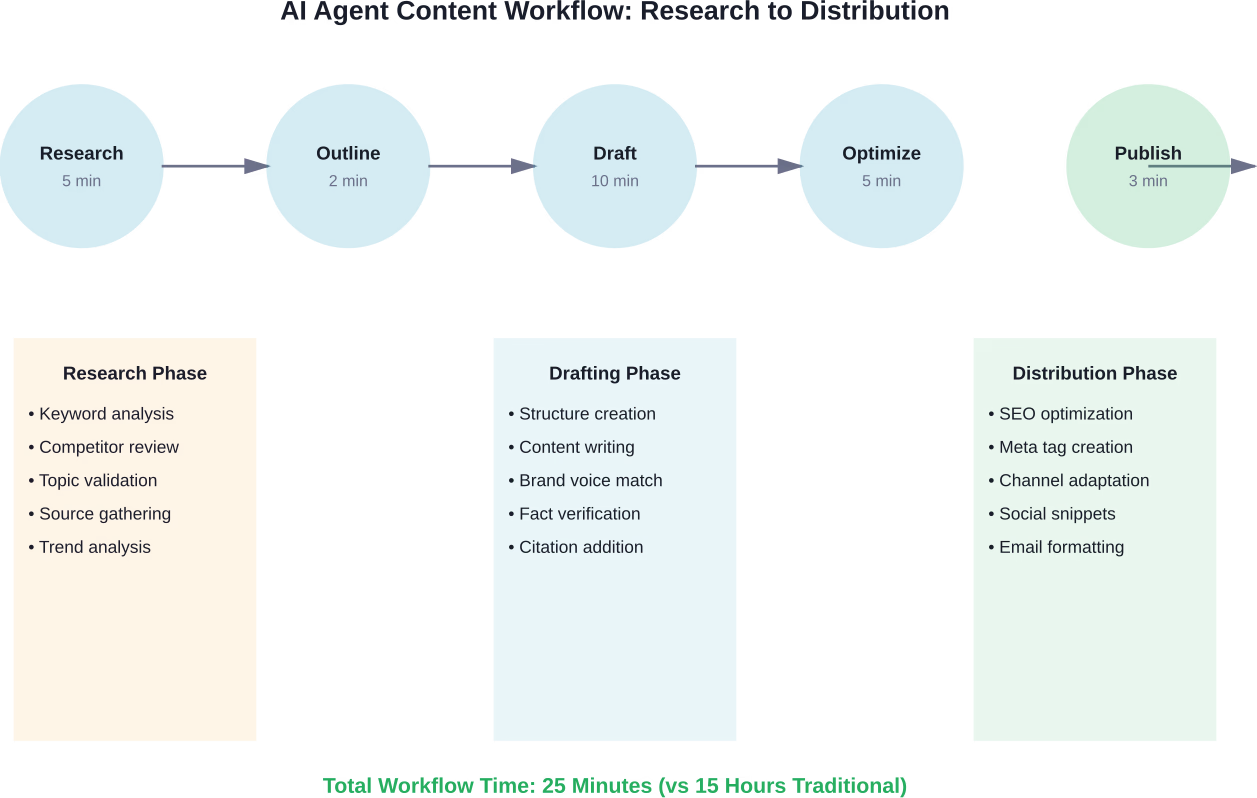
These systems execute complete workflows autonomously—researching topics, drafting content, optimizing for SEO, and preparing distribution—while learning organizational voice and accessing proprietary knowledge bases. The performance gap is measurable and significant.
The distinction matters. Basic AI tools respond to prompts. Agents take actions.
According to BCG, AI agents are artificial intelligence systems that use tools to accomplish goals. They remember across tasks and changing states, use one or more AI models to complete work, and decide when to access internal or external systems on behalf of users.
This enables decision-making and task execution that conventional AI writing assistants can't match.
Modern marketing agents operate with three foundational capabilities. First, they maintain context across extended workflows. An agent researching competitor content remembers those insights when drafting, editing, and optimizing—without re-prompting.
Second, they access multiple systems autonomously. Agents pull data from content management platforms, analytics tools, brand guideline repositories, and customer databases as needed.
Third, they learn organizational patterns. According to California Management Review (published at UC Berkeley), modern AI analytics tools are evolving beyond one-off queries: multiple specialized AI agents can collaborate in agentic workflows, continuously uncovering insights. For example, one agent might monitor campaign metrics and notice a 15% drop in sign-ups, then autonomously trigger a chain of analyses.
That's fundamentally different from asking ChatGPT to write a blog post.
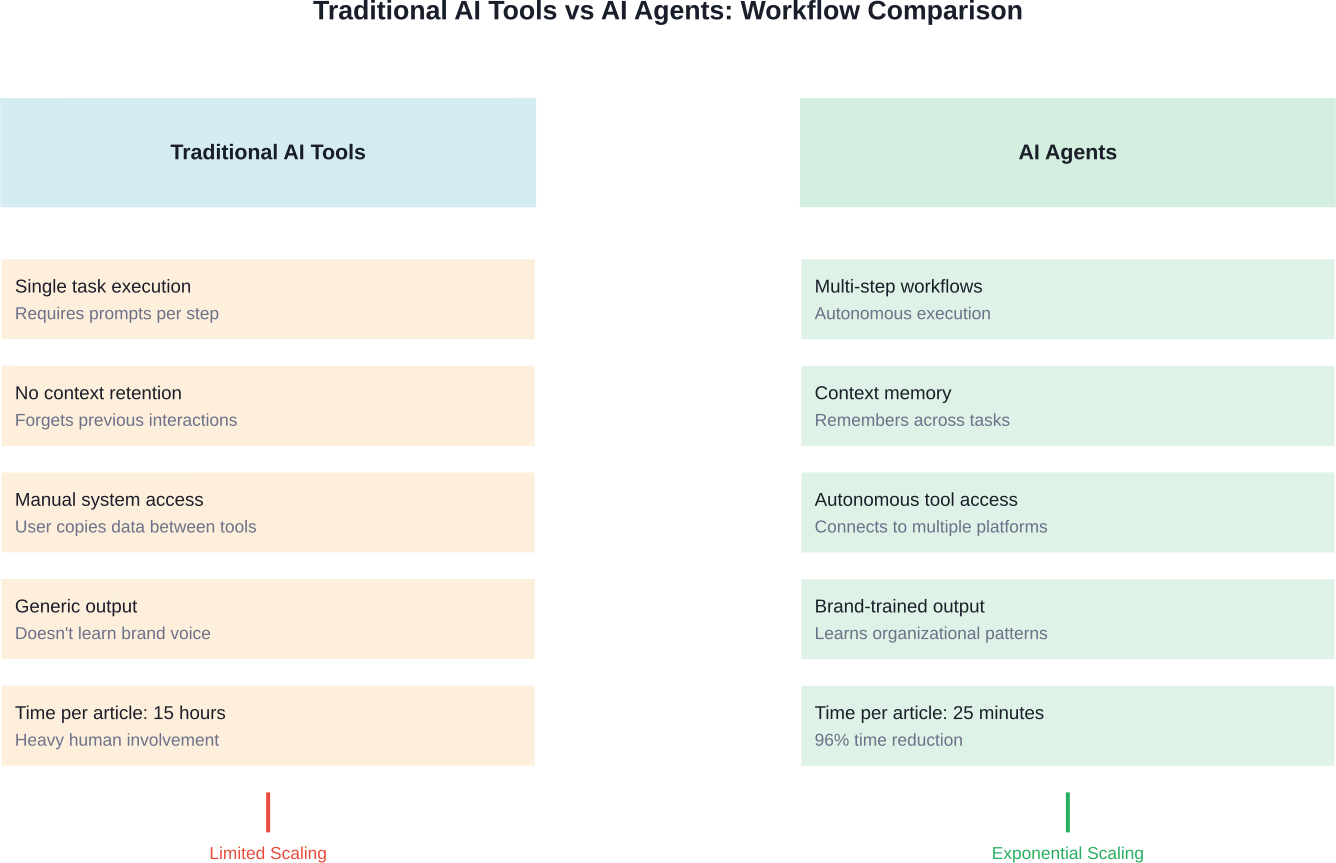
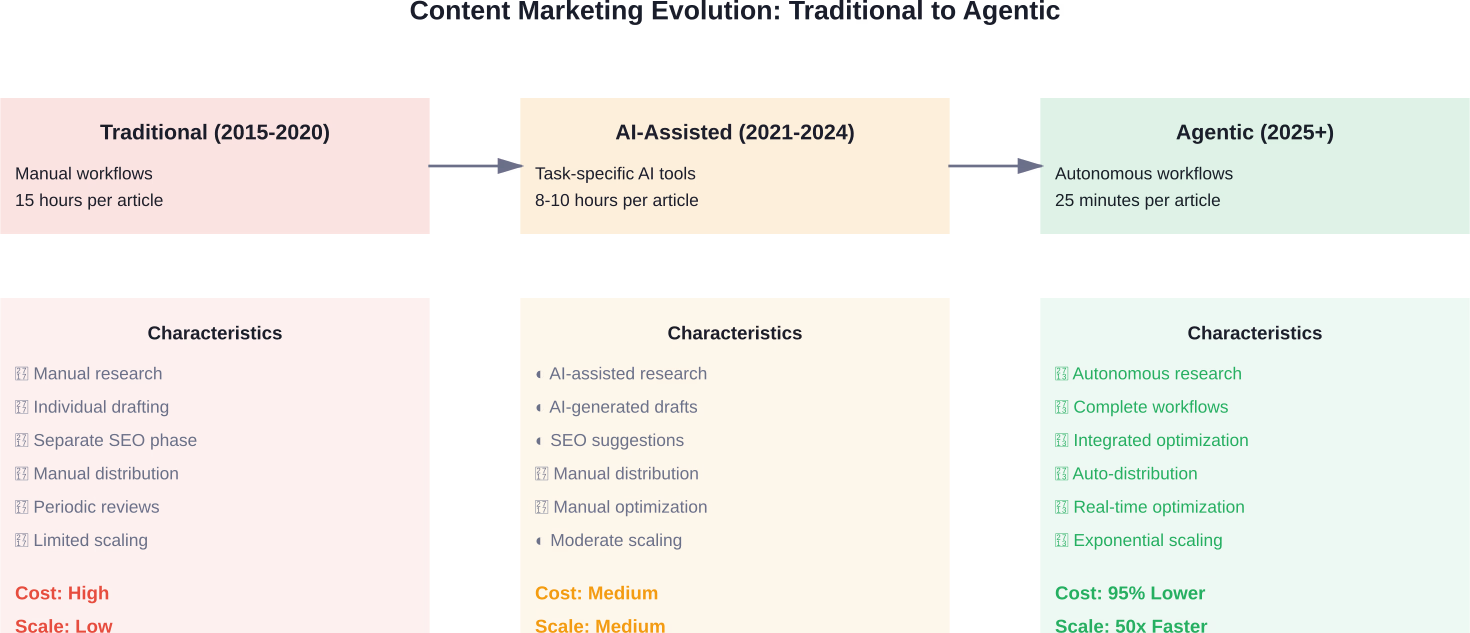
The time compression is dramatic. Traditional content production for a single blog post spans roughly 15 hours across research, outlining, drafting, editing, SEO optimization, and publishing preparation.
AI agents collapse that timeline to approximately 25 minutes—a 96% reduction in production time.
But speed alone doesn't justify the transformation. Cost reduction does.
BCG data shows a leading consumer packaged goods company used intelligent agents to create blog posts, reducing costs by 95% and improving speed by 50x. That's not incremental improvement—it's operational restructuring.
Content strategy traditionally relies on quarterly planning cycles. Teams brainstorm topics, research keywords, map content to buyer journeys, then execute against that roadmap for months.
Agentic systems enable continuous planning. Agents monitor performance metrics in real time, identify content gaps as they emerge, and adjust production priorities autonomously.
Here's where it gets interesting. Traditional editorial calendars are fixed documents. An agent-driven content system operates more like an adaptive algorithm.
When search trends shift, agents detect the movement and prioritize relevant topics. When competitor content outranks owned assets, agents flag opportunities for updates or new angles. When campaign performance indicates audience interest in specific subjects, agents queue corresponding content.
The IBM Institute for Business Value states that no single area of an organization provides a better foundation for the success of generative AI than customer service. That foundation becomes dramatically more valuable when agents manage planning dynamically.
Scaling content production traditionally means sacrificing consistency or investing heavily in editorial oversight. More writers mean more variation in voice, tone, and style—unless extensive review processes slow production.
AI agents trained on organizational content libraries maintain brand voice without per-piece oversight. They analyze existing materials, extract stylistic patterns, and replicate those patterns in new content.
This doesn't mean generic output. Properly configured agents distinguish between different content types—maintaining appropriate tone differences between blog posts, white papers, social media content, and email campaigns.
Generic AI models know general information. Marketing agents need specific knowledge: product specifications, customer pain points, competitive positioning, messaging frameworks, campaign history.
The most effective implementations feed agents comprehensive training data from content management systems, CRM platforms, product documentation, and brand guideline repositories. This creates institutional knowledge that persists regardless of team turnover.
When a content strategist leaves, their understanding of what resonates with the audience doesn't walk out the door if agents have learned those patterns.
Creating content is half the challenge. Distribution is the other half. Agents extend beyond drafting into channel optimization and performance monitoring.
They adapt core content into channel-specific variations—reformatting long-form articles into social media threads, extracting key quotes for LinkedIn posts, generating meta descriptions optimized for click-through rates.
Real talk: this level of automation raises quality control concerns. The answer isn't eliminating human oversight—it's repositioning where humans add value.
Instead of spending hours drafting, marketers review agent output for strategic alignment, approve publication, and focus on higher-level decisions like content strategy and campaign planning.

Another layer that’s starting to appear in these workflows is predictive validation before content or ads even go live. Tools like Extuitive focus on evaluating performance upfront instead of relying entirely on post-launch metrics. Rather than running multiple variations and waiting for results, teams can test creative concepts against simulated audiences and historical patterns to estimate outcomes early.
In practice, this shifts part of optimization from reactive to proactive. Instead of publishing, measuring, and iterating, marketers can filter out weak ideas before they enter the pipeline. It doesn’t replace distribution or monitoring, but it changes how decisions are made at the earlier stages, reducing unnecessary testing cycles and helping teams focus on content and campaigns that are more likely to perform.
Personalized content traditionally requires manual segmentation. Marketing teams create audience personas, develop content variations for each segment, then manually route content accordingly.
Agents analyze user behavior data and dynamically adjust content presentation. A visitor researching enterprise solutions sees different examples and case studies than someone exploring small business options—without creating separate articles.
This extends to email marketing, where agents customize messaging based on recipient engagement history, purchase behavior, and interaction patterns. Not just inserting a name into a template—restructuring the entire message based on individual user context.
Content performance traditionally relies on periodic reviews. Teams examine metrics monthly or quarterly, identify successful pieces, and attempt to replicate those elements in future content.
Agentic workflows enable continuous optimization. Agents monitor performance metrics in real time, identify patterns that correlate with engagement, and adjust future content accordingly.
When certain headline structures consistently outperform others, agents incorporate those patterns. When specific content formats drive more conversions, agents prioritize those formats. When particular topics generate sustained traffic, agents develop related content automatically.
Page views and social shares are easy to measure. Revenue impact is harder. Agents connect content performance to business outcomes by tracking user journeys from initial content engagement through conversion events.
This attribution capability answers questions that have historically frustrated content marketers: Which blog posts actually drive revenue? What content moves prospects from awareness to consideration? Where do leads drop off in the content journey?
According to research on leveraging AI in customer experience published by the American Marketing Association, AI technologies serve as customer-facing agents, integrate into products, and play integral roles in next-generation offerings.
Implementing AI agents isn't just a technology decision. It's an organizational restructuring that changes how marketing teams operate, what skills they need, and where they focus effort.
BCG research on agentic scenarios emphasizes that preparedness, not prediction, creates advantage. The question isn't whether the market will be 10% agent-driven or 90%—it's how to build capabilities that work across that spectrum.
Writing ability remains valuable, but shifts from creation to evaluation. Marketers need to assess whether agent-generated content meets quality standards, aligns with strategy, and serves audience needs.
Data literacy becomes more critical. Understanding what metrics matter, how to interpret performance data, and which insights should drive strategy requires analytical capabilities that traditional copywriting roles didn't emphasize.
Strategic thinking moves to the forefront. When agents handle execution, human value concentrates in higher-level decisions: market positioning, audience selection, campaign architecture, competitive strategy.
The performance numbers look compelling. But implementation isn't plug-and-play. Several obstacles complicate adoption.
First, data quality determines agent effectiveness. Agents trained on inconsistent, outdated, or low-quality content produce unreliable output. Organizations need clean, well-organized content libraries before agents can learn effectively.
Second, integration complexity varies significantly. Connecting agents to content management systems, analytics platforms, and customer databases requires technical configuration. Some platforms offer pre-built integrations; others require custom development.
Third, change management impacts adoption success. Teams accustomed to manual workflows resist automation that feels threatening to job security. Successful implementations position agents as productivity multipliers rather than replacements.
Government oversight of AI applications is evolving rapidly. The Federal Trade Commission has launched enforcement actions against companies making deceptive AI claims.
In March 2026, Air AI and its owners will be banned from marketing business opportunities to settle FTC charges the company misled many entrepreneurs and small businesses. In June 2024, the FTC filed suit against FBA Machine and Bratislav Rozenfeld alleging false guarantees that consumers could make money operating online storefronts using AI-powered software.
These actions signal regulatory attention to AI marketing claims. Organizations implementing agents must ensure accuracy in how they describe capabilities and avoid overpromising results.
Real-world adoption data from the American Marketing Association reveals significant uptake. An American Marketing Association survey conducted in September 2024 found nearly 90% of marketers have used generative AI tools.
According to the American Marketing Association survey, chatbots like ChatGPT are the most popular tool for content generation, with 62% of marketers using them at work. AI-powered tools like Grammarly follow closely at 58%.
But usage doesn't equal sophisticated implementation. Most current applications focus on individual tasks rather than complete workflows. The transition from basic AI writing assistance to full agentic workflows is still early-stage for most organizations.
According to Harvard research on how AI shapes the future of marketing, AI presents marketers with opportunities to personalize customer experiences and build technological skills. That skill-building dimension is critical—teams need time and training to leverage agents effectively.
Looking ahead, BCG identifies conversational advertising as emerging as a distinct line item in media budgets. According to BCG research from January 2026, 53% of organizations are allocating budget to conversational advertising, with nearly three-quarters planning significant increases.
This represents a fundamental shift in advertising mechanics. For the past decade, brands competed for attention across search results, social feeds, and retail media—optimizing for clicks and conversions.
AI agents enable new models where consumers interact conversationally with brand representatives that provide personalized recommendations, answer questions, and facilitate purchases within natural dialogue flows.
Content marketing adapts accordingly. Instead of optimizing articles for search engines, content trains conversational agents. Instead of measuring page views, success metrics track conversation quality and conversion rates within dialogue.
Organizations ready to implement agent-based workflows should approach adoption systematically rather than attempting immediate transformation.
Start with well-defined use cases. Blog content production is a natural starting point—structured workflows, clear quality criteria, measurable outcomes. Social media content adaptation and email marketing personalization follow logically.
Invest in data infrastructure before deploying agents. Clean, organized content libraries enable effective agent training. Integration capabilities allow agents to access the systems they need. Analytics infrastructure provides the performance data that drives continuous improvement.
Plan for team development. Training programs should build evaluation skills, data literacy, and strategic thinking capabilities. Change management initiatives should address concerns about automation transparently.
Measure business impact, not just efficiency gains. Time savings matter, but revenue influence matters more. Track how agent-generated content performs across the full customer journey—from initial awareness through conversion and retention.
Content marketing has always demanded scale. More channels. More touchpoints. More personalization. Traditional approaches hit resource limits quickly.
AI agents remove those constraints. Not by replacing human creativity and strategy—by automating execution at a scale that manual processes can't match.
The performance data is compelling. 96% time reduction. 95% cost reduction. 50x speed improvement. But the strategic value extends beyond efficiency metrics.
Organizations that master agentic workflows can respond to market changes faster, test content strategies more extensively, personalize experiences more deeply, and measure business impact more accurately than competitors relying on traditional approaches.
The question isn't whether AI agents will transform content marketing. They already are. The question is how quickly organizations build the capabilities to leverage them effectively.
Start with infrastructure. Build data systems that support agent training. Develop integration capabilities that allow agents to access necessary platforms. Create measurement frameworks that track business outcomes, not just vanity metrics.
Invest in team capabilities. Train marketers to evaluate agent output, interpret performance data, and make strategic decisions that agents execute. Position automation as productivity amplification, not job elimination.
And begin now. The gap between early adopters and late followers widens as agents accumulate learning from execution cycles. Organizations that delay implementation forfeit competitive advantage that becomes harder to recover as agent-augmented competitors scale content operations exponentially.
The content marketing transformation is underway. The organizations that thrive will be those that build agentic capabilities while competitors are still debating whether the technology is ready.


