Instagram Ads Agencies in Vancouver: Top Providers That Actually Drive Results
Explore top Instagram ads agencies in Vancouver delivering strong ROAS and precise targeting. The best Meta ads providers for local brands in 2026 now.
Mar 24, 2026



Meta's minimum daily budget is $1 per day, but testing campaigns need $30-$50 per day minimum to generate meaningful data in 2026. To exit the learning phase, Meta's algorithm requires roughly 50 conversions per week per ad set, which typically demands $200-$300 daily depending on your cost per acquisition. Running below these thresholds keeps campaigns stuck in learning limited status, resulting in unstable delivery and inflated costs.
Setting a Meta ads budget in 2026 isn't about hitting the platform's technical minimum. It's about feeding the algorithm enough data to actually learn who your buyers are.
The uncomfortable truth? That $1 per day minimum Meta allows is functionally useless for conversion campaigns. Running at that level generates roughly 70-100 impressions per day, nowhere near enough for Meta's AI-driven Andromeda and GEM systems to identify your target audience, much less optimize delivery.
According to Search Engine Land (published January 28, 2026), Meta's advertising system underwent significant changes with the introduction of Andromeda and GEM, which now determine how ads are selected, ranked, and sequenced across the platform. These systems require substantial conversion signals to optimize effectively, and low budgets simply can't feed them the data they need.
This post covers Meta's actual minimum budget requirements, how to calculate the right daily spend based on campaign objectives, and smart allocation strategies that work within the constraints of the 2026 advertising landscape.
Meta's platform allows different minimum daily budgets depending on campaign objectives. But here's the thing: these minimums are what the platform accepts, not what actually works.
According to data from Granular Marketing, Meta's minimum spend requirement is $1.00 per day, the same baseline that's existed for years. LinkedIn requires $10 per day minimum, while TikTok's minimum daily budget for a campaign is $50, and for an ad group is $20.
But technical minimums miss the point entirely.

Minimum budgets in Meta ads usually exist for one reason – you need enough spend to figure out what works. A big part of that budget goes into testing creatives and messages that were never likely to perform in the first place. Extuitive cuts into that waste.
It uses AI agents modeled on real consumer behavior to predict how ads will perform before they go live, helping you compare variations and filter out weaker options early. Instead of relying only on paid testing, you start with a smaller, more focused set of creatives that already show stronger signals. That means fewer experiments, tighter budget allocation, and faster path to something worth scaling. If your testing budget keeps growing just to find winners, shift part of that process earlier. Run your creatives through Extuitive first, then put spend behind the ideas that actually have a chance to perform.
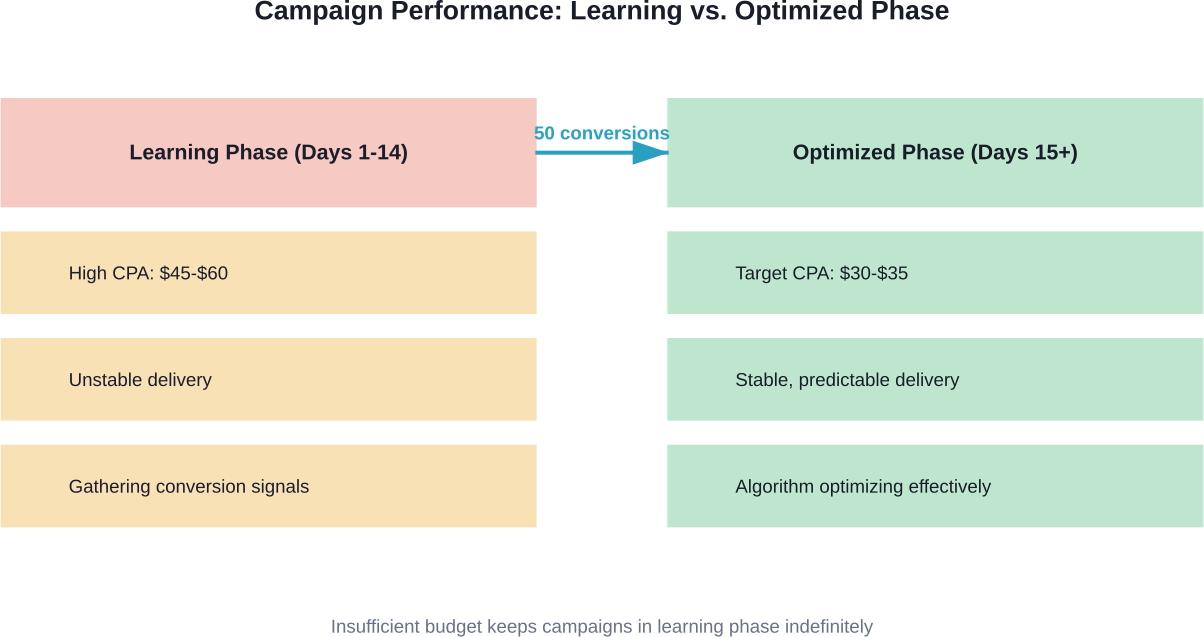
The learning phase is where most advertisers burn money without realizing it. Meta's algorithm needs conversion events to optimize delivery. Not impressions. Not clicks. Conversions.
Meta's own guidance states that an ad set needs approximately 50 conversions per week to exit the learning phase. Below that threshold, the ad set enters "Learning Limited" status, which means:
According to Stackmatix, running a conversion campaign at $1 per day generates roughly 70-100 impressions, nowhere near enough for Meta's algorithm to find the target audience or optimize delivery. The platform needs volume to train its models.
So what's the actual minimum spend to exit the learning phase?
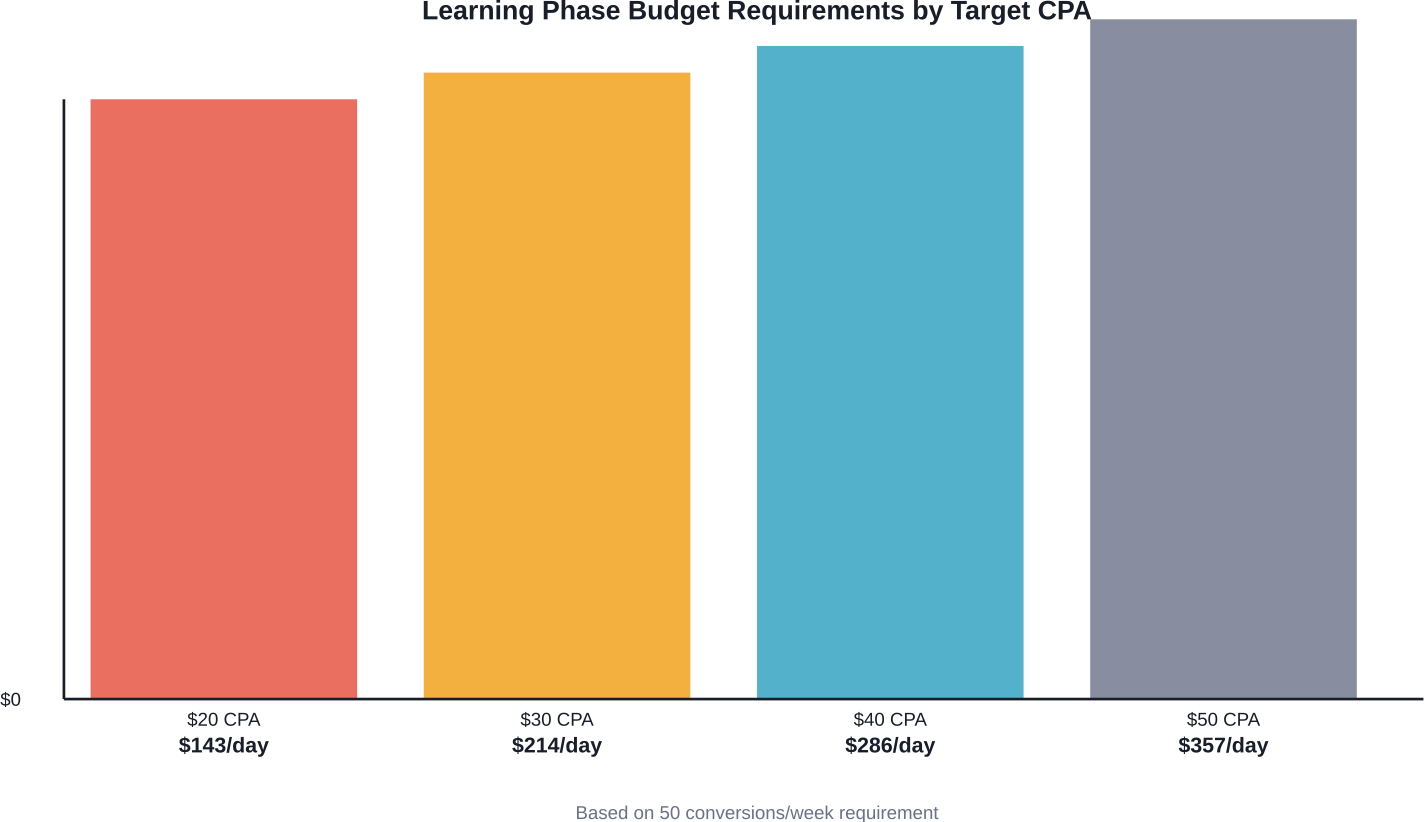
Use this formula: (Target CPA × 50) ÷ 7 = minimum daily budget per ad set
Let's break that down with real numbers.
If the target cost per acquisition is $30, the math looks like this:
($30 × 50) ÷ 7 = $214 per day per ad set
That's roughly $6,400 per month for a single ad set to generate enough conversions for the algorithm to optimize effectively.
If the cost per acquisition is $40: ($40 × 50) ÷ 7 = $286 per day, or approximately $8,600 per month.
Now, that assumes the campaign actually converts at the target CPA. In reality, during the learning phase, costs run higher. Which means the budget needs to account for that inefficiency.
This is where most small budget campaigns fail. They're not funding the learning phase adequately, so they never exit it. The algorithm never stabilizes. Costs stay elevated. Results stay inconsistent.
The advertising landscape shifted significantly between 2024 and 2026. According to community discussions, CPM and cost per lead rates have increased in 2025-2026 due to higher competition.
More advertisers are flooding Meta's auction every quarter. Competition drives costs up. Advantage+ campaigns, which rely heavily on Meta's AI optimization, need conversion signals to function. Low budgets can't provide those signals.
Here's what happens when running $500 per month on Meta ads in 2026:
That breaks down to roughly $16 per day. At current CPM rates, that generates approximately 1,000 impressions daily. With average conversion rates, that might produce 1-2 conversions per week if everything goes perfectly.
But the algorithm needs 50 conversions per week per ad set. That's not 2% of the requirement. It's 2-4%.
The campaign sits in Learning Limited status indefinitely. Delivery becomes erratic. The algorithm can't identify patterns because there aren't enough data points. Cost per result stays elevated because the system never optimizes.
It's not a testing budget. It's a donation to Meta.
The situation gets worse when splitting that $500 across multiple campaigns or ad sets. Running three ad sets at $5 per day each doesn't give three chances to succeed. It guarantees three failures.
Each ad set needs its own data volume to learn. Splitting the budget below functional minimums means none of the ad sets get enough signal to optimize. The result is bad data across the board, which leads to bad decisions about what's working and what isn't.
According to AdStellar AI, poorly structured campaigns create audience overlap, waste budget on competing ad sets, and make optimization nearly impossible. A campaign structure should eliminate overlap and ensure each ad set gets sufficient budget to generate meaningful data.
If the budget doesn't support the ideal $200-$300 per day per ad set, there are smarter ways to allocate limited resources than spreading them thin.
Run one well-funded campaign instead of multiple underfunded ones. Consolidating the budget into a single Advantage+ Shopping Campaign or a single conversion campaign with broad targeting gives the algorithm the best chance to find buyers within budget constraints.
Meta's 2026 algorithm improvements favor consolidation. The Andromeda and GEM systems work better with larger data pools rather than fragmented micro-audiences.
If running below ideal budget thresholds, extend the testing window before making decisions. Where a well-funded campaign might show clear results in 7-10 days, a lower-budget campaign needs 4-6 weeks minimum.
According to Stackmatix, campaigns need at least 14 days minimum before making any decisions, with 4-6 weeks recommended for a real testing window when working with constrained budgets.
Patience becomes critical. Evaluating performance too early with limited data leads to killing winners and scaling losers.
With limited budget, creative quality becomes the primary lever for performance. The algorithm handles targeting and delivery, but only if fed quality creative assets.
Invest the budget into producing 4-6 strong creative variations rather than testing dozens of audience segments. Let Meta's algorithm find the audience while testing which messages and formats resonate.
According to Meta's announcements at Shoptalk, the platform introduced product set optimization and other retail media tools designed to improve ad performance around individual product SKUs. These tools work best when creative quality is high and budget allows the system to gather sufficient performance data.
Different business models and price points require different minimum budgets to test effectively on Meta in 2026.
These ranges assume campaigns optimizing for conversions and attempting to exit the learning phase within a reasonable timeframe. Lower budgets are possible for awareness or engagement objectives, but conversion campaigns demand higher spend.
Sometimes the smartest move is waiting until the budget allows for proper testing. Launching a conversion campaign with $20 per day won't provide usable data. It will burn money and create frustration.
If the current budget is below $1,500-$3,000 per month for a single offer, consider these alternatives:
There's no shame in acknowledging budget constraints and choosing a different path. Better to wait and launch properly than to waste limited resources on underfunded campaigns that can't succeed.
Meta's advertising system evolved significantly with the rollout of Andromeda and GEM in late 2025 and early 2026. According to Search Engine Land's analysis published January 28, 2026, these AI-driven systems fundamentally changed how ads are selected, ranked, and sequenced across Meta's platforms.
The Andromeda system processes billions of ad auction decisions per second, using machine learning models trained on massive datasets of user behavior and conversion patterns. GEM (Graph-based Event Modeling) maps the relationship between users, content, and conversion events to predict which users are most likely to convert.
Both systems require substantial data to function effectively. Small sample sizes produce unreliable predictions. The algorithm needs volume to identify patterns and optimize delivery.
This is why budget requirements increased compared to previous years. The AI is more sophisticated, but it's also more data-hungry. Feeding it insufficient data produces worse results than simpler targeting methods from earlier years.
When working with budget constraints, structure testing methodically to extract maximum learning from limited spend.
Parallel testing runs multiple variables simultaneously. It's faster but requires more budget because each variation needs sufficient volume to produce statistical significance.
Sequential testing evaluates one variable at a time. It's slower but works better with limited budgets because the entire budget focuses on a single test.
For campaigns under $3,000 per month, sequential testing makes more sense. Test creative first with broad targeting. Once a winning creative emerges, test placement or audience refinements while keeping the winning creative constant.
Creative is the highest-impact variable in Meta campaigns. According to industry discussions, creative testing should follow a structured framework rather than random experimentation.
Start with 3-4 distinct creative approaches, not minor variations. Test different hooks, different angles, different formats. A carousel versus a single image versus a video tests format. Different value propositions test messaging.
Run each creative variation for a minimum of 3-5 days at $30-$50 per day before evaluating. Look for clear performance differences in cost per result, not small fluctuations.
Kill obvious losers after 5 days. Scale clear winners. Test marginal performers longer if budget allows.
According to AdAmigo.ai's guide on Meta Ads budget automation, automated rules can prevent budget waste by pausing underperforming ads or adjusting spend based on specific conditions.
Set up rules to pause ad sets that exceed target CPA by 50% after spending 2x the target CPA. This prevents runaway spending on ad sets that aren't working.
Create rules to increase budget by 20% on ad sets that achieve target CPA with at least 10 conversions. This captures winning performance without manual monitoring.
Automation becomes more critical with limited budgets because there's less margin for waste.
Knowing when to increase budget versus when to shut down a campaign separates profitable advertisers from those who burn money indefinitely.
Scale when these conditions are met:
Scale gradually. Increase budget by 20-30% every 3-4 days rather than doubling overnight. Large budget increases reset the learning phase and destabilize performance.
Shut down campaigns when:
Don't confuse the learning phase with fundamental campaign failure. The learning phase should show some conversions, even if costs are elevated. Zero conversions after significant spend indicates a deeper problem with offer, creative, or targeting.
If the budget truly can't support proper conversion campaign testing, there are alternative approaches that provide value without requiring $3,000+ monthly spend.
Retargeting campaigns convert at higher rates with lower cost per acquisition because the audience already has awareness. A retargeting campaign can work effectively at $20-$30 per day if there's sufficient website traffic to retarget.
Build the retargeting pool through organic social, content marketing, SEO, or other channels. Then run Meta retargeting campaigns to convert that warm traffic.
This doesn't scale infinitely because the retargeting pool is limited, but it can produce profitable returns with smaller budgets than cold prospecting requires.
Running awareness or engagement campaigns at $10-$20 per day can build an audience and test creative concepts before committing to conversion campaigns.
Use engagement campaigns to identify which creative formats and messages generate the most interaction. Use awareness campaigns to build retargeting pools of people who watched videos or engaged with content.
These objectives don't directly generate sales, but they provide cheaper learning and audience building that supports future conversion campaigns.
Meta's Advantage+ Creative automatically tests variations of uploaded assets, creating combinations of different text, images, and formats. This reduces the budget needed for manual creative testing because the system handles variation testing internally.
Upload multiple creative assets and let Advantage+ Creative test combinations. The algorithm allocates delivery to better-performing variations automatically, reducing the need for separate ad sets for each creative variation.
Different campaign objectives have different budget requirements and efficiency profiles in 2026.
Advantage+ Shopping Campaigns consolidate all targeting and creative into a single campaign, letting Meta's algorithm handle optimization. According to Meta's 2026 product announcements, these campaigns work best with higher budgets because the algorithm needs volume to test and optimize across the entire catalog.
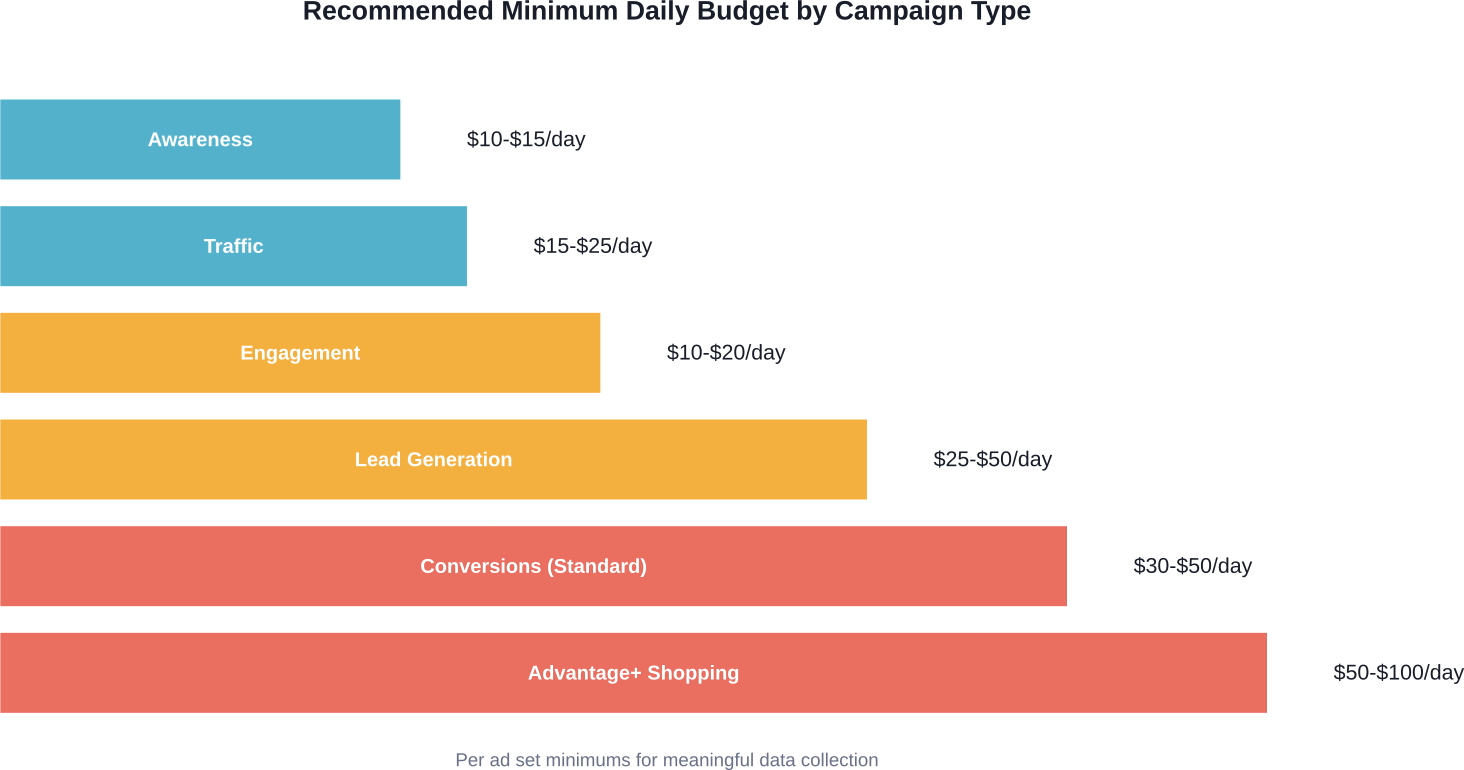
Minimum recommended budget: $50-$100 per day minimum, ideally $150+ per day for e-commerce businesses with average order values above $50.
Standard conversion campaigns with manual targeting and creative testing require the learning phase budget calculations outlined earlier. These campaigns give more control but require more budget per ad set because each ad set learns independently.
Minimum recommended budget: $30-$50 per day per ad set, with 2-3 ad sets maximum for budgets under $5,000 per month.
Lead generation campaigns using Meta's native lead forms convert at higher rates than landing page traffic campaigns because there's less friction. However, lead quality can vary significantly.
These campaigns can work at slightly lower budgets than sales campaigns. Minimum recommended budget: $25-$40 per day for B2C lead generation, $50-$100 per day for B2B lead generation where cost per lead is higher.
Certain budget allocation mistakes appear repeatedly across Meta advertising campaigns. Avoiding these saves money and accelerates learning.
The most common mistake is running too many ad sets with insufficient budget for each. Five ad sets at $10 per day each perform worse than one ad set at $50 per day because none of the fragmented ad sets generate enough data to optimize.
Consolidation beats fragmentation in almost every scenario when working with limited budgets.
Evaluating performance after 2-3 days with limited budget produces misleading data. Small sample sizes create high variance. What looks like a loser on day 3 might be a winner by day 10.
Set evaluation windows based on conversion volume, not calendar days. Evaluate after at least 20-30 conversions per variation, or after 14 days minimum, whichever comes first.
Running the same creative for weeks without monitoring frequency and engagement metrics leads to fatigue. When frequency exceeds 3-4, the same people see the ad repeatedly, causing CTR to decline and costs to rise.
Refresh creative every 2-3 weeks even if performance is stable. Proactive creative rotation prevents fatigue before it impacts costs.
Optimizing for link clicks instead of conversions might seem like a way to work with smaller budgets, but it produces poor results. The algorithm optimizes for exactly what it's told to optimize for. Optimize for clicks, get clickers. Optimize for conversions, get buyers.
If the budget can't support conversion optimization, run awareness or engagement campaigns instead of running conversion campaigns optimized for proxy metrics.
For marketers working within organizations, getting budget increases requires demonstrating results with current spending.
Track these metrics to build the case for increased budget:
Present budget requests with clear projections. If current spend of $3,000 per month generates $12,000 in revenue (4x ROAS), projecting that $6,000 per month would generate $24,000 in revenue is reasonable, assuming creative and market conditions remain constant.
Show the constraint. If campaigns are consistently hitting daily budget caps and showing strong performance, that indicates demand exists beyond current budget levels. This is the strongest signal for scaling the budget.
Meta advertising in 2026 rewards advertisers who understand the platform's data requirements and budget accordingly. The algorithm is more sophisticated than ever, but sophistication requires fuel. That fuel is conversion data.
For businesses just starting with Meta ads, the honest minimum for testing conversion campaigns is $1,500-$3,000 per month. This allows for one properly funded ad set at $50-$100 per day, giving the algorithm a chance to optimize and providing enough data to make informed decisions.
Below that threshold, focus the budget on creative asset production, test with lower-cost objectives like awareness or engagement, or invest in building organic audiences and retargeting pools until the budget can support proper conversion testing.
When a budget is available, structure campaigns simply. One campaign, one ad set, 3-4 creative variations, broad targeting. Let Meta's algorithm do what it does best. Resist the urge to over-segment and over-complicate.
Monitor learning phase status obsessively. If ad sets stay in Learning Limited for more than 14 days, either increase budget or consolidate further. Learning Limited status is a death sentence for campaign performance.
Scale gradually based on clear performance data. Increase budget by 20-30% every 3-4 days when performance is stable and profitable. Kill campaigns quickly when they show clear failure signals after sufficient spend.
And most importantly: creative quality matters more than budget optimization. The best budget allocation strategy can't save bad creative. The worst budget allocation can still succeed with exceptional creativity. Invest in the creative assets first, then invest in the budget to test them properly.
Ready to structure your Meta campaigns for 2026? Start with the budget you actually have, not the budget you wish you had. Build campaigns that work within constraints rather than pretending those constraints don't exist. And when you do have a budget to scale, scale decisively based on data, not hope.


